
BuddhistCatholicContemplativeEvangelicalGeneral ChristianHinduJewishLatter-day SaintMuslimNew VisionsProgressive Christian
Beliefs
- Buddhist
- Catholic
- Contemplative
- Evangelical
- General Christian
- Hindu
- Jewish
- Latter-day Saint
- More Voices
- Muslim
- New Visions
- Pagan
- Progressive Christian
Topics
- Religion News
- Food and Religion
- Sports and Religion
- Religious Art
- Religious Music and Entertainment
- Religious Events
- History and Religion
- Style and Religion
- Politics and Religion
- Women in Religion
- Recreation Outdoors and Religion
- Business Finance and Religion
- Careers Workplace and Religion
- Education and Religion
- Family Parenting and Religion
- Health Fitness and Religion
- Home and Religion
- Relationships and Religion
- Technology and Religion
- Travel and Religion
Columnists
- Buddhist Columnists
- Business Finance and Religion Columnists
- Careers Workplace and Religion Columnists
- Catholic Columnists
- Contemplative Columnists
- Education and Religion Columnists
- Evangelists Columnists
- Family Parenting and Religion Columnists
- General Christian Columnists
- Health Fitness and Religion Columnists
- Hindu Columnists
- History and Religion Columnists
- Home and Religion Columnists
- Jewish Columnists
- More Voices Columnists
- Latter Day Columnists
- Muslim Columnists
- New Visions Columnists
- Nonreligious Columnists
- Pagan Columnists
- Politics and Religion Columnists
- Progressive Columnists
- Recreation Outdoors and Religion Columnists
- Relationships and Religion Columnists
- Religion News Columnists
- Religious Art Columnists
- Religious Events Columnists
- Religious Music and Entertainment Columnists
- Sports and Religion Columnists
- Style and Religion Columnists
- Technology and Religion Columnists
- Travel and Religion Columnists
- Women in Religion Columnists
Resource Library
- 2026 Calendar
- Library of World Religions
- The 100 Most Holy Places on Earth
- Patheos Answers
- Podcasts
- Videos
- Faith Leaders Database
- Anglican Episcopalian
- Bahai
- Baptist
- Buddhism
- Christianity
- Confucianism
- Eastern Orthodoxy
- Hinduism
- Holiness and Pentecostal
- ISKCON
- Islam
- Judaism
- Lutheran
- Methodist
- The Church of Jesus Christ of Latter-day Saints
- New Age
- Paganism
- Presbytarian and Reformed
- Protestantism
- Religion Behind the Scenes
- Roman Catholic
- Scientology
- Shia Islam
- Sikhism
- Sufism
- Sunni Islam
- Taoism
- Zen
- See all religions
Research Tools
 Ad-Free & Subscriber Log-In Subscription Support
Ad-Free & Subscriber Log-In Subscription Support
Follow Patheos 

- Trending:
- Forgiveness
- |
- Marriage
- |
- Consciousness
- |
- Death Penalty
- |
- Election
- |
- Halloween
 PaterFamilias Today
- Home
- Evangelical
- Are Protestants Human? (And what that has to do with my pulpit.)
Are Protestants Human? (And what that has to do with my pulpit.)
Last updated on: December 14, 2015 at 3:24 pm by C. R. Wiley
Are Protestants Human? (And what that has to do with my pulpit.) 2015-12-14T15:24:46-04:00 C. R. Wiley
Patheos Explore the world's faith through different perspectives on religion and spirituality! Patheos has the views of the prevalent religions and spiritualities of the world.
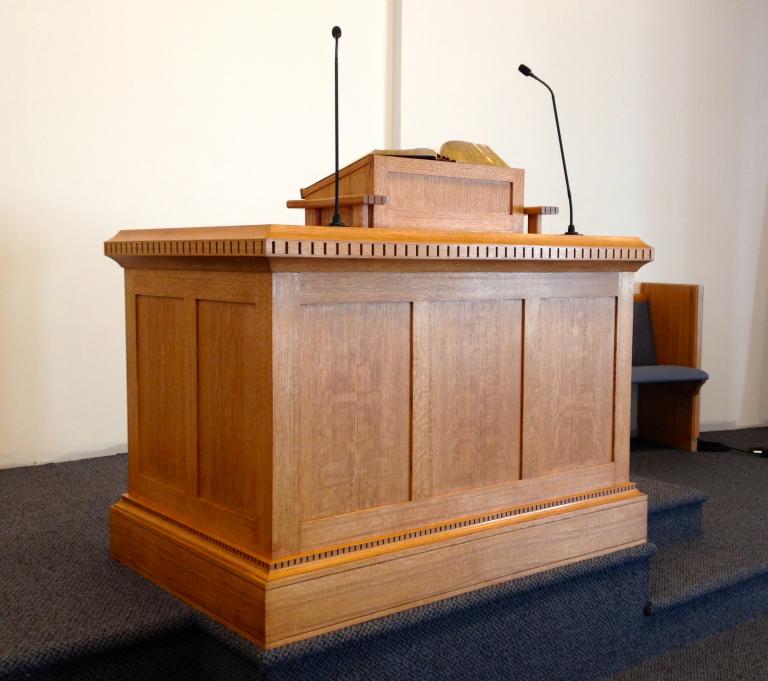
My pulpit.
I designed it and it was built by a furniture maker in my church. It is made from hand selected quarter-sawn red oak from the Berkshire Mountains.
Animals, I assume, are literalists.
Metaphors, analogies: animals just don’t get them. I tried a few on my dog. No success. Culture is just lost on him.
I’ve observed that philistines are literalists too. (I’ll let you make the connection.)
There is something philistine to Protestantism, at least in its lowest expressions. I suppose that has something to do with being against things, i.e. “protesting”. The finer arts tend to be for things; they’re allusive. There’s a ***“this is that”***ness about them. And since many Protestants are adamant that “is” doest really mean “is” they tend to miss what “is” is for.
I’ve been thinking about this because I’m designing the liturgical furniture for my church. Since I’m a Presbyterian it’s not a long list: pulpit, table, and font.
I’m fortunate to have a master furniture maker in my congregation. I draw up a concept, he works with it, makes a model, brings it back for review, and so forth. The furnishings themselves are then constructed from quarter-sawn red oak from the Berkshires. Naturally, since we’re Presbyterians, we started with the pulpit.
I asked some folks recently for their thoughts on pulpits. I’m happy to say they all agreed that pulpits are important. They said that a pulpit should be big, well-made, and even majestic. But when asked why, they couldn’t quite say. For them it basically it came down to, “Preaching is important and a pulpit should say that.”
It’s a start.
As already noted, I’m a Presbyterian, so I like to start with the Bible when I can. Beginning there, the go to for liturgical furnishings is the tabernacle in the wilderness. The instructions for its making were detailed, their arrangement precise. And we see from the book of Hebrews that this wasn’t just fussy or capricious, the furnishings were allusive. They mirrored the heavenly court.

This is not a pulpit.
It is a Gnostic abomination. If you insist on having one of these–here’s where I got the photo: http://www.displays2go.com/P-24090/Acrylic-Pulpit-has-1-Shelf?utm_source=google.pla&utm_medium=cpc&utm_campaign=GooglePLA&gclid=Cj0KEQiA7rmzBRDezri2r6bz1qYBEiQAg-YEtu7cGUa7-hgE9IUbj2z02xj3x-C65_w4nYW2OuWA1qgaAj7L8P8HAQ
Our tendency to separate religion and politics, and to moralize and privatize worship, keeps us from seeing this connection. The altar (which was outside the tent, by the way) was for winning the favor of a king, the laver made supplicants presentable, the table for the bread was for sharing a meal with the king (12 loaves, recall, for the 12 tribes, the people of God), but the most important item in the tabernacle was the Ark of the Covenant.
What was it? Sure, it was a box. It held things. It contained the tablets of stone, the 10 Commandments, Aaron’s staff, and a jar of manna. There were the cherubim on top, bowing toward the center (that should have put to rest the notion that statuary necessitates idolatry, but it didn’t), then there were the poles for carrying it around.
While all those things are significant (they signify things), they’re not the most important thing. The most important thing is the Spirit of God sat on the Mercy Seat between the cherubim on the top of the box.
The Ark was a throne. You can also see that it was a litter, one used to carry a king. (The tabernacle is a mobile court, but that’s okay since it mirrored the eternal and fixed court above.) And the contents of the Ark alluded to the king’s gifts to his people: law, leadership, and provision.
With a little imagination we can see that the traditional arrangement of Protestant furnishings mirror this nicely. Laver for font, table before the Ark for communion table, and Ark for pulpit. Because, yes, the pulpit is a throne. (If I weren’t a Presbyterian, I’d say we got lucky.)
“The Ark was a throne. You can also see that it was a litter, one used to carry a king.”
The pulpit is not the throne of a preacher, and it is certainly not a lectern (I’m sick of hearing that one). It is the throne of the Word. And the Living Word is the Lord Jesus Christ. The Bible points to him. As you can see with the one I designed, the Bible resting on it is enormous. It fills the seat upon which it rests. It can be seen from the furthest reaches of the sanctuary. Because it is Christ, the Living Word who washes and feeds us. the preacher simply proclaims him from every page of scripture. As the saying goes, “It’s not about me.”
Because the Word became flesh we have a reason to believe that matter can speak. Another good reason is the stuff we make furniture out of was made by the Word. Quarter-sawn red oak says something. It’s weighty (my pulpit weighs about four hundred pounds), it’s beautiful too. People can see a connection to the weight of God’s glory, even though they can’t quite put it into words.
One last parting note. If you look carefully you can see that my pulpit is intended to resemble a throne on a box.
Previous Post

December 11, 2015
The Sky Hook and the Virgin Birth
Next Post

December 16, 2015 Saving Nature from the Hippies
Browse Our Archives
Select a Category Advising a Daughter Aristotle Art Atheism Author and Speaking Appearances Beauty Building Working Houses C R Wiley Children Community Creativity Cultural Apologetics Fatherhood Fiction Fidelity in marriage Film Freedom Gravitas H. P. Lovecraft Happiness Household Economy Infant Baptism Inklings Interpreting the Bible Interviews Jack Donovan Liturgy Localism Man of the House Manliness Martial Virtue Medieval Cosmology Metaphysics Mortimus Clay NecronomiCon New Left New Testament Household Codes Nietzsche Nominalism/Realism Politics Poverty Preaching Productive Property Reaching men Science Self-Sufficiency Side Hustles Social Ethics Social Security Spiritual Disciplines Sublime Techno-gnosticism The Pastor's Survival Guide Theology of the Family Tradition Uncategorized Virtue Weird Fiction
Select a Month February 2019 November 2018 October 2018 July 2018 June 2018 May 2018 April 2018 March 2018 February 2018 January 2018 December 2017 November 2017 October 2017 September 2017 August 2017 July 2017 June 2017 May 2017 April 2017 March 2017 February 2017 January 2017 December 2016 November 2016 October 2016 September 2016 August 2016 July 2016 June 2016 May 2016 April 2016 March 2016 February 2016 January 2016 December 2015
Follow Us!
TAKE THE
Religious Wisdom Quiz
Who said, "Lord, if you are willing, you can make me clean"?
Select your answer to see how you score.
A centurion A leper A tax collector A blind man
Books by This Author Books by PaterFamilias Today
Books by C. R. Wiley

The Purloined Boy (The Weirdling Cycle #1)

Man of the House: A Handbook for Building a Shelter That Will Last in a World That Is Falling Apart
Related posts from PaterFamilias Today

Transcendence: Meaning from Above

Gutting Creation of Meaning Guts Scripture

Is This Evangelicalism's Red-Pill Moment?

Making the Good Life from Home
TRENDING AT PATHEOS Evangelical

How the author of the world's best hymn...
I've been working with John Newton for a while now. This makes...

Long before this Lectio Divina, Psalm 130 - the song - started...

What About the Trees? Another Living Parable
After I finished writing the last article about falling leaves as a...

Why Classical Education Is a Conversation, Not a...
Come and Read: Joy in Classical Education When I was a little...

Falling Leaves: A Living Parable on Letting Go
I’ve spent the vast majority of my life in the southeast corner...

Cornell University has received a great deal of negative publicity and intense...
view all Evangelical blogs
Ad-Free & Subscriber Log-In Subscription Support
- About Us
- 2026 Calendar
- Videos
- Podcasts
- Library of World Religions
- Faith In Media Tracker
- Advertise With Us
- Write for Us
- Privacy Policy
- Terms of Service
- Do Not Sell My Data
- Contact Us
- Radiant Digital
- Manage Newsletter Subscriptions
- Unsubscribe From Notifications
- Sitemap
Copyright 2008-2026, Patheos. All rights reserved.
Subscription Support Ad-Free & Subscriber Log-In
Follow Patheos