
BuddhistCatholicContemplativeEvangelicalGeneral ChristianHinduJewishLatter-day SaintMuslimNew VisionsProgressive Christian
Beliefs
- Buddhist
- Catholic
- Contemplative
- Evangelical
- General Christian
- Hindu
- Jewish
- Latter-day Saint
- More Voices
- Muslim
- New Visions
- Pagan
- Progressive Christian
Topics
- Religion News
- Food and Religion
- Sports and Religion
- Religious Art
- Religious Music and Entertainment
- Religious Events
- History and Religion
- Style and Religion
- Politics and Religion
- Women in Religion
- Recreation Outdoors and Religion
- Business Finance and Religion
- Careers Workplace and Religion
- Education and Religion
- Family Parenting and Religion
- Health Fitness and Religion
- Home and Religion
- Relationships and Religion
- Technology and Religion
- Travel and Religion
Columnists
- Buddhist Columnists
- Business Finance and Religion Columnists
- Careers Workplace and Religion Columnists
- Catholic Columnists
- Contemplative Columnists
- Education and Religion Columnists
- Evangelists Columnists
- Family Parenting and Religion Columnists
- General Christian Columnists
- Health Fitness and Religion Columnists
- Hindu Columnists
- History and Religion Columnists
- Home and Religion Columnists
- Jewish Columnists
- More Voices Columnists
- Latter Day Columnists
- Muslim Columnists
- New Visions Columnists
- Nonreligious Columnists
- Pagan Columnists
- Politics and Religion Columnists
- Progressive Columnists
- Recreation Outdoors and Religion Columnists
- Relationships and Religion Columnists
- Religion News Columnists
- Religious Art Columnists
- Religious Events Columnists
- Religious Music and Entertainment Columnists
- Sports and Religion Columnists
- Style and Religion Columnists
- Technology and Religion Columnists
- Travel and Religion Columnists
- Women in Religion Columnists
Resource Library
- 2026 Calendar
- Library of World Religions
- The 100 Most Holy Places on Earth
- Patheos Answers
- Podcasts
- Videos
- Faith Leaders Database
- Anglican Episcopalian
- Bahai
- Baptist
- Buddhism
- Christianity
- Confucianism
- Eastern Orthodoxy
- Hinduism
- Holiness and Pentecostal
- ISKCON
- Islam
- Judaism
- Lutheran
- Methodist
- The Church of Jesus Christ of Latter-day Saints
- New Age
- Paganism
- Presbytarian and Reformed
- Protestantism
- Religion Behind the Scenes
- Roman Catholic
- Scientology
- Shia Islam
- Sikhism
- Sufism
- Sunni Islam
- Taoism
- Zen
- See all religions
Research Tools
 Ad-Free & Subscriber Log-In Subscription Support
Ad-Free & Subscriber Log-In Subscription Support
Follow Patheos 

- Trending:
- Forgiveness
- |
- Marriage
- |
- Consciousness
- |
- Death Penalty
- |
- Election
- |
- Halloween
 Give Us This Day
- Home
- Evangelical
- Why Did God Strike Ananias and Sapphira dead?
Why Did God Strike Ananias and Sapphira dead?
Last updated on: August 16, 2017 at 5:32 pm by Fr. Charles Erlandson
Why Did God Strike Ananias and Sapphira dead? 2017-08-16T17:32:46-05:00 Fr. Charles Erlandson
Patheos Explore the world's faith through different perspectives on religion and spirituality! Patheos has the views of the prevalent religions and spiritualities of the world.
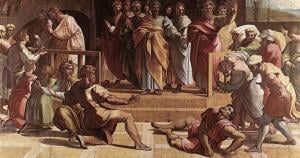 Acts 5:1-11
The story of Ananias and Sapphira begins not with Ananias and Sapphira but with the attitude of the early church. That attitude was one of love and unity. In 2:44-47, we read one of the most beautiful descriptions of any church anywhere (even more beautiful than St. Peter’s or St. Paul’s or the Crystal Cathedral!): “Now all who believed were together, and had all things in common, and sold their possessions and goods, and divided them among all, as anyone had need. So continuing daily with one accord in the temple, and breaking bread from house to house, they ate their food with gladness and simplicity of heart, praising God and having favor with all the people. And the Lord added to the church daily those who were being saved.”
So important is this attitude of the early church that St. Luke feels compelled to write about it again in 4:32-35: “Now the multitude of those who believed were of one heart and one soul; neither did anyone say that any of the things he possessed was his own, but they had all things in common. And with great power the apostles gave witness to the resurrection of the Lord Jesus. And great grace was upon them all. Nor was there anyone among them who lacked; for all who were possessors of lands or houses sold them, and brought the proceeds of the things that were sold, and laid them at the apostles’ feet; and they distributed to each as anyone had need.”
In particular, we read in 4:36, there was a man named Joses (Barnabas), who was a Levite from Cyprus. He had land, sold it, and brought the money and laid it at the apostles’ feet.
From Barnabas, we learn a few important things. First, when Luke records that the people had all things in common (verse 32), it’s obvious that it wasn’t “communism,” even if you take out all the torture and bloodletting and general superfluity of naughtiness that Communism involves. From Barnabas we learn that the early Christians still retained legal right to their property and possessions. What is remarkable about the early church, therefore, is that even while they freely retained their legal ownership over their possessions, “neither did anyone say that any of the things he possessed was his own” (verse 32).
Isn’t this the attitude we ought to have, that on the one hand, God has given us legal and earthly ownership of our possessions but that on the other hand, since God is the ultimate owner we should not think of them as exclusively our own?
Whenever God’s people had this attitude in the book of Acts, they were blessed. They had favor with the people (2:47), none of the early Christians were in need (4:34), and great grace was upon them (4:33). It must have warmed the hearts of the early Christians every time someone like Barnabas sold what was his, took the money, and laid it at the feet of the apostles.
But when God blesses His people through their faithfulness to Him, men are tempted to receive the blessing of God without faith and faithfulness. And so we come to the sad story of Ananias and Sapphira.
“What if it were possible,” we can almost hear Ananias and Sapphira saying, “to sell one of our possessions (I know we’re still arguing about whether it should be your mother’s ring or my prize cow), take some of the money and give it to the church, and retain a hefty sum for ourselves? Yes, we’re out a little money, but we still get to keep some of it. And think of the praise we’ll get!”
And now for a comic interlude, before things get too serious. When I was in ninth grade, my twin brother Danny had something funny happen to him. He was in Mr. Loth’s health class, and the class had just gotten back their graded tests. As Danny perused his test, he discovered that Mr. Loth had made a grading error and had not marked a question wrong that Danny had missed. Danny, who was both honest and the smartest kid in his class, upon discovering Mr. Loth’s error, promptly took this test up to Mr. Loth.
“Mr. Loth, you made a mistake on my test. You should have counted this one wrong.”
Mr. Loth looked at the paper, thought a second and then said, “You’re right: that one should have been wrong,” and then handed Danny back his paper without taking any action.
Billy Sims, who tried hard to be a bad kid but was basically too nice to pull it off, saw his opportunity. He, too, had missed a question that Mr. Loth had not marked wrong. Seeing what just happened to Danny, here was his chance to look like a good guy but without having to sacrifice any points on his test.
Billy sauntered up to Mr. Loth’s desk.
“Mr. Loth, I missed a question on my test too that you forgot to mark wrong.”
Mr. Loth looked at the paper, thought a second and then said, “You’re right, Billy: that one should have been wrong.” But then he took out his red pen, deducted 3 points, and handed the paper back to Billy Sims. (Comic interlude off.)
As we know, Ananias and Sapphira went through with their plan. They were under no compulsion to have sold their property, except maybe a little subtle peer pressure. But they sold their possession, not from the Spirit of love and unity, but from a wicked spirit of pride. In the end, as we know, they both were struck dead.
And this is the part that offends us. Wasn’t this, well, a little harsh. I mean, come on Lord, it was just a little white lie. And they did some good: they really did give some money to the church for the poor.
I’m not sure how you’ll interpret this passage, but I’m going with the idea that God is completely holy and just. If He struck Ananias and Sapphira dead, then they deserved it. And this is where things get really scary. We often ask the question “Why?” Why did God strike Ananias and Sapphira dead? Yes, I know He did things like that in the Old Testament (and that’s why I don’t read the Old Testament much). But I thought He wasn’t like that anymore in the New Testament. I thought it was the Love, Love, Love channel all day all the time.
The sobering thought is that He struck them dead because they deserved it. If He is truly holy, then such a sin is a grave violation of His holy person. If He is truly just, and Ananias and Sapphira sinned against Almighty God and broke His Law, the just reward of which is death, then such a sin deserved death.
Ananias and Sapphira seem like particularly proud and sinful people, but are they really that much worse than some of us, even Christians? What is our attitude toward our possessions? Do we believe that it’s all really God’s and that we’re just stewards? Do we cheerfully give our 10% or more, or do we hoard it for ourselves, rationalizing why we can afford a new car and larger house and even a single luxury item and yet can’t afford a tithe?
Do I willingly, joyfully, have the attitude that if God asked me to sell off some of my possessions to provide for a brother or sister in the Lord who truly needed it I would do it?
Or have I done some of the good deeds I’ve done with a secret hope that someone will notice and give me a little credit? Have I ever shaded the truth a little bit to make myself look better?
To make matters worse, we have to count not only the sins that we think are directly offensive to God but also the sins against His Church. Peter speaks as if God and His people are one. He connects men (the apostles) with God (the Holy Spirit), telling Ananias and Sapphira that they had not lied to men but to the Holy Spirit (who is one with the Church).
It’s easy to see why we might wonder why God was so harsh on Ananias and Sapphira. It’s likely that just as God performed miracles through the apostles that we don’t commonly see today, He also struck people down in a dramatic way that we don’t often see today. They seem like flip sides of the same coin. Without getting into a discussion of why God acted so dramatically then, at the beginning of the Church, but doesn’t now, the question remains: “Why?”
The real question is “Why not?” Why doesn’t God strike people dead today? Surely, many of us deserve it just as much as Ananias and Sapphira. Why doesn’t God strike us all dead for our sins?
Because God is not only holy and just but also merciful and loving.
The next time you’re tempted to skip over a part of the Bible you don’t like: DON’T! You’re likely to have missed a wonderful lesson in the character of God, and you’re likely to have missed a wonderful lesson in mercy and love.
Prayer: Lord Jesus Christ, Son of God, have mercy on me, a sinner.
Point for Meditation: Meditate today on the ways in which you have acted like Ananias and Sapphira. Confess your sins, and repent of them. And then bask in the mercy and forgiveness of God.
Resolution: I resolve to spend time today confessing my sins that I might receive the blessed mercy of God.
Death of Ananias – U.S. Public Domain

Previous Post

May 16, 2016
We've all Become a Bunch of Secularists
Next Post

May 18, 2016 Voices and Choices
Browse Our Archives
Select a Category Book Reviews Featured Give Us This Day Give Us This Day Devotional love me love my wife Love My Wife Reformed Catholicism Blog Spirit-Reality Take This Cup Uncategorized
Select a Month February 2022 November 2021 October 2021 August 2021 January 2021 December 2020 November 2020 September 2020 August 2020 July 2020 June 2020 May 2020 September 2018 July 2018 March 2018 November 2017 October 2017 September 2017 August 2017 July 2017 June 2017 May 2017 April 2017 March 2017 February 2017 January 2017 December 2016 November 2016 October 2016 September 2016 August 2016 July 2016 June 2016 May 2016 April 2016 March 2016 February 2016 January 2016 December 2015 November 2015 October 2015 September 2015 August 2015 July 2015 June 2015 May 2015 April 2015 March 2015 February 2015 January 2015 December 2014 November 2014 October 2014 September 2014 August 2014 July 2014 June 2014 May 2014 April 2014 March 2014 February 2014 January 2014 December 2013 November 2013 October 2013 September 2013 August 2013 July 2013 June 2013 May 2013 April 2013 March 2013 February 2013 January 2013 December 2012 November 2012 October 2012 September 2012 August 2012 July 2012 June 2012 May 2012 April 2012 March 2012 February 2012 January 2012 December 2011 November 2011 October 2011 September 2011 August 2011 July 2011 May 2011 April 2011 March 2011 February 2011 January 2011
Follow Us!
TAKE THE
Religious Wisdom Quiz
Which Gospel is written by a doctor?
Select your answer to see how you score.
John Mark Matthew Luke
Related posts from Give Us This Day

Is Christianity a Relationship and Not a Religion?


Participating in the Unity of the Trinity

The Different States of Love - and the...
TRENDING AT PATHEOS Evangelical

How the author of the world's best hymn...
I've been working with John Newton for a while now. This makes...

Long before this Lectio Divina, Psalm 130 - the song - started...

What About the Trees? Another Living Parable
After I finished writing the last article about falling leaves as a...

Why Classical Education Is a Conversation, Not a...
Come and Read: Joy in Classical Education When I was a little...

Falling Leaves: A Living Parable on Letting Go
I’ve spent the vast majority of my life in the southeast corner...

Cornell University has received a great deal of negative publicity and intense...
view all Evangelical blogs
Ad-Free & Subscriber Log-In Subscription Support
- About Us
- 2026 Calendar
- Videos
- Podcasts
- Library of World Religions
- Faith In Media Tracker
- Advertise With Us
- Write for Us
- Privacy Policy
- Terms of Service
- Do Not Sell My Data
- Contact Us
- Radiant Digital
- Manage Newsletter Subscriptions
- Unsubscribe From Notifications
- Sitemap
Copyright 2008-2026, Patheos. All rights reserved.
Subscription Support Ad-Free & Subscriber Log-In
Follow Patheos