
BuddhistCatholicContemplativeEvangelicalGeneral ChristianHinduJewishLatter-day SaintMuslimNew VisionsProgressive Christian
Beliefs
- Buddhist
- Catholic
- Contemplative
- Evangelical
- General Christian
- Hindu
- Jewish
- Latter-day Saint
- More Voices
- Muslim
- New Visions
- Pagan
- Progressive Christian
Topics
- Religion News
- Food and Religion
- Sports and Religion
- Religious Art
- Religious Music and Entertainment
- Religious Events
- History and Religion
- Style and Religion
- Politics and Religion
- Women in Religion
- Recreation Outdoors and Religion
- Business Finance and Religion
- Careers Workplace and Religion
- Education and Religion
- Family Parenting and Religion
- Health Fitness and Religion
- Home and Religion
- Relationships and Religion
- Technology and Religion
- Travel and Religion
Columnists
- Buddhist Columnists
- Business Finance and Religion Columnists
- Careers Workplace and Religion Columnists
- Catholic Columnists
- Contemplative Columnists
- Education and Religion Columnists
- Evangelists Columnists
- Family Parenting and Religion Columnists
- General Christian Columnists
- Health Fitness and Religion Columnists
- Hindu Columnists
- History and Religion Columnists
- Home and Religion Columnists
- Jewish Columnists
- More Voices Columnists
- Latter Day Columnists
- Muslim Columnists
- New Visions Columnists
- Nonreligious Columnists
- Pagan Columnists
- Politics and Religion Columnists
- Progressive Columnists
- Recreation Outdoors and Religion Columnists
- Relationships and Religion Columnists
- Religion News Columnists
- Religious Art Columnists
- Religious Events Columnists
- Religious Music and Entertainment Columnists
- Sports and Religion Columnists
- Style and Religion Columnists
- Technology and Religion Columnists
- Travel and Religion Columnists
- Women in Religion Columnists
Resource Library
- 2026 Calendar
- Library of World Religions
- The 100 Most Holy Places on Earth
- Patheos Answers
- Podcasts
- Videos
- Faith Leaders Database
- Anglican Episcopalian
- Bahai
- Baptist
- Buddhism
- Christianity
- Confucianism
- Eastern Orthodoxy
- Hinduism
- Holiness and Pentecostal
- ISKCON
- Islam
- Judaism
- Lutheran
- Methodist
- The Church of Jesus Christ of Latter-day Saints
- New Age
- Paganism
- Presbytarian and Reformed
- Protestantism
- Religion Behind the Scenes
- Roman Catholic
- Scientology
- Shia Islam
- Sikhism
- Sufism
- Sunni Islam
- Taoism
- Zen
- See all religions
Research Tools
 Ad-Free & Subscriber Log-In Subscription Support
Ad-Free & Subscriber Log-In Subscription Support
Follow Patheos 

- Trending:
- Forgiveness
- |
- Marriage
- |
- Consciousness
- |
- Death Penalty
- |
- Election
- |
- Halloween
 Give Us This Day
- Home
- Evangelical
- Wednesday of the Fourth Sunday in Advent – Revelation 21:9-27
Wednesday of the Fourth Sunday in Advent – Revelation 21:9-27
Last updated on: December 22, 2015 at 6:04 pm by Fr. Charles Erlandson
Wednesday of the Fourth Sunday in Advent – Revelation 21:9-27 2015-12-22T18:04:26-05:00 Fr. Charles Erlandson
Patheos Explore the world's faith through different perspectives on religion and spirituality! Patheos has the views of the prevalent religions and spiritualities of the world.
 Revelation 21:9-27
I love playing the word association game. If someone says “Light,” then I might say “Dark.” If they say “Black,” I might say “White.” Actually, knowing me, I’ll go out of my way to find something to say other than the obvious. If you said “White,” I’d be more likely to say something like “Knight” or “Rabbit.”
But I’d like to play a one-word, word association game. But when I give you this one word, I want you to think not just of a word but also of a more complete response – an explanation, a definition, an image. Ready?
What’s the first thing that comes into your mind when I say the word “Church”? If you give yourself a minute to extend your response, what’s your gut reaction to “Church?”
When St. John sees the Church and thinks of it, he sees what God has revealed to Him in Revelation 21. It might not seem like a compelling picture to us, but that’s only because we no longer know how to read poetry, especially the poetry of the Bible. In fact, one of the reasons we so misinterpret the book of Revelation and it becomes the Obfuscation of St. John is because we will not read the poetry of Revelation as poetry. We also don’t see the Revelation of Jesus Christ very well because we have not first read books like Ezekiel and Isaiah, which are also prophetic, figurative, and poetic.
When I see the Church, I see the Bride of Jesus Christ, and I see the Lamb’s wife. I see God’s heavenly city coming down from heaven and being filled with the Holy Spirit. I see God’s people being transfigured into the Temple of God where he tabernacles with them, and I see the Church having the glory of God Himself. I see the Shekinah glory that illuminated Moses’ face and so filled the Old Testament temple that the priests fled for their lives. Only now this same glory is in us because we are God’s Temple. We have His treasure in these earthen vessels. We are like the precious Dead Sea Scrolls hidden in literal earthen vessels, a homely vessel housing one of the greatest treasures known to man.
When I see the Church, I see the Bride of Jesus Christ adorned for her marriage, adorned with all sorts of precious jewels, which are befitting for the wife of such a glorious Husband. I see on her the precious jewels of love, joy, and peace; longsuffering, kindness, and goodness; and faithfulness, gentleness, and self-control.
When I see the Church, I see her built on the foundation of the Old Testament prophets and the New Testament apostles, the gates and foundation stones that St. John saw. And I see a great company of living stones that compose the rest of the Church, and that is all of the saints both in heaven and on earth.
I see a Church to which the nations will come for healing and to find true treasure beyond belief (or, that are found only by belief). (St. John’s prophecy is for a time when there are still nations that exist and are able to come to Christ.) When I see Jesus Christ in the Church, I see the fulfillment of Isaiah 60. I don’t see Isaiah’s prophecy skipping ahead of the entire ministry of Jesus Christ and looking forward to His Second Coming: I see holy Isaiah seeing the same thing St. John saw, which was a revelation of Jesus Christ in His Church, here and now, as well as there and then (in the future in heaven).
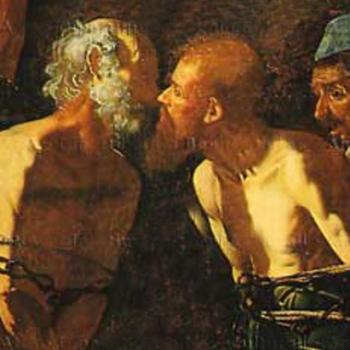
And that’s where I see you and me and all the saints at Good Shepherd Reformed Episcopal Church or wherever I happen to see them in this world. I’ve always found it curious that our Orthodox brothers and sisters bow to and kiss icons. I understand the 7th Ecumenical Council and all that, but it seems to me that if we really want to bow down to and kiss the icons of God, we should be bowing down to and kissing each other.
In fact, this is exactly what we should be doing, though of course the kiss must be the holy kiss of 1 Thessalonians 5:26. My constant refrain to my children in evening prayer is that we are the Body of Christ and the Temple of God and that God comes to us through His Church, His people. Therefore, what we say and do is the way people see Jesus Christ. And therefore the way we see the people around us is the way we see Jesus Christ.
This is why the St. John’s Revelation is so important and precious to me: because he gives me a revelation not only of Jesus Christ but especially of Jesus Christ in His holy temple, the Church, His Bride – you and me!
Wishing I had said it this way myself, C.S. Lewis said in “The Weight of Glory”:
“It may be possible for each to think too much of his own potential glory hereafter; it is hardly possible for him to think too often or too deeply about that of his neighbour. The load, or weight, or burden of my neighbor’s glory should be laid on my back, a load so heavy that only humility can carry it, and the backs of the proud will be broken. It is a serious thing to live in a society of possible gods and goddesses, to remember that the dullest and most uninteresting person you can talk to may one day be a creature which, if you saw it now, you would be strongly temped to worship, or else a horror and a corruption such as you meet, if at all, only in a nightmare. All day long we are, in some degree, helping each other to one or other of these destinations. It is in the light of these overwhelming possibilities, it is with the awe and circumspection proper to them, that we should conduct all our dealings with one another, all friendships, all loves, all play, all politics.
There are no ordinary people. You have never talked to a mere mortal. Nations, cultures, arts, civilizations — these are mortal, and their life is to ours as the life of a gnat. But it is immortals whom we joke with, work with, marry, snub, and exploit — immortal horrors or everlasting splendours. This does not mean that we are to be perpetually solemn. We must play. But our merriment must be of that kind (and it is, in fact, the merriest kind) which exists between people who have, from the outset, taken each other seriously — no flippancy, no superiority, no presumption. And our charity must be a real and costly love, with deep feeling for the sins in spite of which we love the sinner–no mere tolerance, or indulgence which parodies love as flippancy parodies merriment. Next to the Blessed Sacrament itself, your neighbour is the holiest object presented to your senses. If he is your Christian neighbour, he is holy in almost the same way, for in him also Christ vere latitat — the glorifier and the glorified, Glory Himself, is truly hidden.”
This is what St. John, the disciple whom Jesus loved, wishes to reveal to us this morning. It is nothing less than Jesus Christ in us, the Marriage of the Lamb and His Wife. Revelation has everything to do with us, after all!
Prayer: O Lord, I ask that You would reveal Yourself to me today through Your Son, Jesus Christ, the Lamb of God. Help me to see Him through His Church and the people You put in my life, even as You use me to reflect Your glory to others. Help me to live today as if I truly am part of the beautiful and holy Bride of Jesus Christ. Amen.
Points for Meditation:
- If you truly saw your local church as the Temple of God and the Bride of Jesus Christ, how would you minister differently in terms of the gifts and talents you brought to the church? Be honest and specific.
- If you truly saw the people in your life as made in the image of God, what are some practical and specific ways you might behave differently toward them today?
Resolution: I resolve to practice seeing the people I meet today as made in the image of God and to see the Church as the Bride of Jesus Christ.
© 2015 Fr. Charles Erlandson
Previous Post

December 21, 2015
Tuesday of the Fourth Sunday in Advent - Revelation 21:1-8
Next Post
December 22, 2015 Christmas Eve - Matthew 1:18-25
Browse Our Archives
Select a Category Book Reviews Featured Give Us This Day Give Us This Day Devotional love me love my wife Love My Wife Reformed Catholicism Blog Spirit-Reality Take This Cup Uncategorized
Select a Month February 2022 November 2021 October 2021 August 2021 January 2021 December 2020 November 2020 September 2020 August 2020 July 2020 June 2020 May 2020 September 2018 July 2018 March 2018 November 2017 October 2017 September 2017 August 2017 July 2017 June 2017 May 2017 April 2017 March 2017 February 2017 January 2017 December 2016 November 2016 October 2016 September 2016 August 2016 July 2016 June 2016 May 2016 April 2016 March 2016 February 2016 January 2016 December 2015 November 2015 October 2015 September 2015 August 2015 July 2015 June 2015 May 2015 April 2015 March 2015 February 2015 January 2015 December 2014 November 2014 October 2014 September 2014 August 2014 July 2014 June 2014 May 2014 April 2014 March 2014 February 2014 January 2014 December 2013 November 2013 October 2013 September 2013 August 2013 July 2013 June 2013 May 2013 April 2013 March 2013 February 2013 January 2013 December 2012 November 2012 October 2012 September 2012 August 2012 July 2012 June 2012 May 2012 April 2012 March 2012 February 2012 January 2012 December 2011 November 2011 October 2011 September 2011 August 2011 July 2011 May 2011 April 2011 March 2011 February 2011 January 2011
Follow Us!
TAKE THE
Religious Wisdom Quiz
Who said: "I am the Alpha and the Omega, who is, and who was, and who is to come, the Almighty"?
Select your answer to see how you score.
John God (the Lord God) An angel Jesus
Related posts from Give Us This Day

James Clark - Book Review of Take This...

Revelation 8 - Heavenly Worship and Prayer
Greet One Another With a Holy Kiss

TRENDING AT PATHEOS Evangelical

How the author of the world's best hymn...
I've been working with John Newton for a while now. This makes...

Long before this Lectio Divina, Psalm 130 - the song - started...

What About the Trees? Another Living Parable
After I finished writing the last article about falling leaves as a...

Why Classical Education Is a Conversation, Not a...
Come and Read: Joy in Classical Education When I was a little...

Falling Leaves: A Living Parable on Letting Go
I’ve spent the vast majority of my life in the southeast corner...

Cornell University has received a great deal of negative publicity and intense...
view all Evangelical blogs
Ad-Free & Subscriber Log-In Subscription Support
- About Us
- 2026 Calendar
- Videos
- Podcasts
- Library of World Religions
- Faith In Media Tracker
- Advertise With Us
- Write for Us
- Privacy Policy
- Terms of Service
- Do Not Sell My Data
- Contact Us
- Radiant Digital
- Manage Newsletter Subscriptions
- Unsubscribe From Notifications
- Sitemap
Copyright 2008-2026, Patheos. All rights reserved.
Subscription Support Ad-Free & Subscriber Log-In
Follow Patheos