
BuddhistCatholicContemplativeEvangelicalGeneral ChristianHinduJewishLatter-day SaintMuslimNew VisionsProgressive Christian
Beliefs
- Buddhist
- Catholic
- Contemplative
- Evangelical
- General Christian
- Hindu
- Jewish
- Latter-day Saint
- More Voices
- Muslim
- New Visions
- Pagan
- Progressive Christian
Topics
- Religion News
- Food and Religion
- Sports and Religion
- Religious Art
- Religious Music and Entertainment
- Religious Events
- History and Religion
- Style and Religion
- Politics and Religion
- Women in Religion
- Recreation Outdoors and Religion
- Business Finance and Religion
- Careers Workplace and Religion
- Education and Religion
- Family Parenting and Religion
- Health Fitness and Religion
- Home and Religion
- Relationships and Religion
- Technology and Religion
- Travel and Religion
Columnists
- Buddhist Columnists
- Business Finance and Religion Columnists
- Careers Workplace and Religion Columnists
- Catholic Columnists
- Contemplative Columnists
- Education and Religion Columnists
- Evangelists Columnists
- Family Parenting and Religion Columnists
- General Christian Columnists
- Health Fitness and Religion Columnists
- Hindu Columnists
- History and Religion Columnists
- Home and Religion Columnists
- Jewish Columnists
- More Voices Columnists
- Latter Day Columnists
- Muslim Columnists
- New Visions Columnists
- Nonreligious Columnists
- Pagan Columnists
- Politics and Religion Columnists
- Progressive Columnists
- Recreation Outdoors and Religion Columnists
- Relationships and Religion Columnists
- Religion News Columnists
- Religious Art Columnists
- Religious Events Columnists
- Religious Music and Entertainment Columnists
- Sports and Religion Columnists
- Style and Religion Columnists
- Technology and Religion Columnists
- Travel and Religion Columnists
- Women in Religion Columnists
Resource Library
- 2026 Calendar
- Library of World Religions
- The 100 Most Holy Places on Earth
- Patheos Answers
- Podcasts
- Videos
- Faith Leaders Database
- Anglican Episcopalian
- Bahai
- Baptist
- Buddhism
- Christianity
- Confucianism
- Eastern Orthodoxy
- Hinduism
- Holiness and Pentecostal
- ISKCON
- Islam
- Judaism
- Lutheran
- Methodist
- The Church of Jesus Christ of Latter-day Saints
- New Age
- Paganism
- Presbytarian and Reformed
- Protestantism
- Religion Behind the Scenes
- Roman Catholic
- Scientology
- Shia Islam
- Sikhism
- Sufism
- Sunni Islam
- Taoism
- Zen
- See all religions
Research Tools
 Ad-Free & Subscriber Log-In Subscription Support
Ad-Free & Subscriber Log-In Subscription Support
Follow Patheos 

- Trending:
- Forgiveness
- |
- Marriage
- |
- Consciousness
- |
- Death Penalty
- |
- Election
- |
- Halloween
 Give Us This Day
- Home
- Evangelical
- The Day of the Lord
The Day of the Lord
Last updated on: March 23, 2018 at 4:51 pm by Fr. Charles Erlandson
The Day of the Lord 2018-03-23T16:51:14-05:00 Fr. Charles Erlandson
Patheos Explore the world's faith through different perspectives on religion and spirituality! Patheos has the views of the prevalent religions and spiritualities of the world.
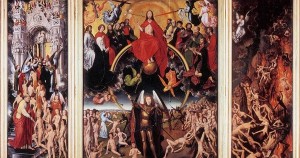 2 Thessalonians 2:1-12
There are a number of interpretations of what St. Paul is referring to when he speaks of the Day of the Lord, the son of perdition, and other things. To do justice to presenting my own understanding would detract from the devotional nature of these meditations, and yet it is necessary in this passage to offer some background.
When reading the Bible, we must always remember to place any given text in its proper context, which includes the surrounding verses and chapter, the entire book (remembering that there were no chapter and verse divisions in the original books of the Bible), the entire Bible, and the literary, historical, and cultural situation in which the book of the Bible was written and received.
When we read Old Testament, we understand that we must work to apply it to ourselves because things have changed. But when reading the New Testament, too often we assume that things for us will be exactly like 1st century, without any effort to apply to our circumstances.
The first thing we should understand about 2 Thessalonians 2, then, is that Paul is writing to a specific church, the one in Thessalonica, in the first century, because they had questions about the Day of the Lord and related ideas. Paul expects the 1st century Thessalonians to understand what he is talking about and see how it applies to them.
In trying to understand it ourselves, we have a basic choice to make regarding what Paul meant. The Day of the Lord and the Man of Perdition could refer to things that were to happen shortly and that the Thessalonians could expect to understand and experience. For example, the son of perdition would sit as God in the temple of God, which stood only until A.D. 70. In this case, the immediate context that Paul is speaking about is now past, and we have to interpret what the passage means for us today.
On the other hand, the things Paul is speaking about could be things still future to even us who live 2000 years later, things that (since we’ve waited for them 2000 years) are also unlikely to be directly about our own generation.
In either case, the point for us is the same: that Paul is not specifically prophesying about events in the year 2013, any more than he was talking about events that were about to happen in 1970 when The Late Great Planet Earth was written (we are now 2 generations after that book.) In either case, however, we must find an application for today, for surely this passage speaks to us today, as does all of Scripture.
We can all affirm that like the Thessalonians, there is evil in our culture and generation. There are certainly antichrists in our culture, there are those who exalt themselves above God, and there is lawlessness. We have an increasing number of people who claim the divine is inside them (and they don’t mean the Holy Spirit), and in American culture, there is little argument that as a whole we are more lawless than we used to be. Even among Christians there are those who proclaim that Jesus Christ can be our Savior without being our Lord and those who say that since we are under grace and not law it doesn’t matter how we live (which is antinomianism or lawlessness.) In other words, we all intuitively understand that we are facing the same problems the 1st century Thessalonians faced.
One of the most revealing things about my recent studies in the sociology of religion, especially in the historical sociology of Christianity, as well as my reading in church history is this world-shattering (if you live in a little, fragile world like I do sometimes) conclusion: that every generation and every culture is decadent and filled with miserable sinners who are making the world worse than how they found it. For example, while the Middle Ages might be seen as a high point of the influence of Christianity over culture, we must consider not only the terrible problems of the Church that necessitated a drastic Reformation, but we might also wish to consider that once you begin looking outside of the educated elite who remained faithful, there was an enormous amount of spiritual ignorance, apathy, and rebellion.
We might even assert (well – I might assert it – I won’t drag you into my intellectual adventures) a First Spiritual Law of Thermodynamics, which is that “The spiritual entropy of the universe tends to a maximum.”
In other words, spiritually, things are running down and getting worse. And they have been for thousands of years. But if St. Paul thought so, and we think so then how come the end hasn’t come? I don’t think that when most of us look at the 1950s we think that things had gotten much, much worse than things were in the Roman Empire. In other words, the world can’t be running down spiritually in a straight downward line. In fact, in some ways, we have to admit that they are spiritually getting better. Every time someone is made a Christian, the world has gotten better spiritually, and there are a lot more Christians around today than ever before, and over a larger part of the earth than ever before.
This means we have to assert a Second Spiritual Law of Thermodynamics which states: Jesus Christ is the same yesterday, today, and tomorrow, and His Body, the Church, is always inhabited by the Holy Spirit and is always being regenerated, reformed, and revitalized, just like any living body.
This means that not only is the world getting worse whenever evil men and lawlessness prevail but also that it is getting better whenever the Kingdom of God is established by men who turn to Christ and live as faithful disciples.
The bottom line for the Christian is this: though the sons of perdition and the men of lawlessness may attempt to sit as God in the temple of God, the fact is that Jesus Christ is enthroned at the right hand of the Father in the true Temple not made with hands. This is our response to the evil around us: to remember and turn to God and resolve to lead holy lives in His kingdom.
That Jesus Christ, the King of kings, is on the throne and that Jesus Christ will come again for His saints are the ultimate realities for every creature. And they are our realities this very day, regardless of the sin and lawlessness of others.
Prayer: Lord Jesus, I praise You because You sit at the right hand of the Father, enthroned in heaven. Look down upon me with mercy this day and calm whatever fears I have about the progress of evil men in Your world. Increase my faith and encourage me in all righteousness that through my life Your kingdom may be established here on earth as it is in heaven.
Points for Meditation:
- What evils did the 1st century of St. Paul’s letters and ours have in common? Meditate on how Paul counseled the churches to respond to the evil and trouble in their lives. Apply this counsel to your own life and times.
Resolution: I resolve to remember the eternal and heavenly reality today, that Jesus Christ is on the throne and that the Lord is in His holy Temple.
The Last Judgment by Hans Memling – U.S. Public Domain

Previous Post

September 28, 2015
The Syllogism of Glory
Next Post
September 30, 2015 Glory Be
Browse Our Archives
Select a Category Book Reviews Featured Give Us This Day Give Us This Day Devotional love me love my wife Love My Wife Reformed Catholicism Blog Spirit-Reality Take This Cup Uncategorized
Select a Month February 2022 November 2021 October 2021 August 2021 January 2021 December 2020 November 2020 September 2020 August 2020 July 2020 June 2020 May 2020 September 2018 July 2018 March 2018 November 2017 October 2017 September 2017 August 2017 July 2017 June 2017 May 2017 April 2017 March 2017 February 2017 January 2017 December 2016 November 2016 October 2016 September 2016 August 2016 July 2016 June 2016 May 2016 April 2016 March 2016 February 2016 January 2016 December 2015 November 2015 October 2015 September 2015 August 2015 July 2015 June 2015 May 2015 April 2015 March 2015 February 2015 January 2015 December 2014 November 2014 October 2014 September 2014 August 2014 July 2014 June 2014 May 2014 April 2014 March 2014 February 2014 January 2014 December 2013 November 2013 October 2013 September 2013 August 2013 July 2013 June 2013 May 2013 April 2013 March 2013 February 2013 January 2013 December 2012 November 2012 October 2012 September 2012 August 2012 July 2012 June 2012 May 2012 April 2012 March 2012 February 2012 January 2012 December 2011 November 2011 October 2011 September 2011 August 2011 July 2011 May 2011 April 2011 March 2011 February 2011 January 2011
Follow Us!
TAKE THE
Religious Wisdom Quiz
Who was thrown into a muddy cistern for prophesying Jerusalem's fall?
Select your answer to see how you score.
Isaiah Jeremiah Baruch Micah
Related posts from Give Us This Day
John 2:13-25 - Cleansing the Temple
Luke 21:20-38 - Look Up to Jesus
Mark 13:14-23 - The Horror and the Mercy
TRENDING AT PATHEOS Evangelical

The REST of Your Life: A Creative Wrestles...
This week I had a conversation with a good friend from church....

How the author of the world's best hymn...
I've been working with John Newton for a while now. This makes...

Long before this Lectio Divina, Psalm 130 - the song - started...

What About the Trees? Another Living Parable
After I finished writing the last article about falling leaves as a...

Why Classical Education Is a Conversation, Not a...
Come and Read: Joy in Classical Education When I was a little...

Cornell University has received a great deal of negative publicity and intense...
view all Evangelical blogs
Ad-Free & Subscriber Log-In Subscription Support
- About Us
- 2026 Calendar
- Videos
- Podcasts
- Library of World Religions
- Faith In Media Tracker
- Advertise With Us
- Write for Us
- Privacy Policy
- Terms of Service
- Do Not Sell My Data
- Contact Us
- Radiant Digital
- Manage Newsletter Subscriptions
- Unsubscribe From Notifications
- Sitemap
Copyright 2008-2026, Patheos. All rights reserved.
Subscription Support Ad-Free & Subscriber Log-In
Follow Patheos