
BuddhistCatholicContemplativeEvangelicalGeneral ChristianHinduJewishLatter-day SaintMuslimNew VisionsProgressive Christian
Beliefs
- Buddhist
- Catholic
- Contemplative
- Evangelical
- General Christian
- Hindu
- Jewish
- Latter-day Saint
- More Voices
- Muslim
- New Visions
- Pagan
- Progressive Christian
Topics
- Religion News
- Food and Religion
- Sports and Religion
- Religious Art
- Religious Music and Entertainment
- Religious Events
- History and Religion
- Style and Religion
- Politics and Religion
- Women in Religion
- Recreation Outdoors and Religion
- Business Finance and Religion
- Careers Workplace and Religion
- Education and Religion
- Family Parenting and Religion
- Health Fitness and Religion
- Home and Religion
- Relationships and Religion
- Technology and Religion
- Travel and Religion
Columnists
- Buddhist Columnists
- Business Finance and Religion Columnists
- Careers Workplace and Religion Columnists
- Catholic Columnists
- Contemplative Columnists
- Education and Religion Columnists
- Evangelists Columnists
- Family Parenting and Religion Columnists
- General Christian Columnists
- Health Fitness and Religion Columnists
- Hindu Columnists
- History and Religion Columnists
- Home and Religion Columnists
- Jewish Columnists
- More Voices Columnists
- Latter Day Columnists
- Muslim Columnists
- New Visions Columnists
- Nonreligious Columnists
- Pagan Columnists
- Politics and Religion Columnists
- Progressive Columnists
- Recreation Outdoors and Religion Columnists
- Relationships and Religion Columnists
- Religion News Columnists
- Religious Art Columnists
- Religious Events Columnists
- Religious Music and Entertainment Columnists
- Sports and Religion Columnists
- Style and Religion Columnists
- Technology and Religion Columnists
- Travel and Religion Columnists
- Women in Religion Columnists
Resource Library
- 2026 Calendar
- Library of World Religions
- The 100 Most Holy Places on Earth
- Patheos Answers
- Podcasts
- Videos
- Faith Leaders Database
- Anglican Episcopalian
- Bahai
- Baptist
- Buddhism
- Christianity
- Confucianism
- Eastern Orthodoxy
- Hinduism
- Holiness and Pentecostal
- ISKCON
- Islam
- Judaism
- Lutheran
- Methodist
- The Church of Jesus Christ of Latter-day Saints
- New Age
- Paganism
- Presbytarian and Reformed
- Protestantism
- Religion Behind the Scenes
- Roman Catholic
- Scientology
- Shia Islam
- Sikhism
- Sufism
- Sunni Islam
- Taoism
- Zen
- See all religions
Research Tools
 Ad-Free & Subscriber Log-In Subscription Support
Ad-Free & Subscriber Log-In Subscription Support
Follow Patheos 

- Trending:
- Forgiveness
- |
- Marriage
- |
- Consciousness
- |
- Death Penalty
- |
- Election
- |
- Halloween
 Give Us This Day
- Home
- Evangelical
- Wednesday of Epiphany 5 – 1 Thessalonians 2:17-3:13
Wednesday of Epiphany 5 – 1 Thessalonians 2:17-3:13
Last updated on: February 11, 2014 at 11:43 pm by Fr. Charles Erlandson
Wednesday of Epiphany 5 – 1 Thessalonians 2:17-3:13 2014-02-11T23:43:48-05:00 Fr. Charles Erlandson
Patheos Explore the world's faith through different perspectives on religion and spirituality! Patheos has the views of the prevalent religions and spiritualities of the world.
 1 Thessalonians 2:17-3:13

There are a lot of myths that we receive in American culture that are not necessarily consistent with the life in Christ revealed in the Bible. One of these is what I call the Myth of Graduation.
We like graduations, and with good reason. Graduations mark the times when we have graduated or progressed from one stage of life to another. So we graduate from high school or college, not only because we have survived a particular course of study but because we are about to move from one stage of life to another. So graduations like these are reasons to celebrate.
But sometimes we believe that when we graduate from either high school or college or from our parents’ household that we also graduate from community, that is, that we have now progressed to the point that we should be able to stand on our own two feet, completely alone. It’s true that as we get older we should be more independent of our parents in being able to make choices and live without their financial support or direct oversight. It’s true that when we marry we must leave and cleave. But it’s a tragic mistake to think that such a graduation is a Graduation to Individualism, which is the cultural myth we sometimes swallow.
In fact, this Graduation to Individualism is actually a kind of regression. Part of the first 18 or more years of our life were hopefully spent teaching us not just to “grow up” but also to “grow out,” that is, to grow in our ability to live together in love in a community where each carries his own burden but also carries the burdens of others.
One of the things that kids growing up most reject is their parents’ attempts to “check up” on them, to make sure they are doing well. In 1 Thessalonians 3, St. Paul makes clear to the Thessalonians that he doesn’t believe they have or should have graduated from the need to have others check up on them. On the contrary, Paul is like a mother hen to his churches, or like a father checking out the prospective boyfriends of his daughter.
He sends Timothy to “check up” on the Thessalonians by establishing them and encouraging them (verse 2), so that no one would be shaken by the afflictions they were experiencing (verse 3.) Previously, Paul had told the Thessalonians that he had hoped to come check up on them himself but could not. So instead he sends his best agent, Timothy, and puts him on the case.
Like any parent, Paul is overjoyed to be told that his children, the Thessalonians were standing firm in faith and love (verse 6.) What must have rejoiced his heart just as much was to hear that they had fond memories of him, as he did for them.
I wonder sometimes how well American churches are doing in checking up on their members. On the one hand, it’s hard and thankless work for pastors to check up on their parishioners. In some cases, this is not even a central focus of the local church, which may be so large that members are relatively anonymous. On the other hand, parishioners are the ones who are most resistant to being “checked up” on. We don’t want the pastor “interfering” in our lives or “hassling” us, as if we weren’t self-sufficient or doing O.K. by ourselves. Should a pastor do the very duty of “checking up,” which he has sworn to do and for which he has taken vows, then watch out! That pastor may be just about to lose a sheep to another less watchful shepherd and flock.
The truth is, often we aren’t doing well and have wandered like lost sheep, and that is exactly why we don’t want any pastor “snooping” around our homes and lives. In acting this way, we have become like Adam and Eve who only hid from the Lord when they were ashamed because they knew they had done something wrong and were spiritually naked before Him.
But we have a godly obligation both to check and be checked. God has bound us to a local Body of Christ, to which we are to be submitted. We are to welcome our pastors’ checking into our lives: we should rejoice that they care enough to correct or rebuke us if they have to. And we should all be willing to do the checking ourselves. It is not only the pastors who have an obligation to check into the well-being of church members: it is the ministry of every member. Those who are your neighbors in your church, those whose lives are closest to yours, are the ones you should be checking on, to make sure they are standing fast in love and faith.
Only if we “interfere” by “checking on” each other in godly love will any of us be able to stand. And only if we “check on” each other will we learn to live in the godly love and unity that is to characterize each and every church.
Prayer: Father, may You direct me in my way. May You cause me and those in my church to increase and abound in love to one another and to all, just as St. Paul and the Thessalonians loved each other and checked on each other. May You establish my heart in holiness before You at the coming of our Lord Jesus Christ with all His saints.
Points for Meditation:
1. Reflect on your attitude toward being “checked up on” by other Christians.
2. Is there someone you are supposed to be checking on that you have neglected to love in this way?
3. In what ways does your local church encourage or discourage members to keep each other accountable?
Resolution: I resolve to open my life to having other Christians, especially in my church, come close enough to my life that they are able to assist me in my Christian life.
© 2014 Fr. Charles Erlandson
Give Us This Day daily devotional
Previous Post

February 10, 2014
Tuesday of 5th Sunday after Epiphany - 1 Thessalonians 2:1-13
Next Post
February 13, 2014 Thursday of 5th Sunday after Epiphany - 1 Thessalonians 4:1-12
Browse Our Archives
Select a Category Book Reviews Featured Give Us This Day Give Us This Day Devotional love me love my wife Love My Wife Reformed Catholicism Blog Spirit-Reality Take This Cup Uncategorized
Select a Month February 2022 November 2021 October 2021 August 2021 January 2021 December 2020 November 2020 September 2020 August 2020 July 2020 June 2020 May 2020 September 2018 July 2018 March 2018 November 2017 October 2017 September 2017 August 2017 July 2017 June 2017 May 2017 April 2017 March 2017 February 2017 January 2017 December 2016 November 2016 October 2016 September 2016 August 2016 July 2016 June 2016 May 2016 April 2016 March 2016 February 2016 January 2016 December 2015 November 2015 October 2015 September 2015 August 2015 July 2015 June 2015 May 2015 April 2015 March 2015 February 2015 January 2015 December 2014 November 2014 October 2014 September 2014 August 2014 July 2014 June 2014 May 2014 April 2014 March 2014 February 2014 January 2014 December 2013 November 2013 October 2013 September 2013 August 2013 July 2013 June 2013 May 2013 April 2013 March 2013 February 2013 January 2013 December 2012 November 2012 October 2012 September 2012 August 2012 July 2012 June 2012 May 2012 April 2012 March 2012 February 2012 January 2012 December 2011 November 2011 October 2011 September 2011 August 2011 July 2011 May 2011 April 2011 March 2011 February 2011 January 2011
Follow Us!
TAKE THE
Religious Wisdom Quiz
Which book prophesies the destruction of Nineveh?
Select your answer to see how you score.
Jonah Obadiah Nahum Zephaniah
Related posts from Give Us This Day

James Clark - Book Review of Take This...

No Golden Age of the Church - The...
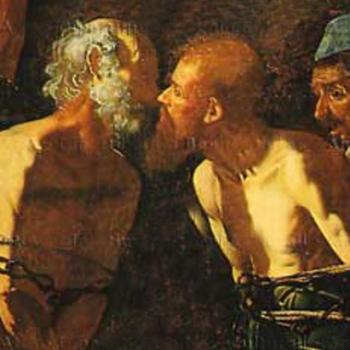
Greet One Another With a Holy Kiss

Is Christianity a Relationship and Not a Religion?
TRENDING AT PATHEOS Evangelical

How the author of the world's best hymn...
I've been working with John Newton for a while now. This makes...

Long before this Lectio Divina, Psalm 130 - the song - started...

What About the Trees? Another Living Parable
After I finished writing the last article about falling leaves as a...

Why Classical Education Is a Conversation, Not a...
Come and Read: Joy in Classical Education When I was a little...

Falling Leaves: A Living Parable on Letting Go
I’ve spent the vast majority of my life in the southeast corner...

Cornell University has received a great deal of negative publicity and intense...
view all Evangelical blogs
Ad-Free & Subscriber Log-In Subscription Support
- About Us
- 2026 Calendar
- Videos
- Podcasts
- Library of World Religions
- Faith In Media Tracker
- Advertise With Us
- Write for Us
- Privacy Policy
- Terms of Service
- Do Not Sell My Data
- Contact Us
- Radiant Digital
- Manage Newsletter Subscriptions
- Unsubscribe From Notifications
- Sitemap
Copyright 2008-2026, Patheos. All rights reserved.
Subscription Support Ad-Free & Subscriber Log-In
Follow Patheos