
BuddhistCatholicContemplativeEvangelicalGeneral ChristianHinduJewishLatter-day SaintMuslimNew VisionsProgressive Christian
Beliefs
- Buddhist
- Catholic
- Contemplative
- Evangelical
- General Christian
- Hindu
- Jewish
- Latter-day Saint
- More Voices
- Muslim
- New Visions
- Pagan
- Progressive Christian
Topics
- Religion News
- Food and Religion
- Sports and Religion
- Religious Art
- Religious Music and Entertainment
- Religious Events
- History and Religion
- Style and Religion
- Politics and Religion
- Women in Religion
- Recreation Outdoors and Religion
- Business Finance and Religion
- Careers Workplace and Religion
- Education and Religion
- Family Parenting and Religion
- Health Fitness and Religion
- Home and Religion
- Relationships and Religion
- Technology and Religion
- Travel and Religion
Columnists
- Buddhist Columnists
- Business Finance and Religion Columnists
- Careers Workplace and Religion Columnists
- Catholic Columnists
- Contemplative Columnists
- Education and Religion Columnists
- Evangelists Columnists
- Family Parenting and Religion Columnists
- General Christian Columnists
- Health Fitness and Religion Columnists
- Hindu Columnists
- History and Religion Columnists
- Home and Religion Columnists
- Jewish Columnists
- More Voices Columnists
- Latter Day Columnists
- Muslim Columnists
- New Visions Columnists
- Nonreligious Columnists
- Pagan Columnists
- Politics and Religion Columnists
- Progressive Columnists
- Recreation Outdoors and Religion Columnists
- Relationships and Religion Columnists
- Religion News Columnists
- Religious Art Columnists
- Religious Events Columnists
- Religious Music and Entertainment Columnists
- Sports and Religion Columnists
- Style and Religion Columnists
- Technology and Religion Columnists
- Travel and Religion Columnists
- Women in Religion Columnists
Resource Library
- 2026 Calendar
- Library of World Religions
- The 100 Most Holy Places on Earth
- Patheos Answers
- Podcasts
- Videos
- Faith Leaders Database
- Anglican Episcopalian
- Bahai
- Baptist
- Buddhism
- Christianity
- Confucianism
- Eastern Orthodoxy
- Hinduism
- Holiness and Pentecostal
- ISKCON
- Islam
- Judaism
- Lutheran
- Methodist
- The Church of Jesus Christ of Latter-day Saints
- New Age
- Paganism
- Presbytarian and Reformed
- Protestantism
- Religion Behind the Scenes
- Roman Catholic
- Scientology
- Shia Islam
- Sikhism
- Sufism
- Sunni Islam
- Taoism
- Zen
- See all religions
Research Tools
 Ad-Free & Subscriber Log-In Subscription Support
Ad-Free & Subscriber Log-In Subscription Support
Follow Patheos 

- Trending:
- Forgiveness
- |
- Marriage
- |
- Consciousness
- |
- Death Penalty
- |
- Election
- |
- Halloween
 Give Us This Day
- Home
- Evangelical
- Meet Philemon: Slave Owner
Meet Philemon: Slave Owner
Last updated on: April 20, 2018 at 12:00 pm by Fr. Charles Erlandson
Meet Philemon: Slave Owner 2018-04-20T12:00:28-05:00 Fr. Charles Erlandson
Patheos Explore the world's faith through different perspectives on religion and spirituality! Patheos has the views of the prevalent religions and spiritualities of the world.
 Meet Philemon: Slave Owner
What a delight to get to read Philemon. When left to our own devices, how many of us pick up the Bible one morning and say, “Hmmmm. I think I’ll read the book of Philemon today!”?
But I’m glad to be able to read it this morning and that our lectionary plan to read through the entire Bible has led us to Philemon today. In this one-chapter book, we see a picture of the radical command to love that Jesus Christ places upon all of His disciples.
The central issue of Paul’s letter to Philemon is that of love, but love that must be acted out in a very specific, real-life, circumstance. The circumstance is that Onesimus, who is a slave belonging to Philemon, has run away from Philemon.
The contrast in the relationship of Philemon to Onesimus as Christians to their relationship if they were still pagans is a picture of the difference between life in the Kingdom of God and life in the kingdom of Man, and it is the difference between a world ruled by love and one ruled by self.
In the Roman world, a slave who ran away could face severe consequences and potentially even the death penalty. The slave could be seen as a member of the family or as just a piece of property. If the owner were concerned that the slave was rebellious, he could have him punished or even put to death. At a minimum, he would expect the prompt return of his slave for him to deal with as he saw fit.
But in the Kingdom of God, Paul strongly urges Philemon to act in love. He begins by appealing to the love that he already knows Philemon has shown. In verse 4, Paul has heard of Philemon’s love and faith toward both Jesus Christ and all the saints. Philemon’s love has even extended to hosting a church in his house (verse 2). Paul has great joy and consolation in Philemon’s love because the hearts of the saints have been refreshed by him (verse 7).
As an apostle, Paul could demand that Philemon do what is loving. But he does not want to compel Philemon, knowing that love must be voluntary (verse 14). But instead, for love’s sake (verse 9), he appeals to Philemon on the basis of love to do what is loving to Onesimus. In this case, this meant receiving Onesimus, the unprofitable and runaway slave. More than this, it meant receiving him now as a beloved brother in Christ, because he became Paul’s “son,” that is, born again, under Paul’s ministry (verse 10). Philemon had every right to receive Onesimus back as a slave, and one under discipline. But Paul exhorts Philemon to receive him with love as a brother in Christ now.
Of course, Paul’s exhortation, to one who loves God, is even more powerful than compulsion because Paul himself is in prison when he writes to Philemon about slavery and love. Exhorting on the basis of the love of God, the love of Paul, and the love Philemon himself has demonstrated is the most powerful persuader to one who desires to love.
To do what Paul is asking would require a tremendous amount of love on the part of Philemon: love for God, love for Paul, and love for his new brother in Christ – Onesimus. While giving up a valuable property in human terms, Philemon is gaining a brother in Christ, and one who is likely to work more faithfully out of love than he had ever worked before when he was a slave of compulsion. Paul is so convinced that Philemon will act in love that he is convinced that he will do even more than Paul urges (verse 21).
But Paul urges Philemon therefore to receive Onesimus back no longer as a slave and yet more than a slave. And this leads to the love that is required of Onesimus. Though Paul’s letter is to Philemon, Christian love is also required of Onesimus. Onesimus must humbly return to Philemon and make restitution for all the wrong he has done (verse 18). Though he might potentially return as a slave in bondage, Paul wants him to return as a bondservant of Jesus Christ – and such bondservants make the best servants of all. When he was a slave, apparently he was not a very profitable one. But now that he is a slave of God, he promises to be a much more profitable servant to Philemon (verse 11).
Onesimus is now truly profitable, because he is first the slave of God. Love will make him profitable, whose name (“Onesimus”) means “profitable” (Paul seems to be playing on the meaning of Onesimus’ name in verse 11).
Paul is confident that Onesimus will return and act in love toward Philemon because he had ministered so faithfully to Paul himself (12.) And this leads to the love of the third person involved: Paul himself. It is because of his love for both Philemon and Onesimus that Paul is acting as a minister of reconciliation. Paul knows that in the church, there is neither slave nor free, and yet all are servants of one another. This is not an abstraction with Paul but must be lived out in real lives.
But Paul’s love is not merely in getting others to love: his own teaching requires him to give up himself for the good of Philemon. Paul wanted to keep Onesimus for himself – not as a slave but as a willing servant of the Lord. In fact, Paul calls him “my own heart”! Paul’s love for Onesimus is great, but his love for Philemon must be just as great because he willingly gives up Onesimus for the good of Philemon. And that is the definition of love: giving up your own things for the good of others. Paul’s love is so great that he is even willing to pay what Onesimus owes Philemon, even though it is not technically Paul’s problem or debt.
We don’t know exactly how things turned out between Philemon and Onesimus. Onesimus is mentioned in Colossians 4:9 as a faithful and beloved brother, and church tradition says that he was martyred. There is even a possibility (how likely we do not know) that he is the same Onesimus who is mentioned by St. Ignatius as an early bishop.
What we can say with confidence is that being a slave to self is true bondage but being a slave to God is not only true freedom but also the only means to true love.
If Philemon and Onesimus and Paul can love in such a difficult circumstance, in what ways is God calling each of you to love more as these three men loved?
Prayer: Father, who by Your love sent Your Son into the world to save sinners, grant me Your love today. So fill my heart with love of You that I might be enslaved to Your holy will and Person. Give me the grace to be able to give up my own things for the good of others that in loving neighbor I might better love You.
Point for meditation:
- Spend some time imagining the historical situation that Philemon, Onesimus, or Paul was in. What did that person have to give up? Are you willing to give up similar things for the good of someone else?
- Find one relationship in your life where God is calling you to give up your things for the good of others. Remember to see that what you do to this person is what you are doing to Jesus Christ Himself. Take concrete action in showing love toward the person God has put in your mind.
Resolution: I resolve to meditate today on the meaning of love as portrayed in the story of Philemon, Onesimus, and Paul.
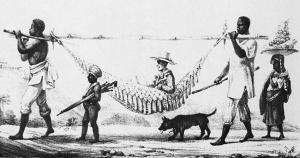
Slaves and Slaveowner – U.S. Public Domain

Previous Post

November 3, 2015
Are Good Works Necessary?
Next Post
November 5, 2015 Friday of Trinity 22 - 2 John
Browse Our Archives
Select a Category Book Reviews Featured Give Us This Day Give Us This Day Devotional love me love my wife Love My Wife Reformed Catholicism Blog Spirit-Reality Take This Cup Uncategorized
Select a Month February 2022 November 2021 October 2021 August 2021 January 2021 December 2020 November 2020 September 2020 August 2020 July 2020 June 2020 May 2020 September 2018 July 2018 March 2018 November 2017 October 2017 September 2017 August 2017 July 2017 June 2017 May 2017 April 2017 March 2017 February 2017 January 2017 December 2016 November 2016 October 2016 September 2016 August 2016 July 2016 June 2016 May 2016 April 2016 March 2016 February 2016 January 2016 December 2015 November 2015 October 2015 September 2015 August 2015 July 2015 June 2015 May 2015 April 2015 March 2015 February 2015 January 2015 December 2014 November 2014 October 2014 September 2014 August 2014 July 2014 June 2014 May 2014 April 2014 March 2014 February 2014 January 2014 December 2013 November 2013 October 2013 September 2013 August 2013 July 2013 June 2013 May 2013 April 2013 March 2013 February 2013 January 2013 December 2012 November 2012 October 2012 September 2012 August 2012 July 2012 June 2012 May 2012 April 2012 March 2012 February 2012 January 2012 December 2011 November 2011 October 2011 September 2011 August 2011 July 2011 May 2011 April 2011 March 2011 February 2011 January 2011
Follow Us!
TAKE THE
Religious Wisdom Quiz
Who was Saul's son?
Select your answer to see how you score.
Absalom Samuel David Jonathan
Related posts from Give Us This Day

Is Christianity a Relationship and Not a Religion?

The Different States of Love - and the...

Are You Really the Disciple Jesus Loved?
John 13:1-17 - The New Commandment
TRENDING AT PATHEOS Evangelical

The REST of Your Life: A Creative Wrestles...
This week I had a conversation with a good friend from church....

How the author of the world's best hymn...
I've been working with John Newton for a while now. This makes...

Long before this Lectio Divina, Psalm 130 - the song - started...

What About the Trees? Another Living Parable
After I finished writing the last article about falling leaves as a...

Why Classical Education Is a Conversation, Not a...
Come and Read: Joy in Classical Education When I was a little...

Cornell University has received a great deal of negative publicity and intense...
view all Evangelical blogs
Ad-Free & Subscriber Log-In Subscription Support
- About Us
- 2026 Calendar
- Videos
- Podcasts
- Library of World Religions
- Faith In Media Tracker
- Advertise With Us
- Write for Us
- Privacy Policy
- Terms of Service
- Do Not Sell My Data
- Contact Us
- Radiant Digital
- Manage Newsletter Subscriptions
- Unsubscribe From Notifications
- Sitemap
Copyright 2008-2026, Patheos. All rights reserved.
Subscription Support Ad-Free & Subscriber Log-In
Follow Patheos