
BuddhistCatholicContemplativeEvangelicalGeneral ChristianHinduJewishLatter-day SaintMuslimNew VisionsProgressive Christian
Beliefs
- Buddhist
- Catholic
- Contemplative
- Evangelical
- General Christian
- Hindu
- Jewish
- Latter-day Saint
- More Voices
- Muslim
- New Visions
- Pagan
- Progressive Christian
Topics
- Religion News
- Food and Religion
- Sports and Religion
- Religious Art
- Religious Music and Entertainment
- Religious Events
- History and Religion
- Style and Religion
- Politics and Religion
- Women in Religion
- Recreation Outdoors and Religion
- Business Finance and Religion
- Careers Workplace and Religion
- Education and Religion
- Family Parenting and Religion
- Health Fitness and Religion
- Home and Religion
- Relationships and Religion
- Technology and Religion
- Travel and Religion
Columnists
- Buddhist Columnists
- Business Finance and Religion Columnists
- Careers Workplace and Religion Columnists
- Catholic Columnists
- Contemplative Columnists
- Education and Religion Columnists
- Evangelists Columnists
- Family Parenting and Religion Columnists
- General Christian Columnists
- Health Fitness and Religion Columnists
- Hindu Columnists
- History and Religion Columnists
- Home and Religion Columnists
- Jewish Columnists
- More Voices Columnists
- Latter Day Columnists
- Muslim Columnists
- New Visions Columnists
- Nonreligious Columnists
- Pagan Columnists
- Politics and Religion Columnists
- Progressive Columnists
- Recreation Outdoors and Religion Columnists
- Relationships and Religion Columnists
- Religion News Columnists
- Religious Art Columnists
- Religious Events Columnists
- Religious Music and Entertainment Columnists
- Sports and Religion Columnists
- Style and Religion Columnists
- Technology and Religion Columnists
- Travel and Religion Columnists
- Women in Religion Columnists
Resource Library
- 2026 Calendar
- Library of World Religions
- The 100 Most Holy Places on Earth
- Patheos Answers
- Podcasts
- Videos
- Faith Leaders Database
- Anglican Episcopalian
- Bahai
- Baptist
- Buddhism
- Christianity
- Confucianism
- Eastern Orthodoxy
- Hinduism
- Holiness and Pentecostal
- ISKCON
- Islam
- Judaism
- Lutheran
- Methodist
- The Church of Jesus Christ of Latter-day Saints
- New Age
- Paganism
- Presbytarian and Reformed
- Protestantism
- Religion Behind the Scenes
- Roman Catholic
- Scientology
- Shia Islam
- Sikhism
- Sufism
- Sunni Islam
- Taoism
- Zen
- See all religions
Research Tools
 Ad-Free & Subscriber Log-In Subscription Support
Ad-Free & Subscriber Log-In Subscription Support
Follow Patheos 

- Trending:
- Forgiveness
- |
- Marriage
- |
- Consciousness
- |
- Death Penalty
- |
- Election
- |
- Halloween
 Give Us This Day
- Home
- Evangelical
- Thursday of 5th Sunday after Trinity – Acts 19:8-20
Thursday of 5th Sunday after Trinity – Acts 19:8-20
Last updated on: July 23, 2014 at 11:41 pm by Fr. Charles Erlandson
Thursday of 5th Sunday after Trinity – Acts 19:8-20 2014-07-23T23:41:32-05:00 Fr. Charles Erlandson
Patheos Explore the world's faith through different perspectives on religion and spirituality! Patheos has the views of the prevalent religions and spiritualities of the world.
 Acts 19:8-20
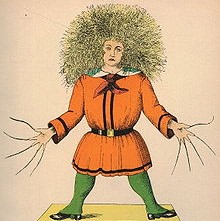
The Story of Little Suck-a-Thumb
One day, Mamma said, “Conrad dear,
I must go out and leave you here.
But mind now, Conrad, what I say,
Don’t suck your thumb while I’m away.
The great tall tailor always comes
To little boys that suck their thumbs.
And ere they dream what he’s about
He takes his great sharp scissors
And cuts their thumbs clean off, – and then
You know, they never grow again.”
Mamma had scarcely turn’d her back,
The thumb was in, alack! alack!
The door flew open, in he ran,
The great, long, red-legged scissorman.
Oh! children, see! the tailor’s come
And caught our little Suck-a-Thumb.
Snip! Snap! Snip! the scissors go;
And Conrad cries out – Oh! Oh! Oh!
Snip! Snap! Snip! They go so fast;
That both his thumbs are off at last.
Mamma comes home; there Conrad stands,
And looks quite sad, and shows his hands;-
“Ah!” said Mamma “I knew he’d come
To naughty little Suck-a-Thumb.”
So goes the Story of Little Suck-A-Thumb, a story taken from the 19th century German classic Struwwelpeter. (To see the original artwork that accompanies this story go to http://www.fln.vcu.edu/struwwel/daumen_e.html).
Why do I re-tell such a story (aside from whatever twisted entertainment value it might offer)? It’s a cautionary fairy tale, much like the one in today’s lesson.
What? You didn’t hear it? It’s only my favorite cautionary fairy tale in the entire New Testament, even if it is a fairy tale that literally happened. Surely you remember the Story of the Sons of Sceva? This story always makes me laugh. I suppose the moral of the story could have been “Don’t Try This At Home Kids” (or DTTAHK as I sometimes say to my kids when at home). There’s something hilarious about the sons of Sceva presuming to use the name of Christ, being overpowered by the possessed man, and leaving the premises naked and wounded.
Once I get over my fit of laughter, I relax and the seriousness of the story settles in. There really is an utterly serious lesson in the sons of Sceva, and it is this: Thou shalt not take the name of the Lord thy God in vain. The sin of the sons of Sceva was, in essence, was to take the name of the Lord in vain.
Sometimes we like to tame God and His Commandments so that they are more manageable. One of our favorites is to reduce the 3rd Commandment to simply not using words like “Hell” or “damn” or “God” unless we really mean them. I think this is one legitimate application, but it is only superficial. I can’t stand it when people on Trading Spaces or some other show invariably see what people have done to their homes and say the obligatory, “Oh – my – God!” I’ve heard way too many Christians thoughtlessly say this.
But that’s the least of our worries, and it’s only a symptom of a much larger problem. Why would a good Christian ever say “Oh – my- God!” in such a way that he didn’t mean it? Apparently the word “God” has become so distant and objectified to them that no thought of God Himself is in the head when the offensive phrase is uttered.
But there’s much more to the 3rd Commandment than just avoiding such trivializing uses of God’s name. We should think of our entire lives in terms of God’s Name, for our identity is wrapped up in the Name of God. Why do we call ourselves Christians? Because we claim to be followers of Jesus Christ. We make some extraordinary (and true) claims about Jesus Christ.
But what is the world to think of Jesus Christ when in His Name Christians refuse to follow Him or acknowledge Him in all their ways? It’s not just non-Christians but especially Christians who must examine their use of the Name of the Lord. To me, the worst violation of the prohibition of taking the Lord’s name in vain occurs when someone claims to be a Christian and then leads a life that is shameful to Jesus Christ.
Few Christians blaspheme God directly with their words, but all too many do by their thoughts and lives. It’s not enough to claim to be a Christian and to take on the Name of God: we must live by that Name which is above every other name. Many claim the name of Christ, but many practically and in their hearts act as if He doesn’t exist or is insignificant. And some dishonor that Name by putting the names of other gods ahead of Him, gods whose names may be familiar sports or the names of Presidents on green pieces of paper or the names of things parked in the garage or dock or closets.
In Acts 19 today, we find some examples of positive ways to keep the 3rd Commandment. Although it’s never mentioned by name in Acts 19, I think that it is above all else a life of prayer that will save us from taking the Lord’s Name in vain.
Some of you may be familiar with the acronym ACTS to help us remember 4 of the chief aspects of prayer:
A- Adoration
C – Confession
T – Thanksgiving
S – Supplication
We find people honoring the name of God by adoring Him in verse 17 when both the Jews and Greeks in Ephesus heard what Paul did in the Name of Christ (“And the name of the Lord Jesus was magnified”) and saw what happened to the sons of Sceva when they dishonored His Name. We can be sure, as well, that Paul himself magnified the Name of Jesus and did his miracles only in and through the Name of Jesus.
In verse 18, we find that in response to Paul’s use of Christ’s Name vs. the sons of Sceva, that many who had believed came and confessed their deeds. Every time you confess your sins you are admitting that you are a sinner and acknowledging that God is almighty, holy, just, and merciful. The daily act of confession allows for the gospel story, the story of redemption, to be told once again and for God’s name to be glorified once again. Every time you go on as if there is no problem, you dishonor God and His Name.
Although we don’t see thanksgiving in this passage, it is another primary aspect of prayer by which we honor God’s name. Every time you give thanks for something, you are saying that you didn’t get it all for yourself and that you don’t really deserve it. By giving thanks, you honor God by acknowledging Him, and not you, to be the giver of every good and perfect gift. Every time you grumble or complain, or focus on what you don’t have, or every time you take God’s gifts as if you’ve earned them or they are naturally yours, you dishonor God and His Name.
In verses 11 and 12 we read of those faith is so great that even the handkerchiefs or aprons brought from Paul’s body to the body of a sick one would heal them. This kind of extreme supplication, in which the sick person and loved ones cried out to God in their need, is also a way of honoring God and His Name. But every time we think we can do it on our own or believe that things just happen by themselves, we don’t honor God.
So learn today from Paul to honor the name of the Lord, and learn from the sons of Sceva not to take His name in vain. For His is the Name above every name, and His is the Name that God has placed on you!
Prayer: Our Father, who art in heaven, hallowed be thy Name. Thy kingdom come. Thy will be done, on earth as it is in heaven. Give us this day our daily bread. And forgive us our trespasses, as we forgive those who trespass against us. And lead us not into temptation, but deliver us from evil. For thine is the kingdom, and the power, and the glory, for ever and ever. Amen.
Point for Meditation: In what ways have I not been honoring God’s Name? In what ways is He calling me to honor His Name more?
Resolution: I resolve to find one way to specifically and intentionally honor God’s Name today.
© 2014 Fr. Charles Erlandson
Give Us This Day daily devotional
taking the Lord’s name in vain
Previous Post

July 22, 2014
Wednesday of 5th Sunday after Trinity - Acts 18:24-19:7
Next Post
July 24, 2014 Friday of 5th Sunday after Trinity - Acts 19:21-41
Browse Our Archives
Select a Category Book Reviews Featured Give Us This Day Give Us This Day Devotional love me love my wife Love My Wife Reformed Catholicism Blog Spirit-Reality Take This Cup Uncategorized
Select a Month February 2022 November 2021 October 2021 August 2021 January 2021 December 2020 November 2020 September 2020 August 2020 July 2020 June 2020 May 2020 September 2018 July 2018 March 2018 November 2017 October 2017 September 2017 August 2017 July 2017 June 2017 May 2017 April 2017 March 2017 February 2017 January 2017 December 2016 November 2016 October 2016 September 2016 August 2016 July 2016 June 2016 May 2016 April 2016 March 2016 February 2016 January 2016 December 2015 November 2015 October 2015 September 2015 August 2015 July 2015 June 2015 May 2015 April 2015 March 2015 February 2015 January 2015 December 2014 November 2014 October 2014 September 2014 August 2014 July 2014 June 2014 May 2014 April 2014 March 2014 February 2014 January 2014 December 2013 November 2013 October 2013 September 2013 August 2013 July 2013 June 2013 May 2013 April 2013 March 2013 February 2013 January 2013 December 2012 November 2012 October 2012 September 2012 August 2012 July 2012 June 2012 May 2012 April 2012 March 2012 February 2012 January 2012 December 2011 November 2011 October 2011 September 2011 August 2011 July 2011 May 2011 April 2011 March 2011 February 2011 January 2011
Follow Us!
TAKE THE
Religious Wisdom Quiz
Who stopped David from taking revenge on Nabal?
Select your answer to see how you score.
Ahinoam Michal Jonathan Abigail
Related posts from Give Us This Day

James Clark - Book Review of Take This...

Revelation 8 - Heavenly Worship and Prayer

The Day I Prayed for the G.I. Joe...

The Different States of Love - and the...
TRENDING AT PATHEOS Evangelical

The REST of Your Life: A Creative Wrestles...
This week I had a conversation with a good friend from church....

How the author of the world's best hymn...
I've been working with John Newton for a while now. This makes...

Long before this Lectio Divina, Psalm 130 - the song - started...

What About the Trees? Another Living Parable
After I finished writing the last article about falling leaves as a...

Why Classical Education Is a Conversation, Not a...
Come and Read: Joy in Classical Education When I was a little...

Cornell University has received a great deal of negative publicity and intense...
view all Evangelical blogs
Ad-Free & Subscriber Log-In Subscription Support
- About Us
- 2026 Calendar
- Videos
- Podcasts
- Library of World Religions
- Faith In Media Tracker
- Advertise With Us
- Write for Us
- Privacy Policy
- Terms of Service
- Do Not Sell My Data
- Contact Us
- Radiant Digital
- Manage Newsletter Subscriptions
- Unsubscribe From Notifications
- Sitemap
Copyright 2008-2026, Patheos. All rights reserved.
Subscription Support Ad-Free & Subscriber Log-In
Follow Patheos