
BuddhistCatholicContemplativeEvangelicalGeneral ChristianHinduJewishLatter-day SaintMuslimNew VisionsProgressive Christian
Beliefs
- Buddhist
- Catholic
- Contemplative
- Evangelical
- General Christian
- Hindu
- Jewish
- Latter-day Saint
- More Voices
- Muslim
- New Visions
- Pagan
- Progressive Christian
Topics
- Religion News
- Food and Religion
- Sports and Religion
- Religious Art
- Religious Music and Entertainment
- Religious Events
- History and Religion
- Style and Religion
- Politics and Religion
- Women in Religion
- Recreation Outdoors and Religion
- Business Finance and Religion
- Careers Workplace and Religion
- Education and Religion
- Family Parenting and Religion
- Health Fitness and Religion
- Home and Religion
- Relationships and Religion
- Technology and Religion
- Travel and Religion
Columnists
- Buddhist Columnists
- Business Finance and Religion Columnists
- Careers Workplace and Religion Columnists
- Catholic Columnists
- Contemplative Columnists
- Education and Religion Columnists
- Evangelists Columnists
- Family Parenting and Religion Columnists
- General Christian Columnists
- Health Fitness and Religion Columnists
- Hindu Columnists
- History and Religion Columnists
- Home and Religion Columnists
- Jewish Columnists
- More Voices Columnists
- Latter Day Columnists
- Muslim Columnists
- New Visions Columnists
- Nonreligious Columnists
- Pagan Columnists
- Politics and Religion Columnists
- Progressive Columnists
- Recreation Outdoors and Religion Columnists
- Relationships and Religion Columnists
- Religion News Columnists
- Religious Art Columnists
- Religious Events Columnists
- Religious Music and Entertainment Columnists
- Sports and Religion Columnists
- Style and Religion Columnists
- Technology and Religion Columnists
- Travel and Religion Columnists
- Women in Religion Columnists
Resource Library
- 2026 Calendar
- Library of World Religions
- The 100 Most Holy Places on Earth
- Patheos Answers
- Podcasts
- Videos
- Faith Leaders Database
- Anglican Episcopalian
- Bahai
- Baptist
- Buddhism
- Christianity
- Confucianism
- Eastern Orthodoxy
- Hinduism
- Holiness and Pentecostal
- ISKCON
- Islam
- Judaism
- Lutheran
- Methodist
- The Church of Jesus Christ of Latter-day Saints
- New Age
- Paganism
- Presbytarian and Reformed
- Protestantism
- Religion Behind the Scenes
- Roman Catholic
- Scientology
- Shia Islam
- Sikhism
- Sufism
- Sunni Islam
- Taoism
- Zen
- See all religions
Research Tools
 Ad-Free & Subscriber Log-In Subscription Support
Ad-Free & Subscriber Log-In Subscription Support
Follow Patheos 

- Trending:
- Forgiveness
- |
- Marriage
- |
- Consciousness
- |
- Death Penalty
- |
- Election
- |
- Halloween
 Give Us This Day
- Home
- Evangelical
- The Structural Definition of Anglicanism
The Structural Definition of Anglicanism
Last updated on: November 16, 2011 at 8:32 pm by Fr. Charles Erlandson
The Structural Definition of Anglicanism 2011-11-16T20:32:03-05:00 Fr. Charles Erlandson
Patheos Explore the world's faith through different perspectives on religion and spirituality! Patheos has the views of the prevalent religions and spiritualities of the world.
 The Structural Definition of Anglicanism

I began my last blog with the idea that in order to define adequately religious identities, it’s best to use complex and even multiple definitions. Last time I offered a normative definition of Anglicanism, a kind of definition which is especially helpful in defining religious identities more specifically. However, normative definitions of Anglicanism don’t quite capture all that it means to be Anglican.
A second kind of definition of Anglicanism is what I am calling the “structural” (or “institutional”) definition of Anglicanism. Structural or institutional definitions focus on official relationships between churches that claim a shared identity. It turns out that it is not only norms that have held Anglicanism together over the centuries but also structures or institutions. In fact, historically it has been the authority of Anglican structures and institutions (especially the Church of England in the context of the English state) that have decreed or legislated the specifically Anglican norms of the Prayer Book and Articles.
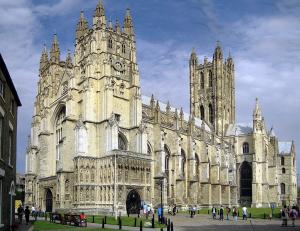
Structural definitions of Anglicanism presently center on equating Anglicanism with the Anglican Communion and thus provide the clearest definitions of Anglicanism, because it’s relatively easy to say who is or is not a part of the Anglican Communion. The Anglican Communion may be defined as the group of churches that are in formal communion with the See of Canterbury and is thus defined primarily in institutional or structural terms, with little definition of theology or practice. The structural unity of the Anglican Communion is maintained not only by the See of Canterbury but also by the other Instruments of Unity: the Lambeth Conferences, the Anglican Consultative Council, and the Primates’ Meeting. This structural definition appears to be (not surprisingly) the basis for Lambeth Conference discussions and resolutions, as well as discussions arising out of the Anglican-Roman Catholic International Commission (ARCIC), which focus on the Anglican Communion as the locus of Anglicanism in the world today.
While the structural definition of Anglicanism has the virtues of simplicity and brevity and is one that is, perhaps, most commonly employed today, it does have important limitations. If, for example, “Anglican Communion” and “Anglicanism” are coterminous, would this mean that churches not formally in communion with Canterbury but that appear for all intents and purposes to be Anglican (for example, the Reformed Episcopal Church or Anglican Province in America) should be considered less Anglican than churches in the Anglican Communion whose norms and practices are less clearly those of the Church of England (for example, the Church of South India)?
Even more critical to any definition of Anglicanism that hopes to survive the early part of the twenty-first century is the problem of how to define churches on either side of a fracture in Anglicanism between more orthodox and more liberal versions of Anglicanism. This fracturing seems destined to split the Anglican Communion itself, even if the fracture is more of a de facto than a de jure one. Should the Church of Nigeria, for example, decide to declare itself at some point out of communion with a liberal Canterbury, would that mean that it ceased to be Anglican? Furthermore, what if Canterbury or any of the churches in communion with it should surrender vital aspects of what has traditionally been defined as Anglican? Would such a church continue to be Anglican merely on the basis of being in formal communion with Canterbury?
The equation of Anglicanism with the Anglican Communion is a fairly recent phenomenon and not the only possible structural definition of Anglicanism. Did Anglicanism not exist prior to the first Lambeth Conference in 1867, and did the mere creation of that Conference create Anglicanism by fiat? Such questions suggest that it is not sufficient to simply identify Anglicanism with the Anglican Communion and that other kinds of definitions of Anglicanism are necessary to fully describe it.
Regardless of the merits of the Anglican Communion as the definition of Anglicanism, it remains true that structural definitions of Anglicanism have always been important. Historically, of course, Anglicanism could be equated with the Church of England, before the American and Scottish churches were created in the eighteenth centuries. The various structures of the Church of England have been immensely important in defining Anglicanism and holding it together. These structures include the authority of the Archbishop of Canterbury, the diocesan structure of the Church of England, and Convocation (a meeting of representative national church leaders).
Due to the ancient idea of Christendom and the theory of two powers, in which the church and state were taken to be two parts of the same entity, the relationship between the church and state in the Church of England has historically been very close. This means that in order to understand Anglicanism history and identity, the role of the English state in governing the English church (though by no means always direct) must be kept in mind.
This relationship is most famously the case when seen in terms of the power Henry VIII exerted over the Church of England. But Anglicanism in its post-Reformational identity cannot be understood apart from the authority exerted by Edward VI (under whose reign both The Book of Common Prayer and the Thirty-nine Articles were composed) and Elizabeth (who consolidated Anglican identity in a way that is often underestimated).
While the structural or institutional identity of Anglicanism was, thus, originally closely related to the interaction of the English church and state, other structural forces and identities have supplemented and superseded this identity. The structural identity of Anglicanism may be most closely related today to the Anglican Communion; however, the rise of the Global South and the realignment (which is both a normative and structural realignment) of orthodox Anglicanism makes it clear that new structures, such as GAFCON are emerging. These may not only supplement but perhaps one day supersede the Anglican Communion as the primary structural identity for orthodox Anglicans.
Most difficult of all to comprehend, and yet most likely to occur, is the situation in which competing structural identities exist side by side. A kind of networked identity may become the norm, in which a hodgepodge of various structural relationships will exist between the different Anglican churches. This is both liberating for churches that have often been marginalized by the dominance of the Church of England and The Episcopal Church but also confusing. The ACNA, for example, will have to sort the question of its structural identity: how will the various churches represented relate to one another? Will their be a truly common identity, or will ACNA be a coalition of related churches?
Issues of structural identity also relate to ecclesiology, the place of bishops, the role of councils, and many other issues which I don’t have time to address in this essay. But structural identity must be reckoned with, and it can’t, ultimately, be separated from normative identity.
The structural definition of Anglicanism, while in itself insufficient, is a necessary and important part of any definition of Anglicanism. Next time, I’ll look at what I call “stylistic” definitions of Anglicanism, or definitions related to a particularly Anglican ethos.
Previous Post

November 16, 2011
Thursday of the 21st Sunday after Trinity - 2 Timothy 3
Next Post
November 17, 2011 Friday of the 21st Sunday after Trinity - 2 Timothy 4:1-8
Browse Our Archives
Select a Category Book Reviews Featured Give Us This Day Give Us This Day Devotional love me love my wife Love My Wife Reformed Catholicism Blog Spirit-Reality Take This Cup Uncategorized
Select a Month February 2022 November 2021 October 2021 August 2021 January 2021 December 2020 November 2020 September 2020 August 2020 July 2020 June 2020 May 2020 September 2018 July 2018 March 2018 November 2017 October 2017 September 2017 August 2017 July 2017 June 2017 May 2017 April 2017 March 2017 February 2017 January 2017 December 2016 November 2016 October 2016 September 2016 August 2016 July 2016 June 2016 May 2016 April 2016 March 2016 February 2016 January 2016 December 2015 November 2015 October 2015 September 2015 August 2015 July 2015 June 2015 May 2015 April 2015 March 2015 February 2015 January 2015 December 2014 November 2014 October 2014 September 2014 August 2014 July 2014 June 2014 May 2014 April 2014 March 2014 February 2014 January 2014 December 2013 November 2013 October 2013 September 2013 August 2013 July 2013 June 2013 May 2013 April 2013 March 2013 February 2013 January 2013 December 2012 November 2012 October 2012 September 2012 August 2012 July 2012 June 2012 May 2012 April 2012 March 2012 February 2012 January 2012 December 2011 November 2011 October 2011 September 2011 August 2011 July 2011 May 2011 April 2011 March 2011 February 2011 January 2011
Follow Us!
TAKE THE
Religious Wisdom Quiz
In Hebrews, what did Moses consider more valuable than the treasures of Egypt?
Select your answer to see how you score.
Eternal life God's covenant The promised land Disgrace for the sake of Christ
Related posts from Give Us This Day

James Clark - Book Review of Take This...
Tracts for the Times 2.0 Tract #2 Part...
Tract #2 Part 1 – When Did Anglicanism...
Tract #1 – What is Anglicanism?
TRENDING AT PATHEOS Evangelical

How the author of the world's best hymn...
I've been working with John Newton for a while now. This makes...

Long before this Lectio Divina, Psalm 130 - the song - started...

What About the Trees? Another Living Parable
After I finished writing the last article about falling leaves as a...

Why Classical Education Is a Conversation, Not a...
Come and Read: Joy in Classical Education When I was a little...

Falling Leaves: A Living Parable on Letting Go
I’ve spent the vast majority of my life in the southeast corner...

Cornell University has received a great deal of negative publicity and intense...
view all Evangelical blogs
Ad-Free & Subscriber Log-In Subscription Support
- About Us
- 2026 Calendar
- Videos
- Podcasts
- Library of World Religions
- Faith In Media Tracker
- Advertise With Us
- Write for Us
- Privacy Policy
- Terms of Service
- Do Not Sell My Data
- Contact Us
- Radiant Digital
- Manage Newsletter Subscriptions
- Unsubscribe From Notifications
- Sitemap
Copyright 2008-2026, Patheos. All rights reserved.
Subscription Support Ad-Free & Subscriber Log-In
Follow Patheos