
BuddhistCatholicContemplativeEvangelicalGeneral ChristianHinduJewishLatter-day SaintMuslimNew VisionsProgressive Christian
Beliefs
- Buddhist
- Catholic
- Contemplative
- Evangelical
- General Christian
- Hindu
- Jewish
- Latter-day Saint
- More Voices
- Muslim
- New Visions
- Pagan
- Progressive Christian
Topics
- Religion News
- Food and Religion
- Sports and Religion
- Religious Art
- Religious Music and Entertainment
- Religious Events
- History and Religion
- Style and Religion
- Politics and Religion
- Women in Religion
- Recreation Outdoors and Religion
- Business Finance and Religion
- Careers Workplace and Religion
- Education and Religion
- Family Parenting and Religion
- Health Fitness and Religion
- Home and Religion
- Relationships and Religion
- Technology and Religion
- Travel and Religion
Columnists
- Buddhist Columnists
- Business Finance and Religion Columnists
- Careers Workplace and Religion Columnists
- Catholic Columnists
- Contemplative Columnists
- Education and Religion Columnists
- Evangelists Columnists
- Family Parenting and Religion Columnists
- General Christian Columnists
- Health Fitness and Religion Columnists
- Hindu Columnists
- History and Religion Columnists
- Home and Religion Columnists
- Jewish Columnists
- More Voices Columnists
- Latter Day Columnists
- Muslim Columnists
- New Visions Columnists
- Nonreligious Columnists
- Pagan Columnists
- Politics and Religion Columnists
- Progressive Columnists
- Recreation Outdoors and Religion Columnists
- Relationships and Religion Columnists
- Religion News Columnists
- Religious Art Columnists
- Religious Events Columnists
- Religious Music and Entertainment Columnists
- Sports and Religion Columnists
- Style and Religion Columnists
- Technology and Religion Columnists
- Travel and Religion Columnists
- Women in Religion Columnists
Resource Library
- 2026 Calendar
- Library of World Religions
- The 100 Most Holy Places on Earth
- Patheos Answers
- Podcasts
- Videos
- Faith Leaders Database
- Anglican Episcopalian
- Bahai
- Baptist
- Buddhism
- Christianity
- Confucianism
- Eastern Orthodoxy
- Hinduism
- Holiness and Pentecostal
- ISKCON
- Islam
- Judaism
- Lutheran
- Methodist
- The Church of Jesus Christ of Latter-day Saints
- New Age
- Paganism
- Presbytarian and Reformed
- Protestantism
- Religion Behind the Scenes
- Roman Catholic
- Scientology
- Shia Islam
- Sikhism
- Sufism
- Sunni Islam
- Taoism
- Zen
- See all religions
Research Tools
 Ad-Free & Subscriber Log-In Subscription Support
Ad-Free & Subscriber Log-In Subscription Support
Follow Patheos 

- Trending:
- Forgiveness
- |
- Marriage
- |
- Consciousness
- |
- Death Penalty
- |
- Election
- |
- Halloween
 Give Us This Day
- Home
- Evangelical
- The Forgotten Man of Christmas – Matthew 1:18-25
The Forgotten Man of Christmas – Matthew 1:18-25
Last updated on: September 1, 2016 at 12:13 am by Fr. Charles Erlandson
The Forgotten Man of Christmas – Matthew 1:18-25 2016-09-01T00:13:21-05:00 Fr. Charles Erlandson
Patheos Explore the world's faith through different perspectives on religion and spirituality! Patheos has the views of the prevalent religions and spiritualities of the world.
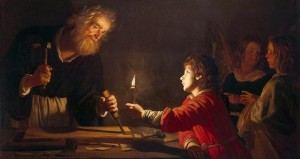 Emmanuel – “God with us.” That is the great theme of Christmas.
When God became man, even His infant presence brought blessing to all who beheld Him. We think of faithful Anna, ministering at the temple, and of Simeon. John the Baptist kicked in the womb when he felt the presence of Mary and of the blessed Jesus still inside her. And, of course, Mary was the most highly favored one of all.
The characters and plots of the Christmas story are familiar to all of us. But there is one person who is often neglected in the Christmas story, someone who has much to teach us. He is the focus of much of the first two chapters of the Gospel of Matthew. He is who I call “The Forgotten Man of Christmas,” and his name is Joseph.
Where is Joseph in the whirlwind of activity of the birth of the Savior of the world?
As I meditated on the life of Joseph, I took an informal survey of the portrayal of the Christmas story in art through the centuries. I looked at approximately 100 paintings depicting scenes such as the birth in the stable, the visits of the shepherds and the magi, and the flight into Egypt. I was amused at what I found. In some paintings I found just what I expected: a Joseph in the thick of things, looking adoringly at his son who was also the Son of God. But in a large percentage of the paintings I found Joseph portrayed in the following ways:
Absent; to the side; way in the back; way in the back to the side; way in the back beating chestnuts (in one painting); with his back to us; with his back to us carrying a saw; and asleep (sometimes with his head in his hands). The consensus opinion of tradition seemed to portray Joseph as “bewildered and inadequate,” “tired and burdened.”
But when I read the Gospel according to St. Matthew, that isn’t the portrait I see. Instead, I marvel at how much attention Matthew gives to this Joseph. I find a Joseph who is a godly father and a Joseph who is an example to us of faith, as well as an example of God’s grace in our lives.
If you try to imagine Christmas without Joseph, if you imagine for a moment the Holy Family, there is a gaping hole without the silent but strong presence of Joseph. Without a Joseph, Jesus would grow up the son of an unwed mother. It would be hard to imagine the Jews seriously considering His claims had he grown up in such a fashion. It’s probable that Joseph already had to contend with jeers and sneers on account of the fact that Mary was pregnant before she married him. But in time these would have been forgotten because the fact was that Jesus did have a human father.
Joseph was a true father to Jesus. And I think I’ve got a lot of pressure on me as a father! Can you imagine what a burden it would have been to have to raise a son who was the Son of God? When do you assert your fatherly prerogatives, and when do you hold back for fear that you might be in the wrong? What do you do when your little son begins correcting you?
And how must Joseph have worried at times, knowing he was the human protector of and provider for God’s Son on earth! In spite of the angelic words of comfort, wouldn’t he have been a little afraid when he heard Herod wanted to kill this special son of his, whom he was to protect?
But Joseph was truly the father of Jesus.
Joseph was there to give Jesus advice as He grew in grace and stature. He was there to teach Jesus about God from the time He was born. Children form a great deal of their conception of God from their fathers. Even the mere presence of Joseph, who is all too often absent in art, would have been important to Jesus. And Jesus had to grow in His knowledge of God just like the rest of us. It must have been the wisdom, righteousness, and faithfulness of Jesus’ earthly father that provided him with much of his ever-growing knowledge of His heavenly Father.
Joseph gave Jesus his trade. In time, the Son of God became a carpenter, just like his earthly father. Joseph must have spent many hours with his son Jesus teaching him the tools and techniques of his trade. And although Jesus was without sin, that doesn’t mean that he could drive a nail straight the first time he held a hammer or that he never hit Joseph’s thumb when learning to hammer. After all, Jesus would still have been a little human boy holding sharp objects in his hands!
Joseph also gave Jesus his name and lineage and inheritance. He was willing to give Jesus his good name even though Jesus would not be his natural son. He unhesitatingly adopted Jesus as his own son and treated him just as a natural born son, in fact giving him the place as his firstborn, with all of the attendant rights and privileges. Joseph had to agree to make Jesus a part of his family and to give his name to one who was not of his flesh and blood.
We know that Mary pondered or treasured all of the events surrounding Jesus in her heart. But what must have Joseph felt, knowing that it was his name that was to be given to Jesus: Jesus, the carpenter’s son, or Jesus bar Joseph of Nazareth? And, in fact, it was Joseph who was given the privilege of naming the child, in obedience to the angel’s word. Unlike his relative Zacharias, Joseph believed and obeyed, and Joseph called his son’s name Jesus, “He saves.”
Joseph was also a righteous man of God whose example of faith we would do well to follow, for wherever we find Joseph in the Gospels we find him doing what is right.
Even before Joseph hears the good news of his son, Matthew makes a point of telling us that Joseph was a just man. Though his betrothed, his wife-to-be Mary, had apparently gotten herself pregnant out of wedlock by a man other than Joseph, we see no signs of jealousy or hatred or spite or revenge on the part of Joseph. Instead, we find in Matthew 1:19 that he, “being a just man, and not willing to make her a public example, was minded to put her away secretly.” Even though he had apparently been wronged, he would not do wrong back. He had no desire to “teach Mary a lesson” or to publicly humiliate her.
Next, we find Joseph being visited by the angel for the first time. The angel tells Joseph to not be afraid to take Mary as his wife, for that which is conceived in her is of the Holy Ghost. Now I’m sure Joseph had many questions about what the angel said. There was so much he must not have understood, for who could comprehend such marvelous and mysterious words?! But we see no sign of hesitation in Joseph, only a simple comment in verse 24: “Then Joseph, being raised from sleep, did as the angel of the Lord had bidden him. . . .”
How different from the response of Abraham and Sarah, or of Zacharias when he was told the news of John the Baptist, also by an angel! They laughed or questioned: Joseph quietly believed and obeyed.
Joseph responded just as faithfully when the angel told him to flee to Egypt from Herod’s slaughter of the innocents. When it was time to return back to Israel, we find that Joseph was afraid to go back, for the son of Herod was now ruling. Amazingly, we read in Matthew 2:22, “But when he heard that Archelaus did reign in the room of his father Herod, he was afraid to go there. Notwithstanding, being warned of God in a dream, he turned aside into the parts of Galilee.”
Isn’t Joseph, in this passage, the very essence of faith? Isn’t faith obeying the Word of God, regardless of what personal consequences are which that obedience may bring? In this forgotten man of Christmas, we find the kind of faith we all wish we had.
There is one final reason we should remember Joseph, and that is because he is a symbol of the grace which we all receive from Jesus Christ.
“Hail, Mary full of grace!!” the angel sang. But he could just have easily sung “Hail, Joseph, full of grace!” It’s true that Mary carried the Son of God in her womb, but Jesus was no less a son of Joseph, whose name and inheritance, and blessing and trade he took.
Joseph, of all the men who ever lived, was chosen to be the father of our Lord Jesus Christ. As we have already seen, this was no easy task, and perhaps the old masters were right in painting Joseph as burdened and tired, bewildered and inadequate. But he was faithful in all that God had given him to do while here on earth. The fact that he obeyed, even while burdened and tired and bewildered and inadequate, is even more wonderful.
If Mary, the recipient of an angelic visit, was full of grace, then Joseph, the recipient of three angelic visits, was certainly also full of grace. God’s unmerited favor, His grace, came down upon Joseph.
We have already seen that Jesus was adopted into the family of Joseph and given his name. But in a more important sense Joseph was adopted into the family of Jesus: the family of God. Joseph, being a just man who feared God, had to be brought to a knowledge of Jesus, his son, as Jesus the Son of God.
This, above all other things in the life of Joseph, demonstrated the grace of God.
In a way, many of us may feel like forgotten men, women, and children. Forgotten, neglected – even rejected. Maybe someone on your Christmas card list forgot to send you a card or maybe some of you kids didn’t get for Christmas all that you expected. Maybe for some of us the gifts we could afford weren’t quite as nice this year. Or perhaps more seriously for some reason we can’t seem to find it within ourselves to rejoice in this season of Christmas or at whatever time of the year it is that you are reading this. Maybe there are trials on the job or at home, within our own families.
At times, we all feel forgotten.
But Christmas (and every day is Christmas for the Christian!) is a time for all to remember, to remember that God is indeed with us. If you believe that Jesus, the son of Joseph, is the Lord who was born to die for our sins, then you will be adopted as a child of God. God has adopted us, and like Joseph He has made us all a part of His Holy Family – the Church.
There are no forgotten Christians at Christmas time, or at any other time, for God has remembered His people. God came to earth to be with us, and when He came, He came bearing gifts for all who love Him.
Prayer: Almighty God, who hast given us thy only-begotten Son to take our nature upon him, and as at this time to be born of a pure virgin; Grant that we being regenerate, and made thy children by adoption and grace, may daily be renewed by thy Holy Spirit; through the same our Lord Jesus Christ, who liveth and reigneth thee and the same Spirit ever, one God, world without end. (The Collect for Christmas, from The Book of Common Prayer)
Point for Meditation:
- How can I be more faithful in my calling, as Joseph was in his calling as a father?
- How can I demonstrate more faith, as Joseph did in accepting Mary and Jesus and protecting them in the face of fear?
- How can I accept more freely and joyfully the grace of Jesus Christ in my life today?
Resolution: I resolve to practice today seeing my lot and calling in life as being from the Lord and then treating them accordingly.
Image is public domain https://commons.wikimedia.org/wiki/File:Gerrit_van_Honthorst_-_Childhood_of_Christ_-_WGA11656.jpg

Previous Post

August 31, 2016
Thursday of Trinity 14 - Matthew 5:38-48
Next Post
September 1, 2016 Friday of Trinity 14 - Matthew 6:1-18
Browse Our Archives
Select a Category Book Reviews Featured Give Us This Day Give Us This Day Devotional love me love my wife Love My Wife Reformed Catholicism Blog Spirit-Reality Take This Cup Uncategorized
Select a Month February 2022 November 2021 October 2021 August 2021 January 2021 December 2020 November 2020 September 2020 August 2020 July 2020 June 2020 May 2020 September 2018 July 2018 March 2018 November 2017 October 2017 September 2017 August 2017 July 2017 June 2017 May 2017 April 2017 March 2017 February 2017 January 2017 December 2016 November 2016 October 2016 September 2016 August 2016 July 2016 June 2016 May 2016 April 2016 March 2016 February 2016 January 2016 December 2015 November 2015 October 2015 September 2015 August 2015 July 2015 June 2015 May 2015 April 2015 March 2015 February 2015 January 2015 December 2014 November 2014 October 2014 September 2014 August 2014 July 2014 June 2014 May 2014 April 2014 March 2014 February 2014 January 2014 December 2013 November 2013 October 2013 September 2013 August 2013 July 2013 June 2013 May 2013 April 2013 March 2013 February 2013 January 2013 December 2012 November 2012 October 2012 September 2012 August 2012 July 2012 June 2012 May 2012 April 2012 March 2012 February 2012 January 2012 December 2011 November 2011 October 2011 September 2011 August 2011 July 2011 May 2011 April 2011 March 2011 February 2011 January 2011
Follow Us!
TAKE THE
Religious Wisdom Quiz
How do you show your love for God?
Select your answer to see how you score.
All of these Looking Forward to Heaven Prayer Keeping His Commandments
Related posts from Give Us This Day

Revelation 8 - Heavenly Worship and Prayer
Luke 24:36-53 - St. Luke's Symphony
TRENDING AT PATHEOS Evangelical

The REST of Your Life: A Creative Wrestles...
This week I had a conversation with a good friend from church....

How the author of the world's best hymn...
I've been working with John Newton for a while now. This makes...

Long before this Lectio Divina, Psalm 130 - the song - started...

What About the Trees? Another Living Parable
After I finished writing the last article about falling leaves as a...

Why Classical Education Is a Conversation, Not a...
Come and Read: Joy in Classical Education When I was a little...

Cornell University has received a great deal of negative publicity and intense...
view all Evangelical blogs
Ad-Free & Subscriber Log-In Subscription Support
- About Us
- 2026 Calendar
- Videos
- Podcasts
- Library of World Religions
- Faith In Media Tracker
- Advertise With Us
- Write for Us
- Privacy Policy
- Terms of Service
- Do Not Sell My Data
- Contact Us
- Radiant Digital
- Manage Newsletter Subscriptions
- Unsubscribe From Notifications
- Sitemap
Copyright 2008-2026, Patheos. All rights reserved.
Subscription Support Ad-Free & Subscriber Log-In
Follow Patheos