
BuddhistCatholicContemplativeEvangelicalGeneral ChristianHinduJewishLatter-day SaintMuslimNew VisionsProgressive Christian
Beliefs
- Buddhist
- Catholic
- Contemplative
- Evangelical
- General Christian
- Hindu
- Jewish
- Latter-day Saint
- More Voices
- Muslim
- New Visions
- Pagan
- Progressive Christian
Topics
- Religion News
- Food and Religion
- Sports and Religion
- Religious Art
- Religious Music and Entertainment
- Religious Events
- History and Religion
- Style and Religion
- Politics and Religion
- Women in Religion
- Recreation Outdoors and Religion
- Business Finance and Religion
- Careers Workplace and Religion
- Education and Religion
- Family Parenting and Religion
- Health Fitness and Religion
- Home and Religion
- Relationships and Religion
- Technology and Religion
- Travel and Religion
Columnists
- Buddhist Columnists
- Business Finance and Religion Columnists
- Careers Workplace and Religion Columnists
- Catholic Columnists
- Contemplative Columnists
- Education and Religion Columnists
- Evangelists Columnists
- Family Parenting and Religion Columnists
- General Christian Columnists
- Health Fitness and Religion Columnists
- Hindu Columnists
- History and Religion Columnists
- Home and Religion Columnists
- Jewish Columnists
- More Voices Columnists
- Latter Day Columnists
- Muslim Columnists
- New Visions Columnists
- Nonreligious Columnists
- Pagan Columnists
- Politics and Religion Columnists
- Progressive Columnists
- Recreation Outdoors and Religion Columnists
- Relationships and Religion Columnists
- Religion News Columnists
- Religious Art Columnists
- Religious Events Columnists
- Religious Music and Entertainment Columnists
- Sports and Religion Columnists
- Style and Religion Columnists
- Technology and Religion Columnists
- Travel and Religion Columnists
- Women in Religion Columnists
Resource Library
- 2026 Calendar
- Library of World Religions
- The 100 Most Holy Places on Earth
- Patheos Answers
- Podcasts
- Videos
- Faith Leaders Database
- Anglican Episcopalian
- Bahai
- Baptist
- Buddhism
- Christianity
- Confucianism
- Eastern Orthodoxy
- Hinduism
- Holiness and Pentecostal
- ISKCON
- Islam
- Judaism
- Lutheran
- Methodist
- The Church of Jesus Christ of Latter-day Saints
- New Age
- Paganism
- Presbytarian and Reformed
- Protestantism
- Religion Behind the Scenes
- Roman Catholic
- Scientology
- Shia Islam
- Sikhism
- Sufism
- Sunni Islam
- Taoism
- Zen
- See all religions
Research Tools
 Ad-Free & Subscriber Log-In Subscription Support
Ad-Free & Subscriber Log-In Subscription Support
Follow Patheos 

- Trending:
- Forgiveness
- |
- Marriage
- |
- Consciousness
- |
- Death Penalty
- |
- Election
- |
- Halloween
 Give Us This Day
- Home
- Evangelical
- Saturday of Lent 3 – Mark 12:13-17
Saturday of Lent 3 – Mark 12:13-17
Last updated on: March 4, 2016 at 12:59 pm by Fr. Charles Erlandson
Saturday of Lent 3 – Mark 12:13-17 2016-03-04T12:59:01-05:00 Fr. Charles Erlandson
Patheos Explore the world's faith through different perspectives on religion and spirituality! Patheos has the views of the prevalent religions and spiritualities of the world.
 Mark 12:13-17
Here’s one that ought to keep your brains busy for a while: what is the proper relationship between the Church and the State? Such things used to be self-evident. Well, sort of. At times Christians have been persecuted by the State and yet loyal subjects; the biggest advocates of State power; advocates of the Church and State being nearly coterminous; at the forefront of fighting for the separation of Church and State; and other variants of these configurations.
In America today, there’s a lot of confusion on this issue for a number of reasons. It’s not one that most American Christians think much about, certainly not in a very informed way. But the time for slumber is past, and the rules have changed. Until fairly recently, it was pretty easy to see that America was a largely Christian nation, in terms of its national character and ethos. The original colonies had such staunchly Christian charters that would give ACLU members a coronary!
While the Constitution prohibited the establishment of religion by the federal government, Christianity was de facto the established religion. What was originally meant is that no particular brand of Christianity would be given privileges over any other. But the assumption was that America was a Christian nation, and we see those assumptions in many vestiges of her founding.
But the rules have changed. Jefferson’s unofficial comment about the separation of Church and State has been deified to act as part of the Constitution itself. Under the influence of this powerful idea and the powerful army that has defended it and attacked its enemies, America has become a place where a divorce has been pronounced between Church and the State and religion and public affairs. This phenomenon is what sociologists call “secularization,” and it has less to do with the common perception that religion is going away and everything to do with the effect that religion has lost its influence over our public lives.
This configuration of the relationship between the Church and the State which is called secularization is symbolized by the common slogan that “I’m spiritual but I’m not religious.” People mean different things by this. One of the things that is suggested is that I can approach God in my own individual way, however I want, and not based on some larger institution’s view of God. A corollary concept would be that religion is forbidden from having any direct public influence over the affairs of the nation.
If you’ve paid attention to the 2008 presidential campaigning, the issue arose in several contexts, especially regarding the Southern Baptist beliefs of Mike Huckabee and the Mormonism of Mitt Romney. Notice how when anyone dares to suggest that his religion actually effects how he will govern, he is smacked down by both parties.
I believe that a large part of what people are calling postmodernism is really post-Constantianism. What has happened is an unravelling of the understanding that America was founded on Christianity, though not any particular form of it and not constitutionally. What we are seeing is the emergence of a supermarket of religions where the consumer is king. What we are witnessing is the unparalleled degree of choice in every area of our lives, including religion.
Whether by the decree of the State or the simple limitations of culture and geography, the fact is that most people throughout history have only practically had very limited choices in religion. In certain lands, you would be Christian because that’s who the culture was and there was a high price for not being or pretending to be a Christian, at least on the outside. Even as late as the 1960s, it was still Christianity that ruled America culturally. You could see this even in the reaction to religion because the religion being reacted to was always Christianity. It’s no surprise that the most rabid atheists usually grew up in Christian homes where Christianity may have been done poorly. I had an intuition that this might be the case for the notorious Marilyn Manson, and so it was.
We are therefore entering an age where it will be necessary to make a choice to be a Christian: it will no longer be assumed that you are a Christian just because your parents were or everyone else in the South is. With this, will come the terrible prospect of persecution but also the wonderful opportunity for truly grasping the cost of Christian discipleship.
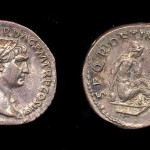
So what does this have to do with our lesson this morning? Regardless of which Church-State configuration exists, Jesus the Good Shepherd guides us into the truth. We are to obey the civil authorities and give them what they are owed, even when we don’t like it, for they are instituted by God. The coin in ancient times was a symbol of a king and empire’s dominion. When a king conquered other lands, one of the first things he would do was to issue his own coinage. The dominion of a king’s power could be measured by the extent of where his coinage was accepted. Because the king or empire produced the coins, they owned them and had a claim on them and everything attached to them.
The Roman coin bore the image of the Roman emperor, and so the coin and the labor attached to it belonged to the emperor to some (but not an absolute) degree. But the man himself bears the image of God Himself, and everything attached to that man belongs to God. Not just the coin, not just the increase, but everything – especially the man himself.
This was the testimony of the early church, who lived under the Roman emperor. “You give to Caesar only money. But to God, give yourself,” Tertullian said. St. Augustine reminds us that that “We are God’s money. But we are like coins that have wandered away from the treasury. What was once stamped upon us has been worn down by our wandering. The One who restamps his image upon us is the One who first formed us. He himself seeks his own coin, as Caesar sought his coin. It is in this sense that he says, ‘Render to Caesar the things that are Caesar’s, and to God the things that are God’s,’ to Caesar his coins, to God your very selves.”
We have today an unparalleled degree of choice. What will you do with the resources God has given you? The money which is His, and not just the United States government’s, and of which there is more than ever before in history; the time, of which there is more leisure time than in much of history; yourself, of which there is exactly as much as at any other time in history?
You pay Uncle Sam and lesser sams perhaps 15 to 40% of your increase – probably because you have to. What will you give God who deserves it all but is less tyrannical in this life about extracting it?
Regardless of which configuration of Church and State we find ourselves under, there is the same configuration of the relationship between the Creator and His image: we should render to God what is God’s, and we are God’s. And you and I are God’s: body, mind, and soul.
Prayer: O Lord our Governor, whose glory is in all the world: We commend this nation to your merciful care, that, being guided by your Providence, we may dwell secure in your peace. Grant to the President of the United States, the Governor of this State (or Commonwealth), and to all in authority, wisdom and strength to know and to do your will. Fill them with the love of truth and righteousness, and make them ever mindful of their calling to serve this people in your fear; through Jesus Christ our Lord, who lives and reigns with you and the Holy Spirit, one God, world without end. Amen.
Points for Meditation:
- Has the amazing degree of choice in your life been a blessing to you? What have you done with the much which God has entrusted to your care?
- Examine your attitude about giving to the State, as well as your attitude about giving yourself to God.
Resolution: As Lent continues, renew your vow to give yourself to the Lord in one specific area, remembering that you are His image and owe all to Him.
© 2016 Fr. Charles Erlandson
render to Caesar what is Caesar’s
“I’m spiritual but not religious”
Previous Post

March 3, 2016
Friday of Lent 3 - Mark 12:1-12
Next Post
March 6, 2016 Monday of Lent 4 - Mark 12:18-27
Browse Our Archives
Select a Category Book Reviews Featured Give Us This Day Give Us This Day Devotional love me love my wife Love My Wife Reformed Catholicism Blog Spirit-Reality Take This Cup Uncategorized
Select a Month February 2022 November 2021 October 2021 August 2021 January 2021 December 2020 November 2020 September 2020 August 2020 July 2020 June 2020 May 2020 September 2018 July 2018 March 2018 November 2017 October 2017 September 2017 August 2017 July 2017 June 2017 May 2017 April 2017 March 2017 February 2017 January 2017 December 2016 November 2016 October 2016 September 2016 August 2016 July 2016 June 2016 May 2016 April 2016 March 2016 February 2016 January 2016 December 2015 November 2015 October 2015 September 2015 August 2015 July 2015 June 2015 May 2015 April 2015 March 2015 February 2015 January 2015 December 2014 November 2014 October 2014 September 2014 August 2014 July 2014 June 2014 May 2014 April 2014 March 2014 February 2014 January 2014 December 2013 November 2013 October 2013 September 2013 August 2013 July 2013 June 2013 May 2013 April 2013 March 2013 February 2013 January 2013 December 2012 November 2012 October 2012 September 2012 August 2012 July 2012 June 2012 May 2012 April 2012 March 2012 February 2012 January 2012 December 2011 November 2011 October 2011 September 2011 August 2011 July 2011 May 2011 April 2011 March 2011 February 2011 January 2011
Follow Us!
TAKE THE
Religious Wisdom Quiz
What does the name "Abraham" mean?
Select your answer to see how you score.
Strong leader Blessed man Shelter Father of many
Related posts from Give Us This Day

I'm Spiritual But Not Religious
What's Postmodernism and what's the Answer to it?
Mark 12:13-17 - What is the proper relationship...
TRENDING AT PATHEOS Evangelical

How the author of the world's best hymn...
I've been working with John Newton for a while now. This makes...

Long before this Lectio Divina, Psalm 130 - the song - started...

What About the Trees? Another Living Parable
After I finished writing the last article about falling leaves as a...

Why Classical Education Is a Conversation, Not a...
Come and Read: Joy in Classical Education When I was a little...

Falling Leaves: A Living Parable on Letting Go
I’ve spent the vast majority of my life in the southeast corner...

Cornell University has received a great deal of negative publicity and intense...
view all Evangelical blogs
Ad-Free & Subscriber Log-In Subscription Support
- About Us
- 2026 Calendar
- Videos
- Podcasts
- Library of World Religions
- Faith In Media Tracker
- Advertise With Us
- Write for Us
- Privacy Policy
- Terms of Service
- Do Not Sell My Data
- Contact Us
- Radiant Digital
- Manage Newsletter Subscriptions
- Unsubscribe From Notifications
- Sitemap
Copyright 2008-2026, Patheos. All rights reserved.
Subscription Support Ad-Free & Subscriber Log-In
Follow Patheos