
BuddhistCatholicContemplativeEvangelicalGeneral ChristianHinduJewishLatter-day SaintMuslimNew VisionsProgressive Christian
Beliefs
- Buddhist
- Catholic
- Contemplative
- Evangelical
- General Christian
- Hindu
- Jewish
- Latter-day Saint
- More Voices
- Muslim
- New Visions
- Pagan
- Progressive Christian
Topics
- Religion News
- Food and Religion
- Sports and Religion
- Religious Art
- Religious Music and Entertainment
- Religious Events
- History and Religion
- Style and Religion
- Politics and Religion
- Women in Religion
- Recreation Outdoors and Religion
- Business Finance and Religion
- Careers Workplace and Religion
- Education and Religion
- Family Parenting and Religion
- Health Fitness and Religion
- Home and Religion
- Relationships and Religion
- Technology and Religion
- Travel and Religion
Columnists
- Buddhist Columnists
- Business Finance and Religion Columnists
- Careers Workplace and Religion Columnists
- Catholic Columnists
- Contemplative Columnists
- Education and Religion Columnists
- Evangelists Columnists
- Family Parenting and Religion Columnists
- General Christian Columnists
- Health Fitness and Religion Columnists
- Hindu Columnists
- History and Religion Columnists
- Home and Religion Columnists
- Jewish Columnists
- More Voices Columnists
- Latter Day Columnists
- Muslim Columnists
- New Visions Columnists
- Nonreligious Columnists
- Pagan Columnists
- Politics and Religion Columnists
- Progressive Columnists
- Recreation Outdoors and Religion Columnists
- Relationships and Religion Columnists
- Religion News Columnists
- Religious Art Columnists
- Religious Events Columnists
- Religious Music and Entertainment Columnists
- Sports and Religion Columnists
- Style and Religion Columnists
- Technology and Religion Columnists
- Travel and Religion Columnists
- Women in Religion Columnists
Resource Library
- 2026 Calendar
- Library of World Religions
- The 100 Most Holy Places on Earth
- Patheos Answers
- Podcasts
- Videos
- Faith Leaders Database
- Anglican Episcopalian
- Bahai
- Baptist
- Buddhism
- Christianity
- Confucianism
- Eastern Orthodoxy
- Hinduism
- Holiness and Pentecostal
- ISKCON
- Islam
- Judaism
- Lutheran
- Methodist
- The Church of Jesus Christ of Latter-day Saints
- New Age
- Paganism
- Presbytarian and Reformed
- Protestantism
- Religion Behind the Scenes
- Roman Catholic
- Scientology
- Shia Islam
- Sikhism
- Sufism
- Sunni Islam
- Taoism
- Zen
- See all religions
Research Tools
 Ad-Free & Subscriber Log-In Subscription Support
Ad-Free & Subscriber Log-In Subscription Support
Follow Patheos 

- Trending:
- Forgiveness
- |
- Marriage
- |
- Consciousness
- |
- Death Penalty
- |
- Election
- |
- Halloween
 Give Us This Day
- Home
- Evangelical
- Monday of Trinity 16 – Matthew 9:18-35
Monday of Trinity 16 – Matthew 9:18-35
Last updated on: October 5, 2014 at 11:15 pm by Fr. Charles Erlandson
Monday of Trinity 16 – Matthew 9:18-35 2014-10-05T23:15:02-05:00 Fr. Charles Erlandson
Patheos Explore the world's faith through different perspectives on religion and spirituality! Patheos has the views of the prevalent religions and spiritualities of the world.
 Matthew 9:18-35
So many wonderful choices today! Do I want to be a ruler whose daughter is raised from the dead, a woman whose twelve-year flow of blood is healed, a blind man who sight is restored, or a mute and demon-possessed man who is healed?
How ‘bout I get to be all of them!
In a way, I do, because the point of each of these healings is more about Jesus Christ and who He is revealed to be than it is about me. The miracles of Jesus, in fact all parts of the Bible, are first and foremost about Jesus Christ. And today the Scriptures teach me about a God made man who has power over disease, and demons, and even life itself! Only after I understand Jesus can I understand where I am in today’s lesson.
I feel as if my bold adventure in writing Give Us This Day has been a life lesson in how to interpret the Scriptures. Not only do I have to begin to look and listen to God’s Word in new ways to keep hearing what He wants me to hear but I also have to find the balance between trying to stretch the New Testament out on a procrustean bed so that every passage fits exactly into my life, down to every literal detail, and the other extreme of simply poo-pooing what Scripture says.
So here we go again. On the one hand, I want desperately to have faith and be healed from every infirmity I have. The Scriptures seem to suggest that if only I had faith, I would be healed from whatever troubles me: “According to your faith, let it be to you” (verse 29). On the other hand, I know that I and other faithful Christians aren’t always healed. I remember that even St. Paul was not granted that the thorn in his flesh would be removed. Even the Son of God was denied His fervent, sweat-as-blood soaked prayer in the Garden.
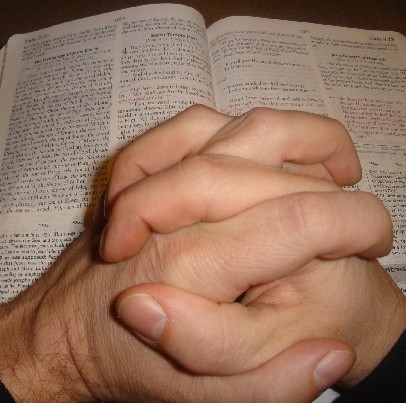
And so there must be another way: a holding of the two hands together in prayer. I choose both to have faith and to accept that I won’t always be healed. The truth is that sometimes I will be healed from my troubles, and other times I won’t. Do I have true faith only in the times I’m healed? No – I will have faith both when God heals me and when He doesn’t, so that in all things I put my trust in Him. Ironically, it is often in not being healed that our faith is demonstrated.
Maybe we should step back a moment and examine the nature of faith. Is faith only faith when the desire of the faithful one has been granted? In that case, was the faith of Abraham null and void because he didn’t receive all his promises? Was Paul’s or Jesus’ faith really faithlessness, since their prayers “weren’t answered.”
You can see that this gets us nowhere fast. Isn’t faith a trust in God and His goodness, regardless of how things turn out? If so, let me show you how an unanswered prayer might demonstrate a remarkably strong faith.
First, let’s assume that the poor slob whose prayer “isn’t answered” is, in fact, praying for what he needs. Let’s assume further that when he asks, he truly believes that God can deliver him and will, if it pleases Him. Already, we can see faith in work in such a man.
Now here comes the tricky part. What if God doesn’t deliver that man? What are our options? We could posit that the man had no faith, but as we’ve already seen that isn’t always the case. Here’s another point: after how much time has passed can we say that God hasn’t heard and answered the prayer? Some prayers, such as healing, may be open-ended for quite a long time. Furthermore, is it necessary that every prayer be answered affirmatively? If that were the case, then we’d have to infallibly know what was good for us, so that God would always give us what we asked for.
The only other option is that we must sometimes ask for things that aren’t in our best interest. Yes, it would be good for God to heal each and every one of us from every problem we’ve ever had. But God doesn’t, so He must have something better in mind. This is the way faith thinks, because its basic instinct is to trust in God and His goodness over and against what the flesh and the world might naturally affirm as good.
This is faith in action: to trust in God, even when, especially when, sight doesn’t affirm God or His goodness.
Let’s return to our unhealed man. What might happen if he were healed quickly and easily every time? Given our fallen nature, it would be easy for us to go on our merry way, forgetting God and thinking that we were owed this healing. But what about the unhealed man? If he keeps his faith in God, in spite of not being healed, what great faith that man has!
Faith, once again, trusts in God and His goodness; therefore, faith waits humbly and patiently for the Lord, and it accepts whatever the Lord grants. Faith believes that as long as it trusts in God that whatever the answer is will be something God gives him out of love and goodness.
In this way, whether the prayer “is answered” or not, the prayer of faith is always answered, because God will honor the one who is faithful to Him: “He has filled the hungry with good things.” What the prayer of faith ultimately wants is what the Father wants. And that’s the whole point of prayer and faith: that we may be united to the will of the Father, regardless of what that will is.
This isn’t always the case, mind you, but the saint who has faith in trouble and is not healed may be the saint with the greatest faith of all. He may be one, like Paul and Jesus, who God loves in a special way. God must believe that ones with faith such as these have faith so strong that they can withstand a loving “No” from the Father. They are the ones who are driven moment by moment and day by day to the One who can sustain them in their spirit, even if their flesh is decaying. These are the ones who are called to share in their Master’s sufferings, as He first suffered for them.
Such a saint may also be the saint who has more than his fair share of prayers “answered” as well! This is because he is one who is learning to trust the Father in all things, and so he finds favor with his Lord.
And so I vow to be faithful to God, to have and to hold Him from this day forward, for better for worse, for richer or for poorer, in sickness and in health, to love and to cherish, for death will not part us.
Prayer: Lord Jesus Christ, Son of God, have mercy on me, a sinner!
Points for Meditation:
- How have you accepted God’s “No”s in your life? Is it possible that He intends to bless you through them but you haven’t realized it?
- Meditate on these words: “Faith asks, knowing the Father hears us. Hope waits for His reply. Love accepts that reply with joy.”
Resolution: I resolve to ask God for faith during difficult times when He seems to be slow in answering.
© 2014 Fr. Charles Erlandson
Give Us This Day daily devotional
Previous Post

October 4, 2014
Saturday of Trinity 15 - Matthew 9:9-17
Next Post
October 6, 2014 Thursday of Trinity 16 - Matthew 10:32-11:1
Browse Our Archives
Select a Category Book Reviews Featured Give Us This Day Give Us This Day Devotional love me love my wife Love My Wife Reformed Catholicism Blog Spirit-Reality Take This Cup Uncategorized
Select a Month February 2022 November 2021 October 2021 August 2021 January 2021 December 2020 November 2020 September 2020 August 2020 July 2020 June 2020 May 2020 September 2018 July 2018 March 2018 November 2017 October 2017 September 2017 August 2017 July 2017 June 2017 May 2017 April 2017 March 2017 February 2017 January 2017 December 2016 November 2016 October 2016 September 2016 August 2016 July 2016 June 2016 May 2016 April 2016 March 2016 February 2016 January 2016 December 2015 November 2015 October 2015 September 2015 August 2015 July 2015 June 2015 May 2015 April 2015 March 2015 February 2015 January 2015 December 2014 November 2014 October 2014 September 2014 August 2014 July 2014 June 2014 May 2014 April 2014 March 2014 February 2014 January 2014 December 2013 November 2013 October 2013 September 2013 August 2013 July 2013 June 2013 May 2013 April 2013 March 2013 February 2013 January 2013 December 2012 November 2012 October 2012 September 2012 August 2012 July 2012 June 2012 May 2012 April 2012 March 2012 February 2012 January 2012 December 2011 November 2011 October 2011 September 2011 August 2011 July 2011 May 2011 April 2011 March 2011 February 2011 January 2011
Follow Us!
TAKE THE
Religious Wisdom Quiz
Who was told to prophesy to the mountains and valleys of Israel?
Select your answer to see how you score.
Hosea Daniel Micah Ezekiel
Related posts from Give Us This Day

James Clark - Book Review of Take This...
Mark 16:1-11 - How to Seek God

Revelation 8 - Heavenly Worship and Prayer

The Day I Prayed for the G.I. Joe...
TRENDING AT PATHEOS Evangelical

How the author of the world's best hymn...
I've been working with John Newton for a while now. This makes...

Long before this Lectio Divina, Psalm 130 - the song - started...

What About the Trees? Another Living Parable
After I finished writing the last article about falling leaves as a...

Why Classical Education Is a Conversation, Not a...
Come and Read: Joy in Classical Education When I was a little...

Falling Leaves: A Living Parable on Letting Go
I’ve spent the vast majority of my life in the southeast corner...

Cornell University has received a great deal of negative publicity and intense...
view all Evangelical blogs
Ad-Free & Subscriber Log-In Subscription Support
- About Us
- 2026 Calendar
- Videos
- Podcasts
- Library of World Religions
- Faith In Media Tracker
- Advertise With Us
- Write for Us
- Privacy Policy
- Terms of Service
- Do Not Sell My Data
- Contact Us
- Radiant Digital
- Manage Newsletter Subscriptions
- Unsubscribe From Notifications
- Sitemap
Copyright 2008-2026, Patheos. All rights reserved.
Subscription Support Ad-Free & Subscriber Log-In
Follow Patheos