
BuddhistCatholicContemplativeEvangelicalGeneral ChristianHinduJewishLatter-day SaintMuslimNew VisionsProgressive Christian
Beliefs
- Buddhist
- Catholic
- Contemplative
- Evangelical
- General Christian
- Hindu
- Jewish
- Latter-day Saint
- More Voices
- Muslim
- New Visions
- Pagan
- Progressive Christian
Topics
- Religion News
- Food and Religion
- Sports and Religion
- Religious Art
- Religious Music and Entertainment
- Religious Events
- History and Religion
- Style and Religion
- Politics and Religion
- Women in Religion
- Recreation Outdoors and Religion
- Business Finance and Religion
- Careers Workplace and Religion
- Education and Religion
- Family Parenting and Religion
- Health Fitness and Religion
- Home and Religion
- Relationships and Religion
- Technology and Religion
- Travel and Religion
Columnists
- Buddhist Columnists
- Business Finance and Religion Columnists
- Careers Workplace and Religion Columnists
- Catholic Columnists
- Contemplative Columnists
- Education and Religion Columnists
- Evangelists Columnists
- Family Parenting and Religion Columnists
- General Christian Columnists
- Health Fitness and Religion Columnists
- Hindu Columnists
- History and Religion Columnists
- Home and Religion Columnists
- Jewish Columnists
- More Voices Columnists
- Latter Day Columnists
- Muslim Columnists
- New Visions Columnists
- Nonreligious Columnists
- Pagan Columnists
- Politics and Religion Columnists
- Progressive Columnists
- Recreation Outdoors and Religion Columnists
- Relationships and Religion Columnists
- Religion News Columnists
- Religious Art Columnists
- Religious Events Columnists
- Religious Music and Entertainment Columnists
- Sports and Religion Columnists
- Style and Religion Columnists
- Technology and Religion Columnists
- Travel and Religion Columnists
- Women in Religion Columnists
Resource Library
- 2026 Calendar
- Library of World Religions
- The 100 Most Holy Places on Earth
- Patheos Answers
- Podcasts
- Videos
- Faith Leaders Database
- Anglican Episcopalian
- Bahai
- Baptist
- Buddhism
- Christianity
- Confucianism
- Eastern Orthodoxy
- Hinduism
- Holiness and Pentecostal
- ISKCON
- Islam
- Judaism
- Lutheran
- Methodist
- The Church of Jesus Christ of Latter-day Saints
- New Age
- Paganism
- Presbytarian and Reformed
- Protestantism
- Religion Behind the Scenes
- Roman Catholic
- Scientology
- Shia Islam
- Sikhism
- Sufism
- Sunni Islam
- Taoism
- Zen
- See all religions
Research Tools
 Ad-Free & Subscriber Log-In Subscription Support
Ad-Free & Subscriber Log-In Subscription Support
Follow Patheos 

- Trending:
- Forgiveness
- |
- Marriage
- |
- Consciousness
- |
- Death Penalty
- |
- Election
- |
- Halloween
 Give Us This Day
- Home
- Evangelical
- What Do We Mean by the Communion of the Saints?
What Do We Mean by the Communion of the Saints?
Last updated on: November 2, 2017 at 8:45 am by Fr. Charles Erlandson
What Do We Mean by the Communion of the Saints? 2017-11-02T08:45:10-05:00 Fr. Charles Erlandson
Patheos Explore the world's faith through different perspectives on religion and spirituality! Patheos has the views of the prevalent religions and spiritualities of the world.
 Revelation 7: All Saints’ Day
Driving down the highway, you’ve all seen the billboards with a beautiful young couple with smiles that are 10 feet wide.
Why are they smiling?
Because they’re happy to be inviting you to their church, where you can find a place to belong and be with beautiful people just like you and.
Now don’t get me wrong: it’s important to find place where you can belong. And fellowship with family and friends is extraordinarily important.
And I would get up on Sunday morning just to hang out with all of you beautiful people, because I love you.
But I have some news for you: you’re not the main reason I come to church.
We all want desperately to belong.
We belong with other people and want to find the deepest fellowship possible with each other.
But if your main goal in life is to find peace and joy in human fellowship, you will not find it.
And so it is that though I want to tell you about the communion of saints as we approach All Saints Day, but I can’t do that until I’ve first told you about 2 other things.
For contrary to church billboards and popular theology, there is something more important than human fellowship: and that is fellowship with God.
First, comes the communion within God Himself: the Father, the Son, and the Holy Spirit. Then comes the communion Jesus Christ has with His Body and Bride, the holy catholic Church.
And only then comes the communion of saints.
For without the communion of the Holy Trinity, and without the communion of Christ and His Church, there can be no true communion between men.
1. Communion in the Holy Trinity: between God and God
The world must look like the God who created it. And so this world is exquisitely beautiful and abundantly good. It also a world where the many become one. For God is a communion of 3 persons in 1 God. The Father, the Son, and the Spirit are bound together by their ecstatic love for one another which goes out of itself to The Other.
And so a God who IS communion creates a world of communion, intended for communion.
Everywhere we look, men cry out for communion. It is not good for man to be alone, and men will endure the most painful relationships to avoid the greater hell of loneliness. They devote their greatest musical energies to crooning about love and singing its ecstatic glories, and then the next song weeping and lamenting when the idol of a merely human love is shattered daily in their lives.
Because man broke his communion with God by going his own way and obeying himself rather than God. And from our sin is born all of the great conflicts of the world, between a man and his own family, between man and himself, and between man and God’s creation. From our sin comes the breaking of the communion of the world.
But the dream of human communion can only come true when communion is first sought in God. And so in the Apostles’ Creed, we remember the sacred story about the Father who created the world as a communion; the Son who came to restore the world to communion; and the Spirit who came to give this communion life.
2. Communion between Christ and His Church: Between God and Man
After we have confessed the Father and the Son in the Creed, we tell the part of the story where this God of communion shares Himself with man. Conceived by the Holy Ghost, Jesus Christ is God. Born of the Virgin Mary, Jesus Christ is God.
The best picture for the kind of union God wants with man is the marriage between and man and his wife. In the beginning . . . was a marriage. God created man so that, in due time, God could marry mankind!
But how can Jesus, one man, though He is also God, marry all of mankind? Because at the Incarnation, God the Son didn’t wed Himself to just one human person, but to all of human nature. For it is all of humanity, corporate man – to which God is married in Christ.
But this marriage of God and man that took place in Jesus Christ is also expressed in another way: through Christ’s marriage to His Bride, the Church. The eternal communion of love between the Father, Son, and Spirit, which was expressed in the Incarnation of Jesus Christ, is now expressed as well in Christ and His Bride.
God’s eternal communion, which He bequeaths to the Church through her life in Christ, is made visible to us in many ways. But nowhere in the Church is Christ’s communion with His Bride made more visible and delightful than in the Holy Communion, the Lord’s Supper.
The Eucharist is the sacrament of the union of the Bride and Bridegroom. For in the Holy Communion we are present at the earthly representation of the Marriage Feast of the Lamb of God that takes place in heaven.
The Bible teaches that when we take the Holy Communion, we have true communion with Jesus Christ. 1 Corinthians 10:16 – “The cup of blessing that we bless, is it not a participation in the blood of Christ? The bread that we break, is it not a participation in the body of Christ?”
III. Communion of the Saints: Between Men
The story of the Creed continues: I believe in the Holy catholic Church . . . the communion of saints. That communion of saints, that sweet fellowship we desire with each other as humans, comes only in the Church . . . who has communion with Jesus Christ . . . who has communion with the Father and Spirit.
And now we can truly have human fellowship, because God has first given all Christians fellowship with Him, through His Son. As St. Paul teaches in 1 Corinthians 10:17 – “Because there is one bread, we who are many are one body, for we all partake of the one bread.”
Now we can know the communion of saints!
Now we can understand Revelation 7!
**“**After these things I looked, and behold, a great multitude which no one could number, of all nations, tribes, peoples, and tongues, standing before the throne and before the Lamb, clothed with white robes, with palm branches in their hands, and crying out with a loud voice, saying, “Salvation belongs to our God who sits on the throne, and to the Lamb!”
It is gathered around God’s throne in worship, in union with the Lamb of God, that we have communion with God. It is united around one Lord, one faith, and one baptism that we are all united with one another in Christ.
But some others are there with us! Who are these?
Verse 11 of Revelation 7: “All the angels stood around the throne and the elders and the four living creatures, and fell on their faces before the throne and worshiped God.”
Does this ring a heavenly bell? In the Anglican Communion service we hear “Therefore with angels and archangels and all the company of heaven . . . .” And the writer of Hebrews tells us that as the Church in communion with Christ, we are in the presence of angels: “But you have come to Mount Zion and to the city of the living God, the heavenly Jerusalem, to an innumerable company of angels, to the general assembly and church of the firstborn who are registered in heaven, to God the Judge of all, to the spirits of just men made perfect.”
One more person is there, in Revelation 7:15: “Therefore they are before the throne of God, and serve Him day and night in His temple. And He who sits on the throne will dwell among them.”
Who are these saints, with whom we are in communion?
They are all the saints gathered here this morning around God’s throne.
They are all members of Good Shepherd Reformed Episcopal Church where I worship.
They all of our brothers and sisters in the Reformed Episcopal Church here in the U.S., in Canada, in Cuba, in Croatia, in Germany, and even in Nepal.
They are all of the Anglicans in the Anglican Church in North America.
They are all baptized, faithful Christians in the world today, from all churches.
They are all of the saints in the past who have gone to the Lord before us, which is the Church Triumphant.
They are even all of the saints who will ever be, for God is outside of time!
We all have beloved saints who have gone before us. They, too, are a part of the one Body of Jesus Christ, and so they share with us the communion of saints.
Have not some of you felt a mystical bond with them? This bond, this wondrous union, is only possible through our communion first with Jesus Christ, and through Him with the Holy Trinity.
So let us celebrate together the Feast of All Saints together, in the presence of the Lamb of God, in fellowship with angels, archangels, and our loved ones who have gone before us.
What else is left, but to prepare our hearts to receive Jesus Christ as we eat with Him at the Marriage Feast of the Lamb!
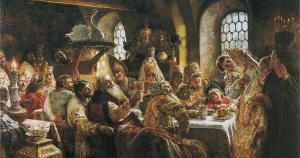
A Boyar Wedding Feast in the U.S. Public Domain

Previous Post

October 24, 2017
Why Do We Hide From Romans 1?
Next Post

November 20, 2017 Greet One Another With a Holy Kiss
Browse Our Archives
Select a Category Book Reviews Featured Give Us This Day Give Us This Day Devotional love me love my wife Love My Wife Reformed Catholicism Blog Spirit-Reality Take This Cup Uncategorized
Select a Month February 2022 November 2021 October 2021 August 2021 January 2021 December 2020 November 2020 September 2020 August 2020 July 2020 June 2020 May 2020 September 2018 July 2018 March 2018 November 2017 October 2017 September 2017 August 2017 July 2017 June 2017 May 2017 April 2017 March 2017 February 2017 January 2017 December 2016 November 2016 October 2016 September 2016 August 2016 July 2016 June 2016 May 2016 April 2016 March 2016 February 2016 January 2016 December 2015 November 2015 October 2015 September 2015 August 2015 July 2015 June 2015 May 2015 April 2015 March 2015 February 2015 January 2015 December 2014 November 2014 October 2014 September 2014 August 2014 July 2014 June 2014 May 2014 April 2014 March 2014 February 2014 January 2014 December 2013 November 2013 October 2013 September 2013 August 2013 July 2013 June 2013 May 2013 April 2013 March 2013 February 2013 January 2013 December 2012 November 2012 October 2012 September 2012 August 2012 July 2012 June 2012 May 2012 April 2012 March 2012 February 2012 January 2012 December 2011 November 2011 October 2011 September 2011 August 2011 July 2011 May 2011 April 2011 March 2011 February 2011 January 2011
Follow Us!
TAKE THE
Religious Wisdom Quiz
What Christian group is known for its historic peace churches and pacifism?
Select your answer to see how you score.
Methodists Presbyterians Quakers Pentecostals
Related posts from Give Us This Day

The Different States of Love - and the...
John 7:25-36 - Recognizing God in all Things
Luke 7:36-50 - Anointing The Feet
Mark 12:18-27 - What will the Resurrection be...
TRENDING AT PATHEOS Evangelical

How the author of the world's best hymn...
I've been working with John Newton for a while now. This makes...

Long before this Lectio Divina, Psalm 130 - the song - started...

What About the Trees? Another Living Parable
After I finished writing the last article about falling leaves as a...

Why Classical Education Is a Conversation, Not a...
Come and Read: Joy in Classical Education When I was a little...

Falling Leaves: A Living Parable on Letting Go
I’ve spent the vast majority of my life in the southeast corner...

Cornell University has received a great deal of negative publicity and intense...
view all Evangelical blogs
Ad-Free & Subscriber Log-In Subscription Support
- About Us
- 2026 Calendar
- Videos
- Podcasts
- Library of World Religions
- Faith In Media Tracker
- Advertise With Us
- Write for Us
- Privacy Policy
- Terms of Service
- Do Not Sell My Data
- Contact Us
- Radiant Digital
- Manage Newsletter Subscriptions
- Unsubscribe From Notifications
- Sitemap
Copyright 2008-2026, Patheos. All rights reserved.
Subscription Support Ad-Free & Subscriber Log-In
Follow Patheos