
BuddhistCatholicContemplativeEvangelicalGeneral ChristianHinduJewishLatter-day SaintMuslimNew VisionsProgressive Christian
Beliefs
- Buddhist
- Catholic
- Contemplative
- Evangelical
- General Christian
- Hindu
- Jewish
- Latter-day Saint
- More Voices
- Muslim
- New Visions
- Pagan
- Progressive Christian
Topics
- Religion News
- Food and Religion
- Sports and Religion
- Religious Art
- Religious Music and Entertainment
- Religious Events
- History and Religion
- Style and Religion
- Politics and Religion
- Women in Religion
- Recreation Outdoors and Religion
- Business Finance and Religion
- Careers Workplace and Religion
- Education and Religion
- Family Parenting and Religion
- Health Fitness and Religion
- Home and Religion
- Relationships and Religion
- Technology and Religion
- Travel and Religion
Columnists
- Buddhist Columnists
- Business Finance and Religion Columnists
- Careers Workplace and Religion Columnists
- Catholic Columnists
- Contemplative Columnists
- Education and Religion Columnists
- Evangelists Columnists
- Family Parenting and Religion Columnists
- General Christian Columnists
- Health Fitness and Religion Columnists
- Hindu Columnists
- History and Religion Columnists
- Home and Religion Columnists
- Jewish Columnists
- More Voices Columnists
- Latter Day Columnists
- Muslim Columnists
- New Visions Columnists
- Nonreligious Columnists
- Pagan Columnists
- Politics and Religion Columnists
- Progressive Columnists
- Recreation Outdoors and Religion Columnists
- Relationships and Religion Columnists
- Religion News Columnists
- Religious Art Columnists
- Religious Events Columnists
- Religious Music and Entertainment Columnists
- Sports and Religion Columnists
- Style and Religion Columnists
- Technology and Religion Columnists
- Travel and Religion Columnists
- Women in Religion Columnists
Resource Library
- 2026 Calendar
- Library of World Religions
- The 100 Most Holy Places on Earth
- Patheos Answers
- Podcasts
- Videos
- Faith Leaders Database
- Anglican Episcopalian
- Bahai
- Baptist
- Buddhism
- Christianity
- Confucianism
- Eastern Orthodoxy
- Hinduism
- Holiness and Pentecostal
- ISKCON
- Islam
- Judaism
- Lutheran
- Methodist
- The Church of Jesus Christ of Latter-day Saints
- New Age
- Paganism
- Presbytarian and Reformed
- Protestantism
- Religion Behind the Scenes
- Roman Catholic
- Scientology
- Shia Islam
- Sikhism
- Sufism
- Sunni Islam
- Taoism
- Zen
- See all religions
Research Tools
 Ad-Free & Subscriber Log-In Subscription Support
Ad-Free & Subscriber Log-In Subscription Support
Follow Patheos 

- Trending:
- Forgiveness
- |
- Marriage
- |
- Consciousness
- |
- Death Penalty
- |
- Election
- |
- Halloween
 Give Us This Day
- Home
- Evangelical
- Matthew 26:17-30 – The Lord’s Supper
Matthew 26:17-30 – The Lord’s Supper
Last updated on: November 22, 2016 at 6:23 pm by Fr. Charles Erlandson
Matthew 26:17-30 – The Lord’s Supper 2016-11-22T18:23:45-05:00 Fr. Charles Erlandson
Patheos Explore the world's faith through different perspectives on religion and spirituality! Patheos has the views of the prevalent religions and spiritualities of the world.
** **One of my favorite painters is the surrealist Salvador Dali. In 1976 Dali painted a painting titled “Gala Contemplating the Mediterranean Sea which at Twenty Metres Becomes the Portrait of Abraham Lincoln,” (commonly called “Lincoln in Dalivision). In this painting, he used 252 tiles that, when seen up close, look like his wife, Gala, looking out a window, with other images thrown in. But as you move back from the painting, a picture of Abraham Lincoln emerges. Not long after this, the world of photo mosaics was born.
And that’s what the Gospel of Matthew is like. The entire meaning of the Gospel, the Good News, is about to be revealed in a startling way so that all of those wonderful individual pictures Matthew’s been showing us now reveal themselves to be part of a much larger picture.
For several chapters, now, Jesus has been teaching about the coming of the New Covenant and the cataclysmic events that would usher it in. He actually began teaching about it in the very first words of His public ministry: “Repent, for the kingdom of heaven is at hand” (Matthew 4:17). He then proceeds to talk about the Kingdom and the blessings it will bring upon those who are poor in spirit and who hunger and thirst for righteousness, after which He teaches about the new Law in the New Covenant. He demonstrates that there is a new power in this New Covenant by the many miracles He performed.
In choosing the 12, He prepares for the continuation of this New Covenant after He must die and be raised up and then ascend into heaven. He tells parables about what life in the kingdom will be like, and He miraculously feeds both the 5000 and 4000 as a way of teaching about how He will feed those who hunger after righteousness in the New Covenant.
Beginning in Chapter 16, He begins to teach about a terrible price that must be paid in order for this New Covenant to be put into place. That price is His own life, which He will give for the life of the world, and it will involve a sacrifice on the part of His disciples as well. He teaches some more about the coming of the New Covenant, teaching in many different ways that Israel of the Old Covenant has rejected her Savior, killing the prophets and soon the Son Himself. His harshest words are for the leaders of Israel, who should have prepared the people and led them to the Messiah and the New Covenant but who instead are determined to keep the people in great darkness. And then He teaches about how terrible the events will be that mark the fullness of the coming of this New Covenant.
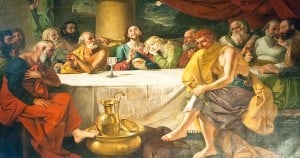
Here in Chapter 26, when we come to the Last Supper and the institution of the Lord’s Supper, suddenly the entire book of Matthew comes into focus. Each of the stories and teachings we have heard are all part of the larger picture of the coming of the New Covenant and the coming of the Kingdom of Heaven. But it’s not until we come to Matthew 26 that things start to make more sense. The Lord’s Supper bridges the gap between Jesus’ teaching about the New Covenant and it being put into effect. It’s amazing how short the account of it is. It would look rather unobtrusive, if we weren’t already alerted to its immense significance. In Matthew’s account, he spends 9 verses talking about the preparations for the Passover and the coming betrayal of Him. The description of the actual supper lasts only 4 short verses, and then Jesus and the disciples leave for the Mount of Olives.
It all happens so quickly, that it would be easy to miss. O.K., so Jesus is at the Passover with His disciples. We would expect that, since this was a required feast, and we’ve heard about Jesus going to Passovers before. We’ve been hearing about Jesus being betrayed and going to die and then being raised up on the third day for some time, and it seems time to get the inevitable over with. We all know that Jesus has to go into Gethsemane to pray and be betrayed and then experience the terrible events of the Passion and Crucifixion.
So why this interlude with the disciples at the Passover? It’s just a religious obligation, and one that was part of the Old Covenant, isn’t it?
But these 4 verses are not only what connects the parts of Matthew’s Gospel: they’re also what connects us to Matthew’s Gospel and the narrative of the coming of Christ and the New Covenant. Just as Jesus had gathered up His chosen 12 apostles to be His Body and continue the work of the Incarnation, now He also provides the means by which they will continually be fed and strengthened to be His Body and do His will on earth. In the Lord’s Supper He gives Himself to them for heavenly food, the bread which comes down from heaven. In this supper, He gives Himself to them, His Body and His Blood, that they might become His Body and be one with Him.
Having established His Church and given Himself to her by His supper, He also made it possible for that Body to continue to live and be one with Him, even after the 12 were dead. In this humble supper, He seals the New Covenant for all time, even as all of the Old Covenant is consumed and fulfilled within the New Covenant. All of the sacrifices of the Old Testament and all of the feasts and festivals are contained in this humble meal. All of the Gospel, from the Incarnation in which the Father gives His Son and His Body and Blood for us to the Crucifixion to the Resurrection and the Ascension, are served to us, here in this humble fellowship meal.
Here is the Passover Lamb, the Lamb of God that takes away the sins of the world. Here is the meaning of all that God had told Israel 1500 years before, and here is the meaning of our lives 2000 years later.
Here is the betrayal of mankind, Adam’s sin being repeated by Judas, and Adam and Judas’ sins being repeated by us. But here also is the sacrifice that takes away the sins of the world, for all who eat with faith. Here is the Crucifixion of our Lord for our sins, and here is our own death. But here also is His Resurrection and our new life with Him.
This humble supper is the fulfillment of the Passover and the prediction of the Crucifixion. It is the fulfillment of the Incarnation, and the prediction of the Resurrection. For us, it is the fulfillment of all, because in it we find Christ. In it, we remember God’s promises and mighty deeds and we anticipate the future hope of glory. And in it, we come to understand the meaning of the narrative of our lives and all of the smaller images that sometimes don’t make sense by themselves.
It would be easy to read these 4 small verses and pass by as if nothing particularly significant had just happened. It would be easy to read them quickly and without due attention because we’ve seen it all before.
But here is the meaning of our lives. Here is the New Covenant. Here is Jesus Christ, His life, His Body and His Blood, offered to us anew, each and every time we come to this humble supper.
So now is the time to prepare for the next time you come to this supper. Do not treat it lightly. Do not pass over it, as if it were nothing. For in it, is Life itself, for in it, is Jesus Christ, who is the New Covenant and all its blessings.
Prayer: Almighty God, whose blessed Son Jesus Christ has ordained in the Holy Sacrament the perpetual memorial of His death and the communion of His risen life; grant that when in obedience to Thy command, we keep the feast, we may approach Thy table with love and humble hope; that, discerning its sacred mystery, we may feed by faith upon His Body and Blood, and be made partakers of Thy heavenly grace; through the same Jesus Christ our Lord. Amen.
Points for Meditation:
- If you are in anguish because of sin or difficult circumstances, remember the heavenly food Jesus offers to you at this time.
- How might you more adequately prepare to eat the Lord’s Supper the next time it is offered to you?
Resolution: I resolve to prepare adequately for the next time I come to the Lord’s Supper.
Last Supper – Creative Commons Attribution-Share Alike 3.0 Unported license

Previous Post
November 21, 2016
Matthew 26:1-16 - Anointing the Body of Christ
Next Post

November 23, 2016 The Sacrament of Thanksgiving
Browse Our Archives
Select a Category Book Reviews Featured Give Us This Day Give Us This Day Devotional love me love my wife Love My Wife Reformed Catholicism Blog Spirit-Reality Take This Cup Uncategorized
Select a Month February 2022 November 2021 October 2021 August 2021 January 2021 December 2020 November 2020 September 2020 August 2020 July 2020 June 2020 May 2020 September 2018 July 2018 March 2018 November 2017 October 2017 September 2017 August 2017 July 2017 June 2017 May 2017 April 2017 March 2017 February 2017 January 2017 December 2016 November 2016 October 2016 September 2016 August 2016 July 2016 June 2016 May 2016 April 2016 March 2016 February 2016 January 2016 December 2015 November 2015 October 2015 September 2015 August 2015 July 2015 June 2015 May 2015 April 2015 March 2015 February 2015 January 2015 December 2014 November 2014 October 2014 September 2014 August 2014 July 2014 June 2014 May 2014 April 2014 March 2014 February 2014 January 2014 December 2013 November 2013 October 2013 September 2013 August 2013 July 2013 June 2013 May 2013 April 2013 March 2013 February 2013 January 2013 December 2012 November 2012 October 2012 September 2012 August 2012 July 2012 June 2012 May 2012 April 2012 March 2012 February 2012 January 2012 December 2011 November 2011 October 2011 September 2011 August 2011 July 2011 May 2011 April 2011 March 2011 February 2011 January 2011
Follow Us!
TAKE THE
Religious Wisdom Quiz
Which two apostles went up to the temple at the "hour of prayer" and healed a lame man in Acts 3?
Select your answer to see how you score.
James and Jude Paul and Barnabas Peter and John Philip and Stephen
Related posts from Give Us This Day
John 13:1-17 - The New Commandment
Luke 22:14-30 - Eating with Jesus, Past, Present,...

Luke 22:1-13 - Christ the Passover
TRENDING AT PATHEOS Evangelical

The REST of Your Life: A Creative Wrestles...
This week I had a conversation with a good friend from church....

How the author of the world's best hymn...
I've been working with John Newton for a while now. This makes...

Long before this Lectio Divina, Psalm 130 - the song - started...

What About the Trees? Another Living Parable
After I finished writing the last article about falling leaves as a...

Why Classical Education Is a Conversation, Not a...
Come and Read: Joy in Classical Education When I was a little...

Cornell University has received a great deal of negative publicity and intense...
view all Evangelical blogs
Ad-Free & Subscriber Log-In Subscription Support
- About Us
- 2026 Calendar
- Videos
- Podcasts
- Library of World Religions
- Faith In Media Tracker
- Advertise With Us
- Write for Us
- Privacy Policy
- Terms of Service
- Do Not Sell My Data
- Contact Us
- Radiant Digital
- Manage Newsletter Subscriptions
- Unsubscribe From Notifications
- Sitemap
Copyright 2008-2026, Patheos. All rights reserved.
Subscription Support Ad-Free & Subscriber Log-In
Follow Patheos