
BuddhistCatholicContemplativeEvangelicalGeneral ChristianHinduJewishLatter-day SaintMuslimNew VisionsProgressive Christian
Beliefs
- Buddhist
- Catholic
- Contemplative
- Evangelical
- General Christian
- Hindu
- Jewish
- Latter-day Saint
- More Voices
- Muslim
- New Visions
- Pagan
- Progressive Christian
Topics
- Religion News
- Food and Religion
- Sports and Religion
- Religious Art
- Religious Music and Entertainment
- Religious Events
- History and Religion
- Style and Religion
- Politics and Religion
- Women in Religion
- Recreation Outdoors and Religion
- Business Finance and Religion
- Careers Workplace and Religion
- Education and Religion
- Family Parenting and Religion
- Health Fitness and Religion
- Home and Religion
- Relationships and Religion
- Technology and Religion
- Travel and Religion
Columnists
- Buddhist Columnists
- Business Finance and Religion Columnists
- Careers Workplace and Religion Columnists
- Catholic Columnists
- Contemplative Columnists
- Education and Religion Columnists
- Evangelists Columnists
- Family Parenting and Religion Columnists
- General Christian Columnists
- Health Fitness and Religion Columnists
- Hindu Columnists
- History and Religion Columnists
- Home and Religion Columnists
- Jewish Columnists
- More Voices Columnists
- Latter Day Columnists
- Muslim Columnists
- New Visions Columnists
- Nonreligious Columnists
- Pagan Columnists
- Politics and Religion Columnists
- Progressive Columnists
- Recreation Outdoors and Religion Columnists
- Relationships and Religion Columnists
- Religion News Columnists
- Religious Art Columnists
- Religious Events Columnists
- Religious Music and Entertainment Columnists
- Sports and Religion Columnists
- Style and Religion Columnists
- Technology and Religion Columnists
- Travel and Religion Columnists
- Women in Religion Columnists
Resource Library
- 2026 Calendar
- Library of World Religions
- The 100 Most Holy Places on Earth
- Patheos Answers
- Podcasts
- Videos
- Faith Leaders Database
- Anglican Episcopalian
- Bahai
- Baptist
- Buddhism
- Christianity
- Confucianism
- Eastern Orthodoxy
- Hinduism
- Holiness and Pentecostal
- ISKCON
- Islam
- Judaism
- Lutheran
- Methodist
- The Church of Jesus Christ of Latter-day Saints
- New Age
- Paganism
- Presbytarian and Reformed
- Protestantism
- Religion Behind the Scenes
- Roman Catholic
- Scientology
- Shia Islam
- Sikhism
- Sufism
- Sunni Islam
- Taoism
- Zen
- See all religions
Research Tools
 Ad-Free & Subscriber Log-In Subscription Support
Ad-Free & Subscriber Log-In Subscription Support
Follow Patheos 

- Trending:
- Forgiveness
- |
- Marriage
- |
- Consciousness
- |
- Death Penalty
- |
- Election
- |
- Halloween
 Give Us This Day
- Home
- Evangelical
- Matthew 24:1-14 – Has the Kingdom Come?
Matthew 24:1-14 – Has the Kingdom Come?
Last updated on: November 13, 2016 at 10:00 pm by Fr. Charles Erlandson
Matthew 24:1-14 – Has the Kingdom Come? 2016-11-13T22:00:25-05:00 Fr. Charles Erlandson
Patheos Explore the world's faith through different perspectives on religion and spirituality! Patheos has the views of the prevalent religions and spiritualities of the world.
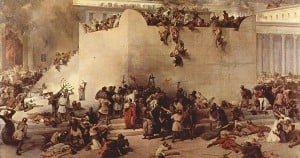 Sometimes, a man’s got to do what a man’s got to do. In this case, I feel compelled to say a word about Matthew 24 and its relationship to eschatology. It’s necessary to do this to understand Matthew 24, as well as to apply this passage to our lives today. In a word, I believe that Jesus is speaking in Matthew 24 about events that would transpire in the 1st century, not His Second Coming.
Let me offer a few points of evidence. First, when Jesus proclaims His woes upon the scribes and Pharisees, saying that they will kill the prophets He sends, He concludes by saying, “Assuredly, I say to you, all these things will come upon this generation” (Matthew 23:36). Without getting into arguments about the Greek word for “generation,” it’s abundantly clear that Jesus is talking to the actual scribes and Pharisees that He’s just pronounced the woes upon. They will persecute Jesus’ messengers, and He says to them that all these things will come upon this generation.
Second, it’s in response to Jesus saying that the Temple will be destroyed that the disciples ask when these things will be and what will be the sign of His coming (24:1-3). They’re asking not about the end of all time but about the events leading to the destruction of the Temple. Jesus’ answer, therefore, is an answer about the destruction of the Temple.
Third, when the disciples ask Jesus what will be the sign of His coming, they can’t mean His Second Coming: they have no idea there will be a Second Coming because Jesus hasn’t left yet. They’re not even sure at this point that He has to die. The Greek word for Jesus’ “coming” here is parousia, a word that was used for a state visit in the Roman Empire or for a dramatic event, such as a miracle, which revealed the power and presence of a god. It is in these senses that Jesus would come to destroy the Temple.
Finally, when Jesus talks about not being deceived and about being killed, He’s talking directly to His disciples who are right there with Him.
It might seem as if I’m putting a damper on things and that I’m killing the eschatological party. Sorry, there’s no Rapture anywhere in this passage. It’s true that I am taking our eyes off of what will happen when right before the Second Coming. But that’s not a bad thing. The truth is, we know very little about this and any speculation we might enjoy doesn’t really have a lot to do with what God has asked us to do in this life.
Far from diminishing life in the Kingdom of Heaven, I hope that by putting this passage in perspective I may magnify it so that we can see it for the exciting adventure and eternal joy that it is. What all of this means to us is that we already live in the New Age because the New Covenant, with its New King, New High Priest, New Temple, New Sacrifice, and New Life, has already come. The destruction of the Old Covenant was an earth-quaking, heaven-shaking event. As we Christians know, the coming of Christ – not only in His birth but in His life, His death, His Resurrection, His Ascension, His coming in A.D. 70, and His presence among us for 2000 years – has absolutely changed the world.
But since the Kingdom of Heaven is not here in all of its glory, the Kingdom of Man remains. For this reason, we should not be surprised that Jesus’ words to His disciples of the 1st century sound fresh to His disciples in the 21st century. Nation still rises against nation, and I suppose they will until the end of time and all is made right. Christians still experience tribulation, and those of us in the U.S. who have been spared thus far should read more about the tribulation of Christians across the world, knowing that one day such things may happen here as well. Pay attention to the hate crime laws in Europe and Canada, as just one example, and remember that your children may one day live in a U.S. where persecution of Christians is possible. False prophets are still with us and still deceive many. Lawlessness still abounds, and the love of many has grown cold.
A strange thing happened to me when I was studying for my Ph.D. in Religious Studies. I was studying the identity of contemporary orthodox Anglicanism and broke through something similar to the sound barrier. Previously, though I had been an Anglican since 1988, I had thought of Anglicanism in terms of the various textbooks and introductions to Anglicanism that I’d read. When most of us learn history, we get a very smoothed out, gutless, lifeless history. It’s why we think we don’t like history, and it’s why history looks so different from the textbooks when you look at it up close.
What I discovered is that there really was no golden age of Anglicanism, and that, furthermore, there was no golden age of Christianity. The truth is that if you were to look at the age of the apostles, the age of the Ecumenical Councils, the age of the Reformation, or any age you cared to look at, things in Christianity would be messy and ugly. In every age you would find persecution and heresy, apostasy and wolves in sheep’s clothing, lawlessness and love grown cold. But in every age you would also find saints and martyrs, heroic leaders and courageous teachers, and love reborn and sacrificially given by Christians to their neighbors.
This is what I see in contemporary America. I see a period of almost 50 years of moral decline: the things we tolerate today would have been unimaginable 50 years ago. The things that Christian parents let their children watch and hear and do would have been unimaginable 50 years ago and incomprehensible to most Christians for the past 2000 years. I hear mega-churches that peddle self-help therapy instead of the gospel of Jesus Christ, and I see fuzzy-headed syncretists who think that it’s cool to be ambiguous and not have answers and to not be their parents’ church. I see mainline churches in decline, and I see a triumphant secularism in every aspect of American public life: education, academia, the media, and politics. I see a nation that might not long endure if present trends continue.
But I also see a church that transcends America and will outlive the 21st century. I see a Church that struggles to disentangle itself from its hangover from the Roman Empire and its models of the Church. I see a gospel of the kingdom that continues to be preached in the U.S. and throughout the world, and I see Christians heroically and joyfully witnessing to the nations. I see a vast army of Christians who will endure to the end and shall be saved.
Most of all, I see the Son of Man sitting at the right hand of the Father, the King of kings and Lord of lords whose kingdom and throne and scepter cannot be shaken. I see a Christ who has come, has seen, and has conquered. I see my Lord and my God. And that’s right where I want to be!
Prayer: O Lord our governor, we beseech Thee, of Thy mercy,
That we may have the heavenly vision,
And behold things as they seem unto Thee,
That the turmoil of this world may be seen by us
To be bringing forth the sweet peace of the eternal years,
And that in all the troubles and sorrows of our own heart
We may behold good, and so, with quiet mind
An inward peace, careless of outward storm,
We may do the duty of life which brings to us
A quiet heart, ever trusting in Thee.
We give Thee thanks for all Thy mercy.
We beseech Thy forgiveness of all our sins.
We pray Thy guidance in all things,
Thy presence in the hour of death,
Thy glory in the life to come.
Of Thy mercy hear us,
Through Jesus Christ our Lord.
Amen. (George Dawson)
Points for Meditation:
- Do current events worry you? How might seeing Christ in heaven help you not to worry?
- What are some ways in which the glory of God’s Kingdom is available to you today?
Resolution: I resolve to meditate on Christ in heaven and allow my worship of Him to govern how I see the world today.
Destruction of the Temple in Jerusalem – Public Domain

Previous Post

November 11, 2016
Matthew 23:24-39 - Under Jesus' Wings
Next Post
November 14, 2016 Matthew 24:15-28 - The End of the World as We Knew It
Browse Our Archives
Select a Category Book Reviews Featured Give Us This Day Give Us This Day Devotional love me love my wife Love My Wife Reformed Catholicism Blog Spirit-Reality Take This Cup Uncategorized
Select a Month February 2022 November 2021 October 2021 August 2021 January 2021 December 2020 November 2020 September 2020 August 2020 July 2020 June 2020 May 2020 September 2018 July 2018 March 2018 November 2017 October 2017 September 2017 August 2017 July 2017 June 2017 May 2017 April 2017 March 2017 February 2017 January 2017 December 2016 November 2016 October 2016 September 2016 August 2016 July 2016 June 2016 May 2016 April 2016 March 2016 February 2016 January 2016 December 2015 November 2015 October 2015 September 2015 August 2015 July 2015 June 2015 May 2015 April 2015 March 2015 February 2015 January 2015 December 2014 November 2014 October 2014 September 2014 August 2014 July 2014 June 2014 May 2014 April 2014 March 2014 February 2014 January 2014 December 2013 November 2013 October 2013 September 2013 August 2013 July 2013 June 2013 May 2013 April 2013 March 2013 February 2013 January 2013 December 2012 November 2012 October 2012 September 2012 August 2012 July 2012 June 2012 May 2012 April 2012 March 2012 February 2012 January 2012 December 2011 November 2011 October 2011 September 2011 August 2011 July 2011 May 2011 April 2011 March 2011 February 2011 January 2011
Follow Us!
TAKE THE
Religious Wisdom Quiz
What does "do not worry about tomorrow" teach?
Select your answer to see how you score.
Ignore everything Only seek money Worry all the time Trust God for the future
Related posts from Give Us This Day

Luke 22:14-30 - Eating with Jesus, Past, Present,...
Luke 21:20-38 - Look Up to Jesus
Luke 20:27-40 - Every Day is Easter
TRENDING AT PATHEOS Evangelical

The REST of Your Life: A Creative Wrestles...
This week I had a conversation with a good friend from church....

How the author of the world's best hymn...
I've been working with John Newton for a while now. This makes...

Long before this Lectio Divina, Psalm 130 - the song - started...

What About the Trees? Another Living Parable
After I finished writing the last article about falling leaves as a...

Why Classical Education Is a Conversation, Not a...
Come and Read: Joy in Classical Education When I was a little...

Cornell University has received a great deal of negative publicity and intense...
view all Evangelical blogs
Ad-Free & Subscriber Log-In Subscription Support
- About Us
- 2026 Calendar
- Videos
- Podcasts
- Library of World Religions
- Faith In Media Tracker
- Advertise With Us
- Write for Us
- Privacy Policy
- Terms of Service
- Do Not Sell My Data
- Contact Us
- Radiant Digital
- Manage Newsletter Subscriptions
- Unsubscribe From Notifications
- Sitemap
Copyright 2008-2026, Patheos. All rights reserved.
Subscription Support Ad-Free & Subscriber Log-In
Follow Patheos