
BuddhistCatholicContemplativeEvangelicalGeneral ChristianHinduJewishLatter-day SaintMuslimNew VisionsProgressive Christian
Beliefs
- Buddhist
- Catholic
- Contemplative
- Evangelical
- General Christian
- Hindu
- Jewish
- Latter-day Saint
- More Voices
- Muslim
- New Visions
- Pagan
- Progressive Christian
Topics
- Religion News
- Food and Religion
- Sports and Religion
- Religious Art
- Religious Music and Entertainment
- Religious Events
- History and Religion
- Style and Religion
- Politics and Religion
- Women in Religion
- Recreation Outdoors and Religion
- Business Finance and Religion
- Careers Workplace and Religion
- Education and Religion
- Family Parenting and Religion
- Health Fitness and Religion
- Home and Religion
- Relationships and Religion
- Technology and Religion
- Travel and Religion
Columnists
- Buddhist Columnists
- Business Finance and Religion Columnists
- Careers Workplace and Religion Columnists
- Catholic Columnists
- Contemplative Columnists
- Education and Religion Columnists
- Evangelists Columnists
- Family Parenting and Religion Columnists
- General Christian Columnists
- Health Fitness and Religion Columnists
- Hindu Columnists
- History and Religion Columnists
- Home and Religion Columnists
- Jewish Columnists
- More Voices Columnists
- Latter Day Columnists
- Muslim Columnists
- New Visions Columnists
- Nonreligious Columnists
- Pagan Columnists
- Politics and Religion Columnists
- Progressive Columnists
- Recreation Outdoors and Religion Columnists
- Relationships and Religion Columnists
- Religion News Columnists
- Religious Art Columnists
- Religious Events Columnists
- Religious Music and Entertainment Columnists
- Sports and Religion Columnists
- Style and Religion Columnists
- Technology and Religion Columnists
- Travel and Religion Columnists
- Women in Religion Columnists
Resource Library
- 2026 Calendar
- Library of World Religions
- The 100 Most Holy Places on Earth
- Patheos Answers
- Podcasts
- Videos
- Faith Leaders Database
- Anglican Episcopalian
- Bahai
- Baptist
- Buddhism
- Christianity
- Confucianism
- Eastern Orthodoxy
- Hinduism
- Holiness and Pentecostal
- ISKCON
- Islam
- Judaism
- Lutheran
- Methodist
- The Church of Jesus Christ of Latter-day Saints
- New Age
- Paganism
- Presbytarian and Reformed
- Protestantism
- Religion Behind the Scenes
- Roman Catholic
- Scientology
- Shia Islam
- Sikhism
- Sufism
- Sunni Islam
- Taoism
- Zen
- See all religions
Research Tools
 Ad-Free & Subscriber Log-In Subscription Support
Ad-Free & Subscriber Log-In Subscription Support
Follow Patheos 

- Trending:
- Forgiveness
- |
- Marriage
- |
- Consciousness
- |
- Death Penalty
- |
- Election
- |
- Halloween
 Give Us This Day
- Home
- Evangelical
- Luke 6:12-26 – The Beatitudes
Luke 6:12-26 – The Beatitudes
Last updated on: March 30, 2017 at 9:00 pm by Fr. Charles Erlandson
Luke 6:12-26 – The Beatitudes 2017-03-30T21:00:56-05:00 Fr. Charles Erlandson
Patheos Explore the world's faith through different perspectives on religion and spirituality! Patheos has the views of the prevalent religions and spiritualities of the world.
**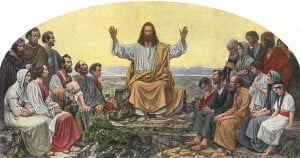 **Having been baptized and thus anointed as Prophet, Priest, and King, Jesus now begins demonstrating that the Kingdom of Heaven is at hand by His miracles. In Luke 6, He initiates a new phase of spreading the Kingdom He has come to establish: He begins to establish His Church.
I want you to notice how Jesus prepared for the great work that the Father had given Him: He spends all night in prayer in verse 12. Only after He has secluded Himself and prayed does He call His 12 apostles the next day, upon whom He will build His Church.
After calling the 12 apostles, Jesus begins to teach more directly about the Kingdom of Heaven, over which He rules. As a preacher, I like noticing the fact that Jesus may have spent all night in prayer not only asking for wisdom and strength to pick His disciples wisely but noticing also that He may have stayed up all night finishing His sermon – the Sermon on the Mount!
In His teaching, Jesus is, if you will, laying down the laws of His kingdom. He is revealing to His subjects how His Kingdom works and how it is that He chooses to rule. In the Beatitudes, Jesus is fulfilling not only the Law but also the Wisdom literature, for He is really speaking about wisdom above all things.
Just as the Psalms and the Proverbs set before us two ways of life, so does Jesus. These two paths are, of course, the way of the wise and the way of the fool. It would be fruitful to meditate on the meaning of each of the phrases in the Beatitudes, but it may be more profitable for me to tell you that they are all really talking about the same thing. The essence of the Beatitudes is love, especially love for God. But this love shows itself in a way that is foreign to man’s nature, for it comes in the form of humility and submission. At the heart of the Beatitudes is the attitude of prayer and a heart that understands that only one who knows that he cannot get for himself what he most truly needs is in a position to be blessed by God.
“Blessed are you poor, for yours is the Kingdom of God.” As with so many of Jesus’ teachings, a wooden literalism in understanding Jesus’ words would lead to heresy and nonsense. Though some have taught this, Jesus is not saying that being poor in earthly possessions is virtuous in and of itself. If this were true, then the hundreds of millions of Hindus in India and Bangladesh, the millions of animists in Africa who remain poor, and virtually everyone before the nineteenth century would be blessed by God by virtue of having been born into poverty. But what a travesty of the life, teaching, and ministry of Jesus – to claim that we are born blessed by God without ever having given our hearts and lives to Him!
The meaning is, of course, given in Matthew’s Gospel: “Blessed are the poor in spirit.” It is this poverty of spirit of which Jesus is speaking and by which Mary not only saw but also bore God. What God wants from us is our recognition that we are spiritually poor. More than this: we are all born spiritually bankrupt, for by nature we do not desire God. I have nothing in this life that I have not been given by God, and I have nothing to give Him back but my spiritual poverty.
“Blessed are you who hunger now, for you shall be filled.” Again, we are not to suppose that being hungry in the belly is virtuous in and of itself. Taken literally (if you want to play that game), then I am blessed about four or five times during the day, but spend a lot of time apart from God’s blessing.
“Blessed are those who hunger and thirst for righteousness” or “blessed are those who hunger for God.” This is the real meaning. Those who are poor in spirit because they are humble and acknowledge their weakness are also those who will be hungry for God. Those who are big, fat, and sassy are full. They’re full alright – they’re full of themselves and they’re filled with God’s good gifts. But they’ve mistaken the gift for the Giver, the creation for the Creator, and so they will go spiritually hungry, thinking they have no need for God.
What God desires is that just as our bellies tell us to go and find food to make us strong, lest we grow weaker and even die, our souls are to tell us to go and find our spiritual food, to make us strong, lest we grow weaker and die. We are to go out and eagerly, joyfully gather our daily bread, the Manna from heaven that God graciously provides, and which is nothing less than God Himself. “He has filled the hungry with good things” because He has fed the spiritually hungry with Himself.
“Blessed are those who weep now, for you shall laugh.” God takes the tragedy of our lives and turns it into a comedy. We weep now, but in the end we shall all laugh. I imagine that in heaven we’ll be laughing all the time and that one of the things we will laugh at is all the bone-headed, foolish things we did on earth. Because sin will be abolished and the sting of death will have been removed, we can safely laugh. I think it may be like those times on earth when we do something embarrassing at which others laugh. At the time, all we feel is shame and embarrassment, but once we are safely removed from the hurt, we can laugh again. Our dunderheadedness and buffoonery here one hearth may be the bread and butter of the great family reunion in heaven.
In this way, we see that the Beatitudes are always fresh in our lives. We are always called to be humble before God and to be hungry for His presence. If you meditate on the Beatitudes, you will see that they are all connected. St. Ambrose wrote, “Let us see how St. Luke encompassed the eight blessings in the four. We know that there are four cardinal virtues: temperance, justice, prudence, and fortitude. One who is poor in spirit is not greedy. One who weeps is not proud but is submissive and tranquil. One who mourns is humble. One who is just does not deny what he knows is given jointly to all for us. One who is merciful gives away his own goods. One who bestows his own goods does not seek another’s, nor does he contrive a trap for his neighbor. These virtues are interwoven and interlinked, so that one who has one may be seen to have several, and a single virtue befits the saints. Where virtue abounds, the reward too abounds . . . . Thus temperance has purity of heart and spirit, justice has compassion, patience has peace, and endurance has gentleness.”
Prayer: Lord, I acknowledge my poverty before You. I have nothing to offer You but myself but ask that out of Your riches You would come and bless me. I am hungry and not happy in this life because I have been filling myself with things that cannot feed me or sustain. Give Yourself to me that I may feed off You and find new life today. Amen.
Point for Meditation: Meditate more fully on the Beatitudes. You may work through them more slowly, or you may choose to look at verses 24-26. Consider in what ways you are poor in spirit and hungry and in what ways you believe yourself to be rich and full and too much accepted by the world.
Resolution: I resolve to meditate on one phrase from the Beatitudes and how it applies to my life.
Sermon on the Mount – U.S. Public Domain

Previous Post

March 7, 2017
Luke 6:1-11 - Stretch out your hand
Next Post
March 9, 2017 Luke 6:27-38 - The Greatest Kind of Love
Browse Our Archives
Select a Category Book Reviews Featured Give Us This Day Give Us This Day Devotional love me love my wife Love My Wife Reformed Catholicism Blog Spirit-Reality Take This Cup Uncategorized
Select a Month February 2022 November 2021 October 2021 August 2021 January 2021 December 2020 November 2020 September 2020 August 2020 July 2020 June 2020 May 2020 September 2018 July 2018 March 2018 November 2017 October 2017 September 2017 August 2017 July 2017 June 2017 May 2017 April 2017 March 2017 February 2017 January 2017 December 2016 November 2016 October 2016 September 2016 August 2016 July 2016 June 2016 May 2016 April 2016 March 2016 February 2016 January 2016 December 2015 November 2015 October 2015 September 2015 August 2015 July 2015 June 2015 May 2015 April 2015 March 2015 February 2015 January 2015 December 2014 November 2014 October 2014 September 2014 August 2014 July 2014 June 2014 May 2014 April 2014 March 2014 February 2014 January 2014 December 2013 November 2013 October 2013 September 2013 August 2013 July 2013 June 2013 May 2013 April 2013 March 2013 February 2013 January 2013 December 2012 November 2012 October 2012 September 2012 August 2012 July 2012 June 2012 May 2012 April 2012 March 2012 February 2012 January 2012 December 2011 November 2011 October 2011 September 2011 August 2011 July 2011 May 2011 April 2011 March 2011 February 2011 January 2011
Follow Us!
TAKE THE
Religious Wisdom Quiz
Who said, "The stone the builders rejected has become the cornerstone"?
Select your answer to see how you score.
Jesus David Isaiah Paul
Related posts from Give Us This Day
Easter: Do Not Go Home Unchanged
Good Friday - Suffering as a Means to...

Greet One Another With a Holy Kiss

TRENDING AT PATHEOS Evangelical

The REST of Your Life: A Creative Wrestles...
This week I had a conversation with a good friend from church....

How the author of the world's best hymn...
I've been working with John Newton for a while now. This makes...

Long before this Lectio Divina, Psalm 130 - the song - started...

What About the Trees? Another Living Parable
After I finished writing the last article about falling leaves as a...

Why Classical Education Is a Conversation, Not a...
Come and Read: Joy in Classical Education When I was a little...

Cornell University has received a great deal of negative publicity and intense...
view all Evangelical blogs
Ad-Free & Subscriber Log-In Subscription Support
- About Us
- 2026 Calendar
- Videos
- Podcasts
- Library of World Religions
- Faith In Media Tracker
- Advertise With Us
- Write for Us
- Privacy Policy
- Terms of Service
- Do Not Sell My Data
- Contact Us
- Radiant Digital
- Manage Newsletter Subscriptions
- Unsubscribe From Notifications
- Sitemap
Copyright 2008-2026, Patheos. All rights reserved.
Subscription Support Ad-Free & Subscriber Log-In
Follow Patheos