
BuddhistCatholicContemplativeEvangelicalGeneral ChristianHinduJewishLatter-day SaintMuslimNew VisionsProgressive Christian
Beliefs
- Buddhist
- Catholic
- Contemplative
- Evangelical
- General Christian
- Hindu
- Jewish
- Latter-day Saint
- More Voices
- Muslim
- New Visions
- Pagan
- Progressive Christian
Topics
- Religion News
- Food and Religion
- Sports and Religion
- Religious Art
- Religious Music and Entertainment
- Religious Events
- History and Religion
- Style and Religion
- Politics and Religion
- Women in Religion
- Recreation Outdoors and Religion
- Business Finance and Religion
- Careers Workplace and Religion
- Education and Religion
- Family Parenting and Religion
- Health Fitness and Religion
- Home and Religion
- Relationships and Religion
- Technology and Religion
- Travel and Religion
Columnists
- Buddhist Columnists
- Business Finance and Religion Columnists
- Careers Workplace and Religion Columnists
- Catholic Columnists
- Contemplative Columnists
- Education and Religion Columnists
- Evangelists Columnists
- Family Parenting and Religion Columnists
- General Christian Columnists
- Health Fitness and Religion Columnists
- Hindu Columnists
- History and Religion Columnists
- Home and Religion Columnists
- Jewish Columnists
- More Voices Columnists
- Latter Day Columnists
- Muslim Columnists
- New Visions Columnists
- Nonreligious Columnists
- Pagan Columnists
- Politics and Religion Columnists
- Progressive Columnists
- Recreation Outdoors and Religion Columnists
- Relationships and Religion Columnists
- Religion News Columnists
- Religious Art Columnists
- Religious Events Columnists
- Religious Music and Entertainment Columnists
- Sports and Religion Columnists
- Style and Religion Columnists
- Technology and Religion Columnists
- Travel and Religion Columnists
- Women in Religion Columnists
Resource Library
- 2026 Calendar
- Library of World Religions
- The 100 Most Holy Places on Earth
- Patheos Answers
- Podcasts
- Videos
- Faith Leaders Database
- Anglican Episcopalian
- Bahai
- Baptist
- Buddhism
- Christianity
- Confucianism
- Eastern Orthodoxy
- Hinduism
- Holiness and Pentecostal
- ISKCON
- Islam
- Judaism
- Lutheran
- Methodist
- The Church of Jesus Christ of Latter-day Saints
- New Age
- Paganism
- Presbytarian and Reformed
- Protestantism
- Religion Behind the Scenes
- Roman Catholic
- Scientology
- Shia Islam
- Sikhism
- Sufism
- Sunni Islam
- Taoism
- Zen
- See all religions
Research Tools
 Ad-Free & Subscriber Log-In Subscription Support
Ad-Free & Subscriber Log-In Subscription Support
Follow Patheos 

- Trending:
- Forgiveness
- |
- Marriage
- |
- Consciousness
- |
- Death Penalty
- |
- Election
- |
- Halloween
 Give Us This Day
- Home
- Evangelical
- John 13:1-17 – The New Commandment
John 13:1-17 – The New Commandment
Last updated on: July 12, 2017 at 10:42 pm by Fr. Charles Erlandson
John 13:1-17 – The New Commandment 2017-07-12T22:42:35-05:00 Fr. Charles Erlandson
Patheos Explore the world's faith through different perspectives on religion and spirituality! Patheos has the views of the prevalent religions and spiritualities of the world.
 This meditation is really a Maundy Thursday meditation, but here it is on the Saturday before Holy Week.
Jesus says to you today: “A new commandment I give unto you, That you love one another; as I have loved you, that you also love one another” (John 13:34). This name, “Maundy Thursday,” comes from the Latin words mandatum novum, or “new commandment,” taken from John 13:34.
Now why is this a new commandment? The commandments to love God and love your neighbor as yourself come from the Old Testament. It is new because the commandments to love God and love neighbor are hidden away among 612 other commandments. Each of these was either about loving God or loving neighbor, and yet it was easy to miss. New, because it is through Jesus Christ Himself that we see the love incarnated that we are commanded to have. New, because Jesus is about to demonstrate with His life the love that He teaches with His mouth.
So Jesus gives us a new commandment – in fact, the commandment above all others: the commandment to love. On Maundy Thursday, even before the ultimate story of love found in Good Friday, we find in John 13 a complete teaching on love. For on Maundy Thursday, and every day of our lives, Jesus gives us the example of love, the commandment of love, and the strength to love.
Though the entire life of Jesus was an act of sacrificial love, on Maundy Thursday, Jesus gave His disciples – and that includes us – a striking example of love. For on the night in which He was betrayed, He did not demand that His disciples serve Him . . . . He didn’t pamper Himself . . . . He didn’t give His body rest and luxury to prepare for the exhausting and most trying day ahead.
On the night in which He was betrayed, which was also the night He was tried and sentenced, before He did anything else . . . He washed His disciples’ feet.
Now we may not appreciate the significance of this job in 21st century America, but in Jesus’ day, this was one of the lowest jobs around, reserved for common servants. You may not appreciate how humbling it is to wash another person’s feet, especially in a culture where sandals were worn every day and baths were only as frequent as new moons. But feet in the 1st century – who are we kidding? – feet in every century – are dirty, stinky, and smelly. As a parent of young children, I see that every day. (That’s right, blame the kids!)
I remember once in eighth grade when I was on a youth leadership retreat, and the leaders of the youth group decided to have a foot-washing ceremony one night. Earlier that day, I had gone off by myself to explore and play. I seem to remember something about a tire swing on a tree and a bunch of really wet mud all around it. But I digress.
We gathered in a circle to wash each other’s feet. Slowly, the bowl and towel passed around the circle, until it was Christina Cathcart’s turn to wash someone’s feet: mine. When I took off my shoes and socks, I embarrassingly discovered a ring of black all around my ankles and suddenly remembered the tire swing and pool of mud. I may have been embarrassed, but Christina Cathcart was mortified. How humbling to her, and yet more than anyone else that night she had an opportunity to understand love.
But what if the person washing your feet were Jesus Christ Himself, wiping your feet with His own clothing? This was only one among many acts of love He performed in a life that was a living, walking advertisement for love. As John writes of Jesus, “having loved his own which were in the world, He loved them unto the end.”
When Peter learned the lesson of love, He asked to have not only His feet but also His whole body washed. And we, who are His disciples, are to have our whole bodies and souls washed by Him. This is what He does for us in baptism, coming to us in love, and offering to cleanse us. This is what He does in the Lord’s Supper. In the Prayer of Humble Access we pray: “Grant us, therefore, gracious Lord, so to eat the flesh of thy dear Son Jesus Christ, and to drink his blood, that our sinful bodies may be made clean by his body, and our souls washed through his most precious blood.”
Here, on Maundy Thursday, then, we see both Baptism and the Holy Communion, as Jesus offers Himself to us that we might live in love.
How humbling, that the Lord who washed His disciples’ dirty, stinking feet in the upper room, has washed your sinful soul – much, much dirtier and stinkier than feet can ever get. How humbling, that the King of Glory should come to His disciples this way, and dirty Himself with the stains of our darkest sins, day after day, broken commandment after broken commandment of dirty, slimy sin!
Notice that Jesus gives the example of love first, and then the commandment – as if to say to us: “anyone can tell you to love, but let me show you first so that you will truly understand.” Which is easier? To say, “Love one another” or to actually love and then say “Love as I have loved you”? Jesus follows up His humble example with a concrete commandment, John 13:34 – “A new commandment I give unto you, that you love one another; as I have loved you, that you also love one another.”
It’s not enough for us to simply have our feet washed by our Lord: He washes us so that we might become like Him. He washed His disciples’ feet, so that they might learn love. And He washes your body and soul, so that you might learn to love and serve, as He did.
This love that was so real in the life of Jesus must be made just as real in the life of His disciples. Palm Sunday teaches that the Kingdom of God is a Kingdom of humility, service, and love. And Jesus says, “If you want to be great in the Kingdom of heaven, then learn to be the servant of all.” “No disciple is greater than His master but strives to be like Him in all things.” And now: “Love one another, as I have loved you.”
It is your Christian duty – and a duty that should proceed spontaneously from a washed soul – to wash the feet of the saints. “Love one another, as I have loved you.”
Look for opportunities to serve; make yourself the most humble person you know; take the lowest job in the room. Anoint the Body of your Lord Jesus Christ – anoint His Body, the Church – by loving one another, as He first loved you. The new commandment to love one another begins by loving God but must continue by loving the saints. It must conclude by loving those not like you. Love those who are not like you and who may not reciprocate the favor. Love those who hate you. Remember that Jesus washed the feet and offered His love feast to the very one who betrayed Him.
If we keep opening our arms and doors of our churches, God’s communities of love, we will get some different, strange people come through those doors – and we must love them. We might get some teenagers and young people who don’t dress quite like us or talk just like us or who might say or do some startling things. And we must love them. We might meet neighbors who will eat our food, and play our games, and hear our music – and never even think about coming into God’s house – and we must love them too.
“As I have loved you, you also love one another.”
But how shall we ever find the strength within ourselves for such an impossible task – to love as our Lord loved us? Jesus was able to love perfectly, in spite of the pain He endured, in spite of being rejected, not just because He was God but also because His human nature actively choose to obey the Father and was sustained by the Holy Spirit. That is where He found His strength.
We can only obey this great commandment of Jesus – to love as He loved us – through the same strength that Jesus Christ found: the strength of God the Father through Jesus Christ and by the Holy Spirit.
There are many ways to find the strength of God, but all of them are only through Jesus Christ. But Jesus gave His disciples a special way to celebrate His love and be strengthened to love with His love and power: His supper. After Jesus had shown His disciples the example of love, and after He had given them the commandment of love. He gave them the power of love through the sacramental meal He ate with them. He gave Himself to them, just as He would on the Cross a short time later.
Here before us, on the Lord’s Table whenever we partake, is liquid and solid love – given for you. Here is the power to keep His commandment. And here before us every day, in all of the ways that Jesus offers Himself to us each day, we have Jesus Christ, love incarnate and the power to love.
“A new commandment I give to you, that you love one another; as I have loved you, that you also love one another.”
Resolution: I resolve to find one specific way to love today.
Prayer: Father, as You have loved us by sending Your Son; Jesus, as You have loved us by giving up Your life for us; so may You give us the gift of love through Your Spirit that we may obey Your commandment to love and be made like our Master in all things. Amen.
Points for Meditation:
- As you meditate on the Gospel narratives of Christ’s betrayal, Passion, Crucifixion, and Resurrection, meditate on the love of God as He gives them through the life of Christ.
- As you prepare to partake of the Lord’s Supper this week, take extra care to prepare yourself by meditating on the Lord in His Supper.
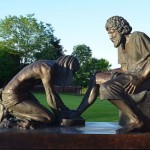
Jesus Washing Feet Statue – Creative Commons Attribution-Share Alike 2.0 Generic license

example power commandment of love
Previous Post
July 11, 2017
John 12:44-50 - Power and Fear, Glory and Shame
Next Post
July 13, 2017 Are You Really the Disciple Jesus Loved?
Browse Our Archives
Select a Category Book Reviews Featured Give Us This Day Give Us This Day Devotional love me love my wife Love My Wife Reformed Catholicism Blog Spirit-Reality Take This Cup Uncategorized
Select a Month February 2022 November 2021 October 2021 August 2021 January 2021 December 2020 November 2020 September 2020 August 2020 July 2020 June 2020 May 2020 September 2018 July 2018 March 2018 November 2017 October 2017 September 2017 August 2017 July 2017 June 2017 May 2017 April 2017 March 2017 February 2017 January 2017 December 2016 November 2016 October 2016 September 2016 August 2016 July 2016 June 2016 May 2016 April 2016 March 2016 February 2016 January 2016 December 2015 November 2015 October 2015 September 2015 August 2015 July 2015 June 2015 May 2015 April 2015 March 2015 February 2015 January 2015 December 2014 November 2014 October 2014 September 2014 August 2014 July 2014 June 2014 May 2014 April 2014 March 2014 February 2014 January 2014 December 2013 November 2013 October 2013 September 2013 August 2013 July 2013 June 2013 May 2013 April 2013 March 2013 February 2013 January 2013 December 2012 November 2012 October 2012 September 2012 August 2012 July 2012 June 2012 May 2012 April 2012 March 2012 February 2012 January 2012 December 2011 November 2011 October 2011 September 2011 August 2011 July 2011 May 2011 April 2011 March 2011 February 2011 January 2011
Follow Us!
TAKE THE
Religious Wisdom Quiz
How many books of the Bible are named after women?
Select your answer to see how you score.
2 4 3 1
Related posts from Give Us This Day

Is Christianity a Relationship and Not a Religion?

Participating in the Unity of the Trinity

The Different States of Love - and the...
Are You Really the Disciple Jesus Loved?
TRENDING AT PATHEOS Evangelical

How the author of the world's best hymn...
I've been working with John Newton for a while now. This makes...

Long before this Lectio Divina, Psalm 130 - the song - started...

What About the Trees? Another Living Parable
After I finished writing the last article about falling leaves as a...

Why Classical Education Is a Conversation, Not a...
Come and Read: Joy in Classical Education When I was a little...

Falling Leaves: A Living Parable on Letting Go
I’ve spent the vast majority of my life in the southeast corner...

Cornell University has received a great deal of negative publicity and intense...
view all Evangelical blogs
Ad-Free & Subscriber Log-In Subscription Support
- About Us
- 2026 Calendar
- Videos
- Podcasts
- Library of World Religions
- Faith In Media Tracker
- Advertise With Us
- Write for Us
- Privacy Policy
- Terms of Service
- Do Not Sell My Data
- Contact Us
- Radiant Digital
- Manage Newsletter Subscriptions
- Unsubscribe From Notifications
- Sitemap
Copyright 2008-2026, Patheos. All rights reserved.
Subscription Support Ad-Free & Subscriber Log-In
Follow Patheos