
BuddhistCatholicContemplativeEvangelicalGeneral ChristianHinduJewishLatter-day SaintMuslimNew VisionsProgressive Christian
Beliefs
- Buddhist
- Catholic
- Contemplative
- Evangelical
- General Christian
- Hindu
- Jewish
- Latter-day Saint
- More Voices
- Muslim
- New Visions
- Pagan
- Progressive Christian
Topics
- Religion News
- Food and Religion
- Sports and Religion
- Religious Art
- Religious Music and Entertainment
- Religious Events
- History and Religion
- Style and Religion
- Politics and Religion
- Women in Religion
- Recreation Outdoors and Religion
- Business Finance and Religion
- Careers Workplace and Religion
- Education and Religion
- Family Parenting and Religion
- Health Fitness and Religion
- Home and Religion
- Relationships and Religion
- Technology and Religion
- Travel and Religion
Columnists
- Buddhist Columnists
- Business Finance and Religion Columnists
- Careers Workplace and Religion Columnists
- Catholic Columnists
- Contemplative Columnists
- Education and Religion Columnists
- Evangelists Columnists
- Family Parenting and Religion Columnists
- General Christian Columnists
- Health Fitness and Religion Columnists
- Hindu Columnists
- History and Religion Columnists
- Home and Religion Columnists
- Jewish Columnists
- More Voices Columnists
- Latter Day Columnists
- Muslim Columnists
- New Visions Columnists
- Nonreligious Columnists
- Pagan Columnists
- Politics and Religion Columnists
- Progressive Columnists
- Recreation Outdoors and Religion Columnists
- Relationships and Religion Columnists
- Religion News Columnists
- Religious Art Columnists
- Religious Events Columnists
- Religious Music and Entertainment Columnists
- Sports and Religion Columnists
- Style and Religion Columnists
- Technology and Religion Columnists
- Travel and Religion Columnists
- Women in Religion Columnists
Resource Library
- 2026 Calendar
- Library of World Religions
- The 100 Most Holy Places on Earth
- Patheos Answers
- Podcasts
- Videos
- Faith Leaders Database
- Anglican Episcopalian
- Bahai
- Baptist
- Buddhism
- Christianity
- Confucianism
- Eastern Orthodoxy
- Hinduism
- Holiness and Pentecostal
- ISKCON
- Islam
- Judaism
- Lutheran
- Methodist
- The Church of Jesus Christ of Latter-day Saints
- New Age
- Paganism
- Presbytarian and Reformed
- Protestantism
- Religion Behind the Scenes
- Roman Catholic
- Scientology
- Shia Islam
- Sikhism
- Sufism
- Sunni Islam
- Taoism
- Zen
- See all religions
Research Tools
 Ad-Free & Subscriber Log-In Subscription Support
Ad-Free & Subscriber Log-In Subscription Support
Follow Patheos 

- Trending:
- Forgiveness
- |
- Marriage
- |
- Consciousness
- |
- Death Penalty
- |
- Election
- |
- Halloween
 Give Us This Day
- Home
- Evangelical
- How I Became an Anglican
How I Became an Anglican
Last updated on: October 13, 2011 at 3:53 pm by Fr. Charles Erlandson
How I Became an Anglican 2011-10-13T15:53:16-05:00 Fr. Charles Erlandson
Patheos Explore the world's faith through different perspectives on religion and spirituality! Patheos has the views of the prevalent religions and spiritualities of the world.
 How I Became an Anglican

The conversion narratives of people who have become Roman Catholics or Orthodox Christians are filled with people courageously and passionately seeking “The True Church.” I wish I could tell you such a glowing conversion narrative in telling you how I became an Anglican. I also wish I could tell you an exciting story about how I became a Christian. I was tempted for a moment to pass off as my own Mike Warnke’s bogus story about having white hair and six inch fingernails and a Satanic ring of 1500 members I once led. But instead, you’re stuck with my real story, in hopes that the story God has written is sufficiently glorious for Him.
The good news is that I’ve never known a moment when I didn’t believe in God and in Jesus Christ, and I haven’t had a real moment of doubt. I know: it’s not very glamorous. But I see it as a kind of miracle in slow motion, this fact that God has always had me in His hand and has never let me go.
I grew up mostly in Bible churches and in a good Christian home where I got a well-grounded sense of God and a strong love of God’s Word. I never really thought about other church traditions much until college or even after. But I remember as a kid having a translucent attraction to Roman Catholicism. I grew up not even being sure Roman Catholics were true Christians because of their many errors. And yet there was something beautiful and mysterious that I saw through a glass darkly.
My first real test of exploring a different church tradition came when I graduated from college in 1983 and decided to live in Humble, Texas with my older brother, Paul. We were pretty sure we weren’t going to go the local Southern Baptist Church, after they tried to palm off on us some literature from that great Baptist theologian: Jimmy Swaggart. By that time we were both staunch Calvinists, and we wanted, if possible, to find a Calvinistic church. What helped us make our decision was a group of people carrying signs reading, “H.E.L.P. – Humble Evangelicals to Limit Poverty.” We grew up in a home where we cared about the poor and civil rights and the Democrat Party (we later had a conversion to Republicanism). We found out about the church involved in H.E.L.P. and decided to visit Believer’s Fellowship one Sunday. George Grant, who has since gone onto bigger and better things, was the pastor at the time, and Kemper Crabb led the music.
We discovered pretty quickly that the church was not only Calvinistic but strongly so. In fact, Believer’s Fellowship turned out to be a Reconstructionist church that had a lot of literature fromTyler,Texasby guys like Gary North, Ray Sutton, and David Chilton. Theologically and liturgically, Believer’s Fellowship was a half a step behind the Reconstructionist Mecca of Tyler, in whose direction we bowed 5 times daily (not really – just checking to make sure you’re still reading). We began reading about church history, economics, politics, and were gun-ho to change the world for Christ.
At that time, the church inTylerand Believer’s Fellowship were both becoming more liturgical. Elements of the Book of Common Prayer were introduced into the worship, something which has shaped me forever. It got into my blood, even before I knew what hit me. It wasn’t until years later that I began to understand why we did what we did.
In 1988 I moved to Mecca (Tyler) to teach at Good Shepherd School. Within a few months, the church had voted to join the Reformed Episcopal Church. I had come for the Reconstructionist theology but stayed for the Anglicanism. Good Shepherd Church experienced a painful transformation from being a Reconstructionist church to being an Anglican one. I made the transition with them, beginning to see not only the lacks and immaturity of Reconstructionism but also the profundity and fullness of Anglicanism.
I’m not sure just why I stayed to become an Anglican. I’m not even sure at what point I became dedicated to becoming an Anglican instead of something else. This seems strange for someone who’s now studied theology, church history, has a Ph.D. in Religious Studies, and who wrote his Ph.D. dissertation on Anglican identity. But what it shows is that people don’t all arrive at their religious identity for the same reason. Some choose to remain whatever their parents were. Some come to a particular church for social reasons and decide to adopt the church tradition of the church that welcomed them. Others dedicate themselves to finding TTC (The True Church) and morph over time from being Evangelical to being Reformed to being Anglican to being Roman Catholic or Orthodox, or follow some other trajectory.
But God worked differently in my life. He brought me to a vibrant church in Tyler that wanted to see God’s Word fully lived out in every area of life. It was a church full of koinonia, body life, and a dedication to theology and practical action in its community. And it just so happened to be using parts of the Prayer Book. That gave me a powerful vision for what a church could be, which led me to another wonderful church – Good Shepherd.
For me, I came to these churches first for something else – a Calvinistic theology worked out in faithful practice in every area of life – but was introduced to Anglican worship and later an Anglican ethos. My life since about 1993 has been one long pursuit of God as He has incarnated Himself into the Anglican tradition. I’ve struggled at times to understand it all, but God has been good and has led me gently into an ever deepening understanding of Himself and His Kingdom, as I’ve been challenged to see if I think Anglicanism is the most faithful reflection of the Church. So far, I have.
Having done this primarily in the Reformed Episcopal Church as expressed in GoodShepherdChurchin Tyler, Anglicanism has become an inseparable part of who I am. I teach at an Anglican classical school where all 5 of my kids attend (the same school I originally came to Tyler for in 1988); I married my wife at Good Shepherd (after having led a book study at Good Shepherd on Jim Jordan’s book Through New Eyes); most of my kids were baptized there; I was ordained there twice and now serve as the assistant rector; I obtained a Ph.D. in Anglicanism; and I teach at an Anglican seminary (Cranmer House).
As with most other things in my life, God has taken the slow, steady, organic way of growing me as an Anglican. Everyone comes to Christ as He incarnates Himself in particular church traditions. I rejoice to say that Christ has come to me not exclusively but especially through Anglicanism.
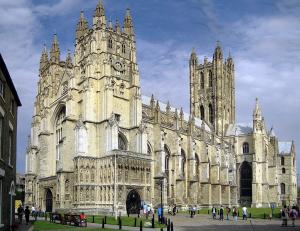
Photo: Pilgrimage on Wikipedia
Previous Post

October 13, 2011
Friday of 16th Sunday after Trinity - 1 Thessalonians 4:13-18
Next Post
October 14, 2011 Saturday of the 16th Sunday after Trinity - 1 Thessalonians 5:1-11
Browse Our Archives
Select a Category Book Reviews Featured Give Us This Day Give Us This Day Devotional love me love my wife Love My Wife Reformed Catholicism Blog Spirit-Reality Take This Cup Uncategorized
Select a Month February 2022 November 2021 October 2021 August 2021 January 2021 December 2020 November 2020 September 2020 August 2020 July 2020 June 2020 May 2020 September 2018 July 2018 March 2018 November 2017 October 2017 September 2017 August 2017 July 2017 June 2017 May 2017 April 2017 March 2017 February 2017 January 2017 December 2016 November 2016 October 2016 September 2016 August 2016 July 2016 June 2016 May 2016 April 2016 March 2016 February 2016 January 2016 December 2015 November 2015 October 2015 September 2015 August 2015 July 2015 June 2015 May 2015 April 2015 March 2015 February 2015 January 2015 December 2014 November 2014 October 2014 September 2014 August 2014 July 2014 June 2014 May 2014 April 2014 March 2014 February 2014 January 2014 December 2013 November 2013 October 2013 September 2013 August 2013 July 2013 June 2013 May 2013 April 2013 March 2013 February 2013 January 2013 December 2012 November 2012 October 2012 September 2012 August 2012 July 2012 June 2012 May 2012 April 2012 March 2012 February 2012 January 2012 December 2011 November 2011 October 2011 September 2011 August 2011 July 2011 May 2011 April 2011 March 2011 February 2011 January 2011
Follow Us!
TAKE THE
Religious Wisdom Quiz
Who wrote many of the Psalms?
Select your answer to see how you score.
Moses Solomon Paul David
Related posts from Give Us This Day
Tracts for the Times 2.0 Tract #2 Part...
Tract #2 Part 1 – When Did Anglicanism...
Tract #1 – What is Anglicanism?
The 1-Sentence Definition of Anglicanism
TRENDING AT PATHEOS Evangelical

How the author of the world's best hymn...
I've been working with John Newton for a while now. This makes...

Long before this Lectio Divina, Psalm 130 - the song - started...

What About the Trees? Another Living Parable
After I finished writing the last article about falling leaves as a...

Why Classical Education Is a Conversation, Not a...
Come and Read: Joy in Classical Education When I was a little...

Falling Leaves: A Living Parable on Letting Go
I’ve spent the vast majority of my life in the southeast corner...

Cornell University has received a great deal of negative publicity and intense...
view all Evangelical blogs
Ad-Free & Subscriber Log-In Subscription Support
- About Us
- 2026 Calendar
- Videos
- Podcasts
- Library of World Religions
- Faith In Media Tracker
- Advertise With Us
- Write for Us
- Privacy Policy
- Terms of Service
- Do Not Sell My Data
- Contact Us
- Radiant Digital
- Manage Newsletter Subscriptions
- Unsubscribe From Notifications
- Sitemap
Copyright 2008-2026, Patheos. All rights reserved.
Subscription Support Ad-Free & Subscriber Log-In
Follow Patheos