
BuddhistCatholicContemplativeEvangelicalGeneral ChristianHinduJewishLatter-day SaintMuslimNew VisionsProgressive Christian
Beliefs
- Buddhist
- Catholic
- Contemplative
- Evangelical
- General Christian
- Hindu
- Jewish
- Latter-day Saint
- More Voices
- Muslim
- New Visions
- Pagan
- Progressive Christian
Topics
- Religion News
- Food and Religion
- Sports and Religion
- Religious Art
- Religious Music and Entertainment
- Religious Events
- History and Religion
- Style and Religion
- Politics and Religion
- Women in Religion
- Recreation Outdoors and Religion
- Business Finance and Religion
- Careers Workplace and Religion
- Education and Religion
- Family Parenting and Religion
- Health Fitness and Religion
- Home and Religion
- Relationships and Religion
- Technology and Religion
- Travel and Religion
Columnists
- Buddhist Columnists
- Business Finance and Religion Columnists
- Careers Workplace and Religion Columnists
- Catholic Columnists
- Contemplative Columnists
- Education and Religion Columnists
- Evangelists Columnists
- Family Parenting and Religion Columnists
- General Christian Columnists
- Health Fitness and Religion Columnists
- Hindu Columnists
- History and Religion Columnists
- Home and Religion Columnists
- Jewish Columnists
- More Voices Columnists
- Latter Day Columnists
- Muslim Columnists
- New Visions Columnists
- Nonreligious Columnists
- Pagan Columnists
- Politics and Religion Columnists
- Progressive Columnists
- Recreation Outdoors and Religion Columnists
- Relationships and Religion Columnists
- Religion News Columnists
- Religious Art Columnists
- Religious Events Columnists
- Religious Music and Entertainment Columnists
- Sports and Religion Columnists
- Style and Religion Columnists
- Technology and Religion Columnists
- Travel and Religion Columnists
- Women in Religion Columnists
Resource Library
- 2026 Calendar
- Library of World Religions
- The 100 Most Holy Places on Earth
- Patheos Answers
- Podcasts
- Videos
- Faith Leaders Database
- Anglican Episcopalian
- Bahai
- Baptist
- Buddhism
- Christianity
- Confucianism
- Eastern Orthodoxy
- Hinduism
- Holiness and Pentecostal
- ISKCON
- Islam
- Judaism
- Lutheran
- Methodist
- The Church of Jesus Christ of Latter-day Saints
- New Age
- Paganism
- Presbytarian and Reformed
- Protestantism
- Religion Behind the Scenes
- Roman Catholic
- Scientology
- Shia Islam
- Sikhism
- Sufism
- Sunni Islam
- Taoism
- Zen
- See all religions
Research Tools
 Ad-Free & Subscriber Log-In Subscription Support
Ad-Free & Subscriber Log-In Subscription Support
Follow Patheos 

- Trending:
- Forgiveness
- |
- Marriage
- |
- Consciousness
- |
- Death Penalty
- |
- Election
- |
- Halloween
 Give Us This Day
- Home
- Evangelical
- Holy Saturday – The Gospel of Suffering, Part III
Holy Saturday – The Gospel of Suffering, Part III
Last updated on: April 15, 2017 at 8:59 am by Fr. Charles Erlandson
Holy Saturday – The Gospel of Suffering, Part III 2017-04-15T08:59:06-05:00 Fr. Charles Erlandson
Patheos Explore the world's faith through different perspectives on religion and spirituality! Patheos has the views of the prevalent religions and spiritualities of the world.
 The 3-fold movement of “The Gospel of Suffering” is this:
- That far from being a sign of God’s non-existence, apathy, or impotence, human suffering is transformed by Christ’s Incarnation into a sign of God’s presence, love, and power.
- That because Christ has become man and suffered to redeem man, suffering is a primary means of participating in God’s nature and being united to Him.
- That as Christians partake of Christ and His suffering, their own suffering is transformed by God into glory and joy.
Here is the 3rd and final part of The Gospel of Suffering:
III. As Christians partake of Christ and His suffering, their own suffering is now not only humiliating and painful but also transformed by God into joy and blessing.
Christ’s suffering, therefore, is a sign of God’s power and love and is a means by which Christians are united to the life of Christ. But the final amazing act of grace has yet to be revealed, for God has promised that those who partake of Christ’s suffering also partake of His glory and joy.
God’s promises to transform suffering into glory and joy are so incredibly wonderful that we might not believe them, had not God clearly revealed them to us in His Word. St. Paul reveals the Gospel of Suffering when he writes: “Not only that, but we rejoice in our sufferings, knowing that suffering produces endurance, and endurance produces character, and character produces hope” (Romans 5:3-4. See also Matthew 5:10; Colossian 1:24, James 1:2-4, and 1 Peter 4:13.)
Having united Himself to His Body, the Church, Jesus Christ continues to live His redemptive life through us. His life, therefore, is the pattern for ours, both individually and corporately. Only after the humiliation of God becoming man, the degradation of being born a helpless infant in a beast’s feeding trough, and the deprivation of suffering and dying, was Christ raised to glory (see Philippians 2.) In fact, it was because Jesus obediently suffered in love that He, in His human nature, was raised to the glory of the Father. “But we see him who for a little while was made lower than the angels, namely Jesus, crowned with glory and honor because of the suffering of death” (Hebrews 2:9).
Perhaps the most beautiful and surprising thing of all is that Christ’s glory and reign began at the very moment when it looked like He was most humiliated and lost: at the Cross. At the Cross, Jesus was raised up and exalted, and the Cross became a Tree of Life. Thus, the Cross is the sum and symbol of God’s transformation of evil into good and suffering into glory.
Since Christians are truly united to Jesus, through suffering, Christians are to live in a state of joy. The suffering doesn’t magically go away, but its meaning and effect in our lives are transformed. What was once humiliating and painful is now joyful and blessed.
How can this be? Because suffering unites us to God, and being united to God is the end of man and the source of all true joy.
Now you know why Paul and Silas were singing for joy at midnight when they sat, mildewing in a Roman jail in Philippi: they knew that they have been counted worthy to partake of Christ’s sufferings. They knew that by their suffering, they were united to their Lord. Now we know why we, too, can rejoice with James in trials and tribulations: by them, we partake of Christ and His nature and character.
We rejoice because suffering is the World’s Greatest Mnemonic Device, which reminds us of God and His goodness. For while we tend to forget God when things are good and hallucinate that we are gods, suffering evaporates our mirages of self and reminds us of who we are. Being deprived, poor, and needy, remind us better than anything else that are, and forever will be, dependent on God and His mercy. Every pang of suffering in your life is God’s reminder to remember Him and turn to Him.
Suffering is also the Angel (“messenger”) of the Lord, announcing that God is very near. If suffering proclaims that we share in the fellowship of Christ’s suffering, it also trumpets that we are truly in the presence of the resurrected, glorified Christ. And, therefore, we rejoice!
It’s no wonder, then, that Christians see God especially in their suffering. It’s no wonder that we often most deeply experience God and His love in our suffering, and not when things appear to be going well.
This Mnemonics of Suffering, as we may call it, is embodied for us in the Eucharist or Lord’s Supper. We remember Jesus Christ every time we partake of Him in His Supper, for the best way to remember someone is to have that Person present before you.
The Lord’s Supper, or Holy Communion, is a partaking of the sacrifice of Christ, including not only His death but also His suffering. But the Holy Communion cannot be a partaking of the suffering and death of Christ without also being a partaking of His Resurrection. Truly partaking of the crucified Christ in the Holy Communion, we receive as well the very life of Christ and are raised to glory with Him. Truly partaking of the Bread of Life and Living Water at the Wedding Feast of the Lamb, we rejoice with exceedingly great joy!
We rejoice because our suffering remind us of the sufferings of others and binds us to them, as Christ has bound Himself to us by His sufferings. Our suffering enables us to sympathize with those who suffer and to seek to bear their burdens in the Name of the suffering Christ. God “comforts us in all our affliction, so that we may be able to comfort those who are in any affliction, with the comfort with which we ourselves are comforted by God. For as we share abundantly in Christ’s sufferings, so through Christ we share abundantly in comfort too,” (2 Corinthians 1:4-5.)
We rejoice, finally, because suffering is the Measure of God and Man. The immense sufferings of Christ are a measure of man’s sins, for with His suffering and death Christ paid for the sins of the whole world. But suffering is also, therefore, a measure of the magnitude of God’s mercy. For as great as our sins are, God’s goodness and love are even greater. Suffering is also a measure of the size of the glory to come. For, St. Paul teaches, “the sufferings of this present time are not worth comparing with the glory that is to be revealed to us” (Romans 8:18).
Far from being a sign of God’s non-existence, apathy, or impotence, human suffering is transformed by Christ’s Incarnation into a sign of God’s presence, love, and power. Because God united Himself in Christ to man and his suffering, suffering is now a means of union with Christ and participating in God’s nature. Because Christians partake of Christ and His suffering, their own suffering is now transformed by God into joy and blessing.
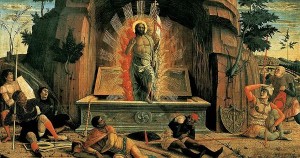
The Resurrection by Mantegna – Public Domain

Previous Post
April 14, 2017
Good Friday - The Gospel of Suffering, Part II
Next Post
April 16, 2017 Easter Monday - Luke 24:1-12
Browse Our Archives
Select a Category Book Reviews Featured Give Us This Day Give Us This Day Devotional love me love my wife Love My Wife Reformed Catholicism Blog Spirit-Reality Take This Cup Uncategorized
Select a Month February 2022 November 2021 October 2021 August 2021 January 2021 December 2020 November 2020 September 2020 August 2020 July 2020 June 2020 May 2020 September 2018 July 2018 March 2018 November 2017 October 2017 September 2017 August 2017 July 2017 June 2017 May 2017 April 2017 March 2017 February 2017 January 2017 December 2016 November 2016 October 2016 September 2016 August 2016 July 2016 June 2016 May 2016 April 2016 March 2016 February 2016 January 2016 December 2015 November 2015 October 2015 September 2015 August 2015 July 2015 June 2015 May 2015 April 2015 March 2015 February 2015 January 2015 December 2014 November 2014 October 2014 September 2014 August 2014 July 2014 June 2014 May 2014 April 2014 March 2014 February 2014 January 2014 December 2013 November 2013 October 2013 September 2013 August 2013 July 2013 June 2013 May 2013 April 2013 March 2013 February 2013 January 2013 December 2012 November 2012 October 2012 September 2012 August 2012 July 2012 June 2012 May 2012 April 2012 March 2012 February 2012 January 2012 December 2011 November 2011 October 2011 September 2011 August 2011 July 2011 May 2011 April 2011 March 2011 February 2011 January 2011
Follow Us!
TAKE THE
Religious Wisdom Quiz
How old was Noah when flood began?
Select your answer to see how you score.
550 years 500 years 600 years 450 years
Related posts from Give Us This Day

James Clark - Book Review of Take This...
Joseph Laughon - Book Review of Take This...
Jesus Took on All Human Suffering - Part...
TRENDING AT PATHEOS Evangelical

How the author of the world's best hymn...
I've been working with John Newton for a while now. This makes...

Long before this Lectio Divina, Psalm 130 - the song - started...

What About the Trees? Another Living Parable
After I finished writing the last article about falling leaves as a...

Why Classical Education Is a Conversation, Not a...
Come and Read: Joy in Classical Education When I was a little...

Falling Leaves: A Living Parable on Letting Go
I’ve spent the vast majority of my life in the southeast corner...

Cornell University has received a great deal of negative publicity and intense...
view all Evangelical blogs
Ad-Free & Subscriber Log-In Subscription Support
- About Us
- 2026 Calendar
- Videos
- Podcasts
- Library of World Religions
- Faith In Media Tracker
- Advertise With Us
- Write for Us
- Privacy Policy
- Terms of Service
- Do Not Sell My Data
- Contact Us
- Radiant Digital
- Manage Newsletter Subscriptions
- Unsubscribe From Notifications
- Sitemap
Copyright 2008-2026, Patheos. All rights reserved.
Subscription Support Ad-Free & Subscriber Log-In
Follow Patheos