
BuddhistCatholicContemplativeEvangelicalGeneral ChristianHinduJewishLatter-day SaintMuslimNew VisionsProgressive Christian
Beliefs
- Buddhist
- Catholic
- Contemplative
- Evangelical
- General Christian
- Hindu
- Jewish
- Latter-day Saint
- More Voices
- Muslim
- New Visions
- Pagan
- Progressive Christian
Topics
- Religion News
- Food and Religion
- Sports and Religion
- Religious Art
- Religious Music and Entertainment
- Religious Events
- History and Religion
- Style and Religion
- Politics and Religion
- Women in Religion
- Recreation Outdoors and Religion
- Business Finance and Religion
- Careers Workplace and Religion
- Education and Religion
- Family Parenting and Religion
- Health Fitness and Religion
- Home and Religion
- Relationships and Religion
- Technology and Religion
- Travel and Religion
Columnists
- Buddhist Columnists
- Business Finance and Religion Columnists
- Careers Workplace and Religion Columnists
- Catholic Columnists
- Contemplative Columnists
- Education and Religion Columnists
- Evangelists Columnists
- Family Parenting and Religion Columnists
- General Christian Columnists
- Health Fitness and Religion Columnists
- Hindu Columnists
- History and Religion Columnists
- Home and Religion Columnists
- Jewish Columnists
- More Voices Columnists
- Latter Day Columnists
- Muslim Columnists
- New Visions Columnists
- Nonreligious Columnists
- Pagan Columnists
- Politics and Religion Columnists
- Progressive Columnists
- Recreation Outdoors and Religion Columnists
- Relationships and Religion Columnists
- Religion News Columnists
- Religious Art Columnists
- Religious Events Columnists
- Religious Music and Entertainment Columnists
- Sports and Religion Columnists
- Style and Religion Columnists
- Technology and Religion Columnists
- Travel and Religion Columnists
- Women in Religion Columnists
Resource Library
- 2026 Calendar
- Library of World Religions
- The 100 Most Holy Places on Earth
- Patheos Answers
- Podcasts
- Videos
- Faith Leaders Database
- Anglican Episcopalian
- Bahai
- Baptist
- Buddhism
- Christianity
- Confucianism
- Eastern Orthodoxy
- Hinduism
- Holiness and Pentecostal
- ISKCON
- Islam
- Judaism
- Lutheran
- Methodist
- The Church of Jesus Christ of Latter-day Saints
- New Age
- Paganism
- Presbytarian and Reformed
- Protestantism
- Religion Behind the Scenes
- Roman Catholic
- Scientology
- Shia Islam
- Sikhism
- Sufism
- Sunni Islam
- Taoism
- Zen
- See all religions
Research Tools
 Ad-Free & Subscriber Log-In Subscription Support
Ad-Free & Subscriber Log-In Subscription Support
Follow Patheos 

- Trending:
- Forgiveness
- |
- Marriage
- |
- Consciousness
- |
- Death Penalty
- |
- Election
- |
- Halloween
 Give Us This Day
- Home
- Evangelical
- Give Us This Day devotional and the lectio divina
Give Us This Day devotional and the lectio divina
Last updated on: September 17, 2016 at 2:55 pm by Guest Contributor
Give Us This Day devotional and the lectio divina 2016-09-17T14:55:21-05:00 Guest Contributor
Patheos Explore the world's faith through different perspectives on religion and spirituality! Patheos has the views of the prevalent religions and spiritualities of the world.
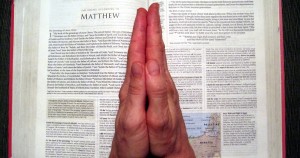 I’m Fr. Charles Erlandson, assistant rector of Good Shepherd Reformed Episcopal Church in Tyler, teacher at Good Shepherd School and at Cranmer Theological House, and husband to Jackie the wonder wife and 6 soul-trying, soul-enriching children.
Welcome to Give Us This Day, the daily Bible devotional I’ve written for every passage in the New Testament.
When I first began writing Give Us This Day, I surveyed the other daily devotionals that were out there and immediately noticed some differences between what I was writing and what others had written. I was concerned that most of the other devotionals only dealt with a verse of the Bible for each day, and I could find none that provided a devotional for every passage of the New Testament.
I also noticed that what I had written was usually longer than the uniformly bite-sized devotionals that seemed to be the publishing norm. In addition, most other devotionals did not include suggestions for further meditations and virtually none offered suggested resolutions to help put into effect what God had revealed through a given passage. At the end of each Give Us This Day meditation, I therefore offer not only a Prayer but also some Points for Further Reflection and a Daily Resolution.
“Give us this day our daily bread” is the most fundamental prayer we can ask on behalf of ourselves. Knowing this, our Lord not only commanded us to pray for this every day but also offers Himself to us as our daily bread.
In one of his sermons, St. Augustine expressed his belief that the feeding of the 4000 isn’t just about filling the bellies of men with bread and fish, nor is it solely about the Holy Communion. For St. Augustine and others, the Bread of Life is also the Holy Scriptures, upon which we are to feed every day, for they are the words of life. That the Word of God is also the Bread of God is satisfyingly illustrated by the Collect for the Second Sunday in Advent in the Book of Common Prayer, in which we ask God to “Grant that we may in such wise hear them [the Scriptures], read, mark, learn, and inwardly digest them.”
However, Christians in the twenty-first century often do not properly eat or digest the Word of God. I’ve noticed some of you snacking in a sort of hit and run fashion, as you rush to lead your “real life.” “I’ll squeeze in a chapter of Bible reading today,” you think. Some of you are to be commended for devoting yourself to studying the Scriptures, but unfortunately it is in such a way that only the mind is fed. Meanwhile, the soul gets spiritual kwashiorkor, which may easily be identified by your distended spiritual belly.
Scripture must therefore be eaten with prayer, which may be likened to the spiritual blood into which the bread of life must be digested and ingested. Through a life of prayer, the Word of God is carried into every part of your life and becomes your life, just as a piece of digested food is broken down, enters the blood, and is carried to every part of your body.
The most fruitful way I know of to receive my daily bread of Scripture is through the ancient practice of the lectio divina, or divine reading, with which I hope many of you are familiar. The essence of the lectio divina is not just another Bible study to inform our minds. Instead, the lectio divina is formative reading, in which we allow the Holy Scriptures, under the inspiration of the Holy Spirit, to form our very being. There are four basic steps in this divine reading:
- lectio – reading/ listening
- Cultivate the ability to listen deeply.
- Your reading is slow, formative reading.
- Your reading is based on previous reading and study.
- meditatio – meditation
- Gently stop reading when you have found a word, phrase, or passage through which God is speaking to you personally.
- Ruminate over this passage, as a cow ruminates or chews its cud.
- Say the passage over and over, noticing different aspects – “taste” it!
- Allow God’s Word to become His word for you at every level of your being and to interact with your inner world of concerns, memories, and ideas.
-
oratio – prayer
- Pray – or dialogue with God – over the passage.
- Interact with God as one who loves you and is present with you.
- Allow God to transform your thoughts, memories, agendas, tendencies, and habits.
- Re-affirm and repeat what God has just told you.
- contemplatio – contemplation
- Rest in the presence of the One who has come to transform and bless you.
- Rest quietly, experiencing the presence of God.
- Leave with a renewed energy and commitment to what God has just told you.
I look forward to reading Holy Scripture with each of you day by day!
Previous Post

August 17, 2016
Thursday of Trinity 12 - Romans 14:13-23
Next Post

August 18, 2016 What is the Bible?
Browse Our Archives
Select a Category Book Reviews Featured Give Us This Day Give Us This Day Devotional love me love my wife Love My Wife Reformed Catholicism Blog Spirit-Reality Take This Cup Uncategorized
Select a Month February 2022 November 2021 October 2021 August 2021 January 2021 December 2020 November 2020 September 2020 August 2020 July 2020 June 2020 May 2020 September 2018 July 2018 March 2018 November 2017 October 2017 September 2017 August 2017 July 2017 June 2017 May 2017 April 2017 March 2017 February 2017 January 2017 December 2016 November 2016 October 2016 September 2016 August 2016 July 2016 June 2016 May 2016 April 2016 March 2016 February 2016 January 2016 December 2015 November 2015 October 2015 September 2015 August 2015 July 2015 June 2015 May 2015 April 2015 March 2015 February 2015 January 2015 December 2014 November 2014 October 2014 September 2014 August 2014 July 2014 June 2014 May 2014 April 2014 March 2014 February 2014 January 2014 December 2013 November 2013 October 2013 September 2013 August 2013 July 2013 June 2013 May 2013 April 2013 March 2013 February 2013 January 2013 December 2012 November 2012 October 2012 September 2012 August 2012 July 2012 June 2012 May 2012 April 2012 March 2012 February 2012 January 2012 December 2011 November 2011 October 2011 September 2011 August 2011 July 2011 May 2011 April 2011 March 2011 February 2011 January 2011
Follow Us!
TAKE THE
Religious Wisdom Quiz
Who was the first man created, according to the Bible?
Select your answer to see how you score.
Moses Adam Jacob Abraham
Related posts from Give Us This Day
John 10:1-30 – The Good Shepherd Part II
Luke 18:31-43 - You are the Blind Man

Mark 1:1-13 - What are you waiting for?

Monday of Trinity 13, 2016 - Matthew 1
TRENDING AT PATHEOS Evangelical

The REST of Your Life: A Creative Wrestles...
This week I had a conversation with a good friend from church....

How the author of the world's best hymn...
I've been working with John Newton for a while now. This makes...

Long before this Lectio Divina, Psalm 130 - the song - started...

What About the Trees? Another Living Parable
After I finished writing the last article about falling leaves as a...

Why Classical Education Is a Conversation, Not a...
Come and Read: Joy in Classical Education When I was a little...

Cornell University has received a great deal of negative publicity and intense...
view all Evangelical blogs
Ad-Free & Subscriber Log-In Subscription Support
- About Us
- 2026 Calendar
- Videos
- Podcasts
- Library of World Religions
- Faith In Media Tracker
- Advertise With Us
- Write for Us
- Privacy Policy
- Terms of Service
- Do Not Sell My Data
- Contact Us
- Radiant Digital
- Manage Newsletter Subscriptions
- Unsubscribe From Notifications
- Sitemap
Copyright 2008-2026, Patheos. All rights reserved.
Subscription Support Ad-Free & Subscriber Log-In
Follow Patheos