
BuddhistCatholicContemplativeEvangelicalGeneral ChristianHinduJewishLatter-day SaintMuslimNew VisionsProgressive Christian
Beliefs
- Buddhist
- Catholic
- Contemplative
- Evangelical
- General Christian
- Hindu
- Jewish
- Latter-day Saint
- More Voices
- Muslim
- New Visions
- Pagan
- Progressive Christian
Topics
- Religion News
- Food and Religion
- Sports and Religion
- Religious Art
- Religious Music and Entertainment
- Religious Events
- History and Religion
- Style and Religion
- Politics and Religion
- Women in Religion
- Recreation Outdoors and Religion
- Business Finance and Religion
- Careers Workplace and Religion
- Education and Religion
- Family Parenting and Religion
- Health Fitness and Religion
- Home and Religion
- Relationships and Religion
- Technology and Religion
- Travel and Religion
Columnists
- Buddhist Columnists
- Business Finance and Religion Columnists
- Careers Workplace and Religion Columnists
- Catholic Columnists
- Contemplative Columnists
- Education and Religion Columnists
- Evangelists Columnists
- Family Parenting and Religion Columnists
- General Christian Columnists
- Health Fitness and Religion Columnists
- Hindu Columnists
- History and Religion Columnists
- Home and Religion Columnists
- Jewish Columnists
- More Voices Columnists
- Latter Day Columnists
- Muslim Columnists
- New Visions Columnists
- Nonreligious Columnists
- Pagan Columnists
- Politics and Religion Columnists
- Progressive Columnists
- Recreation Outdoors and Religion Columnists
- Relationships and Religion Columnists
- Religion News Columnists
- Religious Art Columnists
- Religious Events Columnists
- Religious Music and Entertainment Columnists
- Sports and Religion Columnists
- Style and Religion Columnists
- Technology and Religion Columnists
- Travel and Religion Columnists
- Women in Religion Columnists
Resource Library
- 2026 Calendar
- Library of World Religions
- The 100 Most Holy Places on Earth
- Patheos Answers
- Podcasts
- Videos
- Faith Leaders Database
- Anglican Episcopalian
- Bahai
- Baptist
- Buddhism
- Christianity
- Confucianism
- Eastern Orthodoxy
- Hinduism
- Holiness and Pentecostal
- ISKCON
- Islam
- Judaism
- Lutheran
- Methodist
- The Church of Jesus Christ of Latter-day Saints
- New Age
- Paganism
- Presbytarian and Reformed
- Protestantism
- Religion Behind the Scenes
- Roman Catholic
- Scientology
- Shia Islam
- Sikhism
- Sufism
- Sunni Islam
- Taoism
- Zen
- See all religions
Research Tools
 Ad-Free & Subscriber Log-In Subscription Support
Ad-Free & Subscriber Log-In Subscription Support
Follow Patheos 

- Trending:
- Forgiveness
- |
- Marriage
- |
- Consciousness
- |
- Death Penalty
- |
- Election
- |
- Halloween
 Give Us This Day
- Home
- Evangelical
- Good Friday – The Gospel of Suffering, Part II
Good Friday – The Gospel of Suffering, Part II
Last updated on: April 14, 2017 at 12:32 pm by Fr. Charles Erlandson
Good Friday – The Gospel of Suffering, Part II 2017-04-14T12:32:31-05:00 Fr. Charles Erlandson
Patheos Explore the world's faith through different perspectives on religion and spirituality! Patheos has the views of the prevalent religions and spiritualities of the world.
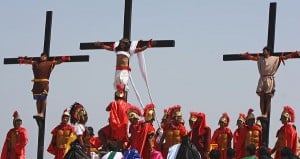 The “Gospel of Suffering” which I began in my last post is this:
- That far from being a sign of God’s non-existence, apathy, or impotence, human suffering is transformed by Christ’s Incarnation into a sign of God’s presence, love, and power.
- That because Christ has become man and suffered to redeem man, suffering is a primary means of participating in God’s nature and being united to Him.
- That as Christians partake of Christ and His suffering, their own suffering is transformed by God into glory and joy.
In this post, we’ll look at Part II.
II. Because Christ has become man and suffered to redeem man, suffering is a primary means of participating in God’s nature and being united to Him.
But God’s presence, power, and love would not be given to man unless by some means the life of Christ, including His suffering, were communicated to His people. This means of communication is the Incarnation of Christ, in which the divine and human nature are joined together forever. All that Jesus accomplished through His suffering, including His exaltation and glorification in His Resurrection and Ascension, are now communicable to man.
So closely has God come to man that St. Peter teaches that we have become partakers of the divine nature (2 Peter 2:14). Jesus shares this new, “divinized” human nature with the Church, who partakes of Christ and has a blessed union with Him. The Church is called “The Body of Christ,” for Christ is truly in us through His Spirit. We have become “one flesh” with Him so that we are not only the Body of Christ but also his Holy Bride.
After Jesus’ human nature ascended into heaven in Acts 1, He sent His Holy Spirit into His Body to make it the living Body of Christ on earth. All throughout the book of Acts, therefore, the Church teaches and does what Jesus taught and did, since Jesus is living in and through the Church.
When the Church in the book of Acts and the Church today (for the Church is one) suffer, they suffer as Jesus Christ*.* The language Jesus uses when He called St. Paul on the road to Damascus is striking: “Saul, Saul, why are you persecuting Me?” (Acts 9:4.) So closely does Jesus identify with His Body and Bride the Church that even though Saul is persecuting the Church, Jesus ask Saul why he’s persecuting Him. The Church, therefore, as the Body of Christ and in union with Christ, suffers for, with, and as Jesus Christ.
We are especially united to Jesus Christ and His suffering through the sacrament of Baptism. St. Paul teaches: “Do you not know that all of us who have been baptized into Christ Jesus were baptized into his death? We were buried therefore with him by baptism into death, in order that, just as Christ was raised from the dead by the glory of the Father, we too might walk in newness of life. For if we have been united with him in a death like his, we shall certainly be united with him in a resurrection like his” (Romans 5:3-5.)
But when we are united to Christ in Baptism, we are united to all of Christ: first His suffering, then His death, and then His Resurrection and Ascension. Recapitulating the life of Christ, we suffer afflictions, and trials which then ultimately lead to glory and joy. For this reason Peter teaches: “But rejoice insofar as you share Christ’s sufferings, that you may also rejoice and be glad when his glory is revealed” (1 Peter 4:13).
At your baptism, the sign of Christ and His suffering was place upon you in the shape of the Cross, which also represents the Name of the Holy Trinity, the Father, the Son, and the Holy Spirit. At your baptism, Christ shared His Cross with you and has bound you to Him by it.
Because we are spiritually and mystically united to Christ, we will suffer as His Body. The suffering of the Church is, therefore, a sign that she belongs to Jesus Christ. We might even say that suffering is a sacrament of God’s presence. When the Church suffers for Jesus Christ, it must be because the Lord who suffered for us is very near.
The suffering of the Church is sacramental because it is a true participation in Christ and His sufferings. Our suffering is Christ’s suffering, and His suffering is our suffering. His Cross is our cross, and our crosses are His.
When we suffer, as members of His suffering Body, we each carry with us a splinter of the One True Cross. Unlike the medieval forgeries of the splinters of the Cross, however, each Christian who suffers is carrying a holy relic, a splinter of the suffering of Christ on the Cross.
God’s blessed and mighty redemption for us is, therefore, something He not only does for us but through us, for we are the Body of Christ, and God has made us partakers of His nature and redemption.
If God’ redemption were simply something He did to us, we’d be rocks.
If His redemption were something He did for us, we’d be children.
If God’s redemption were something He did with us, we’d be men.
But since God’s redemption is something He does through us, we are members of Christ’s Body.
Because of this, the Church also suffers as Christ, united to Him as His Body.
Many Christians believe that their suffering doesn’t count – that somehow the suffering that “counts” is only the suffering of those who are persecuted for Christ’s sake. But Christ has come to redeem all of our suffering, and all of our suffering is united to Christ by His suffering.
There is no suffering so small that it doesn’t count. All Christian suffering counts and is being redeemed by Christ!
Because Christ has become man and suffered to redeem man, suffering is a primary means of participating in God’s nature and being united to Him.
Cruxifixion – Creative Commons Attribution-Share Generic 2.0 license

Previous Post
April 13, 2017
Good Friday - The Gospel of Suffering, Part I
Next Post
April 15, 2017 Holy Saturday – The Gospel of Suffering, Part III
Browse Our Archives
Select a Category Book Reviews Featured Give Us This Day Give Us This Day Devotional love me love my wife Love My Wife Reformed Catholicism Blog Spirit-Reality Take This Cup Uncategorized
Select a Month February 2022 November 2021 October 2021 August 2021 January 2021 December 2020 November 2020 September 2020 August 2020 July 2020 June 2020 May 2020 September 2018 July 2018 March 2018 November 2017 October 2017 September 2017 August 2017 July 2017 June 2017 May 2017 April 2017 March 2017 February 2017 January 2017 December 2016 November 2016 October 2016 September 2016 August 2016 July 2016 June 2016 May 2016 April 2016 March 2016 February 2016 January 2016 December 2015 November 2015 October 2015 September 2015 August 2015 July 2015 June 2015 May 2015 April 2015 March 2015 February 2015 January 2015 December 2014 November 2014 October 2014 September 2014 August 2014 July 2014 June 2014 May 2014 April 2014 March 2014 February 2014 January 2014 December 2013 November 2013 October 2013 September 2013 August 2013 July 2013 June 2013 May 2013 April 2013 March 2013 February 2013 January 2013 December 2012 November 2012 October 2012 September 2012 August 2012 July 2012 June 2012 May 2012 April 2012 March 2012 February 2012 January 2012 December 2011 November 2011 October 2011 September 2011 August 2011 July 2011 May 2011 April 2011 March 2011 February 2011 January 2011
Follow Us!
TAKE THE
Religious Wisdom Quiz
What does 1 Peter say wives can do to win over their unbelieving husbands?
Select your answer to see how you score.
Share the gospel Show them love Pray for them constantly Win them without words by their behavior
Related posts from Give Us This Day

James Clark - Book Review of Take This...
Joseph Laughon - Book Review of Take This...
Jesus Took on All Human Suffering - Part...
TRENDING AT PATHEOS Evangelical

How the author of the world's best hymn...
I've been working with John Newton for a while now. This makes...

Long before this Lectio Divina, Psalm 130 - the song - started...

What About the Trees? Another Living Parable
After I finished writing the last article about falling leaves as a...

Why Classical Education Is a Conversation, Not a...
Come and Read: Joy in Classical Education When I was a little...

Falling Leaves: A Living Parable on Letting Go
I’ve spent the vast majority of my life in the southeast corner...

Cornell University has received a great deal of negative publicity and intense...
view all Evangelical blogs
Ad-Free & Subscriber Log-In Subscription Support
- About Us
- 2026 Calendar
- Videos
- Podcasts
- Library of World Religions
- Faith In Media Tracker
- Advertise With Us
- Write for Us
- Privacy Policy
- Terms of Service
- Do Not Sell My Data
- Contact Us
- Radiant Digital
- Manage Newsletter Subscriptions
- Unsubscribe From Notifications
- Sitemap
Copyright 2008-2026, Patheos. All rights reserved.
Subscription Support Ad-Free & Subscriber Log-In
Follow Patheos