
BuddhistCatholicContemplativeEvangelicalGeneral ChristianHinduJewishLatter-day SaintMuslimNew VisionsProgressive Christian
Beliefs
- Buddhist
- Catholic
- Contemplative
- Evangelical
- General Christian
- Hindu
- Jewish
- Latter-day Saint
- More Voices
- Muslim
- New Visions
- Pagan
- Progressive Christian
Topics
- Religion News
- Food and Religion
- Sports and Religion
- Religious Art
- Religious Music and Entertainment
- Religious Events
- History and Religion
- Style and Religion
- Politics and Religion
- Women in Religion
- Recreation Outdoors and Religion
- Business Finance and Religion
- Careers Workplace and Religion
- Education and Religion
- Family Parenting and Religion
- Health Fitness and Religion
- Home and Religion
- Relationships and Religion
- Technology and Religion
- Travel and Religion
Columnists
- Buddhist Columnists
- Business Finance and Religion Columnists
- Careers Workplace and Religion Columnists
- Catholic Columnists
- Contemplative Columnists
- Education and Religion Columnists
- Evangelists Columnists
- Family Parenting and Religion Columnists
- General Christian Columnists
- Health Fitness and Religion Columnists
- Hindu Columnists
- History and Religion Columnists
- Home and Religion Columnists
- Jewish Columnists
- More Voices Columnists
- Latter Day Columnists
- Muslim Columnists
- New Visions Columnists
- Nonreligious Columnists
- Pagan Columnists
- Politics and Religion Columnists
- Progressive Columnists
- Recreation Outdoors and Religion Columnists
- Relationships and Religion Columnists
- Religion News Columnists
- Religious Art Columnists
- Religious Events Columnists
- Religious Music and Entertainment Columnists
- Sports and Religion Columnists
- Style and Religion Columnists
- Technology and Religion Columnists
- Travel and Religion Columnists
- Women in Religion Columnists
Resource Library
- 2026 Calendar
- Library of World Religions
- The 100 Most Holy Places on Earth
- Patheos Answers
- Podcasts
- Videos
- Faith Leaders Database
- Anglican Episcopalian
- Bahai
- Baptist
- Buddhism
- Christianity
- Confucianism
- Eastern Orthodoxy
- Hinduism
- Holiness and Pentecostal
- ISKCON
- Islam
- Judaism
- Lutheran
- Methodist
- The Church of Jesus Christ of Latter-day Saints
- New Age
- Paganism
- Presbytarian and Reformed
- Protestantism
- Religion Behind the Scenes
- Roman Catholic
- Scientology
- Shia Islam
- Sikhism
- Sufism
- Sunni Islam
- Taoism
- Zen
- See all religions
Research Tools
 Ad-Free & Subscriber Log-In Subscription Support
Ad-Free & Subscriber Log-In Subscription Support
Follow Patheos 

- Trending:
- Forgiveness
- |
- Marriage
- |
- Consciousness
- |
- Death Penalty
- |
- Election
- |
- Halloween
 Give Us This Day
- Home
- Evangelical
- What is the Bible?
What is the Bible?
Last updated on: November 17, 2017 at 1:34 pm by Fr. Charles Erlandson
What is the Bible? 2017-11-17T13:34:52-05:00 Fr. Charles Erlandson
Patheos Explore the world's faith through different perspectives on religion and spirituality! Patheos has the views of the prevalent religions and spiritualities of the world.
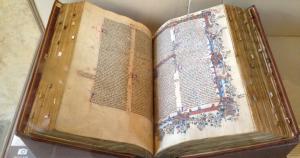 Romans 15:1-16
I love books. At my last count (taken several years ago), I have over 3000 books now – and counting. Every time we move (which has been way too often in the past), Jackie and I are struck by how many boxes of books there are to move. Usually, I have to lift and move them all by myself. After this last doozy of a move, some of them are still orphans or foundlings. I have books on theology, art, literature, education, and from most of the letters in the Library of Congress system.
There are books that attempt to tell us how to help ourselves and how to achieve peace and hope in this troubled world. There’s even one book that I have probably 100 copies of, in all sizes and shapes and translations and in about 10 languages, including Braille. It’s the all-time bestseller which sells so consistently well that the New York Times bestseller list would never have any other #1 if they put it on the list. It is the “Book of books.” It is “the Bible,” which simply means, “The Book.”[1]
The Bible is many things, but this morning St. Paul, with some help from the Collect for the Day, reminds us that the Bible is the book of hope because it leads us to Jesus Christ, who is our hope.
In the first place, we begin with hope because the God who created the heavens and the earth, chocolate and coffee and orchids, has revealed Himself to us. Not only has He left reminders of Himself in every corner of the creation, but He’s also spoken to His people. More specifically, St. Paul says that, “whatever things were written before were written for our learning” (verse 4). When Moses wrote Genesis or Exodus, he was inspired to write them for our learning and life, and when St. Paul wrote to the church in Rome, he wrote for our learning and life.
Why? There are many reasons but the reason Paul gives is so that through the patience and comfort of the Scriptures we me might have hope. Isn’t that, ultimately, the message of Romans? Sometimes we get so hung up on proving theological points that we forget the import of these theologies: hope. Romans and its message of the sinfulness and condemnation of man would have been a pretty bleak book, were it not ultimately about hope. The hope that Paul holds out to us today is that there is no condemnation for those who are in Christ Jesus through faith.
If you read Romans and do not end in hope, then you have either misread Romans or you are stubborn in your sinfulness.
The entire Bible is a book of hope. It has comforted countless saints. Although I don’t recommend this technique, so dense and laden with hope is God’s Word that you could randomly point to a verse in the Bible and find hope there, because God and His offer of salvation are there.
Look: I’ll prove it. I’ll randomly point to 3 verses of the Bible. I promise I won’t fudge the results, although I might have to look at the surrounding verses to find the hope.
Here goes.
- Judges 10:3. “After him arose Jair, a Gileadite; and he judged Israel twenty-two years.” Not very promising, is it? But what do we read in verse 1? “After Abimelech there arose to save Israel Tola the son of Puah.” God raised up the judges, including Jair, to save Israel. There’s your hope.
- Isaiah 49:10. “They shall neither hunger nor thirst, neither heat nor sun shall strike them; for He who has mercy on them will lead them, even by the springs of water He will guide them.” That one’s pretty easy to see. O.K. One more, from the New Testament.
- 2 Timothy 1:12. “For this reason I also suffer these things; nevertheless I am not ashamed, for I know whom I have believed and am persuaded that He is able to keep what I have committed to Him until that Day.” That one’s easy to see, too.
The Word of God is the word of hope. Every time Jackie has gone into labor she has requested that I read to her a list of Bible verses she has gathered together. In the midst of that pain, the Word of God gives her hope and strength like nothing else!
Why do we hope? Because God has made incredibly wonderful promises to us – and we know He will keep them! Every promise God made to Abraham and Israel, He kept, in spite of their unfaithfulness. He even superabundantly fulfilled them in still more wonderful ways through His Son.
This hope has now come even to us Gentiles: “There shall be a root of Jesse; and He who shall rise to reign over the Gentiles, in Him the Gentiles shall hope” (verse 12). In Jesus, our hope is fulfilled as well, and the Bible is a book about Jesus: God with us, God saves.
The Word of God brings peace and hope above all because it brings us to Jesus Christ. It is only because the Word of God brings us to Christ that we have hope and we are saved. No one was ever saved by the Bible, no matter how much they believe it. We Evangelicals should remember that. Only Jesus saves us, and He is the one who will fill us with joy, peace, and hope.
Notice that what Paul ascribes to the Bible in verse 4 he ascribes to God in verses 5 and
- In verse 4, Paul talks about how through patience and comfort the Scriptures produce hope. But in verse 5, it is God who is the God of patience and comfort: the Bible can’t give these things by itself. In verse 13, God is the God of hope who will fill us with joy and peace in believing, that we may abound in hope by the power of the Holy Spirit.
What is the Bible, anyway? If you lived in the second century, what was the Bible? It was a collection of scrolls that you heard read in your local church. You would never have held one, much less owned one. It was and is the Word of God as received by the faithful in the Body of Christ, the community of the faithful.
It is not the Scriptures themselves that give hope and comfort, but the Scriptures as inspired by the Spirit and brought by the Spirit to a faithful hearer that give hope and comfort – and salvation. As with angels, don’t worship the messenger!
I hold to an incarnational, not a Koranic, view of the Bible. The Bible is both divine and human. The Bible by itself is no good. You must also have the Holy Spirit, a faithful hearer, and faithful interpreters. “If a Bible drops in the forest and no one reads it, does it save anyone?” The Bible was written and continues to be read in the context of the Body of Christ. When we read it apart from that Body, we quickly descend into heresy.
There is nothing automatic about reading the Bible and finding hope. I know a lot of students who have gone off to college and attended courses in the Bible. But they received no comfort or hope or joy in those classes because the Bible read with an attitude of doubt and it was treated like an ancient books of myths to be disproved.
But a miracle happens when we read the Bible with faith! Because God, being God, can place Himself in the pages of my Bible, I read it, have faith, and find hope! It becomes a means of grace; the heavens open, and I see Jesus Christ and God through Him!
The Word of God was written for my benefit – and yours!
Therefore, take care how you read it. First of all, you must read it or hear it. If you’re reading this, then certainly you are. But when the manna of my Daily Bread stops falling, don’t stop reading the Bible. If you choose not to read Daily Bread on a given day, that’s no skin off my nose: but make sure you are reading the Bible and seeking God in it.
How should I read it? Consider the Collect for the Second in Advent: “Blessed Lord, who hast caused all holy Scriptures to be written for our learning; Grant that we may in such wise hear them, read, mark, learn, and inwardly digest them, that by patience, and comfort of thy holy Word, we may embrace, and ever hold fast the blessed hope of everlasting life, which thou hast given us in our Saviour Jesus Christ.”
Hear and learn the Bible in the Church; read and mark it on your own and in groups; and inwardly digest it yourself, since no one else can do this for you!
Prayer: Blessed Lord, who hast caused all holy Scriptures to be written for our learning; Grant that we may in such wise hear them, read, mark, learn, and inwardly digest them, that by patience, and comfort of thy holy Word, we may embrace, and ever hold fast the blessed hope of everlasting life, which thou hast given us in our Saviour Jesus Christ.
Points for Meditation:
- Has my reading of the Bible lately been fruitful? What method am I using? What other ways of reading it may make it more alive and profitable to me?
- The next time you read the Bible, pray that you will receive it as the Word of God, and then treat it as the Word of God.
- What are some of your favorite verses that foster hope in you?
Resolution: I resolve to read the Bible this week as the very Word of God and to take whatever time is necessary to properly digest it.
[1] It might be better to call the Bible simply the Word of God because for most of its history people have not experienced it as a book but as a spoken and lived word.
Wycliffe Bible – photo taken by Fr. Erlandson
Previous Post
August 17, 2016
Give Us This Day devotional and the lectio divina
Next Post
August 19, 2016 What Are You Doing With Your Life?
Browse Our Archives
Select a Category Book Reviews Featured Give Us This Day Give Us This Day Devotional love me love my wife Love My Wife Reformed Catholicism Blog Spirit-Reality Take This Cup Uncategorized
Select a Month February 2022 November 2021 October 2021 August 2021 January 2021 December 2020 November 2020 September 2020 August 2020 July 2020 June 2020 May 2020 September 2018 July 2018 March 2018 November 2017 October 2017 September 2017 August 2017 July 2017 June 2017 May 2017 April 2017 March 2017 February 2017 January 2017 December 2016 November 2016 October 2016 September 2016 August 2016 July 2016 June 2016 May 2016 April 2016 March 2016 February 2016 January 2016 December 2015 November 2015 October 2015 September 2015 August 2015 July 2015 June 2015 May 2015 April 2015 March 2015 February 2015 January 2015 December 2014 November 2014 October 2014 September 2014 August 2014 July 2014 June 2014 May 2014 April 2014 March 2014 February 2014 January 2014 December 2013 November 2013 October 2013 September 2013 August 2013 July 2013 June 2013 May 2013 April 2013 March 2013 February 2013 January 2013 December 2012 November 2012 October 2012 September 2012 August 2012 July 2012 June 2012 May 2012 April 2012 March 2012 February 2012 January 2012 December 2011 November 2011 October 2011 September 2011 August 2011 July 2011 May 2011 April 2011 March 2011 February 2011 January 2011
Follow Us!
TAKE THE
Religious Wisdom Quiz
What prophet challenged King Ahab and Queen Jezebel over Naboth's vineyard?
Select your answer to see how you score.
Amos Nathan Elisha Elijah
Related posts from Give Us This Day


Eschatological and Ecumenical Hope
John 12:44-50 - Power and Fear, Glory and...
TRENDING AT PATHEOS Evangelical

How the author of the world's best hymn...
I've been working with John Newton for a while now. This makes...

Long before this Lectio Divina, Psalm 130 - the song - started...

What About the Trees? Another Living Parable
After I finished writing the last article about falling leaves as a...

Why Classical Education Is a Conversation, Not a...
Come and Read: Joy in Classical Education When I was a little...

Falling Leaves: A Living Parable on Letting Go
I’ve spent the vast majority of my life in the southeast corner...

Cornell University has received a great deal of negative publicity and intense...
view all Evangelical blogs
Ad-Free & Subscriber Log-In Subscription Support
- About Us
- 2026 Calendar
- Videos
- Podcasts
- Library of World Religions
- Faith In Media Tracker
- Advertise With Us
- Write for Us
- Privacy Policy
- Terms of Service
- Do Not Sell My Data
- Contact Us
- Radiant Digital
- Manage Newsletter Subscriptions
- Unsubscribe From Notifications
- Sitemap
Copyright 2008-2026, Patheos. All rights reserved.
Subscription Support Ad-Free & Subscriber Log-In
Follow Patheos