
BuddhistCatholicContemplativeEvangelicalGeneral ChristianHinduJewishLatter-day SaintMuslimNew VisionsProgressive Christian
Beliefs
- Buddhist
- Catholic
- Contemplative
- Evangelical
- General Christian
- Hindu
- Jewish
- Latter-day Saint
- More Voices
- Muslim
- New Visions
- Pagan
- Progressive Christian
Topics
- Religion News
- Food and Religion
- Sports and Religion
- Religious Art
- Religious Music and Entertainment
- Religious Events
- History and Religion
- Style and Religion
- Politics and Religion
- Women in Religion
- Recreation Outdoors and Religion
- Business Finance and Religion
- Careers Workplace and Religion
- Education and Religion
- Family Parenting and Religion
- Health Fitness and Religion
- Home and Religion
- Relationships and Religion
- Technology and Religion
- Travel and Religion
Columnists
- Buddhist Columnists
- Business Finance and Religion Columnists
- Careers Workplace and Religion Columnists
- Catholic Columnists
- Contemplative Columnists
- Education and Religion Columnists
- Evangelists Columnists
- Family Parenting and Religion Columnists
- General Christian Columnists
- Health Fitness and Religion Columnists
- Hindu Columnists
- History and Religion Columnists
- Home and Religion Columnists
- Jewish Columnists
- More Voices Columnists
- Latter Day Columnists
- Muslim Columnists
- New Visions Columnists
- Nonreligious Columnists
- Pagan Columnists
- Politics and Religion Columnists
- Progressive Columnists
- Recreation Outdoors and Religion Columnists
- Relationships and Religion Columnists
- Religion News Columnists
- Religious Art Columnists
- Religious Events Columnists
- Religious Music and Entertainment Columnists
- Sports and Religion Columnists
- Style and Religion Columnists
- Technology and Religion Columnists
- Travel and Religion Columnists
- Women in Religion Columnists
Resource Library
- 2026 Calendar
- Library of World Religions
- The 100 Most Holy Places on Earth
- Patheos Answers
- Podcasts
- Videos
- Faith Leaders Database
- Anglican Episcopalian
- Bahai
- Baptist
- Buddhism
- Christianity
- Confucianism
- Eastern Orthodoxy
- Hinduism
- Holiness and Pentecostal
- ISKCON
- Islam
- Judaism
- Lutheran
- Methodist
- The Church of Jesus Christ of Latter-day Saints
- New Age
- Paganism
- Presbytarian and Reformed
- Protestantism
- Religion Behind the Scenes
- Roman Catholic
- Scientology
- Shia Islam
- Sikhism
- Sufism
- Sunni Islam
- Taoism
- Zen
- See all religions
Research Tools
 Ad-Free & Subscriber Log-In Subscription Support
Ad-Free & Subscriber Log-In Subscription Support
Follow Patheos 

- Trending:
- Forgiveness
- |
- Marriage
- |
- Consciousness
- |
- Death Penalty
- |
- Election
- |
- Halloween
 Give Us This Day
- Home
- Evangelical
- The Hope of the Resurrection
The Hope of the Resurrection
Last updated on: March 19, 2018 at 4:59 pm by Fr. Charles Erlandson
The Hope of the Resurrection 2018-03-19T16:59:01-05:00 Fr. Charles Erlandson
Patheos Explore the world's faith through different perspectives on religion and spirituality! Patheos has the views of the prevalent religions and spiritualities of the world.
 The Hope of the Resurrection – 1 Thessalonians 4:13-18
St. Paul, as we have seen in 2 Corinthians, is a firm believer in dealing head on with the hardships of life. In fact, Paul is the one who, having suffered more than most others, can say that he takes pleasure in his infirmities. He has a doctrine that accepts suffering as a suffering with His Lord Jesus Christ and a suffering that is ultimately transformed into glory and joy – even in this life.
So Paul isn’t one to shrink from trials and tribulations. It is in the very midst of such difficulties that Paul is most encouraging to the churches to whom he writes. His encouragement is an earthly encouragement, meaning that he finds great encouragement from the Holy Spirit in this life, even at the moment of greatest suffering. He knows that this momentary and light suffering is producing an eternal weight of glory whose mass is felt even in this life.
But in 1 Thessalonians 4:13-18, Paul offers a different, but related, kind of hope, and that is the hope of the resurrection.
I honestly don’t believe this passage is about a Rapture, which will take Christians out of the Great Tribulation. Even if it were, that hope wouldn’t do any good to any Christian of the past 2000 years who has had to live through all of the trials, tribulations, and persecutions that have been a normal part of Christian life ever since St. Paul wrote these words. St. Paul certainly didn’t seem to believe that he would be delivered any time soon from all that he suffered (one only has to think back to 2 Corinthians to see this.)
Paul’s main point is not that there will be a single Great Tribulation out of which faithful Christians will be raptured, 2000 years or more after he is writing of the Christian hope to the 1st century church at Thessalonica. Again, if that were the hope, then Christians of the past 2000 years would have been sadly disappointed, and what Paul was saying wouldn’t really have applied to the Thessalonians to whom he is writing.
No, Paul’s hope is in a more certain theology, and it is the theology that is at the very center of his teaching and of all genuinely Christian doctrine: the Resurrection.
His point is that we should not, ultimately, sorrow over Christians who have died, because we have absolute confidence that they will rise again. The Resurrection is a central doctrine, of course, because it teaches us that Jesus Christ defeated His enemies and ours: Satan, sin, and death. It teaches us and gives us hope that God is stronger than His enemies and that God will make things right again.
But the doctrine of the Resurrection of Jesus Christ doesn’t do us any good if it is not in some way intimately related to us. Therefore, Paul says in verse 14: “For if we believe that Jesus died and rose again, even so God will bring with Him those who sleep in Jesus.” This is our hope: that just as Jesus was resurrected from the dead by the power of God, so will those who are in Him.
We may have friendly disputes about exactly how things will happen on Judgment Day, because there is so much that we don’t know. But there is one thing we must all be certain of, and that is that since Jesus Christ rose from the dead, so will those who are united to Him by baptism and by faith.
Paul’s immediate concern is that the Thessalonians, who have been grieving for those they love who have died and are uncertain about what will happen to them, will be comforted by the fact of the resurrection of the saints. Because of the absolute certainty of the resurrection to eternal life of those who love the Lord, Paul says that the Thessalonians should comfort one another with these words (verse 18.)
There is no greater pain than death, and there is no greater comfort than the promise of the resurrection to eternal life. This is St. Paul’s main point, and it is just as comforting to us 2000 years later as it was to the Thessalonians of Paul’s day.
But I find that there is another comfort we may find in the hope of the resurrection, and that is in our daily trials and tribulations. Though personally I find great comfort and joy in Paul’s encouragements to accept our suffering as a participation in the suffering of Christ, and all of the benefits that come from enduring suffering patiently with Him, I know that there must be more. I know that God did not create our lives to be full of suffering, and I know that this suffering will one day pass. I know that whatever my pain or grief today – whether physical suffering, mental anguish, enmity or conflict with another person, rejection, depression, persecution, financial trouble, worry over children, insecurity, loneliness, brokenness, failure, or grief – that one day all of this will completely and eternally pass away. These bitter, seemingly relentless sources of pain will all be gone for me one day.
Since Jesus Christ has risen from the dead, and since I will be raised with Him one day, I know with certainty that I and every faithful Christian will one day be delivered from every form of suffering. For one day, we will meet again with the Lord and will always be with Him forevermore.
Prayer: Father, I thank You for Your almighty hand which raised from the dead Your Son Jesus Christ. I thank You that You have not left us without hope but have assured us of our resurrection by Your Resurrection of Your only Son. Give me hope and comfort today, as I receive with faith again Your promise of eternal life with You in heaven.
Resolution and Point for Meditation: I resolve today to acknowledge all the suffering and grief I have today and to be comforted by the fact of the Resurrection, both the Lord’s and mine. I will spend at least a few minutes reflecting on my pain and then reflecting on the joys of the Resurrection. For each separate pain that I remember, I will allow the Lord to triumph over it by His Resurrection and the life He offers me today.
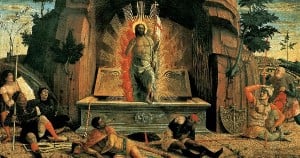
The Resurrection by Mantegna – Public Domain

Previous Post

September 23, 2015
The Abundant Life
Next Post
September 23, 2015 Children of the Light
Browse Our Archives
Select a Category Book Reviews Featured Give Us This Day Give Us This Day Devotional love me love my wife Love My Wife Reformed Catholicism Blog Spirit-Reality Take This Cup Uncategorized
Select a Month February 2022 November 2021 October 2021 August 2021 January 2021 December 2020 November 2020 September 2020 August 2020 July 2020 June 2020 May 2020 September 2018 July 2018 March 2018 November 2017 October 2017 September 2017 August 2017 July 2017 June 2017 May 2017 April 2017 March 2017 February 2017 January 2017 December 2016 November 2016 October 2016 September 2016 August 2016 July 2016 June 2016 May 2016 April 2016 March 2016 February 2016 January 2016 December 2015 November 2015 October 2015 September 2015 August 2015 July 2015 June 2015 May 2015 April 2015 March 2015 February 2015 January 2015 December 2014 November 2014 October 2014 September 2014 August 2014 July 2014 June 2014 May 2014 April 2014 March 2014 February 2014 January 2014 December 2013 November 2013 October 2013 September 2013 August 2013 July 2013 June 2013 May 2013 April 2013 March 2013 February 2013 January 2013 December 2012 November 2012 October 2012 September 2012 August 2012 July 2012 June 2012 May 2012 April 2012 March 2012 February 2012 January 2012 December 2011 November 2011 October 2011 September 2011 August 2011 July 2011 May 2011 April 2011 March 2011 February 2011 January 2011
Follow Us!
TAKE THE
Religious Wisdom Quiz
True or False: Isaiah prophesied that a virgin would conceive and bear a son called Jesus.
Select your answer to see how you score.
TRUE FALSE
Related posts from Give Us This Day

James Clark - Book Review of Take This...
Joseph Laughon - Book Review of Take This...
Jesus Took on All Human Suffering - Part...
TRENDING AT PATHEOS Evangelical

The REST of Your Life: A Creative Wrestles...
This week I had a conversation with a good friend from church....

How the author of the world's best hymn...
I've been working with John Newton for a while now. This makes...

Long before this Lectio Divina, Psalm 130 - the song - started...

What About the Trees? Another Living Parable
After I finished writing the last article about falling leaves as a...

Why Classical Education Is a Conversation, Not a...
Come and Read: Joy in Classical Education When I was a little...

Cornell University has received a great deal of negative publicity and intense...
view all Evangelical blogs
Ad-Free & Subscriber Log-In Subscription Support
- About Us
- 2026 Calendar
- Videos
- Podcasts
- Library of World Religions
- Faith In Media Tracker
- Advertise With Us
- Write for Us
- Privacy Policy
- Terms of Service
- Do Not Sell My Data
- Contact Us
- Radiant Digital
- Manage Newsletter Subscriptions
- Unsubscribe From Notifications
- Sitemap
Copyright 2008-2026, Patheos. All rights reserved.
Subscription Support Ad-Free & Subscriber Log-In
Follow Patheos