
BuddhistCatholicContemplativeEvangelicalGeneral ChristianHinduJewishLatter-day SaintMuslimNew VisionsProgressive Christian
Beliefs
- Buddhist
- Catholic
- Contemplative
- Evangelical
- General Christian
- Hindu
- Jewish
- Latter-day Saint
- More Voices
- Muslim
- New Visions
- Pagan
- Progressive Christian
Topics
- Religion News
- Food and Religion
- Sports and Religion
- Religious Art
- Religious Music and Entertainment
- Religious Events
- History and Religion
- Style and Religion
- Politics and Religion
- Women in Religion
- Recreation Outdoors and Religion
- Business Finance and Religion
- Careers Workplace and Religion
- Education and Religion
- Family Parenting and Religion
- Health Fitness and Religion
- Home and Religion
- Relationships and Religion
- Technology and Religion
- Travel and Religion
Columnists
- Buddhist Columnists
- Business Finance and Religion Columnists
- Careers Workplace and Religion Columnists
- Catholic Columnists
- Contemplative Columnists
- Education and Religion Columnists
- Evangelists Columnists
- Family Parenting and Religion Columnists
- General Christian Columnists
- Health Fitness and Religion Columnists
- Hindu Columnists
- History and Religion Columnists
- Home and Religion Columnists
- Jewish Columnists
- More Voices Columnists
- Latter Day Columnists
- Muslim Columnists
- New Visions Columnists
- Nonreligious Columnists
- Pagan Columnists
- Politics and Religion Columnists
- Progressive Columnists
- Recreation Outdoors and Religion Columnists
- Relationships and Religion Columnists
- Religion News Columnists
- Religious Art Columnists
- Religious Events Columnists
- Religious Music and Entertainment Columnists
- Sports and Religion Columnists
- Style and Religion Columnists
- Technology and Religion Columnists
- Travel and Religion Columnists
- Women in Religion Columnists
Resource Library
- 2026 Calendar
- Library of World Religions
- The 100 Most Holy Places on Earth
- Patheos Answers
- Podcasts
- Videos
- Faith Leaders Database
- Anglican Episcopalian
- Bahai
- Baptist
- Buddhism
- Christianity
- Confucianism
- Eastern Orthodoxy
- Hinduism
- Holiness and Pentecostal
- ISKCON
- Islam
- Judaism
- Lutheran
- Methodist
- The Church of Jesus Christ of Latter-day Saints
- New Age
- Paganism
- Presbytarian and Reformed
- Protestantism
- Religion Behind the Scenes
- Roman Catholic
- Scientology
- Shia Islam
- Sikhism
- Sufism
- Sunni Islam
- Taoism
- Zen
- See all religions
Research Tools
 Ad-Free & Subscriber Log-In Subscription Support
Ad-Free & Subscriber Log-In Subscription Support
Follow Patheos 

- Trending:
- Forgiveness
- |
- Marriage
- |
- Consciousness
- |
- Death Penalty
- |
- Election
- |
- Halloween
 Give Us This Day
- Home
- Evangelical
- Ascension Day – Hebrews 4:14-5:10
Ascension Day – Hebrews 4:14-5:10
Last updated on: May 16, 2012 at 12:45 pm by Fr. Charles Erlandson
Ascension Day – Hebrews 4:14-5:10 2012-05-16T12:45:52-05:00 Fr. Charles Erlandson
Patheos Explore the world's faith through different perspectives on religion and spirituality! Patheos has the views of the prevalent religions and spiritualities of the world.
 Hebrews 4:14-5:10
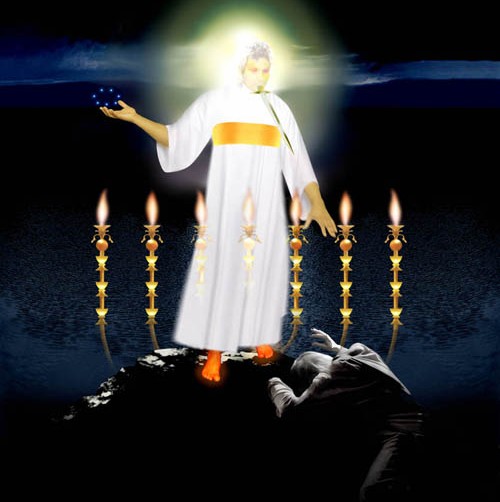
We should all remember the vision of Jesus Christ that St. John records in Revelation 1 (you might want to read it today). I want that image of the bright-as-the-sun Christ to be seared into your memory forever. Maybe we should all go out and stare at the sun for a few seconds to remind us of who Jesus really is. He is not the baby-faced, Bearded Girly Man Christ of Victorian pictures: He is the visible glory of God the Father. He is the retina-dissolving sun!
“And there is no creature hidden from His sight, but all things are naked and open to the eyes of Him to whom we must give account” (Hebrews 4:13). He is the Judge of all creation, under whose feet God has put the earth like a sapphire floor. He is the One who is seated at the right hand of the Father, sitting on His throne, the Judgment Seat. He is the Holy, Living, Fire that will purge all sin and unholiness with His refining fire.
And He’s comin’ to git you!
But in one of the greatest instances of theological whiplash recorded in the Bible, immediately after verse 13, we hear verse 14 (duh!): “Seeing then that we have a great High Priest who has passed through the heavens, Jesus the Son of God, let us hold fast our confession.”
This Jesus, who is infinitely more glorious than the angels or the sun, is sitting on His Judgment Seat at the right hand of the Father. But it turns out that this Judgment Seat is also a Mercy Seat, the one which was enthroned between the cherubim and pictured in the tabernacle and temple. Though we tremble and quake and fall down as if dead before Him, and His hand is heavy upon us, He also offers us that hand and says, “Come on up here with Me.” After making sure that you find your way to the lowest seat in the House, He invites you to the best seat in the House, beside Him.
Though we come whimpering and wailing in weakness before Him to whom we must give an account of every thing we’ve ever said and done on earth (let that settle in a minute, and see how you feel!), He tells us to approach Him with boldness and confidence, that we may obtain mercy and find grace to help in time of need (verses 16). Martin Luther explains the theological whiplash of verses 13 and 14 like this: “After terrifying us, the Apostle now comforts us. After pouring wine into our wound, he now pours oil.”
But we come boldly, not on our own, but only through our great High Priest. If you come before God boldly and confidently in your own self, you will be prostrated before God, never to rise again. God will smack you down! If you waltz into the presence of God and say “Here I AM, now bless Me like you said you would!” Duck! God will not let such unbelief and pride go unpunished. How arrogantly we come before God, though! How much we cheapen the price that Christ paid for us, whenever we let His goodness go to our heads and we think that we have made ourselves acceptable to God.
But if you come, laying hold of the Judgment Seat which is Christ Himself, and clinging to the Mercy of God which is Christ, then God will indeed bless you. Jesus Christ, your High Priest, God Almighty, humbled Himself that you might be exalted. But not without going through Him. This Jesus Christ humbled Himself by becoming a man for you. He learned obedience because of your disobedience. He suffered for your sins, and He who was perfect became sin for you.
He is your sacrifice, and it was a costly one. This High Priest Himself offered up petitions and prayers to the Father, for you. Consider the night on which He was betrayed. Jesus, the Lamb of God, knowing your sin and disobedience because you, like Judas, are His betrayer, set His face to endure the Cross. But because He was a man, He came before the Cross with unspeakable anguish.
Sometimes, we imagine that what Christ suffered was only what a man would suffer. And yet some men have faced death and even died on the Cross and have not resisted it as fiercely or with as much anguish as did Jesus. Is He somehow less than we suppose Him to be? No, but His anguish and what He endured is much greater. He knew that He was not merely facing physical death for Himself but that on the Cross He would take upon Himself every sin you’ve committed today, and not just the 1 or 2 that you just barely managed to remember but the other 1000 that you can’t even remember or acknowledge. He took upon Himself all of your yesterdays’ sins and all of your tomorrows’ sins, and all of mine and all of every humans. And not just the sin but also the penalty for them, which is death. He who knew no sin became your sin and guilt and judgment, all in one, and this is what he feared and dreaded.
And so He prayed so that He dropped drops of sweat like blood and offered up prayers and supplications with vehement cries and tears to Him who was able to save Him from death (verse 7).
Now if Jesus, being God and being perfect, knew how to pray (and in fact prayed more than we do), don’t you think that it would be a good idea for you to learn to pray? If Jesus turned to the Father as He took your sins and guilt and death upon Himself, don’t you think that you can manage to pray for those same sins and guilt and death? He actually paid the terrible price for those things, but all you have to do is to come with vehement cries and tears and come boldly before your High Priest.
How did Jesus come before the Father? With godly fear (verse 7)! He who was God came before God with godly fear, knowing the Holy One to whom He had come, and knowing what it would feel like to come before the All-Holy One carrying the sins of the world.
And yet we come with our sins as if they are nothing. Worst of all – we don’t come at all, as if we don’t still need to, as if God’s grace is automatic, even if we don’t cry out with anguish and vehement tears and cries. But I believe that the root of all sin and evil is prayerlessness. The ultimate sin, the one unforgivable sin, is unbelief. It is refusing to come before God and throw ourselves on His mercy. It is to take His good gifts without returning to His Temple, which is Himself, and return thanks. It is to believe that we don’t need His help and can manage in life without Him.
But the Son of Man, God Incarnate, needed to pray. And He was heard because of His godly fear. God, give me godly fear! Because of Jesus’ godly fear, the Father delivered Him from death.
Wait a minute! Not so fast! I just said that Jesus prayed with a godly fear and that because of that godly fear He was heard. But I’m forgetting something. Jesus died.
Here’s the pattern:
Jesus saw what taking on Himself the sin and guilt and death of the world would mean.
He cried out to the Father with vehement cries and tears and in godly fear that the Father would take this cup from Him.
Because He came in humble prayer and with godly fear, the Father heard His prayer.
Then the Father says “No, I won’t take this cup of suffering from You.”
Then, in a few hours, the Father sends Him to die on the Cross.
When this happens to us (and it does all the time), do we believe that God has heard us? The Father heard the anguished, godly, fearful prayers of the Son. He heard, and said “No.”
And yet He did deliver His Son from death: He raised Him from the dead. But not before He suffered and learned obedience through what He suffered. Now if the Father so treats the Son whom He has loved for eternity past and with the love that only God can have for God, then how do you suppose He will treat you? Being united to the Son, I hope He treats me exactly the same way.
What if God had heard the anguished prayers of the Son and said “Yes” to them (in the way that we, and not God, mean “Yes” – that is, my will be done)? You and I would still be in our sins. You and I would have no right to come boldly before the throne of grace and appear before our High Priest. You and I would still be on the Highway to Hell (“and I’m going down!)
Maybe we’d better re-think how we approach God in our prayers. Maybe we’d better re-think how we want Him to respond. God’s “Yes” is not our “yes.” His ways our higher than our ways.
If even, especially, the Son had to suffer and learn obedience through His suffering, then I’ll gladly have the same. I want to eat all of Jesus, not just the icing. If the Son can suffer all things for me, then I’ll gladly suffer a miniscule amount for Him. If He had to suffer to learn obedience for me, then I’ll gladly enroll in His School of Suffering that I can learn to be like Him.
I’m ready to graduate from the School of Milk to the School of Solid Food. In Hot Springs, Arkansas, there’s a homeschooling group called Solid Rock Academy. But I want to enroll in the Solid Food Academy. I’m ready to sink my teeth into the banquet that Christ has spread before me, which is nothing less than Himself. But when I eat Him, I’ll be eating all of Him, and that means I’ll have to eat His suffering before I can feast on His glory.
Bon appetit!
Prayer: Almighty God, Lord Jesus Christ, my great High Priest, who sits enthroned in glory in heaven: hear my prayers and supplications today. I ask that You would give me a godly fear such as You had; be with me in my temptations and overcome them as You overcame the Tempter; teach me obedience in Your school of suffering, as You yourself learned obedience; and grant me grace in my time of need, which is always now and in all things. Amen.
Points for Meditation:
1. Examine the way that you’ve been approaching God in prayer. Have you been praying as you should? Have you come with humility and confession? Have you come with boldness and faith?
2. Consider the vision of the Christ to whom you come for prayer. Meditate on both His power and glory, but also His humanity and mercy.
3. In what ways is God calling you to maturity, perhaps in prayer, obedience, or suffering?
Resolution: I resolve to boldly come before the throne of grace in prayer today.
© 2012 Fr. Charles Erlandson
David Miles – One Like the Son of Man
Previous Post

May 15, 2012
Ascension Eve (Wednesday of Easter 5) - Luke 24:44-53
Next Post
May 17, 2012 Friday of Easter 5 - Acts 1
Browse Our Archives
Select a Category Book Reviews Featured Give Us This Day Give Us This Day Devotional love me love my wife Love My Wife Reformed Catholicism Blog Spirit-Reality Take This Cup Uncategorized
Select a Month February 2022 November 2021 October 2021 August 2021 January 2021 December 2020 November 2020 September 2020 August 2020 July 2020 June 2020 May 2020 September 2018 July 2018 March 2018 November 2017 October 2017 September 2017 August 2017 July 2017 June 2017 May 2017 April 2017 March 2017 February 2017 January 2017 December 2016 November 2016 October 2016 September 2016 August 2016 July 2016 June 2016 May 2016 April 2016 March 2016 February 2016 January 2016 December 2015 November 2015 October 2015 September 2015 August 2015 July 2015 June 2015 May 2015 April 2015 March 2015 February 2015 January 2015 December 2014 November 2014 October 2014 September 2014 August 2014 July 2014 June 2014 May 2014 April 2014 March 2014 February 2014 January 2014 December 2013 November 2013 October 2013 September 2013 August 2013 July 2013 June 2013 May 2013 April 2013 March 2013 February 2013 January 2013 December 2012 November 2012 October 2012 September 2012 August 2012 July 2012 June 2012 May 2012 April 2012 March 2012 February 2012 January 2012 December 2011 November 2011 October 2011 September 2011 August 2011 July 2011 May 2011 April 2011 March 2011 February 2011 January 2011
Follow Us!
TAKE THE
Religious Wisdom Quiz
Which parable teaches its listener to "Love your neighbor as yourself"?
Select your answer to see how you score.
The Good Samaritan The Talents The Mustard Seed The Lost Sheep
Related posts from Give Us This Day

James Clark - Book Review of Take This...
Joseph Laughon - Book Review of Take This...
Jesus Took on All Human Suffering - Part...
TRENDING AT PATHEOS Evangelical

The REST of Your Life: A Creative Wrestles...
This week I had a conversation with a good friend from church....

How the author of the world's best hymn...
I've been working with John Newton for a while now. This makes...

Long before this Lectio Divina, Psalm 130 - the song - started...

What About the Trees? Another Living Parable
After I finished writing the last article about falling leaves as a...

Why Classical Education Is a Conversation, Not a...
Come and Read: Joy in Classical Education When I was a little...

Cornell University has received a great deal of negative publicity and intense...
view all Evangelical blogs
Ad-Free & Subscriber Log-In Subscription Support
- About Us
- 2026 Calendar
- Videos
- Podcasts
- Library of World Religions
- Faith In Media Tracker
- Advertise With Us
- Write for Us
- Privacy Policy
- Terms of Service
- Do Not Sell My Data
- Contact Us
- Radiant Digital
- Manage Newsletter Subscriptions
- Unsubscribe From Notifications
- Sitemap
Copyright 2008-2026, Patheos. All rights reserved.
Subscription Support Ad-Free & Subscriber Log-In
Follow Patheos