
BuddhistCatholicContemplativeEvangelicalGeneral ChristianHinduJewishLatter-day SaintMuslimNew VisionsProgressive Christian
Beliefs
- Buddhist
- Catholic
- Contemplative
- Evangelical
- General Christian
- Hindu
- Jewish
- Latter-day Saint
- More Voices
- Muslim
- New Visions
- Pagan
- Progressive Christian
Topics
- Religion News
- Food and Religion
- Sports and Religion
- Religious Art
- Religious Music and Entertainment
- Religious Events
- History and Religion
- Style and Religion
- Politics and Religion
- Women in Religion
- Recreation Outdoors and Religion
- Business Finance and Religion
- Careers Workplace and Religion
- Education and Religion
- Family Parenting and Religion
- Health Fitness and Religion
- Home and Religion
- Relationships and Religion
- Technology and Religion
- Travel and Religion
Columnists
- Buddhist Columnists
- Business Finance and Religion Columnists
- Careers Workplace and Religion Columnists
- Catholic Columnists
- Contemplative Columnists
- Education and Religion Columnists
- Evangelists Columnists
- Family Parenting and Religion Columnists
- General Christian Columnists
- Health Fitness and Religion Columnists
- Hindu Columnists
- History and Religion Columnists
- Home and Religion Columnists
- Jewish Columnists
- More Voices Columnists
- Latter Day Columnists
- Muslim Columnists
- New Visions Columnists
- Nonreligious Columnists
- Pagan Columnists
- Politics and Religion Columnists
- Progressive Columnists
- Recreation Outdoors and Religion Columnists
- Relationships and Religion Columnists
- Religion News Columnists
- Religious Art Columnists
- Religious Events Columnists
- Religious Music and Entertainment Columnists
- Sports and Religion Columnists
- Style and Religion Columnists
- Technology and Religion Columnists
- Travel and Religion Columnists
- Women in Religion Columnists
Resource Library
- 2026 Calendar
- Library of World Religions
- The 100 Most Holy Places on Earth
- Patheos Answers
- Podcasts
- Videos
- Faith Leaders Database
- Anglican Episcopalian
- Bahai
- Baptist
- Buddhism
- Christianity
- Confucianism
- Eastern Orthodoxy
- Hinduism
- Holiness and Pentecostal
- ISKCON
- Islam
- Judaism
- Lutheran
- Methodist
- The Church of Jesus Christ of Latter-day Saints
- New Age
- Paganism
- Presbytarian and Reformed
- Protestantism
- Religion Behind the Scenes
- Roman Catholic
- Scientology
- Shia Islam
- Sikhism
- Sufism
- Sunni Islam
- Taoism
- Zen
- See all religions
Research Tools
 Ad-Free & Subscriber Log-In Subscription Support
Ad-Free & Subscriber Log-In Subscription Support
Follow Patheos 

- Trending:
- Forgiveness
- |
- Marriage
- |
- Consciousness
- |
- Death Penalty
- |
- Election
- |
- Halloween
 Give Us This Day
- Home
- Evangelical
- Do I Want to be Like Paul?
Do I Want to be Like Paul?
Last updated on: January 19, 2018 at 4:23 pm by Fr. Charles Erlandson
Do I Want to be Like Paul? 2018-01-19T16:23:42-05:00 Fr. Charles Erlandson
Patheos Explore the world's faith through different perspectives on religion and spirituality! Patheos has the views of the prevalent religions and spiritualities of the world.
 2 Corinthians 12:1-13
Sometimes I want to be the apostle Paul and other times I don’t. Who cannot but hope for such visions and revelations as Paul had, and who cannot help desiring to be caught up into the third heaven? Of course, with such visions and revelations go the kind of persecution we read about yesterday, as well as Paul’s infamous thorn in the flesh.
I would talk more about Paul’s visions, except that I’ve had none like them myself and neither have most of you. In fact, the more I study the life of St. Paul, the more I realize that there are certain aspects of his life that we should imitate (which he himself tells the Corinthians to do in 1 Corinthians 4:16), and there are other aspects we shouldn’t attempt to imitate.
One of the dangers some Christians face is in seeking after the visions and revelations that St. Paul the apostle had, when God never intended for most of us to have such visions. To seek after such visions is, in fact, a matter of pride, for these visions are not something we can produce ourselves and are not necessary for a faithful Christian life. As far as Paul’s revelations go, next time God has ordained you to be an apostle and writer of Holy Scripture, let me know.
Or take Paul’s conversion. Most of us will not be knocked down and see a vision of the resurrected Christ who gives us an explicit commission. We make the mistake of thinking that our lives in Christ will be dramatic as was Paul’s. But what do we do when it turns out that God’s will for our lives is something much more mundane and less exciting? Do we feel cheated, or do we seek after excitements and entertainment? God forbid!
But there are parts of Paul’s life which we can imitate, and one of the chief of these is in the way he accepted and used his suffering. Wouldn’t you know? We get to be like Paul in his sufferings but not in his conversion and visions and revelations. But isn’t it interesting that Paul doesn’t boast about his visions or conversion: in fact, he veils these extraordinary experiences. He says, in essence, “I have this friend, yeah that’s right, this, uh, friend, who had visions and revelations . . . .” But of his suffering he says, “Therefore most gladly I will rather boast in my infirmities.”
Why is this? Paul is very concerned that God and God alone will receive the glory for what He has done in Paul’s life, and not Paul himself. If Paul persists in glorying in his own extraordinary experiences, there will be a temptation by all (including Paul) to become proud and to look at man instead of God. But when it comes to suffering and weakness, it is clear, suddenly, that it is all of God. This is why Paul spoke at length of the earthen vessels in Chapter 4 and why he goes back to the same theme here.
Unlike Paul’s ecstatic visions, there is a lot we can learn from Paul’s thorn in the flesh. We learn, first of all, that there will be suffering and trouble in the life of the Christian. We learn, second, that while some of the suffering in our lives may be messengers of Satan, it is used by God to produce humility in His saints. Once again, I find this principle at work: what Satan and men mean for evil, God means for good in the lives of His saints.
Notice, too, that St. Paul, the same Paul who was an apostle and who had seen these visions and been given these revelations, a mighty man of prayer, prays three times for the thorn in the flesh to be removed. And God doesn’t do it. What else are we to conclude about such suffering other than that God has a holy and loving purpose in it, to produce in us humility, faith, and all of the other fruits of the Spirit. When, however, we attempt to escape suffering, we hinder the very work of the Spirit in our lives, which so often works in and through suffering, and not apart from it.
Therefore, Paul boasts in his suffering, not saying, “Hey, look at me – I’ve suffered more than all of you girly-men put together!” but to say “Look at your own suffering and weakness, and in it see the strength of the Lord.”
The bottom line is this: God’s strength is made perfect in your weakness. Therefore, never forget how weak you are. But since we will forget this, left to our own, God gives us His holy messengers of pain and suffering, which is the feedback mechanism of his spiritual nervous system, to keep all of us lepers from losing pieces of ourselves because we couldn’t feel the danger we were in.
More than this, Paul takes pleasure in his infirmities! Is Paul some kind of holy masochist? What’s going on here? I don’t believe that Paul takes pleasure in the pain and infirmities themselves but in the presence of Christ who comes to him in strength, when he cries out in weakness. Paul can take pleasure in his suffering and weakness, because it is in that suffering and weakness that Jesus Christ comes to him, suffering with Paul and asking Paul to share in His suffering.
Therefore, let us imitate Paul in learning the lessons that God’s grace is always sufficient for us; that God’s strength is made perfect in our weakness; and that when we are weak we are strong because Jesus is with us once again.
Prayer: O Lord Jesus, thank You for speaking through Your holy apostle Paul to me this morning. Thank You for appearing in my life, even if often only in a small, still voice. Thank You that no matter how weak and suffering I am, that You promise to be with me, if only I will accept Your strength that comes in the form of my own weakness. Give me the strength to see You in my weakness today.
Points for Meditation:
- List the ways in which you are weak or suffering, and do one or more of the following:
- Meditate on how God has kept you humble (or offered to keep you humble) through them.
- Meditate on how God has shown His love and strength through each.
- Offer up each one to God as a means of submitting yourself to the loving care of the one who is redeeming your suffering.
- Use each to remind you that God is calling you back to Himself.
Resolution: I resolve to accept my suffering, troubles, infirmities, and weaknesses as a thorn in the flesh that, regardless of their immediate cause, are messengers of God to remind me of His grace and strength and my own humility.
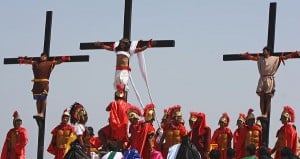
Cruxifixion – Creative Commons Attribution-Share Generic 2.0 license

Previous Post

September 15, 2015
One of My Heroes
Next Post
September 17, 2015 3 Definitions of Love
Browse Our Archives
Select a Category Book Reviews Featured Give Us This Day Give Us This Day Devotional love me love my wife Love My Wife Reformed Catholicism Blog Spirit-Reality Take This Cup Uncategorized
Select a Month February 2022 November 2021 October 2021 August 2021 January 2021 December 2020 November 2020 September 2020 August 2020 July 2020 June 2020 May 2020 September 2018 July 2018 March 2018 November 2017 October 2017 September 2017 August 2017 July 2017 June 2017 May 2017 April 2017 March 2017 February 2017 January 2017 December 2016 November 2016 October 2016 September 2016 August 2016 July 2016 June 2016 May 2016 April 2016 March 2016 February 2016 January 2016 December 2015 November 2015 October 2015 September 2015 August 2015 July 2015 June 2015 May 2015 April 2015 March 2015 February 2015 January 2015 December 2014 November 2014 October 2014 September 2014 August 2014 July 2014 June 2014 May 2014 April 2014 March 2014 February 2014 January 2014 December 2013 November 2013 October 2013 September 2013 August 2013 July 2013 June 2013 May 2013 April 2013 March 2013 February 2013 January 2013 December 2012 November 2012 October 2012 September 2012 August 2012 July 2012 June 2012 May 2012 April 2012 March 2012 February 2012 January 2012 December 2011 November 2011 October 2011 September 2011 August 2011 July 2011 May 2011 April 2011 March 2011 February 2011 January 2011
Follow Us!
TAKE THE
Religious Wisdom Quiz
True or False: Hebrews teaches that the blood of bulls and goats can take away sins.
Select your answer to see how you score.
FALSE TRUE
Related posts from Give Us This Day

James Clark - Book Review of Take This...
Joseph Laughon - Book Review of Take This...
Jesus Took on All Human Suffering - Part...
TRENDING AT PATHEOS Evangelical

The REST of Your Life: A Creative Wrestles...
This week I had a conversation with a good friend from church....

How the author of the world's best hymn...
I've been working with John Newton for a while now. This makes...

Long before this Lectio Divina, Psalm 130 - the song - started...

What About the Trees? Another Living Parable
After I finished writing the last article about falling leaves as a...

Why Classical Education Is a Conversation, Not a...
Come and Read: Joy in Classical Education When I was a little...

Cornell University has received a great deal of negative publicity and intense...
view all Evangelical blogs
Ad-Free & Subscriber Log-In Subscription Support
- About Us
- 2026 Calendar
- Videos
- Podcasts
- Library of World Religions
- Faith In Media Tracker
- Advertise With Us
- Write for Us
- Privacy Policy
- Terms of Service
- Do Not Sell My Data
- Contact Us
- Radiant Digital
- Manage Newsletter Subscriptions
- Unsubscribe From Notifications
- Sitemap
Copyright 2008-2026, Patheos. All rights reserved.
Subscription Support Ad-Free & Subscriber Log-In
Follow Patheos