
BuddhistCatholicContemplativeEvangelicalGeneral ChristianHinduJewishLatter-day SaintMuslimNew VisionsProgressive Christian
Beliefs
- Buddhist
- Catholic
- Contemplative
- Evangelical
- General Christian
- Hindu
- Jewish
- Latter-day Saint
- More Voices
- Muslim
- New Visions
- Pagan
- Progressive Christian
Topics
- Religion News
- Food and Religion
- Sports and Religion
- Religious Art
- Religious Music and Entertainment
- Religious Events
- History and Religion
- Style and Religion
- Politics and Religion
- Women in Religion
- Recreation Outdoors and Religion
- Business Finance and Religion
- Careers Workplace and Religion
- Education and Religion
- Family Parenting and Religion
- Health Fitness and Religion
- Home and Religion
- Relationships and Religion
- Technology and Religion
- Travel and Religion
Columnists
- Buddhist Columnists
- Business Finance and Religion Columnists
- Careers Workplace and Religion Columnists
- Catholic Columnists
- Contemplative Columnists
- Education and Religion Columnists
- Evangelists Columnists
- Family Parenting and Religion Columnists
- General Christian Columnists
- Health Fitness and Religion Columnists
- Hindu Columnists
- History and Religion Columnists
- Home and Religion Columnists
- Jewish Columnists
- More Voices Columnists
- Latter Day Columnists
- Muslim Columnists
- New Visions Columnists
- Nonreligious Columnists
- Pagan Columnists
- Politics and Religion Columnists
- Progressive Columnists
- Recreation Outdoors and Religion Columnists
- Relationships and Religion Columnists
- Religion News Columnists
- Religious Art Columnists
- Religious Events Columnists
- Religious Music and Entertainment Columnists
- Sports and Religion Columnists
- Style and Religion Columnists
- Technology and Religion Columnists
- Travel and Religion Columnists
- Women in Religion Columnists
Resource Library
- 2026 Calendar
- Library of World Religions
- The 100 Most Holy Places on Earth
- Patheos Answers
- Podcasts
- Videos
- Faith Leaders Database
- Anglican Episcopalian
- Bahai
- Baptist
- Buddhism
- Christianity
- Confucianism
- Eastern Orthodoxy
- Hinduism
- Holiness and Pentecostal
- ISKCON
- Islam
- Judaism
- Lutheran
- Methodist
- The Church of Jesus Christ of Latter-day Saints
- New Age
- Paganism
- Presbytarian and Reformed
- Protestantism
- Religion Behind the Scenes
- Roman Catholic
- Scientology
- Shia Islam
- Sikhism
- Sufism
- Sunni Islam
- Taoism
- Zen
- See all religions
Research Tools
 Ad-Free & Subscriber Log-In Subscription Support
Ad-Free & Subscriber Log-In Subscription Support
Follow Patheos 

- Trending:
- Forgiveness
- |
- Marriage
- |
- Consciousness
- |
- Death Penalty
- |
- Election
- |
- Halloween
 Give Us This Day
- Home
- Evangelical
- The Litmus Test of Love
The Litmus Test of Love
Last updated on: December 22, 2017 at 10:21 am by Fr. Charles Erlandson
The Litmus Test of Love 2017-12-22T10:21:38-05:00 Fr. Charles Erlandson
Patheos Explore the world's faith through different perspectives on religion and spirituality! Patheos has the views of the prevalent religions and spiritualities of the world.
 1 Corinthians 16:1-14
“Let all that you do be done with love” (verse 14.) This is a fitting summary of Paul’s first letter to the Corinthian: a fitting summary of the corpus of Paul’s letters of love and labors of love; and a fitting summary, indeed, of the Law and the Gospel.
Jesus Christ Himself, when asked to name the greatest law, gave as His answer (which is the Answer): Love God and love neighbor. Every one of the Ten Commandments is about loving God or loving neighbor, and every one of the 613 laws of the Old Testament as well.
Everything that Paul has been teaching the Corinthians is therefore related to and summed up by the commandment to love. And everything that Paul has been teaching us is also summed up by the commandment to love.
Because love is the litmus test for our every thought, word, and deed, Paul commanded the Corinthians to take up a collection for the saints on Sunday, the first day of the week, when Christians gathered together to eat the Lord’s Supper. Each one was to lay up something to give, in this case to the Jerusalem church. This is a love offering above the tithe that went to the local church: it is alms for the saints, and it must be done, and done in love.
Out of love – love for God, love for the Ephesians (where he was attacked by the “wild beasts” clothed in the form of men), and love for the gospel, Paul decided to remain in Ephesus, because “a great and effective door has opened to me” (verse 9.) Knowing that there are many adversaries – the Jews and the silversmiths and the guardians of the temple of Diana – Paul remains anyway, out of love.
Out of love, we are to speak the same thing and not to have divisions among us (Chapter 1.)
Out of love for God, we consecrate God’s holy temple, and out of love for our brothers and sisters in Christ we edify God’s holy temple, which is His people among whom He lives (Chapter 3.)
Out of love for God, we are to purify His Temple when it becomes polluted and to deal with the sin in our midst, and out of love for our brothers and sisters we discipline those who are immoral and will not repent (Chapter 5.)
Out of love, we do not bring lawsuits against each other but rather allow ourselves to be wronged (Chapter 6,) for love keeps no record of wrongs.
Out of love for God and those whom God has put in our lives (and these are our neighbors), we gladly accept the station in life into which God Himself has placed us, whether Jew or Greek, slave or free, husband or wife, married or single (Chapter 7.)
Out of love for weaker brothers, we willingly give up our liberty to enjoy certain lawful things, that we might not cause them to stumble (Chapter 8.)
Out of love, so that we may be made love as God is love, we are willing to become all things to all people. Even when this is uncomfortable and not our preference, we use ourselves, our gifts and our talents, in whatever way we can so that by whatever means possible some may be saved (Chapter 9.)
Out of love for God, we eat and drink our Lord Jesus Christ, that He might give us His grace to make us participants in Him. Out of love for ourselves, we eat and drink worthily, with repentance and faith in the one who offers Himself to us (Chapters 10 and 11.)
Out of love for the Body of Christ, which is love for God and neighbor and self all rolled up into one, we use the diversity of gifts that God has given us for the good or edification of the whole Body and specific members in particular (Chapters 12 and 14.)
Out of His immense and eternal love, God the Father sent His Son to become a man, to die, and to be raised from the dead – for our good (Chapter 15.)
God, therefore, is love and the initiator of love in our lives. He is the example of love for us: not that we first loved God, but that He first loved us. Because we shall all be changed in the twinkling of an eye and resurrected in the image of our Lord, who has redeemed us by His love, we are to be new creatures, creatures of love in all that we do.
The power of the Resurrection is not therefore just a newfound power in our physical bodies that will never wear out in heaven: it is the power to love as God first loved us.
And because the new and eternal life that God has created in us out of His love has already been given to us and we have been enriched in everything by Him (1:5), we must practice love. For though I may speak with the tongues of men and of angels or can understand all mysteries and knowledge (Chapters 12 and 14); though I have all faith so that I could move mountains (Chapter 15 – faith in the Resurrection and in Christ); though I bestow all my goods to feed the poor (Chapter 16); and though I give my body to be burned (15:32, 16:9): it does not profit me, if I do not love as God has first loved me.
Prayer: Almighty Father, whose beloved Son on the night in which He was betrayed gave us the commandment to love and demonstrated it by His washing of our feet and giving Himself in His Supper; grant that we may by His love be able to love as You have first loved us. Amen.
Points for Meditation:
- Meditate more fully on the ways in which God is calling you to love. It will be beneficial to review 1 Corinthians to find ways in which God is calling you.
- Meditate on the love of God as it relates to the Resurrection and life in heaven.
Resolution: I resolve to find one specific way to practice love today. Do not pick what is easiest or most convenient but that to which you know God is calling you.
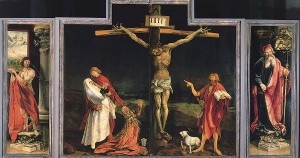
Crucifixion of Christ, Matthias Grunewald – in U.S. Public Domain
\

Previous Post

March 25, 2015
The Resurrection and the Twinkling of an Eye
Next Post
March 27, 2015 Priscilla and Aquila
Browse Our Archives
Select a Category Book Reviews Featured Give Us This Day Give Us This Day Devotional love me love my wife Love My Wife Reformed Catholicism Blog Spirit-Reality Take This Cup Uncategorized
Select a Month February 2022 November 2021 October 2021 August 2021 January 2021 December 2020 November 2020 September 2020 August 2020 July 2020 June 2020 May 2020 September 2018 July 2018 March 2018 November 2017 October 2017 September 2017 August 2017 July 2017 June 2017 May 2017 April 2017 March 2017 February 2017 January 2017 December 2016 November 2016 October 2016 September 2016 August 2016 July 2016 June 2016 May 2016 April 2016 March 2016 February 2016 January 2016 December 2015 November 2015 October 2015 September 2015 August 2015 July 2015 June 2015 May 2015 April 2015 March 2015 February 2015 January 2015 December 2014 November 2014 October 2014 September 2014 August 2014 July 2014 June 2014 May 2014 April 2014 March 2014 February 2014 January 2014 December 2013 November 2013 October 2013 September 2013 August 2013 July 2013 June 2013 May 2013 April 2013 March 2013 February 2013 January 2013 December 2012 November 2012 October 2012 September 2012 August 2012 July 2012 June 2012 May 2012 April 2012 March 2012 February 2012 January 2012 December 2011 November 2011 October 2011 September 2011 August 2011 July 2011 May 2011 April 2011 March 2011 February 2011 January 2011
Follow Us!
TAKE THE
Religious Wisdom Quiz
What is taught about gossip in the Bible?
Select your answer to see how you score.
Avoid it Encourage it Enjoy it Spread it
Related posts from Give Us This Day

Is Christianity a Relationship and Not a Religion?

The Different States of Love - and the...

Are You Really the Disciple Jesus Loved?
John 13:1-17 - The New Commandment
TRENDING AT PATHEOS Evangelical

How the author of the world's best hymn...
I've been working with John Newton for a while now. This makes...

Long before this Lectio Divina, Psalm 130 - the song - started...

What About the Trees? Another Living Parable
After I finished writing the last article about falling leaves as a...

Why Classical Education Is a Conversation, Not a...
Come and Read: Joy in Classical Education When I was a little...

Falling Leaves: A Living Parable on Letting Go
I’ve spent the vast majority of my life in the southeast corner...

Cornell University has received a great deal of negative publicity and intense...
view all Evangelical blogs
Ad-Free & Subscriber Log-In Subscription Support
- About Us
- 2026 Calendar
- Videos
- Podcasts
- Library of World Religions
- Faith In Media Tracker
- Advertise With Us
- Write for Us
- Privacy Policy
- Terms of Service
- Do Not Sell My Data
- Contact Us
- Radiant Digital
- Manage Newsletter Subscriptions
- Unsubscribe From Notifications
- Sitemap
Copyright 2008-2026, Patheos. All rights reserved.
Subscription Support Ad-Free & Subscriber Log-In
Follow Patheos