
BuddhistCatholicContemplativeEvangelicalGeneral ChristianHinduJewishLatter-day SaintMuslimNew VisionsProgressive Christian
Beliefs
- Buddhist
- Catholic
- Contemplative
- Evangelical
- General Christian
- Hindu
- Jewish
- Latter-day Saint
- More Voices
- Muslim
- New Visions
- Pagan
- Progressive Christian
Topics
- Religion News
- Food and Religion
- Sports and Religion
- Religious Art
- Religious Music and Entertainment
- Religious Events
- History and Religion
- Style and Religion
- Politics and Religion
- Women in Religion
- Recreation Outdoors and Religion
- Business Finance and Religion
- Careers Workplace and Religion
- Education and Religion
- Family Parenting and Religion
- Health Fitness and Religion
- Home and Religion
- Relationships and Religion
- Technology and Religion
- Travel and Religion
Columnists
- Buddhist Columnists
- Business Finance and Religion Columnists
- Careers Workplace and Religion Columnists
- Catholic Columnists
- Contemplative Columnists
- Education and Religion Columnists
- Evangelists Columnists
- Family Parenting and Religion Columnists
- General Christian Columnists
- Health Fitness and Religion Columnists
- Hindu Columnists
- History and Religion Columnists
- Home and Religion Columnists
- Jewish Columnists
- More Voices Columnists
- Latter Day Columnists
- Muslim Columnists
- New Visions Columnists
- Nonreligious Columnists
- Pagan Columnists
- Politics and Religion Columnists
- Progressive Columnists
- Recreation Outdoors and Religion Columnists
- Relationships and Religion Columnists
- Religion News Columnists
- Religious Art Columnists
- Religious Events Columnists
- Religious Music and Entertainment Columnists
- Sports and Religion Columnists
- Style and Religion Columnists
- Technology and Religion Columnists
- Travel and Religion Columnists
- Women in Religion Columnists
Resource Library
- 2026 Calendar
- Library of World Religions
- The 100 Most Holy Places on Earth
- Patheos Answers
- Podcasts
- Videos
- Faith Leaders Database
- Anglican Episcopalian
- Bahai
- Baptist
- Buddhism
- Christianity
- Confucianism
- Eastern Orthodoxy
- Hinduism
- Holiness and Pentecostal
- ISKCON
- Islam
- Judaism
- Lutheran
- Methodist
- The Church of Jesus Christ of Latter-day Saints
- New Age
- Paganism
- Presbytarian and Reformed
- Protestantism
- Religion Behind the Scenes
- Roman Catholic
- Scientology
- Shia Islam
- Sikhism
- Sufism
- Sunni Islam
- Taoism
- Zen
- See all religions
Research Tools
 Ad-Free & Subscriber Log-In Subscription Support
Follow Patheos 

- Trending:
- Advent
- |
- Forgiveness
- |
- Thanksgiving
- |
- Election
- |
- Seasonal Holidays
- |
- Marriage

- Home
- Evangelical
- Politics and Religion
- Belief and Disbelief in Christ’s Presence in Holy Communion
Belief and Disbelief in Christ’s Presence in Holy Communion
Last updated on: November 27, 2026 at 6:00 am by Gene Veith
Belief and Disbelief in Christ’s Presence in Holy Communion 2026-11-20T21:09:09-05:00 Gene Veith
Patheos Explore the world's faith through different perspectives on religion and spirituality! Patheos has the views of the prevalent religions and spiritualities of the world.
We know what Catholics believe. We know what Calvinists believe. We know what Lutherans believe. But do they really believe it? What churches are supposed to teach, what they actually teach, and what their members believe may be three different things.
A study entitled Belief in the Real Presence Among American Catholics: Prevalence and Patterns concludes that only 29% of Catholics believe that Christ is present in Holy Communion.
But is that a completely valid conclusion from the researchers’ own data? Here are the findings, as reported by EWTN News:
Researchers asked 1,049 Catholics whether they believe the Eucharist actually becomes “the Body and Blood of Christ” during consecration or whether they believe “the bread and wine are symbols of his body and blood.”
Only 28.8% answered that “the bread and wine truly become the Body and Blood of Christ” and about 58.8% expressed belief that “they are just symbols,” with approximately 12.4% saying “I’m not sure what happens.”
The survey asks whether the bread “becomes” the body of Christ, a reference to transubstantiation. The only other options offered are that the elements are “symbols” of Christ’s body and “I’m not sure.”
That fewer than one out of three Catholics believe in the church’s official teaching of transubstantiation should indeed worry the bishops. But there are other ways of thinking about Christ’s real presence. Is there a “spiritual presence,” as the Reformed believe? Or, better yet, is there a “sacramental union” so that both the bread and the wine and body and blood of Christ as present, as Lutherans believe?
To test for transubstantiation and make conclusions about the real presence is a glaring mistake on the part of the researchers.
To be sure, though, the finding that 58.8% of Catholics are Zwinglians, believing that the elements “are just symbols”–the only theological stance that is precisely described–is telling. (Protestants considering converting to Catholicism, note this well. You may appreciate the Catholicism of Thomas Aquinas, but you may have difficulty finding that in contemporary Catholic parishes today.)
For a more nuanced study of related research, see this 2023 article from the Church Life Journal, What Do American Catholics Really Know and Believe about the Eucharist? It cites research from 2010 that found (my emphasis), “More than four in ten Catholics in the United States (45%) do not know that their church teaches that the bread and wine used in Communion do not merely symbolize but actually become the body and blood of Christ.”
This reflects a shocking failure of catechesis, preaching, and parish education. A later survey from 2022 asked Catholics what they, personally, believe. This time slightly over one-third, 35%, said they believe the elements “become” Christ’s body and blood, with only 8% saying “they are a symbol, nothing happens.” But 57% said in different ways they don’t know, at least some of which may be appropriate acknowledgment of the mystery.
That same study, though, when asking Catholic respondents what they thought their church believed at least gave as an option a description of the real presence, as such, instead of only a description of transubstantiation: “Jesus Christ is truly present under the appearance of bread and wine.” (OK, that the bread and wine are only “appearances” is a nod to transubstantiation, but other real present theologies might accept this formulation.) This is deemed the “correct” teaching of the church, as acknowledged by nearly half, 49%, of the Catholics surveyed. But a majority of the Catholics (51%) are still Zwinglians, believing that “Bread and wine are symbols of Jesus’ actions at the Last Supper, meaning that Jesus is only symbolically present in the consecrated bread and wine.”
But the big revelation for me in this article is what it said about Protestant’s beliefs about the Lord’s supper. I’ll quote the whole paragraph, which references a study from way back in 2008 (my emphasis):
The 2008 American National Election Study (ANES) asked U.S. adult citizens who self-identified as Christians the following yes/no question, “Do you believe that when people take Holy Communion, the bread and wine become the body and blood of Jesus Christ, or do you believe that does not happen?” At that time, 74% of Catholics surveyed indicated a belief that the bread and wine become the body and blood of Jesus Christ. Significant numbers of non-Catholic Christians also stated they had this same belief. Nearly six in ten Protestants (59%) surveyed expressed a belief in transubstantiation and 70% of Lutherans specifically expressed this. In fact, at the time, a majority of all sub-groups of non-Catholic Christians in the United States (i.e., those with a sufficient size that the number of interviews allows for an estimate) expressed a belief regarding the Eucharist that is consistent with the Catholic Church’s teachings on transubstantiation.
So Protestants don’t know what their churches teach about the Lord’s Supper either! But the survey does indicate that a higher view of the sacraments is quite acceptable to Protestants in the pews; indeed, that many rank and file Protestants already hold higher views. They would presumably not find that to be an obstacle, which should be an encouragement for Lutherans. Indeed, it would very likely be a draw.
As for my fellow Lutherans, here is a question: Is there a sense in which we too can say that the bread and wine “become” the body and blood of Jesus Christ without believing in transubstantiation? Luther’s sacramental theology–particularly in his debate with Zwingli–insists that Jesus’ own words must not be taken simply in a symbolic sense: “This is my body” (Matthew 26:26). Isn’t it true that before consecration the bread is simply bread, but that by virtue of the Word of God, the bread “is” Christ’s body. Doesn’t that mean it “becomes” His body, not by changing the substance of the bread but by the sacramental union? So those 70% of Lutherans who responded to that survey in 2008 weren’t wrong? (Help me out, here, you pastors.)
To be sure, there seems to be a major falling off in sacramental belief since 2008 among Catholics. I couldn’t find any recent studies about Lutherans’ beliefs or those of other Protestants. (Correct me if you know of any.) I suspect that a good number of Lutherans also may not know what their church teaches and, even if they do, don’t believe it. For me, though, the notion that Christ is genuinely present in the bread and wine–not just present, but present “for you,” for me, for the remission of our sins–is one of the richest treasures of Lutheranism.
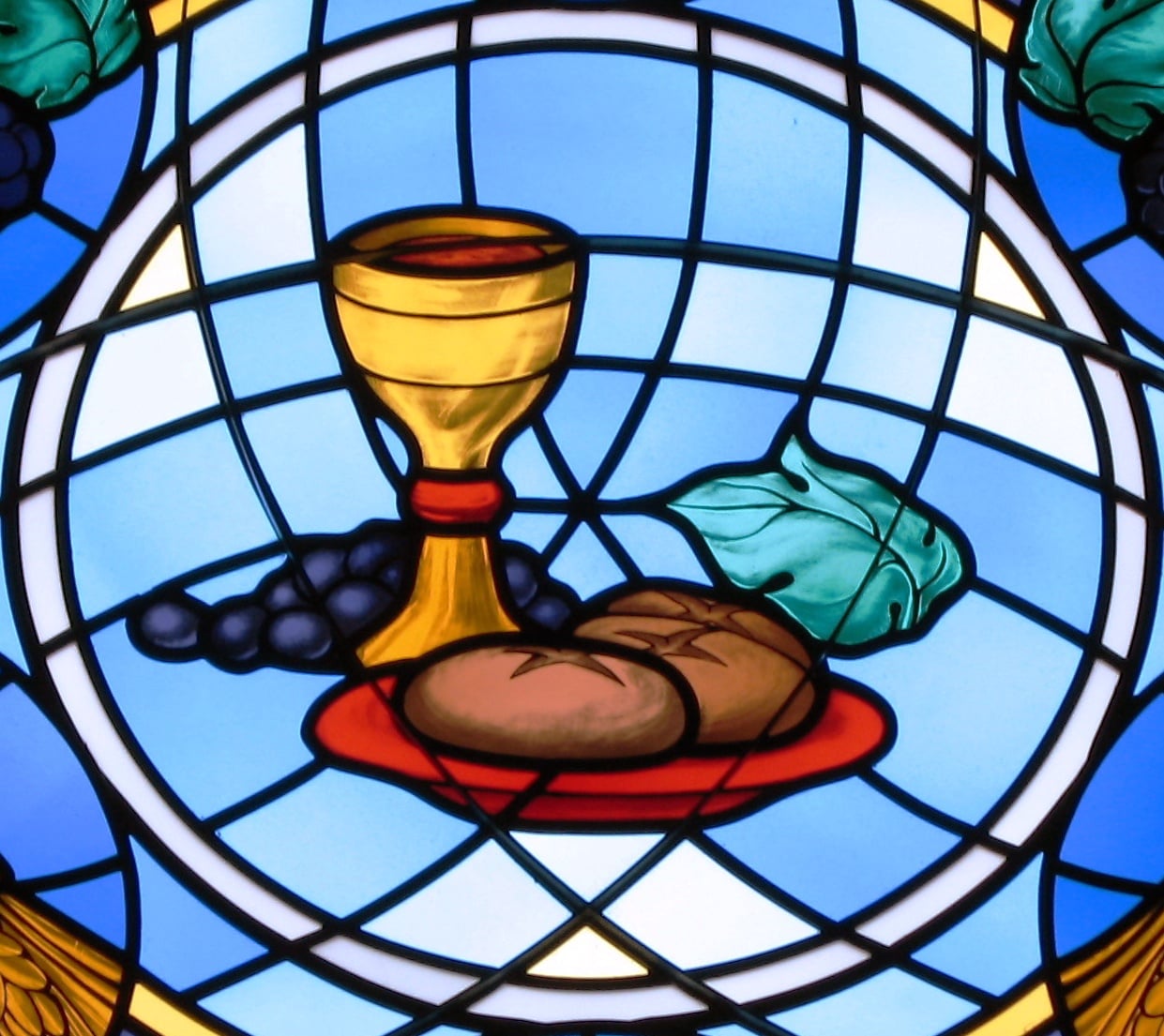
Illustration: St. Michael the Archangel Parish, Findlay, Ohio Eucharistic stained glass window depicting bread and wine by Nheyob, cropped by Tahc – Own work, CC BY-SA 4.0, https://commons.wikimedia.org/wiki/Special:Redirect/page/39730001

Catholic belief in the eucharist
Catholic theology of the eucharist
Previous Post

November 26, 2026
Gratitude as the Parent of All Virtues
Recent Comments
"There must be a distinction between showing gratitude and having gratitude. It is the latter, ..."
Gratitude as the Parent of All ..."
"Well, thanks, Setapart. I appreciate those kind words. And I appreciate all of you readers. ..."
Gratitude as the Parent of All ..."
"In keeping with the theme of this article Dr Veith, thank-you! I am very grateful ..."
Gratitude as the Parent of All ..."
"Happy Thanksgiving everyone! https://youtu.be/blbslHDgceY?si=RROkSfTWKBLXB6qh"
Gratitude as the Parent of All ..."
Browse Our Archives
Select a Category America Apologetics Art baseball Bible Blog Christ Church crime Culture Economics Education Ethics Family Food Football Government History Holidays Holy Week Humor International Islam Language Law Life Issues Literature Media Medicine Movies Music Nature News Personal Philosophy Politics psychology Reformation Religions Sacraments Science sex Social Science Sports technology television terrorism Theology Uncategorized Vocation war
Select a Month November 2026 October 2026 September 2026 August 2026 July 2026 June 2026 May 2026 April 2026 March 2026 February 2026 January 2026 December 2025 November 2025 October 2025 September 2025 August 2025 July 2025 June 2025 May 2025 April 2025 March 2025 February 2025 January 2025 December 2024 November 2024 October 2024 September 2024 August 2024 July 2024 June 2024 May 2024 April 2024 March 2024 February 2024 January 2024 December 2023 November 2023 October 2023 September 2023 August 2023 July 2023 June 2023 May 2023 April 2023 March 2023 February 2023 January 2023 December 2022 November 2022 October 2022 September 2022 August 2022 July 2022 June 2022 May 2022 April 2022 March 2022 February 2022 January 2022 December 2021 November 2021 October 2021 September 2021 August 2021 July 2021 June 2021 May 2021 April 2021 March 2021 February 2021 January 2021 December 2020 November 2020 October 2020 September 2020 August 2020 July 2020 June 2020 May 2020 April 2020 March 2020 February 2020 January 2020 December 2019 November 2019 October 2019 September 2019 August 2019 July 2019 June 2019 May 2019 April 2019 March 2019 February 2019 January 2019 December 2018 November 2018 October 2018 September 2018 August 2018 July 2018 June 2018 May 2018 April 2018 March 2018 February 2018 January 2018 December 2017 November 2017 October 2017 September 2017 August 2017 July 2017 June 2017 May 2017 April 2017 March 2017 February 2017 January 2017 December 2016 November 2016 October 2016 September 2016 August 2016 July 2016 June 2016 May 2016 April 2016 March 2016 February 2016 January 2016 December 2015 November 2015 October 2015 September 2015 August 2015 July 2015 June 2015 May 2015 April 2015 March 2015 February 2015 January 2015 December 2014 November 2014 October 2014 September 2014 August 2014 July 2014 June 2014 May 2014 April 2014 March 2014 February 2014 January 2014 December 2013 November 2013 October 2013 September 2013 August 2013 July 2013 June 2013 May 2013 April 2013 March 2013 February 2013 January 2013 December 2012 November 2012 October 2012 September 2012 August 2012 July 2012 June 2012 May 2012 April 2012 March 2012 February 2012 January 2012 December 2011 November 2011 October 2011 September 2011 August 2011 July 2011 June 2011 May 2011 April 2011 March 2011 February 2011 January 2011 December 2010 November 2010 October 2010 September 2010 August 2010 July 2010 June 2010 May 2010 April 2010 March 2010 February 2010 January 2010 December 2009 November 2009 October 2009 September 2009 August 2009 July 2009 June 2009 May 2009 April 2009 March 2009 February 2009 January 2009 December 2008 November 2008 October 2008 September 2008 August 2008 July 2008 June 2008 May 2008 April 2008 March 2008 February 2008 January 2008 December 2007 November 2007 October 2007
Give A Subscription
Follow Us!
TAKE THE
Religious Wisdom Quiz
Who saw a vision of wheels within wheels by the Kebar River?
Select your answer to see how you score.
Daniel Ezekiel Micah Jonah
Books by This Author Books by Gene Veith
Related posts from Cranach
God and the Contingency of This World


Who Receives the New Benefit of Clergy
TRENDING AT PATHEOS Evangelical

Blue Christmas: Making Room for Grief at Church
A Blue Christmas service makes room for grief, remembrance, and hope. Explore...

We Can Trust That God Will Use Our...
A Jesus-loving young friend who is going through deep suffering sent me...

Everything is worship for Quakers. The Quakers emphasize contemplation, equality, pacifism and...

Happy Thanksgiving! I published this Thanksgiving column back in 2017 in...

More Than a Meal: A Messianic Thanksgiving
A Messianic Thanksgiving What if Thanksgiving became more than a meal to...

The Darkening of the Sun, Moon, and Stars
The darkening of the sun and moon and the falling of stars...
view all Evangelical blogs
What Are Your Thoughts?leave a comment
Ad-Free & Subscriber Log-In Subscription Support
- About Us
- 2026 Calendar
- Videos
- Podcasts
- Library of World Religions
- Faith In Media Tracker
- Advertise With Us
- Write for Us
- Privacy Policy
- Terms of Service
- Do Not Sell My Data
- Contact Us
- Radiant Digital
- Manage Newsletter Subscriptions
- Unsubscribe From Notifications
- Sitemap
Copyright 2008-2026, Patheos, part of the Radiant Digital network of media brands. All rights reserved.
Subscription Support Ad-Free & Subscriber Log-In
Follow Patheos