
BuddhistCatholicContemplativeEvangelicalGeneral ChristianHinduJewishLatter-day SaintMuslimNew VisionsProgressive Christian
Beliefs
- Buddhist
- Catholic
- Contemplative
- Evangelical
- General Christian
- Hindu
- Jewish
- Latter-day Saint
- More Voices
- Muslim
- New Visions
- Pagan
- Progressive Christian
Topics
- Religion News
- Food and Religion
- Sports and Religion
- Religious Art
- Religious Music and Entertainment
- Religious Events
- History and Religion
- Style and Religion
- Politics and Religion
- Women in Religion
- Recreation Outdoors and Religion
- Business Finance and Religion
- Careers Workplace and Religion
- Education and Religion
- Family Parenting and Religion
- Health Fitness and Religion
- Home and Religion
- Relationships and Religion
- Technology and Religion
- Travel and Religion
Columnists
- Buddhist Columnists
- Business Finance and Religion Columnists
- Careers Workplace and Religion Columnists
- Catholic Columnists
- Contemplative Columnists
- Education and Religion Columnists
- Evangelists Columnists
- Family Parenting and Religion Columnists
- General Christian Columnists
- Health Fitness and Religion Columnists
- Hindu Columnists
- History and Religion Columnists
- Home and Religion Columnists
- Jewish Columnists
- More Voices Columnists
- Latter Day Columnists
- Muslim Columnists
- New Visions Columnists
- Nonreligious Columnists
- Pagan Columnists
- Politics and Religion Columnists
- Progressive Columnists
- Recreation Outdoors and Religion Columnists
- Relationships and Religion Columnists
- Religion News Columnists
- Religious Art Columnists
- Religious Events Columnists
- Religious Music and Entertainment Columnists
- Sports and Religion Columnists
- Style and Religion Columnists
- Technology and Religion Columnists
- Travel and Religion Columnists
- Women in Religion Columnists
Resource Library
- 2026 Calendar
- Library of World Religions
- The 100 Most Holy Places on Earth
- Patheos Answers
- Podcasts
- Videos
- Faith Leaders Database
- Anglican Episcopalian
- Bahai
- Baptist
- Buddhism
- Christianity
- Confucianism
- Eastern Orthodoxy
- Hinduism
- Holiness and Pentecostal
- ISKCON
- Islam
- Judaism
- Lutheran
- Methodist
- The Church of Jesus Christ of Latter-day Saints
- New Age
- Paganism
- Presbytarian and Reformed
- Protestantism
- Religion Behind the Scenes
- Roman Catholic
- Scientology
- Shia Islam
- Sikhism
- Sufism
- Sunni Islam
- Taoism
- Zen
- See all religions
Research Tools
 Ad-Free & Subscriber Log-In Subscription Support
Follow Patheos 

- Trending:
- Advent
- |
- Forgiveness
- |
- Thanksgiving
- |
- Election
- |
- Seasonal Holidays
- |
- Marriage

- Home
- Evangelical
- Politics and Religion
- The (Lutheran) Mathematician of Infinity
The (Lutheran) Mathematician of Infinity
Last updated on: September 24, 2026 at 7:41 am by Gene Veith
The (Lutheran) Mathematician of Infinity 2026-09-24T07:41:00-04:00 Gene Veith
Patheos Explore the world's faith through different perspectives on religion and spirituality! Patheos has the views of the prevalent religions and spiritualities of the world.
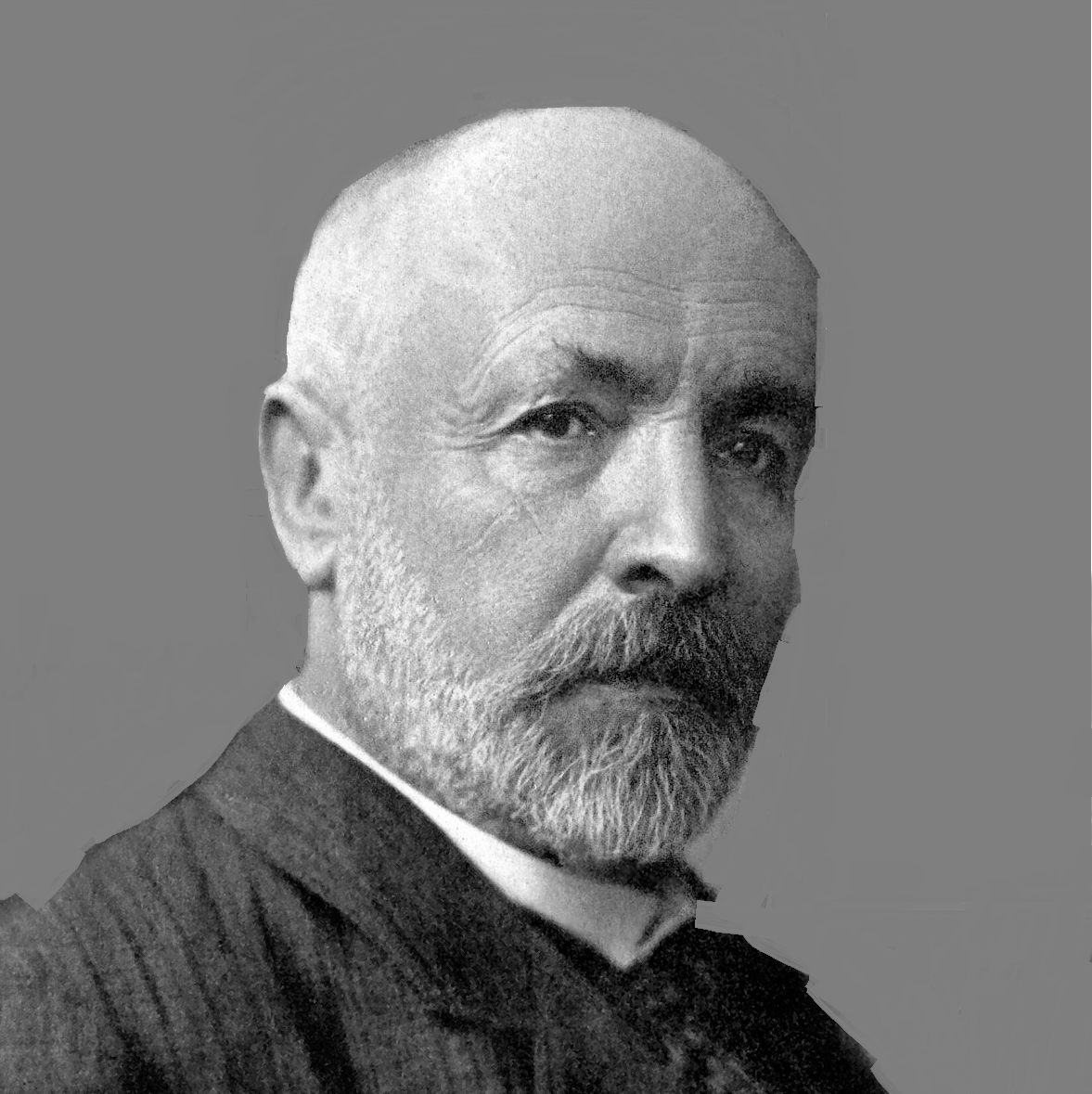
I blogged about the seminal mathematicians for quantum physics Werner Heisenberg and Kurt Gödel, who were believing Lutheran Christians.
I appreciate long-time member of the Cranach community DakotaLutheran, in his comment on the post about Craig’s proof of God’s existence and personality, for alerting me to yet another important Lutheran mathematician: Georg Cantor (1845-1918).
Cantor played a key role in the development of set theory, which has become a fundamental concept in contemporary mathematics. He also pioneered the mathematics of infinity.
For example, he proved that some infinities are larger than others. (Let that mess with your mind for awhile.)
I can’t pretend to follow his mathematical proofs, projects, and contributions. His Wikipedia article goes into some of that, which I invite those of you who do understand them to unpack. (DakotaLutheran, feel free to jump in.) That article underscores that Cantor was a “devout Lutheran” whose faith was closely connected to his work.
As I understand it, theologians from the time of Thomas Aquinas insisted that God alone is infinite. The sequence of numbers can go on forever, since you can always add one to any number, but that is mainly theoretical, something Aquinas called “relatively or potentially infinite.” By Cantor’s time, many scientists and mathematicians denied that anything could be actually infinite.
But Cantor found lots of infinite sets, such as the number of points on any number line. He called these “transfinite.” God is the only “absolute infinite,” but since as he proved some infinities are larger than others, this is no problem to faith. In fact, he argued that the existence of transfinities, both in the mind of man and in creation, depends on their being an absolute infinity, that is God.
Not only that, the prevalence of transfinities proves that the universe is “contingent”–that is, not eternal, determined, and defined by unalterable natural laws, as the 19th century materialists were arguing. Instead, as orthodox theologians have long claimed, God created everything ex nihilo according to His free will.
Let me turn the podium over to the Rev. Dr. Bruce Hedman, a mathematician on the faculty of the University of Connecticut and also a Congregationalist pastor. In 1993, he published an article entitled Cantor’s Concept of Infinity: Implications of Infinity for Contingence, which explores the theological implications of Cantor’s mathematics. Here is the abstract of that article:
Georg Cantor (1845-1918) was a devout Lutheran whose explicit Christian beliefs shaped his philosophy of science. Joseph Dauben has traced the impact Cantor’s Christian convictions had on the development of transfinite set theory. In this paper I propose to examine how Cantor’s transfinite set theory has contributed to an increasingly contingent world view in modern science. The contingence of scientific theories is not just a cautious tentativeness, but arises out of the actual state of the universe itself. The mathematical entities Cantor studied, transfinite numbers, he admitted were fraught with paradoxes. But he believed that they were grounded in a reality beyond this universe, not finally determinable by any mathematical system.
Hedman goes over the math, which those of you who are mathematically inclined can follow, but here are some of his conclusions (Hedman’s headings, my bolds):
The Applicability of Mathematics
Cantor distinguished between the intra-subjective and the trans-subjective existence of all numbers, finite and transfinite. But Cantor believed these dual realities were always found together. This correspondence between the physical and ideal aspects of numbers Cantor believed came from a unity in the universe itself.28Cantor believed in a created harmony between the mind and the physical world, so that mathematical deductions from patterns first suggested by the physical world should reapply to further phenomena. He thought that the transfinites would shed light on the ultimate constitution of matter, which would benefit physics, chemistry, and biology. History has vindicated his expectations. . . .
But this created harmony is contingent. In contrast to Hellenistic philosophy, the human mind is not a divine spark, or an actual piece of God’s own mind. This rationality in our minds and in the physical world is not absolute and self-dependent, but is only a created reflection of an Ultimate Rationality upon which it depends. So no scientific deduction must necessarily be so, nor is any scientific theory beyond revision. Cantor produced a classic example of contingent rationality when he drew the distinction between transfinite numbers, which exist in the human mind, and Absolute Infinity, which is beyond all human determination, and exists only in the mind of God.
Cosmology
Creation
Classical science regarded the physical universe as incontingent, as self-contained and self-explanatory. An incontingent universe must, therefore, be necessarily infinite in duration and extent. Otherwise, the questions as to what came before and what lies beyond have no answer within that incontingent universe itself. The eternity of the universe has been called the first article of the secular faith.29
Cosmology is the bellwether of major paradigm shifts in a culture.30Modern science has returned to a more contingent world view of the universe as finite in duration and extent. Steve Hawking has called Big Bang cosmology one of the great intellectual revolutions.31 Furthermore many modern cosmologists seriously doubt that only one type of universe was logically possible, but rather argue that there were arbitrary elements in the composition of both the structure of the universe and its fundamental constants.32 The ancient Christian doctrine of creation ex nihlio regards the physical universe as God’s free creation whose structure is determined by no necessity nor constraint, but is contingent only upon God’s will. Cantor’s thinking was shaped by his Christian belief in the universe as created. . . .
Cantor’s Universe Not Necessitarian
An incontingent world view regards the universe as having a necessary structure, as being uniquely determined by just the requirement of self-consistency. All phenomena in principle could be deduced from its system of basic laws. A contingent universe does not contain within itself a sufficient explanation of itself, and so cannot be understood simply by a priori reasoning. . . .
Hedman goes on. He closes with a series of “Open Questions” that Cantor did not address, but that his mathematics could be applied to, such as Anselm’s Ontological Argument and Gödel’s Incompleteness Theorem.
Hedman’s last open question was just a gleam in the eye of theorists back in 1993. But it resonates strongly today:
Artificial Intelligence
Devotees of artificial intelligence model human thinking after Turing machines. Yet such can involve even potentially only a countable number of steps. Can one argue that from the uncountability of the real numbers that the human mind can fathom a reality larger than Turing machines can accommodate?
Photograph: Georg Cantor by Sreyansu tm – Own work, CC BY-SA 4.0, https://commons.wikimedia.org/w/index.php?curid=89262795

Previous Post

September 23, 2026
Authoritarian vs. Totalitarian
Next Post

September 25, 2026 Nones, Others, & Switchers
Recent Comments
"Is "moving around" an indicator or harbinger of abandonment of historical orthodoxy? Do the creeds ..."
"What interests me about this discussion of the future of Christianity are reports by Mark ..."
"As far as I know, there is no link. I'm referring to a presentation he ..."
"Can we fix the AI mistake of Huang's reinstatement or the evidence of "corrupted files" ..."
Browse Our Archives
Select a Category America Apologetics Art baseball Bible Blog Christ Church crime Culture Economics Education Ethics Family Food Football Government History Holidays Holy Week Humor International Islam Language Law Life Issues Literature Media Medicine Movies Music Nature News Personal Philosophy Politics psychology Reformation Religions Sacraments Science sex Social Science Sports technology television terrorism Theology Uncategorized Vocation war
Select a Month November 2026 October 2026 September 2026 August 2026 July 2026 June 2026 May 2026 April 2026 March 2026 February 2026 January 2026 December 2025 November 2025 October 2025 September 2025 August 2025 July 2025 June 2025 May 2025 April 2025 March 2025 February 2025 January 2025 December 2024 November 2024 October 2024 September 2024 August 2024 July 2024 June 2024 May 2024 April 2024 March 2024 February 2024 January 2024 December 2023 November 2023 October 2023 September 2023 August 2023 July 2023 June 2023 May 2023 April 2023 March 2023 February 2023 January 2023 December 2022 November 2022 October 2022 September 2022 August 2022 July 2022 June 2022 May 2022 April 2022 March 2022 February 2022 January 2022 December 2021 November 2021 October 2021 September 2021 August 2021 July 2021 June 2021 May 2021 April 2021 March 2021 February 2021 January 2021 December 2020 November 2020 October 2020 September 2020 August 2020 July 2020 June 2020 May 2020 April 2020 March 2020 February 2020 January 2020 December 2019 November 2019 October 2019 September 2019 August 2019 July 2019 June 2019 May 2019 April 2019 March 2019 February 2019 January 2019 December 2018 November 2018 October 2018 September 2018 August 2018 July 2018 June 2018 May 2018 April 2018 March 2018 February 2018 January 2018 December 2017 November 2017 October 2017 September 2017 August 2017 July 2017 June 2017 May 2017 April 2017 March 2017 February 2017 January 2017 December 2016 November 2016 October 2016 September 2016 August 2016 July 2016 June 2016 May 2016 April 2016 March 2016 February 2016 January 2016 December 2015 November 2015 October 2015 September 2015 August 2015 July 2015 June 2015 May 2015 April 2015 March 2015 February 2015 January 2015 December 2014 November 2014 October 2014 September 2014 August 2014 July 2014 June 2014 May 2014 April 2014 March 2014 February 2014 January 2014 December 2013 November 2013 October 2013 September 2013 August 2013 July 2013 June 2013 May 2013 April 2013 March 2013 February 2013 January 2013 December 2012 November 2012 October 2012 September 2012 August 2012 July 2012 June 2012 May 2012 April 2012 March 2012 February 2012 January 2012 December 2011 November 2011 October 2011 September 2011 August 2011 July 2011 June 2011 May 2011 April 2011 March 2011 February 2011 January 2011 December 2010 November 2010 October 2010 September 2010 August 2010 July 2010 June 2010 May 2010 April 2010 March 2010 February 2010 January 2010 December 2009 November 2009 October 2009 September 2009 August 2009 July 2009 June 2009 May 2009 April 2009 March 2009 February 2009 January 2009 December 2008 November 2008 October 2008 September 2008 August 2008 July 2008 June 2008 May 2008 April 2008 March 2008 February 2008 January 2008 December 2007 November 2007 October 2007
Give A Subscription
Follow Us!
TAKE THE
Religious Wisdom Quiz
Who said, "What must I do to be saved?"
Select your answer to see how you score.
Zacchaeus The Philippian jailer Peter Nicodemus
Books by This Author Books by Gene Veith
Related posts from Cranach
A Scientist on the Location of Heaven

Who Receives the New Benefit of Clergy
TRENDING AT PATHEOS Evangelical

Bama Gramma's Blackout Christmas: the Power of Light...
Another Christmas Skit: I have an alter ego: Bama Gramma. She shows...

Thanksgiving as a Way of Life: A Christian...
Each year, Thanksgiving brings families and friends together to share meals, stories,...

Two Women Doctors Who Went Against the Current
Women physicians who transformed healthcare for "Indians" “I shall have an advantage...

Reading Culture Through Scripture, Not the Other Way...
A Radix Teleology and Faith Before Seeing: Essentialism “For we also have...
Thy Word is Truth: The Bible Vindicated by...
My 59th book, completed on 9 November 2026; 204 pages. *****...

Adventurous Lectionary -1st. Sunday of Advent - November...
The Adventurous Lectionary - The First Sunday of Advent – November 29,...
view all Evangelical blogs
What Are Your Thoughts?leave a comment
Ad-Free & Subscriber Log-In Subscription Support
- About Us
- 2026 Calendar
- Videos
- Podcasts
- Library of World Religions
- Faith In Media Tracker
- Advertise With Us
- Write for Us
- Privacy Policy
- Terms of Service
- Do Not Sell My Data
- Contact Us
- Radiant Digital
- Manage Newsletter Subscriptions
- Unsubscribe From Notifications
- Sitemap
Copyright 2008-2026, Patheos, part of the Radiant Digital network of media brands. All rights reserved.
Subscription Support Ad-Free & Subscriber Log-In
Follow Patheos