
BuddhistCatholicContemplativeEvangelicalGeneral ChristianHinduJewishLatter-day SaintMuslimNew VisionsProgressive Christian
Beliefs
- Buddhist
- Catholic
- Contemplative
- Evangelical
- General Christian
- Hindu
- Jewish
- Latter-day Saint
- More Voices
- Muslim
- New Visions
- Pagan
- Progressive Christian
Topics
- Religion News
- Food and Religion
- Sports and Religion
- Religious Art
- Religious Music and Entertainment
- Religious Events
- History and Religion
- Style and Religion
- Politics and Religion
- Women in Religion
- Recreation Outdoors and Religion
- Business Finance and Religion
- Careers Workplace and Religion
- Education and Religion
- Family Parenting and Religion
- Health Fitness and Religion
- Home and Religion
- Relationships and Religion
- Technology and Religion
- Travel and Religion
Columnists
- Buddhist Columnists
- Business Finance and Religion Columnists
- Careers Workplace and Religion Columnists
- Catholic Columnists
- Contemplative Columnists
- Education and Religion Columnists
- Evangelists Columnists
- Family Parenting and Religion Columnists
- General Christian Columnists
- Health Fitness and Religion Columnists
- Hindu Columnists
- History and Religion Columnists
- Home and Religion Columnists
- Jewish Columnists
- More Voices Columnists
- Latter Day Columnists
- Muslim Columnists
- New Visions Columnists
- Nonreligious Columnists
- Pagan Columnists
- Politics and Religion Columnists
- Progressive Columnists
- Recreation Outdoors and Religion Columnists
- Relationships and Religion Columnists
- Religion News Columnists
- Religious Art Columnists
- Religious Events Columnists
- Religious Music and Entertainment Columnists
- Sports and Religion Columnists
- Style and Religion Columnists
- Technology and Religion Columnists
- Travel and Religion Columnists
- Women in Religion Columnists
Resource Library
- 2026 Calendar
- Library of World Religions
- The 100 Most Holy Places on Earth
- Patheos Answers
- Podcasts
- Videos
- Faith Leaders Database
- Anglican Episcopalian
- Bahai
- Baptist
- Buddhism
- Christianity
- Confucianism
- Eastern Orthodoxy
- Hinduism
- Holiness and Pentecostal
- ISKCON
- Islam
- Judaism
- Lutheran
- Methodist
- The Church of Jesus Christ of Latter-day Saints
- New Age
- Paganism
- Presbytarian and Reformed
- Protestantism
- Religion Behind the Scenes
- Roman Catholic
- Scientology
- Shia Islam
- Sikhism
- Sufism
- Sunni Islam
- Taoism
- Zen
- See all religions
Research Tools
 Ad-Free & Subscriber Log-In Subscription Support
Ad-Free & Subscriber Log-In Subscription Support
Follow Patheos 

- Trending:
- Forgiveness
- |
- Marriage
- |
- Consciousness
- |
- Death Penalty
- |
- Election
- |
- Halloween

- Home
- Evangelical
- Politics and Religion
- Moravec’s Paradox
Moravec’s Paradox
Last updated on: September 1, 2026 at 6:00 am by Gene Veith
Moravec’s Paradox 2026-08-23T18:11:17-04:00 Gene Veith
Patheos Explore the world's faith through different perspectives on religion and spirituality! Patheos has the views of the prevalent religions and spiritualities of the world.
I quite randomly came across some correspondence by Anmol Arora of Cambridge University in the British medical journal Lancet. It discussed whether AI and robotic technology might someday take the place of human doctors.
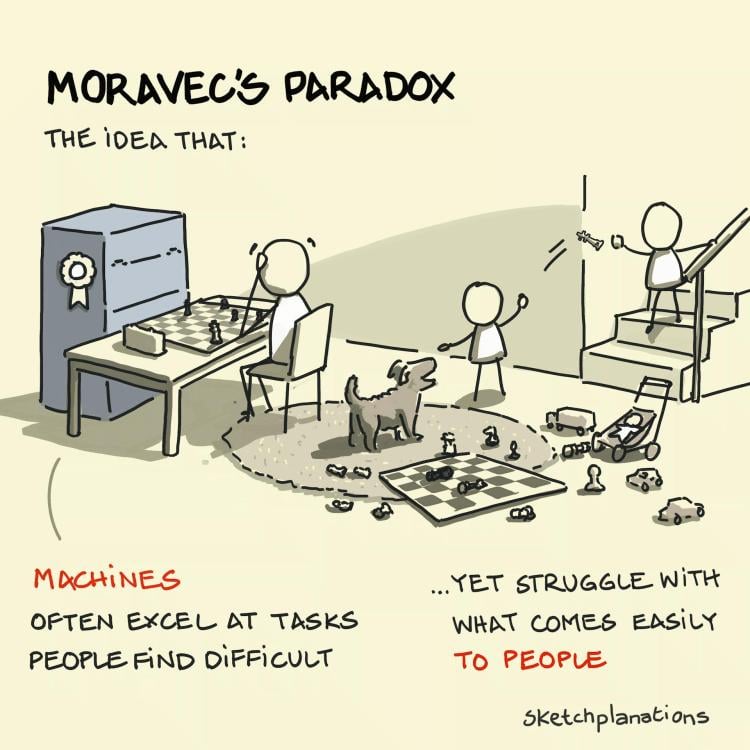
In the course of that, Arora mentioned an intriguing concept with wide applicability. It’s called Moravec’s paradox. I’ll let Arora explain it. From Moravec’s paradox and the fear of job automation in health care:
Moravec’s paradox is a phenomenon observed by robotics researcher Hans Moravec, in which tasks that are easy for humans to perform (eg, motor or social skills) are difficult for machines to replicate, whereas tasks that are difficult for humans (eg, performing mathematical calculations or large scale data analysis) are relatively easy for machines to accomplish.
The Wikipedia article on Moravec’s Paradox quotes what Moravec wrote back in 1988: “It is comparatively easy to make computers exhibit adult level performance on intelligence tests or playing checkers, and difficult or impossible to give them the skills of a one-year-old when it comes to perception and mobility.”
The article quotes similar observations by other pioneers in the AI field:
[Marvin] Minsky emphasized that the most difficult human skills to reverse engineer are those that are below the level of conscious awareness. “In general, we’re least aware of what our minds do best”, he wrote, and added: “we’re more aware of simple processes that don’t work well than of complex ones that work flawlessly”. Steven Pinker wrote in 1994 that “the main lesson of thirty-five years of AI research is that the hard problems are easy and the easy problems are hard.”
Why is this? Moravec offered an evolutionary explanation:
Encoded in the large, highly evolved sensory and motor portions of the human brain is a billion years of experience about the nature of the world and how to survive in it. The deliberate process we call reasoning is, I believe, the thinnest veneer of human thought, effective only because it is supported by this much older and much more powerful, though usually unconscious, sensorimotor knowledge. We are all prodigious olympians in perceptual and motor areas, so good that we make the difficult look easy. Abstract thought, though, is a new trick, perhaps less than 100 thousand years old. We have not yet mastered it. It is not all that intrinsically difficult; it just seems so when we do it.
An alternative answer is that our capacity for abstract thought is only a small part of what makes us human. Our consciousness consists of our sensory perceptions, imagination, memory, conscience, emotions, feelings, and much, much more, with “intelligence” being a very small part of the human makeup. This is because we are embodied souls, created in the image of God Himself. Just as He transcends narrow little categories, so do we.
The Wikipedia article also put Moravec’s paradox in the context of AI development:
In the early days of artificial intelligence research, leading researchers often predicted that they would be able to create thinking machines in just a few decades (see history of artificial intelligence). Their optimism stemmed in part from the fact that they had been successful at writing programs that used logic, solved algebra and geometry problems and played games like checkers and chess. Logic and algebra are difficult for people and are considered a sign of intelligence. Many prominent researchers assumed that, having (almost) solved the “hard” problems, the “easy” problems of vision and commonsense reasoning would soon fall into place. They were wrong. . . .
Rodney Brooks explains that, according to early AI research, intelligence was “best characterized as the things that highly educated male scientists found challenging”, such as chess, symbolic integration, proving mathematical theorems and solving complicated word algebra problems. “The things that children of four or five years could do effortlessly, such as visually distinguishing between a coffee cup and a chair, or walking around on two legs, or finding their way from their bedroom to the living room were not thought of as activities requiring intelligence. Nor were any aesthetic judgments included in the repertoire of intelligence-based skills.”
Back to Arora, who applies these limitations to AI-assisted medicine, showing what the technology can do for doctors, but also what it can’t do, suggesting why human doctors will always be important:
For example, a computer-aided diagnostic system might be able to analyse large volumes of images quickly and accurately but might struggle to recognise clinical context or technical limitations that a human radiologist would easily identify. Similarly, a machine learning algorithm might be able to predict a patient’s risk of a specific condition on the basis of their medical history and laboratory results but might not be able to account for the nuances of the patient’s individual case or consider the effect of social and environmental factors that a human physician would consider.
In surgery, there has been great progress in the field of robotics in health care when robotic elements are controlled by humans, but artificial intelligence driven robotic technology has been much slower to develop.
Thus far, research into clinical artificial intelligence has focused on improving diagnosis and predictive medicine. However, this is only a small component of the daily job of a doctor, at any level. Communicating to patients, performing practical procedures, and choosing investigations requires much more time and effort than the interpretation of results.
This is not to say that the use of artificial intelligence to improve the interpretation of investigations is not important. Rather, this use of artificial intelligence augments the delivery of care provided by humans rather than replacing it. Moravec’s paradox highlights the importance of maintaining a human element in the health-care system
To be sure, humans need to be able to handle the “hard” parts. Education dare not farm out rational analysis completely to machines. A woman whose son was in an engineering program at a major university told me that one of his professors told him that he didn’t need to learn calculus, since he can just have AI handle the math problems. No, he needs to learn calculus, if only to direct and make sense of what AI will spit out.
But Moravec’s paradox reminds us that while technology can help human beings, it cannot replace them.
Illustration: Moravec’s Paradox, by Jono Hey, Sketchplanations under a Creative Commons Attribution-NonCommercial 4.0 International License
Previous Post

August 31, 2026
Monday Miscellany, 8/31/26
Next Post

September 2, 2026 AI Winters
Recent Comments
"Apropos to the post on Gen Z a couple days ago: "If you want the ..."
"“Don't eat with your hands, son, use your entrenching tool.”"
"You serious, Clark?"
"And all tools are made of media, thus making language and literature a tool (see, ..."
Browse Our Archives
Select a Category America Apologetics Art baseball Bible Blog Christ Church crime Culture Economics Education Ethics Family Food Football Government History Holidays Holy Week Humor International Islam Language Law Life Issues Literature Media Medicine Movies Music Nature News Personal Philosophy Politics psychology Reformation Religions Sacraments Science sex Social Science Sports technology television terrorism Theology Uncategorized Vocation war
Select a Month October 2026 September 2026 August 2026 July 2026 June 2026 May 2026 April 2026 March 2026 February 2026 January 2026 December 2025 November 2025 October 2025 September 2025 August 2025 July 2025 June 2025 May 2025 April 2025 March 2025 February 2025 January 2025 December 2024 November 2024 October 2024 September 2024 August 2024 July 2024 June 2024 May 2024 April 2024 March 2024 February 2024 January 2024 December 2023 November 2023 October 2023 September 2023 August 2023 July 2023 June 2023 May 2023 April 2023 March 2023 February 2023 January 2023 December 2022 November 2022 October 2022 September 2022 August 2022 July 2022 June 2022 May 2022 April 2022 March 2022 February 2022 January 2022 December 2021 November 2021 October 2021 September 2021 August 2021 July 2021 June 2021 May 2021 April 2021 March 2021 February 2021 January 2021 December 2020 November 2020 October 2020 September 2020 August 2020 July 2020 June 2020 May 2020 April 2020 March 2020 February 2020 January 2020 December 2019 November 2019 October 2019 September 2019 August 2019 July 2019 June 2019 May 2019 April 2019 March 2019 February 2019 January 2019 December 2018 November 2018 October 2018 September 2018 August 2018 July 2018 June 2018 May 2018 April 2018 March 2018 February 2018 January 2018 December 2017 November 2017 October 2017 September 2017 August 2017 July 2017 June 2017 May 2017 April 2017 March 2017 February 2017 January 2017 December 2016 November 2016 October 2016 September 2016 August 2016 July 2016 June 2016 May 2016 April 2016 March 2016 February 2016 January 2016 December 2015 November 2015 October 2015 September 2015 August 2015 July 2015 June 2015 May 2015 April 2015 March 2015 February 2015 January 2015 December 2014 November 2014 October 2014 September 2014 August 2014 July 2014 June 2014 May 2014 April 2014 March 2014 February 2014 January 2014 December 2013 November 2013 October 2013 September 2013 August 2013 July 2013 June 2013 May 2013 April 2013 March 2013 February 2013 January 2013 December 2012 November 2012 October 2012 September 2012 August 2012 July 2012 June 2012 May 2012 April 2012 March 2012 February 2012 January 2012 December 2011 November 2011 October 2011 September 2011 August 2011 July 2011 June 2011 May 2011 April 2011 March 2011 February 2011 January 2011 December 2010 November 2010 October 2010 September 2010 August 2010 July 2010 June 2010 May 2010 April 2010 March 2010 February 2010 January 2010 December 2009 November 2009 October 2009 September 2009 August 2009 July 2009 June 2009 May 2009 April 2009 March 2009 February 2009 January 2009 December 2008 November 2008 October 2008 September 2008 August 2008 July 2008 June 2008 May 2008 April 2008 March 2008 February 2008 January 2008 December 2007 November 2007 October 2007
Follow Us!
TAKE THE
Religious Wisdom Quiz
Who denied Jesus three times before the rooster crowed?
Select your answer to see how you score.
Peter John Thomas Judas
Books by This Author Books by Gene Veith
Related posts from Cranach



Our New Book on Technology & Vocation

Why AI Bots Don't Really Have Emotions
TRENDING AT PATHEOS Evangelical

Pope Leo Celebrates Mass for Nurses & Docs...
I don't have any idea how he did it, but Pope Leo...

The Sermon on the Mount, Part I: Matthew...
The Sermon on the Mount, Part I (Matthew 4:12-5:12) St. Matthew moves...

What's up from Crossway: Reviewing some of their latest A few weeks...

Janie Learns the Way of the Cross: A...
Teaching children about Jesus' Passion can be challenging. Many parents and educators...

Looking For Good Catholic Writing - October 2026
He alone extends the heavens, and he walks upon the waves of...

In "Irreplaceable," our book on vocation and technology, Trevor Sutton and I...
view all Evangelical blogs
What Are Your Thoughts?leave a comment
Ad-Free & Subscriber Log-In Subscription Support
- About Us
- 2026 Calendar
- Videos
- Podcasts
- Library of World Religions
- Faith In Media Tracker
- Advertise With Us
- Write for Us
- Privacy Policy
- Terms of Service
- Do Not Sell My Data
- Contact Us
- Radiant Digital
- Manage Newsletter Subscriptions
- Unsubscribe From Notifications
- Sitemap
Copyright 2008-2026, Patheos. All rights reserved.
Subscription Support Ad-Free & Subscriber Log-In
Follow Patheos