
BuddhistCatholicContemplativeEvangelicalGeneral ChristianHinduJewishLatter-day SaintMuslimNew VisionsProgressive Christian
Beliefs
- Buddhist
- Catholic
- Contemplative
- Evangelical
- General Christian
- Hindu
- Jewish
- Latter-day Saint
- More Voices
- Muslim
- New Visions
- Pagan
- Progressive Christian
Topics
- Religion News
- Food and Religion
- Sports and Religion
- Religious Art
- Religious Music and Entertainment
- Religious Events
- History and Religion
- Style and Religion
- Politics and Religion
- Women in Religion
- Recreation Outdoors and Religion
- Business Finance and Religion
- Careers Workplace and Religion
- Education and Religion
- Family Parenting and Religion
- Health Fitness and Religion
- Home and Religion
- Relationships and Religion
- Technology and Religion
- Travel and Religion
Columnists
- Buddhist Columnists
- Business Finance and Religion Columnists
- Careers Workplace and Religion Columnists
- Catholic Columnists
- Contemplative Columnists
- Education and Religion Columnists
- Evangelists Columnists
- Family Parenting and Religion Columnists
- General Christian Columnists
- Health Fitness and Religion Columnists
- Hindu Columnists
- History and Religion Columnists
- Home and Religion Columnists
- Jewish Columnists
- More Voices Columnists
- Latter Day Columnists
- Muslim Columnists
- New Visions Columnists
- Nonreligious Columnists
- Pagan Columnists
- Politics and Religion Columnists
- Progressive Columnists
- Recreation Outdoors and Religion Columnists
- Relationships and Religion Columnists
- Religion News Columnists
- Religious Art Columnists
- Religious Events Columnists
- Religious Music and Entertainment Columnists
- Sports and Religion Columnists
- Style and Religion Columnists
- Technology and Religion Columnists
- Travel and Religion Columnists
- Women in Religion Columnists
Resource Library
- 2026 Calendar
- Library of World Religions
- The 100 Most Holy Places on Earth
- Patheos Answers
- Podcasts
- Videos
- Faith Leaders Database
- Anglican Episcopalian
- Bahai
- Baptist
- Buddhism
- Christianity
- Confucianism
- Eastern Orthodoxy
- Hinduism
- Holiness and Pentecostal
- ISKCON
- Islam
- Judaism
- Lutheran
- Methodist
- The Church of Jesus Christ of Latter-day Saints
- New Age
- Paganism
- Presbytarian and Reformed
- Protestantism
- Religion Behind the Scenes
- Roman Catholic
- Scientology
- Shia Islam
- Sikhism
- Sufism
- Sunni Islam
- Taoism
- Zen
- See all religions
Research Tools
 Ad-Free & Subscriber Log-In Subscription Support
Follow Patheos 

- Trending:
- Advent
- |
- Forgiveness
- |
- Thanksgiving
- |
- Election
- |
- Seasonal Holidays
- |
- Marriage

- Home
- Evangelical
- Politics and Religion
- Denying Laity the Chalice–Again
Denying Laity the Chalice–Again
Last updated on: September 22, 2026 at 7:59 am by Gene Veith
Denying Laity the Chalice–Again 2026-09-22T07:59:39-04:00 Gene Veith
Patheos Explore the world's faith through different perspectives on religion and spirituality! Patheos has the views of the prevalent religions and spiritualities of the world.
I can’t help but sympathize with traditionalist Catholics with their Latin mass and their defiance of liberal Catholic theology. But then they pull something that reminds me of just how necessary was the Reformation.
Some arch-conservative bishops are once again denying the laity Communion “in both kinds”; that is, not allowing lay people to drink the wine that is Christ’s blood. The chalice is restricted to priests alone, except for certain special occasions.
The reasoning is that since the bread is transubstantiated into Christ’s body, it would also contain some of His blood, so laypeople don’t really need the wine. It’s better to keep the cup away from laypeople, who might spill it. That would be a great sacrilege.
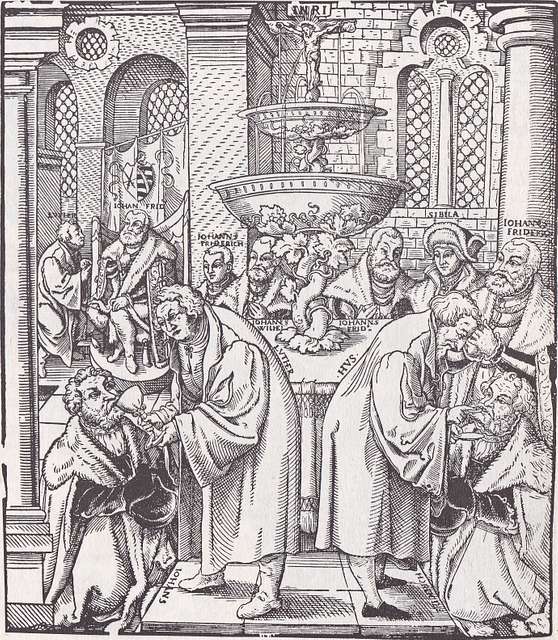
Now this was the practice of the Church of Rome in Luther’s day. It was so important to the church that Czech theologian John Hus was declared a heretic and burned at the stake, in part because he believed laypeople should be able to partake of both the bread and wine in Holy Communion.
After Hus was killed in 1415, his followers valued receiving the cup so much that they fought against the Holy Roman Emperor, the Catholic kings of Europe, and the armies of the pope, who declared five crusades against them! In these so-called Hussite Wars, the Hussites, who pioneered the use of firearms in warfare and fought under the banner of a chalice, actually won those wars. In the peace agreement, the church gave the people of Bohemia (what the land of the Czechs was known as then) a dispensation allowing them to receive the wine.
Anyway, in 1415 the Council of Constance, which burned Hus despite the safe conduct he was promised, made communion in one kind for the laypeople a required practice in the church.
Luther and the other Reformers insisted on communion in both kinds. So in 1562, the Council of Trent issued this decree:
Canon i. If any one shall say, that, by the precept of God, or, by necessity of salvation, all and each of the faithful of Christ ought to receive both species of the most holy sacrament of the Eucharist; let him be anathema.
Canon ii. If any one shall say, that the holy Catholic Church was not induced by just causes and reasons to communicate, under the species of bread only, laymen, and also clerks when not consecrating; let him be anathema.
Canon iii. If any one shall deny, that Christ whole and entire, the fountain and author of all graces, is received under the one species of bread; because that, as some falsely assert, he is not received, according to the institution of Christ himself, under both species; let him be anathema. (Session XXI)
“Let him be anathema” means, literally, let him be cursed. Someone who has been anathemized is excommunicated from the church.
Finally, in 1963, the council known as Vatican II allowed the laity to receive communion in both kinds:
The dogmatic principles which were laid down by the Council of Trent remaining intact, communion under both kinds may be granted when the bishops think fit, not only to clerics and religious, but also to the laity. [Sacrosanctum Concilium, paragraph 55]
Notice, though, that this is at the discretion of the local bishop. After Vatican II, communion in both kinds became pretty much the universal practice. But today, some bishops are having second thoughts.
Writing in the National Catholic Reporter, Karen Park complains that her bishop in Green Bay, Wisconsin no longer allows her to receive the wine. In his statement to his flock, Bishop David Ricken said that he would allow it on occasions that are especially holy (Holy Thursday, the Easter Vigil, the Christmas Midnight Mass, Pentecost, Corpus Christi, Christ the King, Trinity Sunday and Divine Mercy Sunday).
In his pastoral letter, Ricken invokes the “Principle of Progressive Solemnity” claiming that “by their very nature, Masses of the greatest solemnity within the liturgical year demand a higher and fuller ritual.” . . . Other reasons given for the restriction in Ricken’s document include the supposedly greater risk involved in spilling the precious blood as opposed to dropping the host, as well as “unity” that is “continued by the uniformity of distribution of Holy Communion” in the Diocese. According to Ricken, if some parishes in the Green Bay Diocese offer Communion under both kinds and some do not, this uneven practice “could set up the possibility of parishioners traveling to churches to find where Holy Communion is offered from the Cup.”
He is admitting here and elsewhere that the parishioners of his diocese do want the cup. That doesn’t enter into his decision, of course. Historically, the “principle of progressive solemnity,” in effect, has taught that not just some days are holier than others but that priests are holier than the laypeople they are supposed to serve, and letting only priests drink from the chalice imprinted that notion at every Mass. As for worries about “spilling the precious blood,” Jesus Himself spilled His blood for all of us.
As for all of the scholastic reasoning and papal decrees, I refute them with a single verse from God’s Word:
And he took a cup, and when he had given thanks he gave it to them, saying, “Drink of it, all of you, for this is my blood of the covenant, which is poured out for many for the forgiveness of sins. (Matthew 26:27-28)
When it comes to the Sacrament, the Reformed say that “is” means “represents.” And the Roman Catholics say that “all” means “some.”
The main reason this is coming back in some Catholic circles is that they want to return to the “traditional” practices. That is, to Catholicism before all of the modernist innovations of Vatican II. But, as Karen Park points out in the title of her article, “Restricting the chalice is not tradition — it’s a troubling innovation.”
Indeed, as she says, “Communion under both kinds is not a liberal post-conciliar innovation. It was the practice of the ancient church and remained normative for centuries.” The Wikipedia article on Communion in Both Kinds says that restricting the laity from receiving the wine was not practiced in the Western church–it was never practiced in the Eastern church–until the 1100’s or 1200’s. It wasn’t mandated until the Council of Constance in 1414. So to say that the practice is “traditional” looks only to the last six centuries, as if the earlier fourteen centuries did not count in the tradition.
Next time you take the consecrated wine in the Lord’s Supper, think of how many people gave their lives for that privilege.
Illustration: Luther and Hus Administering Communion (woodcut, 1550) via Picryl, Public domain.
Previous Post

September 21, 2026
Monday Miscellany, 9/21/26
Next Post

September 23, 2026 Authoritarian vs. Totalitarian
Recent Comments
"Is "moving around" an indicator or harbinger of abandonment of historical orthodoxy? Do the creeds ..."
"What interests me about this discussion of the future of Christianity are reports by Mark ..."
"As far as I know, there is no link. I'm referring to a presentation he ..."
"Can we fix the AI mistake of Huang's reinstatement or the evidence of "corrupted files" ..."
Browse Our Archives
Select a Category America Apologetics Art baseball Bible Blog Christ Church crime Culture Economics Education Ethics Family Food Football Government History Holidays Holy Week Humor International Islam Language Law Life Issues Literature Media Medicine Movies Music Nature News Personal Philosophy Politics psychology Reformation Religions Sacraments Science sex Social Science Sports technology television terrorism Theology Uncategorized Vocation war
Select a Month November 2026 October 2026 September 2026 August 2026 July 2026 June 2026 May 2026 April 2026 March 2026 February 2026 January 2026 December 2025 November 2025 October 2025 September 2025 August 2025 July 2025 June 2025 May 2025 April 2025 March 2025 February 2025 January 2025 December 2024 November 2024 October 2024 September 2024 August 2024 July 2024 June 2024 May 2024 April 2024 March 2024 February 2024 January 2024 December 2023 November 2023 October 2023 September 2023 August 2023 July 2023 June 2023 May 2023 April 2023 March 2023 February 2023 January 2023 December 2022 November 2022 October 2022 September 2022 August 2022 July 2022 June 2022 May 2022 April 2022 March 2022 February 2022 January 2022 December 2021 November 2021 October 2021 September 2021 August 2021 July 2021 June 2021 May 2021 April 2021 March 2021 February 2021 January 2021 December 2020 November 2020 October 2020 September 2020 August 2020 July 2020 June 2020 May 2020 April 2020 March 2020 February 2020 January 2020 December 2019 November 2019 October 2019 September 2019 August 2019 July 2019 June 2019 May 2019 April 2019 March 2019 February 2019 January 2019 December 2018 November 2018 October 2018 September 2018 August 2018 July 2018 June 2018 May 2018 April 2018 March 2018 February 2018 January 2018 December 2017 November 2017 October 2017 September 2017 August 2017 July 2017 June 2017 May 2017 April 2017 March 2017 February 2017 January 2017 December 2016 November 2016 October 2016 September 2016 August 2016 July 2016 June 2016 May 2016 April 2016 March 2016 February 2016 January 2016 December 2015 November 2015 October 2015 September 2015 August 2015 July 2015 June 2015 May 2015 April 2015 March 2015 February 2015 January 2015 December 2014 November 2014 October 2014 September 2014 August 2014 July 2014 June 2014 May 2014 April 2014 March 2014 February 2014 January 2014 December 2013 November 2013 October 2013 September 2013 August 2013 July 2013 June 2013 May 2013 April 2013 March 2013 February 2013 January 2013 December 2012 November 2012 October 2012 September 2012 August 2012 July 2012 June 2012 May 2012 April 2012 March 2012 February 2012 January 2012 December 2011 November 2011 October 2011 September 2011 August 2011 July 2011 June 2011 May 2011 April 2011 March 2011 February 2011 January 2011 December 2010 November 2010 October 2010 September 2010 August 2010 July 2010 June 2010 May 2010 April 2010 March 2010 February 2010 January 2010 December 2009 November 2009 October 2009 September 2009 August 2009 July 2009 June 2009 May 2009 April 2009 March 2009 February 2009 January 2009 December 2008 November 2008 October 2008 September 2008 August 2008 July 2008 June 2008 May 2008 April 2008 March 2008 February 2008 January 2008 December 2007 November 2007 October 2007
Give A Subscription
Follow Us!
TAKE THE
Religious Wisdom Quiz
Which Persian king allowed Ezra to take Jewish exiles and gifts to Jerusalem?
Select your answer to see how you score.
Nebuchadnezzar Artaxerxes Darius Cyrus
Books by This Author Books by Gene Veith
Related posts from Cranach


Who Receives the New Benefit of Clergy

A Catholic Century or an Evangelical Century?
TRENDING AT PATHEOS Evangelical

Bama Gramma's Blackout Christmas: the Power of Light...
Another Christmas Skit: I have an alter ego: Bama Gramma. She shows...

Thanksgiving as a Way of Life: A Christian...
Each year, Thanksgiving brings families and friends together to share meals, stories,...

Two Women Doctors Who Went Against the Current
Women physicians who transformed healthcare for "Indians" “I shall have an advantage...

Reading Culture Through Scripture, Not the Other Way...
A Radix Teleology and Faith Before Seeing: Essentialism “For we also have...

Thy Word is Truth: The Bible Vindicated by...
My 59th book, completed on 9 November 2026; 204 pages. *****...

Adventurous Lectionary -1st. Sunday of Advent - November...
The Adventurous Lectionary - The First Sunday of Advent – November 29,...
view all Evangelical blogs
What Are Your Thoughts?leave a comment
Ad-Free & Subscriber Log-In Subscription Support
- About Us
- 2026 Calendar
- Videos
- Podcasts
- Library of World Religions
- Faith In Media Tracker
- Advertise With Us
- Write for Us
- Privacy Policy
- Terms of Service
- Do Not Sell My Data
- Contact Us
- Radiant Digital
- Manage Newsletter Subscriptions
- Unsubscribe From Notifications
- Sitemap
Copyright 2008-2026, Patheos, part of the Radiant Digital network of media brands. All rights reserved.
Subscription Support Ad-Free & Subscriber Log-In
Follow Patheos