
BuddhistCatholicContemplativeEvangelicalGeneral ChristianHinduJewishLatter-day SaintMuslimNew VisionsProgressive Christian
Beliefs
- Buddhist
- Catholic
- Contemplative
- Evangelical
- General Christian
- Hindu
- Jewish
- Latter-day Saint
- More Voices
- Muslim
- New Visions
- Pagan
- Progressive Christian
Topics
- Religion News
- Food and Religion
- Sports and Religion
- Religious Art
- Religious Music and Entertainment
- Religious Events
- History and Religion
- Style and Religion
- Politics and Religion
- Women in Religion
- Recreation Outdoors and Religion
- Business Finance and Religion
- Careers Workplace and Religion
- Education and Religion
- Family Parenting and Religion
- Health Fitness and Religion
- Home and Religion
- Relationships and Religion
- Technology and Religion
- Travel and Religion
Columnists
- Buddhist Columnists
- Business Finance and Religion Columnists
- Careers Workplace and Religion Columnists
- Catholic Columnists
- Contemplative Columnists
- Education and Religion Columnists
- Evangelists Columnists
- Family Parenting and Religion Columnists
- General Christian Columnists
- Health Fitness and Religion Columnists
- Hindu Columnists
- History and Religion Columnists
- Home and Religion Columnists
- Jewish Columnists
- More Voices Columnists
- Latter Day Columnists
- Muslim Columnists
- New Visions Columnists
- Nonreligious Columnists
- Pagan Columnists
- Politics and Religion Columnists
- Progressive Columnists
- Recreation Outdoors and Religion Columnists
- Relationships and Religion Columnists
- Religion News Columnists
- Religious Art Columnists
- Religious Events Columnists
- Religious Music and Entertainment Columnists
- Sports and Religion Columnists
- Style and Religion Columnists
- Technology and Religion Columnists
- Travel and Religion Columnists
- Women in Religion Columnists
Resource Library
- 2026 Calendar
- Library of World Religions
- The 100 Most Holy Places on Earth
- Patheos Answers
- Podcasts
- Videos
- Faith Leaders Database
- Anglican Episcopalian
- Bahai
- Baptist
- Buddhism
- Christianity
- Confucianism
- Eastern Orthodoxy
- Hinduism
- Holiness and Pentecostal
- ISKCON
- Islam
- Judaism
- Lutheran
- Methodist
- The Church of Jesus Christ of Latter-day Saints
- New Age
- Paganism
- Presbytarian and Reformed
- Protestantism
- Religion Behind the Scenes
- Roman Catholic
- Scientology
- Shia Islam
- Sikhism
- Sufism
- Sunni Islam
- Taoism
- Zen
- See all religions
Research Tools
 Ad-Free & Subscriber Log-In Subscription Support
Follow Patheos 

- Trending:
- Advent
- |
- Forgiveness
- |
- Thanksgiving
- |
- Election
- |
- Seasonal Holidays
- |
- Marriage

- Home
- Evangelical
- Politics and Religion
- How to Detect AI-Written Fiction
How to Detect AI-Written Fiction
Last updated on: August 14, 2026 at 6:00 am by Gene Veith
How to Detect AI-Written Fiction 2026-08-05T16:24:03-04:00 Gene Veith
Patheos Explore the world's faith through different perspectives on religion and spirituality! Patheos has the views of the prevalent religions and spiritualities of the world.
Yesterday we posted about AI-generated books. But I didn’t have room for the humorous details that I dug up in my research.
I came across an article by Matthew Gault at 404 Media entitled AI Fiction Is Easy to Detect Because It’s Stupid and Bad, Research Finds. That title is funny enough, with its forceful value judgment followed by the objective, scientific “Research Finds.” Here is the first paragraph:
Fiction written by artificial intelligence is easy to detect because it struggles with complex story structure and tends to moralize in clunky ways, according to a preprint study from researchers at University of Maryland, College Park and Google DeepMind. They found that AI fiction has tells that go beyond stereotypical overuse of em-dashes and other obvious AI tropes and have more to do with the formulaic nature of the text itself.
The study that Gault draws on is entitled StoryScope: Investigating idiosyncrasies in AI fiction and can be downloaded here. Researchers looked beyond style to consider content and structure. They used a computer program that broke down the various narrative elements and used it to analyze over 10,000 human-written stories, then gave prompts based on those stories to the various large language models, which generated mirrored stories for comparison.
To sum up, the researchers found that “AI stories over-explain themes and favor tidy, single-track plots while human stories frame protagonists’ choices as more morally ambiguous and have increased temporal complexity (e.g., flashbacks, nonlinear structure).” Here are the specifics:
AI over-explains its themes. AI stories are more explicit and moralizing, (roughly 20% higher on 1-5 scale), with tighter thematic unity and more central moral questions. Narrators explicitly explain the story’s theme 77% of the time, versus 52% for humans: a grieving character’s arc will typically end with the narrator stating the lesson learned. AI dialogue serves philosophical debate more often (59% vs. 34%), and references to other works tend to be vague allusions (72% vs. 50%) rather than specific, named references. The pattern is one of over-determination: AI spells out meaning rather than trusting the reader to infer it.
Human authors subvert linearity. AI stories exhibit tighter causal chains, more protagonist-driven resolutions (69% vs. 46%), and far fewer subplots (79% “no subplots” vs. 57%). AI resolutions favor internal understanding or acceptance (47% vs. 27%), whereas humans are more comfortable with ambiguous endings. Humans use more time jumps, flashbacks and flash-forwards, and nonlinear structure to delay key revelations. AI favors single-track narratives with fewer loose ends; human stories are messier, with time jumps and disjointed causal chains—a human mystery might open at the funeral and spiral backward through decades, while AI tells the same story from first clue to the grand reveal.
AI over-writes the body and senses. AI overwhelmingly conveys emotion through physical sensations and bodily metaphors (81% vs. 38% human), deploys more smell-based imagery (82% vs. 57%), and uses setting as a reflection of characters’ inner states more heavily. AI pays closer attention to physical environment and characters’ inner mental states, showing emotion through bodies and environments rather than naming feelings directly. Where a human author might write that a character “felt afraid,” AI renders fear as a tightening chest, cold sweat, and dimming lamplight. Humans use explicit emotion labels 29% of the time versus just 8% for AI.
Human authors engage the outside world. Humans reference specific texts and authors at nearly double the AI rate (47% vs. 24%) and balance explicit with implicit references more evenly (37% “balanced mix” vs. 16%), whereas AI generally sticks to vague allusions and avoids naming real brands, places, or works. Humans break the fourth wall far more often (67% vs. 39%) and address the reader directly more frequently (28% vs. 7%). Human writing acknowledges its audience as a co-participant (e.g., an aside to “you, dear reader”); AI writes as though no one is watching.
AI writing has less diverse narrative features. Human stories draw from a broader narrative repertoire: they span more locations, carry more dialogue relative to narration, integrate more subplots into overarching themes (42% vs. 21%), and present morally ambivalent protagonists more often (59% vs. 38%), resisting the pull to a narrow set of defaults.
Each AI “author” had its own quirks, so that the study could identify which system wrote which stories:
Claude keeps it cool. Claude has the most distinctive narrative profile of the five LLMs. Its stories are defined by its restraint: event intensity escalates less than in any other source, and narrative voice is the most uniform. Claude takes a reverent/continuist approach to literary tradition, honoring and extending storytelling conventions rather than subverting or challenging them. . . . It favors epilogues and avoids dream sequences, producing careful, consistent stories that favor quiet endings over ’avalanche’ endings.
GPT likes to gossip. GPT centers on socially-oriented storytelling: gossip and rumor as a plot mechanism . . ., a tendency to frame stories as reflections on events from years or decades ago, and ensemble-heavy social networks matching human levels. GPT subverts expectations more than other AI. . . and leaves reconciliations ambiguous.
Gemini, DeepSeek, and Kimi are ‘triplets’. . . .DeepSeek front-loads crucial context that other sources leave until later. Gemini produces the tidiest endings, extended denouements, and the bleakest settings. . . .Kimi has the fewest fingerprints . . . sitting at the generic center of the AI distribution with no distinctive narrative choices.
Yesterday’s post told about the scandal in the publishing world over Mia Ballard’s Shy Girl, a self-published horror novel about a girl who turns into an animal that was picked up by Hachette Books, one of the biggest publishing companies in the world, only to pull the title once it was learned that 78% of the novel was AI-generated.
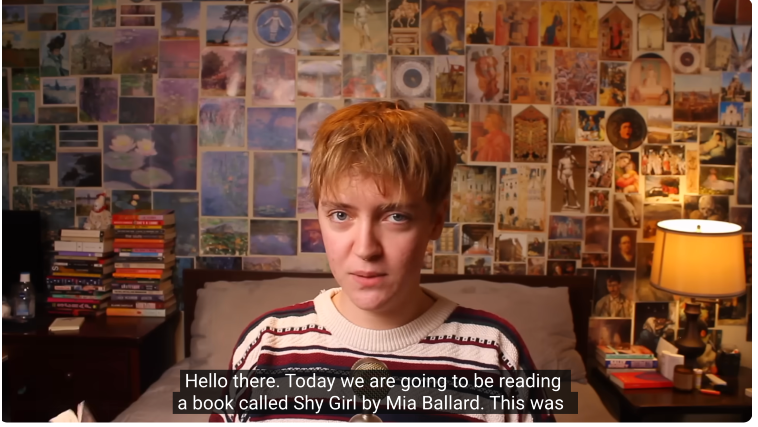
It turns out, readers were suspicious about the human authorship of the book even when it existed only as a self-published novel on Amazon, something Hachette should have investigated prior to its publication. The key analysis was by a young book reviewer known as Frankie, who posted on his YouTube channel Frankie’s Shelf a video entitled I’m Pretty Sure This Book is AI Slop. That video, which lasts for two hours and forty minutes (!), has been viewed 1.9 million times! (I’ve embedded it below.)
Now young Frankie did not use AI-detection software to come to his conclusion. Hachette did that later to confirm that the lad was absolutely right. Frankie simply attended to the book’s language, descriptions, figures of speech, and other narrative elements.
It’s hard to quote a video, so here is a summary of what Frankie found from Charles Amemiya at Medium:
Frankie starts by noting the countless nonsensical metaphors, similes, and other phrases throughout this shady book. In a scene where Gia, the protagonist, gets a birthday cake, she describes the frosting that clings to her fur as: “….sticky and pink, streaked like a brand.” Streaked like a brand? . . .
Here are some other examples of senseless metaphors or phrases:
- A text message Gia gets is described as “a pulse pulling me out of myself.”
- “My breath evens out, the outline of possibility taking shape. A job. The thought lingers, solid and improbable.”
- “His amusement curled like smoke.”
Words and phrases are grossly overused. “Hum” or “humming” appears 26 times. “Rhythm” or “rhythmic” are used 42 times. “Weight” was used 94 times, and “edge” was used 84 times. “Sharp” was used an absurd 159 times. . . .
There are awkward and redundant patterns throughout the book, including what Frankie calls the two-adjective, too-adjective. “The room is too small, too still.” “The laughter from the bar feels too loud, too much.” “It feels too stiff, too formal.”
It’s rife with redundancy, where scenes or thoughts are needlessly re-described. . . .
Here are other tell-tale signs of AI writing:
- Numerous punctuation errors
- Excessive instances of describing things in groups of three
- A large number of plot holes
- Random bits of humour were incongruent with the overall flat tone and voice of the book. This humour was likely written by the author but provides a dissonant contrast to the AI-generated content.
- Excessive use of the “No x, no y, just z” construction
- Many descriptions are illogical, contradictory or are non-sequiturs, another characteristic of generative AI, as LLMs easily “hallucinate” and break from logic and reality.
To be sure, says Amemiya, human writers might occasionally write like this. “But the big difference between us and AI con artists like Ballard is that we generally use these things sparingly,” he writes. “There are bad human writers or people who are still learning how to write, but even these individuals don’t create the type of insanely sloppy prose in Shy Girl.”
Finally, I would like to hereby nominate Frankie for a Pulitzer Prize in literary criticism. The muckety-mucks at Hachette and the academic scholars who have been giving prestigious literary prizes to AI-generated slop have all been shown up by a young man who won’t give us his last name or his age and only identifies himself as “just a guy who likes books.”
Photo: A screenshot from YouTube.
Previous Post

August 13, 2026
Labeling AI
Next Post

August 17, 2026 Monday Miscellany, 8/17/26
Recent Comments
"Wright certainly agrees with 1another that Jesus reigns now, and that His kingdom is already ..."
Belief and Disbelief in Christ’s Presence ..."
"I'm parking this note here for later reference. Apropos to 1another's frequent discussion of the ..."
Belief and Disbelief in Christ’s Presence ..."
"I'll add my voice to others here regarding gratitude. Grace is a faithful categorization of ..."
Gratitude as the Parent of All ..."
"What this study requires is letting Ryan Burge loose on the data. I checked and ..."
Belief and Disbelief in Christ’s Presence ..."
Browse Our Archives
Select a Category America Apologetics Art baseball Bible Blog Christ Church crime Culture Economics Education Ethics Family Food Football Government History Holidays Holy Week Humor International Islam Language Law Life Issues Literature Media Medicine Movies Music Nature News Personal Philosophy Politics psychology Reformation Religions Sacraments Science sex Social Science Sports technology television terrorism Theology Uncategorized Vocation war
Select a Month November 2026 October 2026 September 2026 August 2026 July 2026 June 2026 May 2026 April 2026 March 2026 February 2026 January 2026 December 2025 November 2025 October 2025 September 2025 August 2025 July 2025 June 2025 May 2025 April 2025 March 2025 February 2025 January 2025 December 2024 November 2024 October 2024 September 2024 August 2024 July 2024 June 2024 May 2024 April 2024 March 2024 February 2024 January 2024 December 2023 November 2023 October 2023 September 2023 August 2023 July 2023 June 2023 May 2023 April 2023 March 2023 February 2023 January 2023 December 2022 November 2022 October 2022 September 2022 August 2022 July 2022 June 2022 May 2022 April 2022 March 2022 February 2022 January 2022 December 2021 November 2021 October 2021 September 2021 August 2021 July 2021 June 2021 May 2021 April 2021 March 2021 February 2021 January 2021 December 2020 November 2020 October 2020 September 2020 August 2020 July 2020 June 2020 May 2020 April 2020 March 2020 February 2020 January 2020 December 2019 November 2019 October 2019 September 2019 August 2019 July 2019 June 2019 May 2019 April 2019 March 2019 February 2019 January 2019 December 2018 November 2018 October 2018 September 2018 August 2018 July 2018 June 2018 May 2018 April 2018 March 2018 February 2018 January 2018 December 2017 November 2017 October 2017 September 2017 August 2017 July 2017 June 2017 May 2017 April 2017 March 2017 February 2017 January 2017 December 2016 November 2016 October 2016 September 2016 August 2016 July 2016 June 2016 May 2016 April 2016 March 2016 February 2016 January 2016 December 2015 November 2015 October 2015 September 2015 August 2015 July 2015 June 2015 May 2015 April 2015 March 2015 February 2015 January 2015 December 2014 November 2014 October 2014 September 2014 August 2014 July 2014 June 2014 May 2014 April 2014 March 2014 February 2014 January 2014 December 2013 November 2013 October 2013 September 2013 August 2013 July 2013 June 2013 May 2013 April 2013 March 2013 February 2013 January 2013 December 2012 November 2012 October 2012 September 2012 August 2012 July 2012 June 2012 May 2012 April 2012 March 2012 February 2012 January 2012 December 2011 November 2011 October 2011 September 2011 August 2011 July 2011 June 2011 May 2011 April 2011 March 2011 February 2011 January 2011 December 2010 November 2010 October 2010 September 2010 August 2010 July 2010 June 2010 May 2010 April 2010 March 2010 February 2010 January 2010 December 2009 November 2009 October 2009 September 2009 August 2009 July 2009 June 2009 May 2009 April 2009 March 2009 February 2009 January 2009 December 2008 November 2008 October 2008 September 2008 August 2008 July 2008 June 2008 May 2008 April 2008 March 2008 February 2008 January 2008 December 2007 November 2007 October 2007
Give A Subscription
Follow Us!
TAKE THE
Religious Wisdom Quiz
Who was Rahab's great-great-grandson?
Select your answer to see how you score.
Jesse Solomon King David Boaz
Books by This Author Books by Gene Veith
Related posts from Cranach


The Contingency of Our Technology

Who Receives the New Benefit of Clergy
TRENDING AT PATHEOS Evangelical

In 1943, as a young army recruit in Texas, George M....

How Do We Find Hope In A Crazy...
"Hope is the thing with feathers that perches in the soul, and...

The Adventurous Lectionary – Advent 2 - December...
The Adventurous Lectionary – The Second Sunday of Advent - December 6,...

Prioritizing Jesus This Advent
Miller’s Station UMC| 29 November 2026| Mathew 19:16-27 When we prioritize Jesus,...

A Subtle Indicator of Legalism
Legalism was invented by pastors who don’t want to be woken up...

The Two Advents of the Babe and the...
We just celebrated the great family holiday of Thanksgiving and after going...
view all Evangelical blogs
What Are Your Thoughts?leave a comment
Ad-Free & Subscriber Log-In Subscription Support
- About Us
- 2026 Calendar
- Videos
- Podcasts
- Library of World Religions
- Faith In Media Tracker
- Advertise With Us
- Write for Us
- Privacy Policy
- Terms of Service
- Do Not Sell My Data
- Contact Us
- Radiant Digital
- Manage Newsletter Subscriptions
- Unsubscribe From Notifications
- Sitemap
Copyright 2008-2026, Patheos, part of the Radiant Digital network of media brands. All rights reserved.
Subscription Support Ad-Free & Subscriber Log-In
Follow Patheos