
BuddhistCatholicContemplativeEvangelicalGeneral ChristianHinduJewishLatter-day SaintMuslimNew VisionsProgressive Christian
Beliefs
- Buddhist
- Catholic
- Contemplative
- Evangelical
- General Christian
- Hindu
- Jewish
- Latter-day Saint
- More Voices
- Muslim
- New Visions
- Pagan
- Progressive Christian
Topics
- Religion News
- Food and Religion
- Sports and Religion
- Religious Art
- Religious Music and Entertainment
- Religious Events
- History and Religion
- Style and Religion
- Politics and Religion
- Women in Religion
- Recreation Outdoors and Religion
- Business Finance and Religion
- Careers Workplace and Religion
- Education and Religion
- Family Parenting and Religion
- Health Fitness and Religion
- Home and Religion
- Relationships and Religion
- Technology and Religion
- Travel and Religion
Columnists
- Buddhist Columnists
- Business Finance and Religion Columnists
- Careers Workplace and Religion Columnists
- Catholic Columnists
- Contemplative Columnists
- Education and Religion Columnists
- Evangelists Columnists
- Family Parenting and Religion Columnists
- General Christian Columnists
- Health Fitness and Religion Columnists
- Hindu Columnists
- History and Religion Columnists
- Home and Religion Columnists
- Jewish Columnists
- More Voices Columnists
- Latter Day Columnists
- Muslim Columnists
- New Visions Columnists
- Nonreligious Columnists
- Pagan Columnists
- Politics and Religion Columnists
- Progressive Columnists
- Recreation Outdoors and Religion Columnists
- Relationships and Religion Columnists
- Religion News Columnists
- Religious Art Columnists
- Religious Events Columnists
- Religious Music and Entertainment Columnists
- Sports and Religion Columnists
- Style and Religion Columnists
- Technology and Religion Columnists
- Travel and Religion Columnists
- Women in Religion Columnists
Resource Library
- 2026 Calendar
- Library of World Religions
- The 100 Most Holy Places on Earth
- Patheos Answers
- Podcasts
- Videos
- Faith Leaders Database
- Anglican Episcopalian
- Bahai
- Baptist
- Buddhism
- Christianity
- Confucianism
- Eastern Orthodoxy
- Hinduism
- Holiness and Pentecostal
- ISKCON
- Islam
- Judaism
- Lutheran
- Methodist
- The Church of Jesus Christ of Latter-day Saints
- New Age
- Paganism
- Presbytarian and Reformed
- Protestantism
- Religion Behind the Scenes
- Roman Catholic
- Scientology
- Shia Islam
- Sikhism
- Sufism
- Sunni Islam
- Taoism
- Zen
- See all religions
Research Tools
 Ad-Free & Subscriber Log-In Subscription Support
Ad-Free & Subscriber Log-In Subscription Support
Follow Patheos 

- Trending:
- Forgiveness
- |
- Marriage
- |
- Consciousness
- |
- Death Penalty
- |
- Election
- |
- Halloween

- Home
- Evangelical
- Politics and Religion
- An Odyssey without the Good Parts
An Odyssey without the Good Parts
Last updated on: August 4, 2026 at 11:59 am by Gene Veith
An Odyssey without the Good Parts 2026-08-04T11:59:35-04:00 Gene Veith
Patheos Explore the world's faith through different perspectives on religion and spirituality! Patheos has the views of the prevalent religions and spiritualities of the world.
Last October, I spent my three-week residency at Luther Classical College teaching the Odyssey, so I know it well. I was looking forward to Christopher Nolan’s film version, but now that I have seen it, I am greatly disappointed. Not so much for the reasons other negative reviewers have given, but because the movie left out the good parts of Homer’s epic.
Literature professor though I am, I don’t expect movies to perfectly reflect the books they are based on. The story in a book, which might take weeks to read, is going to be far longer and more involved than the story in a movie, with its running time of less than three hours. Also, the book can depict far more than a movie can. For example, a book can delve into its characters’ minds, showing us what one or more of them are thinking, something a movie can only suggest with good acting. There are also differences in genres that cannot easily be compensated for in switching, say, from an epic poem where the language is everything to a Hollywood film, which must tell its story visually. So I’m tolerant of film adaptations.
And I’m tolerant of the conventions of contemporary cinema, so I wasn’t bothered by the “inclusive” cast of Nolan’s Odyssey, with its black, Hispanic, Asian, and trans Greeks.
I’m not tolerant of woke revisionism, but that usually takes the form of demonizing the past, which we don’t see much of in the movie, except for Circe thinking that men really are pigs and Penelope complaining that she isn’t allowed to rule as Queen.
The biggest complaint I’ve heard is that Nolan’s version eliminates the heroism of Homer’s epic, reducing Odysseus to a veteran with PTSD, with the Trojan War being just another neverending war, highlighting the atrocities and downplaying the martial virtues. I admit, that did get a little ridiculous, as when Odysseus complained that Agamemnon went to war not so much because his brother’s wife ran off with the Trojan prince but because he wanted to control the “trade routes.”
What Nolan was trying to do was to make these Bronze Age characters less barbaric. He tones down the joy of battle, the casual brutality, the lust for honor. Reading the epic makes us learn something about those ancient times, but Nolan’s version is anachronistic. And yet, Homer is such a good writer that he humanizes these barbarians all the same, leaving room to criticize the war and those who fight it.
Homer’s saga is so compelling that his story and his characters have taken on a life of their own. The Romans believed they were descended from the Trojans who escaped the Greek massacre, so Virgil in the Aeneid does present the Trojan Horse as a foul deception and he condemns the cruelty of the Greeks when they sacked the city. (See his heart-breaking description of Achilles’ son slaughtering King Priam and the royal family). Later, in Dante’s Christian telling of the tale, Odysseus is described as a deceiver for his invention of the Trojan Horse ploy, as well as his constant deceit of his men, and is consigned to the Eighth Circle of Hell where false counselors are punished. And for the ultimate Christian deconstruction of the Trojan War, see Troilus and Cressida by Shakespeare, who lampoons everyone’s heroic pretensions as a cover for ego and lust (though he does give Odysseus, a.k.a., Ulysses, the prophetic best lines, in which he anticipates what will happen if we stop believing in the order of the universe, thus anticipating postmodernism by four hundred years). The point is, Nolan is not altogether wrong to be anti-Trojan-war and to present Odysseus as consumed with guilt for fighting it and for ending it the way he did.
Actually, as has been observed, what Nolan does in a rather clumsy way as he seeks to clean up Homer’s epic is to Christianize the Odyssey. For example, in Homer’s story, while Penelope, waiting for her husband over the course of 20 years, is faithful, Odysseus is not, spending a whole year in a sexual relationship with the beautiful Circe (who is not the stereotypical witch of the movie) and seven years in a sexual relationship with the sea-nymph Calypso). Surprisingly in a product from Hollywood, Nolan forebears from giving us any obligatory sex scenes or so much as saying that Odysseus has been unfaithful.
Notice what Nolan does with the “Law of Zeus,” which becomes a recurrent theme throughout the film. The movie describes this law as treating people the way you would want to be treated. Now Zeus never said that! Jesus did! Now the Golden Rule is echoed in other religions and philosophies, but not in Greek paganism. Nolan would know that if he had read Tom Holland–not the Spiderman actor who does a good job of playing Odysseus’ son Telemachus in his movie, but the classical historian of that name, the author of Dominion: How the Christian Revolution Remade the World. This book would inform him that the various moral tenets he stresses in his movie, such as the values of compassion, sexual morality, and peace being better than war, come from Christianity and nowhere else. They are certainly not from Greek paganism, whose gods are far from the guardians of morality that Nolan makes them out to be, but are rather notoriously immoral and indifferent to mortals (as Homer shows throughout his stories).
Now violations of the sacred law of hospitality, which is Nolan’s example of the Law of Zeus and was, in fact, seen as a sacred obligation, is an important theme in both the epic and the movie. This is a case where we can learn something from ancient cultures. Hospitality is violated when the guest runs off with the wife of his host (Paris and Helen), when the host eats his guests (the Cyclops), when the host won’t let her guest leave (Calypso and Odysseus), and when the guests refuse to leave (Penelope’s suitors).
All of this would be clarified if Nolan had just done justice to the Cyclops episode. In Homer, the one-eyed giant is described as someone who recognizes neither the laws of the gods nor of man, part of a tribe that holds no councils (that is, lacking any kind of collective government), in which each individual lives isolated in his own cave. This is to say, the Cyclops lives in a state of anarchy, which, for the social and political minded Greeks, is what makes him a monster.
When Odysseus in the poem invokes the law of hospitality, the Cyclops replies that he doesn’t care about the gods and instead of feeding the men proceeds to eat some of them. The dialogue between Odysseus and the Cyclops as Homer presents it is brilliant, culminating in Odysseus claiming that his name is “Nobody.” After Odysseus pokes his eyes out, the Cyclops calls to his neighbors in the surrounding caves for help, saying “Nobody put my eye out,” whereupon the other Cyclops think there is nothing wrong with him. In this episode, we learn about the law of hospitality and its connection to the gods, and, more than that, we realize that Odysseus wins because he is so smart and the Cyclops is so stupid. The notion that intelligence is more powerful than brute strength is the key to Odysseus’ prowess, and it points to a major value of the Greeks–the life of the mind–that became their greatest legacy to our civilization.
Nolan just presents the Cyclops as a big, scary, inarticulate monster. In leaving out his conversations, he misses out on the opportunity to develop his own themes!
He does this again and again. Odysseus doesn’t save his men from the Lotus Eaters–we would call them blissed-out drug addicts–underscoring the importance of not succumbing to inner pleasures that make you forget that you are a human being with a purpose in life and a home to get to. Rather, Odysseus himself eats the lotus on the island of Calypso, who tries to get him to quit so that he will remember to go home to his family.
And Nolan leaves out the whole point of the Calypso episode, which is crucial both for the story’s character development and its theme: namely, Odysseus’s choice. Calypso, herself a minor deity, gives her captive lover a choice: If you stay with me, she promises, he can be immortal, like her, living in a state of perpetual luxury, sexual pleasure, and the happiness of never having to experience pain, growing old, or death. Or, he could go back home to the ordinary life of a mortal, with his aging wife, day-to-day problems, the decline of old age, and eventual death. Odysseus chooses ordinary human life, preferring his home, his family, and growing old together with Penelope, despite the suffering and death that await them! This is Odysseus at his most heroic. This is true courage and strength. Now we see the depths of his love for his wife, despite everything. Now we see Homer’s thematic depth. But Nolan leaves it all on the cutting-room floor.
He keeps doing this! In the Descent to Hades scene, Nolan presents the dead as just a bunch of zombies, leaving out Homer’s priceless moments: when Odysseus sees his mother but cannot embrace her; when he sees his fellow hero Ajax who is still mad at Odysseus for having been awarded Achilles’ armor instead of himself, still holding on to a petty grudge even though he’s dead; and Achilles himself, who had traded glory for an early death, now saying that he would rather be an unknown farmer than lord it over all the dead.
Nolan turns the retribution against the suitors into just another big fight scene, with Odysseus taking on the whole crowd and almost getting killed. As opposed to showing his son Telemachus fighting by his father’s side, thus showing him attaining manhood, with the loyal swineherd and Athena herself (his patron as the goddess of wisdom) also joining the battle.
Nolan also leaves out the recognition scene, when Penelope tests this stranger who slaughtered the suitors by seeing if he can describe their marriage bed, that intimate knowledge that only her husband could know.
Nor is there anything about Odysseus’ reunion with his elderly father, or the Phacians who exemplify how hospitality is supposed to be carried out, or a blind bard (Homer?) showing up to sing about Trojan war (the same poem that we are reading?).
And Nolan completely changes the ending, having Telemachus be king while Odysseus and Penelope sail off into the sunset to avoid the vengeance of the suitors’ families , as opposed to Homer’s resolution of the revenge codes with the intervention of the Goddess of Wisdom.
I could keep giving examples. And I’ll spare you my complaints about the writing, with its casual American vernacular, as when Telemachus talks about his “Dad” and “Mom,” as opposed to Homer’s beautiful and elevated language.
In short, the main problem with the movie is that Nolan leaves out the very details that make Homer’s epic so human, so meaningful, and so thought-provoking.
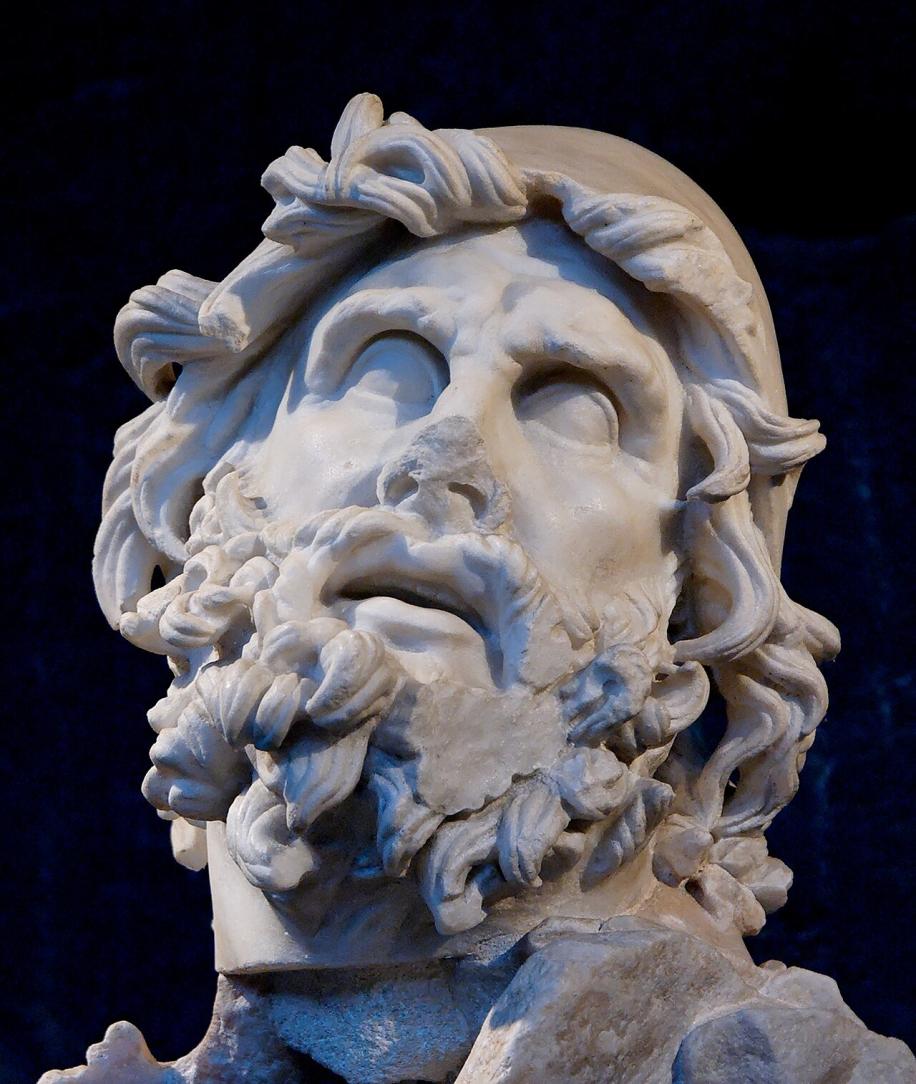
Illustration: Head of Odysseus from a sculptural group representing Odysseus blinding Polyphemus (1st century A.D.), photo by Jastrow – own work, from the Iliade exhibition at the Colosseum, September 2006–February 2007, Public Domain, https://commons.wikimedia.org/w/index.php?curid=1288487
Previous Post

August 3, 2026
Monday Miscellany, 8/3/26
Next Post

August 5, 2026 The Sacred as a Category Beyond Religion
Recent Comments
"I am told one only gets the $90 if one is on a Supplemental Medicare ..."
On Trump’s Political Ads That You ..."
"I too don't think the $5,000 giveaway will happen, but only because the Trumpublicans won't ..."
On Trump’s Political Ads That You ..."
"Well, large cash give-aways are generally bad policy, but really bad in any of the ..."
On Trump’s Political Ads That You ..."
"Well, we think it pretty much fits my thesis, except I'm not sure whether all ..."
On Trump’s Political Ads That You ..."
Browse Our Archives
Select a Category America Apologetics Art baseball Bible Blog Christ Church crime Culture Economics Education Ethics Family Food Football Government History Holidays Holy Week Humor International Islam Language Law Life Issues Literature Media Medicine Movies Music Nature News Personal Philosophy Politics psychology Reformation Religions Sacraments Science sex Social Science Sports technology television terrorism Theology Uncategorized Vocation war
Select a Month October 2026 September 2026 August 2026 July 2026 June 2026 May 2026 April 2026 March 2026 February 2026 January 2026 December 2025 November 2025 October 2025 September 2025 August 2025 July 2025 June 2025 May 2025 April 2025 March 2025 February 2025 January 2025 December 2024 November 2024 October 2024 September 2024 August 2024 July 2024 June 2024 May 2024 April 2024 March 2024 February 2024 January 2024 December 2023 November 2023 October 2023 September 2023 August 2023 July 2023 June 2023 May 2023 April 2023 March 2023 February 2023 January 2023 December 2022 November 2022 October 2022 September 2022 August 2022 July 2022 June 2022 May 2022 April 2022 March 2022 February 2022 January 2022 December 2021 November 2021 October 2021 September 2021 August 2021 July 2021 June 2021 May 2021 April 2021 March 2021 February 2021 January 2021 December 2020 November 2020 October 2020 September 2020 August 2020 July 2020 June 2020 May 2020 April 2020 March 2020 February 2020 January 2020 December 2019 November 2019 October 2019 September 2019 August 2019 July 2019 June 2019 May 2019 April 2019 March 2019 February 2019 January 2019 December 2018 November 2018 October 2018 September 2018 August 2018 July 2018 June 2018 May 2018 April 2018 March 2018 February 2018 January 2018 December 2017 November 2017 October 2017 September 2017 August 2017 July 2017 June 2017 May 2017 April 2017 March 2017 February 2017 January 2017 December 2016 November 2016 October 2016 September 2016 August 2016 July 2016 June 2016 May 2016 April 2016 March 2016 February 2016 January 2016 December 2015 November 2015 October 2015 September 2015 August 2015 July 2015 June 2015 May 2015 April 2015 March 2015 February 2015 January 2015 December 2014 November 2014 October 2014 September 2014 August 2014 July 2014 June 2014 May 2014 April 2014 March 2014 February 2014 January 2014 December 2013 November 2013 October 2013 September 2013 August 2013 July 2013 June 2013 May 2013 April 2013 March 2013 February 2013 January 2013 December 2012 November 2012 October 2012 September 2012 August 2012 July 2012 June 2012 May 2012 April 2012 March 2012 February 2012 January 2012 December 2011 November 2011 October 2011 September 2011 August 2011 July 2011 June 2011 May 2011 April 2011 March 2011 February 2011 January 2011 December 2010 November 2010 October 2010 September 2010 August 2010 July 2010 June 2010 May 2010 April 2010 March 2010 February 2010 January 2010 December 2009 November 2009 October 2009 September 2009 August 2009 July 2009 June 2009 May 2009 April 2009 March 2009 February 2009 January 2009 December 2008 November 2008 October 2008 September 2008 August 2008 July 2008 June 2008 May 2008 April 2008 March 2008 February 2008 January 2008 December 2007 November 2007 October 2007
Follow Us!
TAKE THE
Religious Wisdom Quiz
Who was the major prophet during King Hezekiah's reign in Judah?
Select your answer to see how you score.
Daniel Ezekiel Jeremiah Isaiah
Books by This Author Books by Gene Veith
Related posts from Cranach

Gen Z Wants Evildoers to Be Punished, Not...

On Trump's Political Ads That You Paid For


Why AI Bots Don't Really Have Emotions
TRENDING AT PATHEOS Evangelical

Janie Learns the Way of the Cross: A...
Teaching children about Jesus' Passion can be challenging. Many parents and educators...

Looking For Good Catholic Writing - October 2026
He alone extends the heavens, and he walks upon the waves of...

In "Irreplaceable," our book on vocation and technology, Trevor Sutton and I...

I was strolling through the top floor of the brand new Parthenon...

What Does Gêvâh Mean For Kimberley Guifoyle &...
This week, a lot of the news is focused on Kimberly Guilfoyle....

INNER CIRCLE: Profound Mystery (Of Christ In All...
Ephesians 5:31-32 “For this reason, a man will leave his father and...
view all Evangelical blogs
What Are Your Thoughts?leave a comment
Ad-Free & Subscriber Log-In Subscription Support
- About Us
- 2026 Calendar
- Videos
- Podcasts
- Library of World Religions
- Faith In Media Tracker
- Advertise With Us
- Write for Us
- Privacy Policy
- Terms of Service
- Do Not Sell My Data
- Contact Us
- Radiant Digital
- Manage Newsletter Subscriptions
- Unsubscribe From Notifications
- Sitemap
Copyright 2008-2026, Patheos. All rights reserved.
Subscription Support Ad-Free & Subscriber Log-In
Follow Patheos