
BuddhistCatholicContemplativeEvangelicalGeneral ChristianHinduJewishLatter-day SaintMuslimNew VisionsProgressive Christian
Beliefs
- Buddhist
- Catholic
- Contemplative
- Evangelical
- General Christian
- Hindu
- Jewish
- Latter-day Saint
- More Voices
- Muslim
- New Visions
- Pagan
- Progressive Christian
Topics
- Religion News
- Food and Religion
- Sports and Religion
- Religious Art
- Religious Music and Entertainment
- Religious Events
- History and Religion
- Style and Religion
- Politics and Religion
- Women in Religion
- Recreation Outdoors and Religion
- Business Finance and Religion
- Careers Workplace and Religion
- Education and Religion
- Family Parenting and Religion
- Health Fitness and Religion
- Home and Religion
- Relationships and Religion
- Technology and Religion
- Travel and Religion
Columnists
- Buddhist Columnists
- Business Finance and Religion Columnists
- Careers Workplace and Religion Columnists
- Catholic Columnists
- Contemplative Columnists
- Education and Religion Columnists
- Evangelists Columnists
- Family Parenting and Religion Columnists
- General Christian Columnists
- Health Fitness and Religion Columnists
- Hindu Columnists
- History and Religion Columnists
- Home and Religion Columnists
- Jewish Columnists
- More Voices Columnists
- Latter Day Columnists
- Muslim Columnists
- New Visions Columnists
- Nonreligious Columnists
- Pagan Columnists
- Politics and Religion Columnists
- Progressive Columnists
- Recreation Outdoors and Religion Columnists
- Relationships and Religion Columnists
- Religion News Columnists
- Religious Art Columnists
- Religious Events Columnists
- Religious Music and Entertainment Columnists
- Sports and Religion Columnists
- Style and Religion Columnists
- Technology and Religion Columnists
- Travel and Religion Columnists
- Women in Religion Columnists
Resource Library
- 2026 Calendar
- Library of World Religions
- The 100 Most Holy Places on Earth
- Patheos Answers
- Podcasts
- Videos
- Faith Leaders Database
- Anglican Episcopalian
- Bahai
- Baptist
- Buddhism
- Christianity
- Confucianism
- Eastern Orthodoxy
- Hinduism
- Holiness and Pentecostal
- ISKCON
- Islam
- Judaism
- Lutheran
- Methodist
- The Church of Jesus Christ of Latter-day Saints
- New Age
- Paganism
- Presbytarian and Reformed
- Protestantism
- Religion Behind the Scenes
- Roman Catholic
- Scientology
- Shia Islam
- Sikhism
- Sufism
- Sunni Islam
- Taoism
- Zen
- See all religions
Research Tools
 Ad-Free & Subscriber Log-In Subscription Support
Ad-Free & Subscriber Log-In Subscription Support
Follow Patheos 

- Trending:
- Forgiveness
- |
- Marriage
- |
- Consciousness
- |
- Death Penalty
- |
- Election
- |
- Halloween

- Home
- Evangelical
- Politics and Religion
- Barfield, Bible Study, & a Text on Vocation
Barfield, Bible Study, & a Text on Vocation
Last updated on: May 19, 2026 at 6:00 am by Gene Veith
Barfield, Bible Study, & a Text on Vocation 2026-05-11T12:49:04-04:00 Gene Veith
Patheos Explore the world's faith through different perspectives on religion and spirituality! Patheos has the views of the prevalent religions and spiritualities of the world.
In our post about Owen Barfield, we discussed his prescription for bringing language back from the dead–and, by extension, bringing what we moderns assume to be meaningless reality back from the dead–by attending to the vivid imagery latent in the history of our words. Recognizing the original metaphors that lie behind words that we have turned into dead abstractions, we can see how that ancient imagery connects us to a mindset in which tangible reality is charged with meaning.
This tends to happen, he says, in poetic diction–to use the title of the book in which he discusses all of this–and in imaginative literature more generally. Poetry uses language depicting concrete imagery as a way to convey ideas. It thus connects tangible reality with meaning.
Barfield’s attention to ancient languages, etymology, and the recovery of original meaning also tends to happen in a good Bible study, especially one led by a pastor who brings his training in the original languages to bear on the text. This hit me like a ton of bricks (notice the imagery of my language, cliché though it is) in a recent Sunday morning Bible class led by Concordia Seminary professor Joel Biermann.
A Digression You Can Skip
First, a digression on church politics that non-LCMS members should feel free to skip: I am in the highly unusual position of having both of the top candidates running in the election next month for president of the Lutheran Church Missouri Synod as my pastors. The incumbent, President Matthew Harrison, to keep his hand in parish ministry (more imagery), is our Assistant Pastor. Our vacancy pastor is Professor Biermann.
All of the five men who have been nominated strike me as fine pastors and faithful Christians. Far be it from me to endorse anybody–and since I’m not a convention delegate I have no vote–but just to clarify: Someone in a Facebook chat called Biermann the liberal candidate, but, as I said in that thread, that is far, far from the truth. In months of attending his Bible classes and hearing his sermons, I have never heard anything remotely theologically liberal. I have, however, heard him take the confessional, Biblical position on virtually all of the salient theological issues of our day (e.g., third use of the Law, role of women, against “seeker sensitive worship,” for the inerrancy of Scripture, the efficacy of the Sacraments, the substitutionary atonement, insistent that non-Trinitarians do not worship the Christian God, etc.). He does that so well that I hope he continues as a teacher in the seminary, giving our future pastors a very solid theological grounding, rather than getting bogged down in administrative office. (Note the imagery of my language: standing on solid ground vs. being stuck in the mud of a bog.)
Delving into the Language
*To continue to the topic of this post. . . .*Here is what Pastor Biermann did in the ongoing study he has been leading on the book of Colossians, treating 3:22-4:1, on the hot-button subject of slaves and masters. Here is the text. (He uses the New American Standard translation because, he says, it is more literal. But only the 1995 edition, since later versions adopt more gender-neutral language. I am bolding the words he delves into.)
22 Slaves, in all things obey those who are your masters on earth, not with external service, as those who merely please men, but with sincerity of heart, fearing the Lord. 23 Whatever you do, do your work heartily, as for the Lord rather than for men, 24 knowing that from the Lord you will receive the reward of the inheritance. It is the Lord Christ whom you serve. 25 For he who does wrong will receive the consequences of the wrong which he has done, and that without partiality.
4: 1 Masters, grant to your slaves justice and fairness, knowing that you too have a Master in heaven. (Colossians 3:22-4:1)
Pastor Biermann didn’t tone down the obedience command, any more than he did “submission” in marriage, but he explained that in the Greco-Roman world as in most societies until the 19th century, most economic activity took place in the *house–*the oikos, in Greek, which is where we get our word “economy” (oikos + nomos, the laws of the house). Whether you were a farmer, a craftsman, a merchant, a lawyer, or a ruler, you worked at home, with all of your family joining in. Additional labor was provided by slaves, who lived in the house and were part of the “household.” This was not the chattel slavery based on race, as in America in the antebellum south. But slaves, usually originally from conquered lands, were bought and sold–which is bad enough–and they had no social standing or personal rights. But they constituted as much as one-third of the population and at least that percentage, maybe more, in the early church, the one place where slaves and the free interacted as equals. Under the Greco-Roman “economy,” slaves provided much of the labor, not only manual work but also much of the “white collar” work, including medicine, teaching (as in the pedagogue, literally, the leader of children), and what we would describe as “office work.” Thus this ancient text from a very different economy speaks to us today about our work, and the relationship between employees and their employers. And thus it teaches us about vocation.
Note how in teaching about the historical and cultural context of the passage, Pastor Biermann does not leave it as an interesting but irrelevant fact. Rather, he applies it to our own context, thereby making it relevant!
The Greek word for “master” is “kyrios,” which means lord, the same term used for the “Lord God” and the “Lord Jesus” (as in the liturgy’s Kyrie Eleison, “Lord have mercy.”) A more literal translation would say “Slaves, obey your lords.” The ancient world had a high view of authority, which ties into the teaching of Romans 13 that God’s authority is invested in human authorities (Romans 1). But this text goes on to specify “masters on earth”; that is, in a literal translation of the original Greek, “lords according to the flesh.” We have a Lord according to the Spirit, but we also have multiple lords “according to the flesh.” This is much clearer than the more abstract English translation and it keeps the original sense that we have different kinds of lords.
The NASB may be more literal than other translations, but it falls into another abstraction: “external service.” The Greek word is ophthalomodouleiais (eye, as in ophthalmologist, + slave, doulos, the same word used throughout the passage). Other translations get at the meaning, as “not only when their eye is on you” (NIV), with the ESV being more literal with “eye service.” The original is even more vivid: Slave, don’t be an “eye-slave.”
The word rendered here as the relatively abstract “sincerity” is haplotes, meaning literally “unfolded,” in the sense of a piece of a piece of cloth that is laid straight out; hence, used in Greek to mean straightforward, singleness of purpose, so that as here an “unfolded heart” means sincerity. The word “heartily” in 4:3 is, in the Greek , psyche, meaning “soul.” Do your work “from the soul.” “Work heartily” And, in an important bit of word study, what the English translation renders as “fairness” is the Greek word isototes, meaning equality! Lords according to the flesh are told to treat their slaves with justice and equality.
What This Text Teaches Us About Vocation
Notice how plunging into the original concrete senses of the ancient language illuminates the meaning of the text for us today. We can now see Colossians 3:22-4:1 as an important text for the doctrine of vocation, relating particularly to the economic vocations.
Employees should obey their bosses. Not just working when the boss is watching or to get approval, but straightforwardly. Work from the soul. Work as if you are doing it not for your boss but for Christ. When you are serving your boss with productive labor you are serving Christ.
Employers, treat your employees with justice and equality. Remember that you yourself have a boss in Heaven who will hold you accountable for the way you treat your workers.
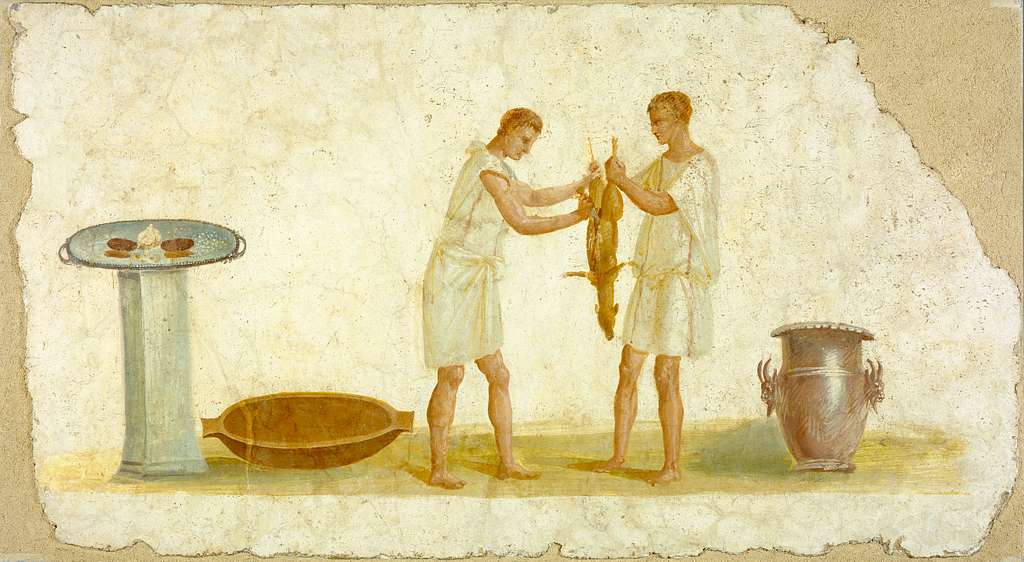
Illustration: Fresco of Roman slaves preparing a meal, Getty Museum, via Picryl, Public Domain. Digital image courtesy of the Getty’s Open Content Program.
original languages of the Bible
vocation of employees and employers
Previous Post

May 18, 2026
Monday Miscellany, 5/18/26
Next Post

May 20, 2026 Choosing Between Vocations
Recent Comments
"VCRs, tape decks, and cassette players are all having a revival among a segment of ..."
"As a (retired) lawyer I see potential liability from sharing things like power or sharp ..."
"I am not sure the items you mentioned, though disused, discontinued, discarded, could be considered ..."
"“Friend, use me in your relations with your neighbor just as you would want your ..."
Browse Our Archives
Select a Category America Apologetics Art baseball Bible Blog Christ Church crime Culture Economics Education Ethics Family Food Football Government History Holidays Holy Week Humor International Islam Language Law Life Issues Literature Media Medicine Movies Music Nature News Personal Philosophy Politics psychology Reformation Religions Sacraments Science sex Social Science Sports technology television terrorism Theology Uncategorized Vocation war
Select a Month October 2026 September 2026 August 2026 July 2026 June 2026 May 2026 April 2026 March 2026 February 2026 January 2026 December 2025 November 2025 October 2025 September 2025 August 2025 July 2025 June 2025 May 2025 April 2025 March 2025 February 2025 January 2025 December 2024 November 2024 October 2024 September 2024 August 2024 July 2024 June 2024 May 2024 April 2024 March 2024 February 2024 January 2024 December 2023 November 2023 October 2023 September 2023 August 2023 July 2023 June 2023 May 2023 April 2023 March 2023 February 2023 January 2023 December 2022 November 2022 October 2022 September 2022 August 2022 July 2022 June 2022 May 2022 April 2022 March 2022 February 2022 January 2022 December 2021 November 2021 October 2021 September 2021 August 2021 July 2021 June 2021 May 2021 April 2021 March 2021 February 2021 January 2021 December 2020 November 2020 October 2020 September 2020 August 2020 July 2020 June 2020 May 2020 April 2020 March 2020 February 2020 January 2020 December 2019 November 2019 October 2019 September 2019 August 2019 July 2019 June 2019 May 2019 April 2019 March 2019 February 2019 January 2019 December 2018 November 2018 October 2018 September 2018 August 2018 July 2018 June 2018 May 2018 April 2018 March 2018 February 2018 January 2018 December 2017 November 2017 October 2017 September 2017 August 2017 July 2017 June 2017 May 2017 April 2017 March 2017 February 2017 January 2017 December 2016 November 2016 October 2016 September 2016 August 2016 July 2016 June 2016 May 2016 April 2016 March 2016 February 2016 January 2016 December 2015 November 2015 October 2015 September 2015 August 2015 July 2015 June 2015 May 2015 April 2015 March 2015 February 2015 January 2015 December 2014 November 2014 October 2014 September 2014 August 2014 July 2014 June 2014 May 2014 April 2014 March 2014 February 2014 January 2014 December 2013 November 2013 October 2013 September 2013 August 2013 July 2013 June 2013 May 2013 April 2013 March 2013 February 2013 January 2013 December 2012 November 2012 October 2012 September 2012 August 2012 July 2012 June 2012 May 2012 April 2012 March 2012 February 2012 January 2012 December 2011 November 2011 October 2011 September 2011 August 2011 July 2011 June 2011 May 2011 April 2011 March 2011 February 2011 January 2011 December 2010 November 2010 October 2010 September 2010 August 2010 July 2010 June 2010 May 2010 April 2010 March 2010 February 2010 January 2010 December 2009 November 2009 October 2009 September 2009 August 2009 July 2009 June 2009 May 2009 April 2009 March 2009 February 2009 January 2009 December 2008 November 2008 October 2008 September 2008 August 2008 July 2008 June 2008 May 2008 April 2008 March 2008 February 2008 January 2008 December 2007 November 2007 October 2007
Follow Us!
TAKE THE
Religious Wisdom Quiz
I went uninvited before the king, risking death, saying 'If I perish, I perish.' Who am I?
Select your answer to see how you score.
Esther Deborah Ruth Vashti
Books by This Author Books by Gene Veith
Related posts from Cranach


Our New Book on Technology & Vocation

Gen Z Wants Evildoers to Be Punished, Not...

TRENDING AT PATHEOS Evangelical

The First Eucharistic Controversy: Christ’s Real Presence
For Catholics, the Eucharist is the source and summit of the Christian...

What a Stop Sign Can Teach Us About...
How to Make a Decision When You Can't Hear God Main point:...

Archdiocese Hosts Military Marriage Retreat in Germany
RASTATT, Germany — The transient military lifestyle, with its frequent deployments and...

Nearly every morning, I make the drive to Detroit with my high-school-age...

The Real AI Story Is Adoption Without Trust
Artificial intelligence has crossed a political threshold. It is no longer a...

A new article, written by Jeff Lindsay and Gale L. Pooley,...
view all Evangelical blogs
What Are Your Thoughts?leave a comment
Ad-Free & Subscriber Log-In Subscription Support
- About Us
- 2026 Calendar
- Videos
- Podcasts
- Library of World Religions
- Faith In Media Tracker
- Advertise With Us
- Write for Us
- Privacy Policy
- Terms of Service
- Do Not Sell My Data
- Contact Us
- Radiant Digital
- Manage Newsletter Subscriptions
- Unsubscribe From Notifications
- Sitemap
Copyright 2008-2026, Patheos. All rights reserved.
Subscription Support Ad-Free & Subscriber Log-In
Follow Patheos