
BuddhistCatholicContemplativeEvangelicalGeneral ChristianHinduJewishLatter-day SaintMuslimNew VisionsProgressive Christian
Beliefs
- Buddhist
- Catholic
- Contemplative
- Evangelical
- General Christian
- Hindu
- Jewish
- Latter-day Saint
- More Voices
- Muslim
- New Visions
- Pagan
- Progressive Christian
Topics
- Religion News
- Food and Religion
- Sports and Religion
- Religious Art
- Religious Music and Entertainment
- Religious Events
- History and Religion
- Style and Religion
- Politics and Religion
- Women in Religion
- Recreation Outdoors and Religion
- Business Finance and Religion
- Careers Workplace and Religion
- Education and Religion
- Family Parenting and Religion
- Health Fitness and Religion
- Home and Religion
- Relationships and Religion
- Technology and Religion
- Travel and Religion
Columnists
- Buddhist Columnists
- Business Finance and Religion Columnists
- Careers Workplace and Religion Columnists
- Catholic Columnists
- Contemplative Columnists
- Education and Religion Columnists
- Evangelists Columnists
- Family Parenting and Religion Columnists
- General Christian Columnists
- Health Fitness and Religion Columnists
- Hindu Columnists
- History and Religion Columnists
- Home and Religion Columnists
- Jewish Columnists
- More Voices Columnists
- Latter Day Columnists
- Muslim Columnists
- New Visions Columnists
- Nonreligious Columnists
- Pagan Columnists
- Politics and Religion Columnists
- Progressive Columnists
- Recreation Outdoors and Religion Columnists
- Relationships and Religion Columnists
- Religion News Columnists
- Religious Art Columnists
- Religious Events Columnists
- Religious Music and Entertainment Columnists
- Sports and Religion Columnists
- Style and Religion Columnists
- Technology and Religion Columnists
- Travel and Religion Columnists
- Women in Religion Columnists
Resource Library
- 2026 Calendar
- Library of World Religions
- The 100 Most Holy Places on Earth
- Patheos Answers
- Podcasts
- Videos
- Faith Leaders Database
- Anglican Episcopalian
- Bahai
- Baptist
- Buddhism
- Christianity
- Confucianism
- Eastern Orthodoxy
- Hinduism
- Holiness and Pentecostal
- ISKCON
- Islam
- Judaism
- Lutheran
- Methodist
- The Church of Jesus Christ of Latter-day Saints
- New Age
- Paganism
- Presbytarian and Reformed
- Protestantism
- Religion Behind the Scenes
- Roman Catholic
- Scientology
- Shia Islam
- Sikhism
- Sufism
- Sunni Islam
- Taoism
- Zen
- See all religions
Research Tools
 Ad-Free & Subscriber Log-In Subscription Support
Follow Patheos 

- Trending:
- Advent
- |
- Forgiveness
- |
- Thanksgiving
- |
- Election
- |
- Seasonal Holidays
- |
- Marriage

- Home
- Evangelical
- Politics and Religion
- His Bleeding Love
His Bleeding Love
Last updated on: April 3, 2026 at 6:00 am by Gene Veith
His Bleeding Love 2026-03-30T18:10:15-04:00 Gene Veith
Patheos Explore the world's faith through different perspectives on religion and spirituality! Patheos has the views of the prevalent religions and spiritualities of the world.
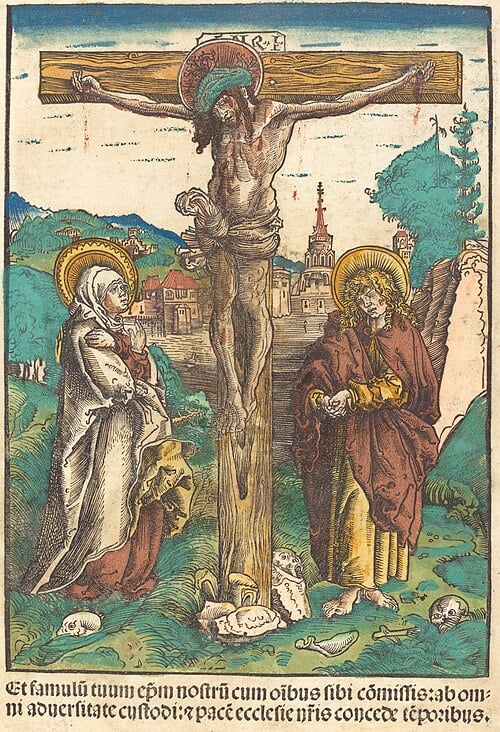
A notable Lenten hymn is “Not All the Blood of Beasts” by Isaac Watts, a meditation on the crucifixion of Jesus and His atoning blood.
I wrote about this hymn in an entry to Lutheran Service Book: Companion to the Hymns, 2 vols., which gives the background, tells about the writers, and discusses the meaning of every hymn in the LSB. This work is a real treasure for hymn lovers, and I was asked to research and write about ten of them.
Last year during Lent, I wrote about my commentary in the LSB Companion for “My Song Is Love Unknown.” This year I thought I would share my article on this other Good Friday classic.
Especially interesting is the way the hymn has been adapted for different theologies. Calvinists believe in a limited atonement, the notion that Christ did not die for everyone, but only for the predestined elect. So Watts, being of that persuasion, originally wrote that the soul looking to the cross “hopes” that its sins are there. The Wesleyan version changes the line so that the soul “knows” its sins are there. And yet Wesleyanism is more subjective, so that version has the soul “feel” the curse removed. Lutherans believe that Christ died for the sins of the entire world, so that none is excluded from His atonement (1 John 2:2), so they use the Wesleyan “knows.” But Lutherans believe that atonement is objective, so they change the subjective “feel” back to Watt’s original “see the curse removed.”
First, the hymn, from Lutheran TV – Hymns from the LSB, which usefully shows the words as the congregation sings:
LSB 431 Not All the Blood of Beasts
Text Background
Before Isaac Watts, English Protestants at worship tended to sing rhymed, metrical paraphrases of the Psalms rather than hymns. Watts took the structures and tunes of the metrical Psalms and gave them fresh, expressive lyrics that were not limited to the Old Testament texts. In doing so with such poetic power, Watts became “the father of English hymnody.”
His first book in this attempt was Hymns and Spiritual Songs, published in 1707. Two years later, he added more songs in a second edition. He would publish another large collection entitled Psalms of David in 1719. In the preface to the second edition of Hymns and Spiritual Songs, Watts summarized his argument that simply singing metrical Psalms confines Christian worshippers to Old Testament expressions rather than their New Testament fulfillment. He also set forth principles for his hymn writing. Though Watts was a non-conformist pastor of strong, mostly Reformed, theological convictions, he said that he tried to compose his hymns so as to avoid sectarian controversies so that Christians of all persuasions could sing them. He also said that he worked hard to restrain his literary impulses so that all Christians, including the less-educated, could understand what they were singing.
“Not All the Blood of Beasts” was published in 1709 in the second, expanded edition of Hymns and Spiritual Songs. It appears in Book II of that collection as one of the hymns “Compos’d on Divine Subjects,” as opposed to the metrical paraphrases of Scripture in Book I and the songs “Prepar’d for the Lord’s Supper” in Book III. The hymn is printed with the headnote “Faith in Christ our Sacrifice.”
This hymn, as it was adopted by many different traditions, appears in a number of variations. For example, in stanza 4, Watts originally says that the soul looking on the burdens that Christ bore on the cross “hopes her guilt was there.” The Wesleyan version gave a stronger assurance: the soul “knows her guilt was there.” The LSB version takes the Wesleyan reading but makes the point even stronger by clearing up the syntax: “I know my guilt is here.” In stanza 5, Watts wrote that “we rejoice/To see the curse removed.” The Wesleyans sought a more subjective response: “we rejoice/To feel the curse removed.” In this case, the LSB goes back to Watts’s original.
Text Discussion
The first line is not meant to cast aspersions on the Jewish religion, as might be assumed today; rather, it is a reference to Hebrews 10, which speaks of how the Old Testament sacrifices (which are not practiced in contemporary Judaism) never took away sin, as such, but instead pointed to the sacrifice of Christ. The first stanza speaks both of “the guilty conscience” and “the stain” of sin, the uncleanness of our fallen nature. The blood of animals cannot give peace and cannot “wash away the stain,” but, as the second stanza says, the “richer blood” of Christ, the Sacrificial Lamb of God, can.
Before killing the animal, the person who brought the sacrifice would first lay his hand on the offering, signifying the transfer of his sin onto the sacrificial victim (Leviticus 3-4). In stanza 3 of the hymn, the sinner is laying his hand on the head of Christ. He does this by confessing his sin and reaching out to Christ in faith.
Watts makes skillful use of spatial imagery to express Christ literally removing sin from the sinner and taking it upon Himself. The Lamb “takes all our sins away.” The speaker looks back to see the burden that Christ is bearing on the cross: “I know my guilt is there.” Because of “the cursed tree,” “we rejoice to see the curse remove.”
The most striking poetic effect is in the last words of the hymn: “His bleeding love.” Christ’s love is not an abstraction, a general quality or disembodied feeling. Christ’s love bleeds. His love is such that He pours out His blood for us. The hymn that begins with the blood of beasts and a still-guilty conscience ends with rejoicing and “a cheerful voice” singing “the bleeding love.”
Illustration: Lucas Cranach, Christ on the Cross between the Virgin and St. John. This file was donated to Wikimedia Commons as part of a project by the National Gallery of Art. Please see the Gallery’s Open Access Policy., CC0, https://commons.wikimedia.org/w/index.php?curid=81680754. [Hand-colored woodcut print.]

Lutheran Service Book Companion
Previous Post
April 2, 2026
Is Communion for the Perfect or for Sinners?
Next Post

April 5, 2026 "He is not here, for he has risen, as he said."
Recent Comments
"Can we teach the AI to play tic-tac-toe and develop a winning strategy?"
"Yes, people are saying......"
"Not that I'm aware of. I'm simply sharing the cryptic comments of those who know ..."
"David, as you, I have been involved with computer program development for a very long ..."
Browse Our Archives
Select a Category America Apologetics Art baseball Bible Blog Christ Church crime Culture Economics Education Ethics Family Food Football Government History Holidays Holy Week Humor International Islam Language Law Life Issues Literature Media Medicine Movies Music Nature News Personal Philosophy Politics psychology Reformation Religions Sacraments Science sex Social Science Sports technology television terrorism Theology Uncategorized Vocation war
Select a Month November 2026 October 2026 September 2026 August 2026 July 2026 June 2026 May 2026 April 2026 March 2026 February 2026 January 2026 December 2025 November 2025 October 2025 September 2025 August 2025 July 2025 June 2025 May 2025 April 2025 March 2025 February 2025 January 2025 December 2024 November 2024 October 2024 September 2024 August 2024 July 2024 June 2024 May 2024 April 2024 March 2024 February 2024 January 2024 December 2023 November 2023 October 2023 September 2023 August 2023 July 2023 June 2023 May 2023 April 2023 March 2023 February 2023 January 2023 December 2022 November 2022 October 2022 September 2022 August 2022 July 2022 June 2022 May 2022 April 2022 March 2022 February 2022 January 2022 December 2021 November 2021 October 2021 September 2021 August 2021 July 2021 June 2021 May 2021 April 2021 March 2021 February 2021 January 2021 December 2020 November 2020 October 2020 September 2020 August 2020 July 2020 June 2020 May 2020 April 2020 March 2020 February 2020 January 2020 December 2019 November 2019 October 2019 September 2019 August 2019 July 2019 June 2019 May 2019 April 2019 March 2019 February 2019 January 2019 December 2018 November 2018 October 2018 September 2018 August 2018 July 2018 June 2018 May 2018 April 2018 March 2018 February 2018 January 2018 December 2017 November 2017 October 2017 September 2017 August 2017 July 2017 June 2017 May 2017 April 2017 March 2017 February 2017 January 2017 December 2016 November 2016 October 2016 September 2016 August 2016 July 2016 June 2016 May 2016 April 2016 March 2016 February 2016 January 2016 December 2015 November 2015 October 2015 September 2015 August 2015 July 2015 June 2015 May 2015 April 2015 March 2015 February 2015 January 2015 December 2014 November 2014 October 2014 September 2014 August 2014 July 2014 June 2014 May 2014 April 2014 March 2014 February 2014 January 2014 December 2013 November 2013 October 2013 September 2013 August 2013 July 2013 June 2013 May 2013 April 2013 March 2013 February 2013 January 2013 December 2012 November 2012 October 2012 September 2012 August 2012 July 2012 June 2012 May 2012 April 2012 March 2012 February 2012 January 2012 December 2011 November 2011 October 2011 September 2011 August 2011 July 2011 June 2011 May 2011 April 2011 March 2011 February 2011 January 2011 December 2010 November 2010 October 2010 September 2010 August 2010 July 2010 June 2010 May 2010 April 2010 March 2010 February 2010 January 2010 December 2009 November 2009 October 2009 September 2009 August 2009 July 2009 June 2009 May 2009 April 2009 March 2009 February 2009 January 2009 December 2008 November 2008 October 2008 September 2008 August 2008 July 2008 June 2008 May 2008 April 2008 March 2008 February 2008 January 2008 December 2007 November 2007 October 2007
Give A Subscription
Follow Us!
TAKE THE
Religious Wisdom Quiz
What king wrote many proverbs and built a great temple?
Select your answer to see how you score.
Hezekiah David Solomon Saul
Books by This Author Books by Gene Veith
Related posts from Cranach

Who Receives the New Benefit of Clergy
TRENDING AT PATHEOS Evangelical

In 1939, President Franklin D. Roosevelt moved Thanksgiving from November 30 to...

Reasons for Restraint: Ricardo Gonzalez, Florida and Dec...
The Morning of January 3 I begin with the dead. On the...

I published this column for Thanksgiving 2012 in the Deseret News....

For many years, Catholicism has been caught up in division over the...

'Statements of Faith' never get shorter
Nothing demonstrates a conservative commitment to faith and faithfulness like a "statement...

Michele's Reviews - Future Grace by John Piper
In God's Place, at God's Pace, by Future Grace Impatience is...
view all Evangelical blogs
What Are Your Thoughts?leave a comment
Ad-Free & Subscriber Log-In Subscription Support
- About Us
- 2026 Calendar
- Videos
- Podcasts
- Library of World Religions
- Faith In Media Tracker
- Advertise With Us
- Write for Us
- Privacy Policy
- Terms of Service
- Do Not Sell My Data
- Contact Us
- Radiant Digital
- Manage Newsletter Subscriptions
- Unsubscribe From Notifications
- Sitemap
Copyright 2008-2026, Patheos, part of the Radiant Digital network of media brands. All rights reserved.
Subscription Support Ad-Free & Subscriber Log-In
Follow Patheos