
BuddhistCatholicContemplativeEvangelicalGeneral ChristianHinduJewishLatter-day SaintMuslimNew VisionsProgressive Christian
Beliefs
- Buddhist
- Catholic
- Contemplative
- Evangelical
- General Christian
- Hindu
- Jewish
- Latter-day Saint
- More Voices
- Muslim
- New Visions
- Pagan
- Progressive Christian
Topics
- Religion News
- Food and Religion
- Sports and Religion
- Religious Art
- Religious Music and Entertainment
- Religious Events
- History and Religion
- Style and Religion
- Politics and Religion
- Women in Religion
- Recreation Outdoors and Religion
- Business Finance and Religion
- Careers Workplace and Religion
- Education and Religion
- Family Parenting and Religion
- Health Fitness and Religion
- Home and Religion
- Relationships and Religion
- Technology and Religion
- Travel and Religion
Columnists
- Buddhist Columnists
- Business Finance and Religion Columnists
- Careers Workplace and Religion Columnists
- Catholic Columnists
- Contemplative Columnists
- Education and Religion Columnists
- Evangelists Columnists
- Family Parenting and Religion Columnists
- General Christian Columnists
- Health Fitness and Religion Columnists
- Hindu Columnists
- History and Religion Columnists
- Home and Religion Columnists
- Jewish Columnists
- More Voices Columnists
- Latter Day Columnists
- Muslim Columnists
- New Visions Columnists
- Nonreligious Columnists
- Pagan Columnists
- Politics and Religion Columnists
- Progressive Columnists
- Recreation Outdoors and Religion Columnists
- Relationships and Religion Columnists
- Religion News Columnists
- Religious Art Columnists
- Religious Events Columnists
- Religious Music and Entertainment Columnists
- Sports and Religion Columnists
- Style and Religion Columnists
- Technology and Religion Columnists
- Travel and Religion Columnists
- Women in Religion Columnists
Resource Library
- 2026 Calendar
- Library of World Religions
- The 100 Most Holy Places on Earth
- Patheos Answers
- Podcasts
- Videos
- Faith Leaders Database
- Anglican Episcopalian
- Bahai
- Baptist
- Buddhism
- Christianity
- Confucianism
- Eastern Orthodoxy
- Hinduism
- Holiness and Pentecostal
- ISKCON
- Islam
- Judaism
- Lutheran
- Methodist
- The Church of Jesus Christ of Latter-day Saints
- New Age
- Paganism
- Presbytarian and Reformed
- Protestantism
- Religion Behind the Scenes
- Roman Catholic
- Scientology
- Shia Islam
- Sikhism
- Sufism
- Sunni Islam
- Taoism
- Zen
- See all religions
Research Tools
 Ad-Free & Subscriber Log-In Subscription Support
Ad-Free & Subscriber Log-In Subscription Support
Follow Patheos 

- Trending:
- Forgiveness
- |
- Marriage
- |
- Consciousness
- |
- Death Penalty
- |
- Election
- |
- Halloween

- Home
- Evangelical
- Politics and Religion
- Valerius, One of the Greatest Devotional Writers
Valerius, One of the Greatest Devotional Writers
Last updated on: March 31, 2026 at 9:45 am by Gene Veith
Valerius, One of the Greatest Devotional Writers 2026-03-31T09:45:25-04:00 Gene Veith
Patheos Explore the world's faith through different perspectives on religion and spirituality! Patheos has the views of the prevalent religions and spiritualities of the world.

In my personal Bible reading, I had just slogged my way through Exodus. Then I was commissioned to review a Reformed commentary on Exodus. Then we visited our clan in Houston, where the church where my son-in-law is pastor, the Bible class was on . . .Exodus.
But the teacher, Rev. Robert Paul, kept drawing from a devotional commentary by someone named Valerius Herberger that was all about Jesus in the book of Exodus. Intrigued, we ordered the book. I decided to read it as a Lenten discipline, thinking that if I found it tedious I could use it a mortification of the flesh.
To my astonishment, I found it to be one of the most stimulating, inspiring, and edifying devotionals I have ever read!
Valerius Herberger (1562–1627) was a German-Polish pastor in the city of Fraustadt, Silesia, where he was born. His church was confiscated and turned over to the Catholics by the Catholic king of Poland, Sigismund III of the Swedish house of Vasa (his cousin would be Sweden’s King Gustavus Adolphus, the Lutheran hero of the Thirty Years War). When that happened, Valerius reconstituted his little congregation in his home.
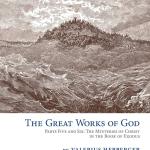
He was a prodigious writer, publishing sermons, a commentary on Revelations, the hymn “Farewell, I Gladly Leave Thee” (in the ELS hymnal), and his magnum opus The Great Works of God, concerning Jesus as the Core and Marrow of Scripture. According to this useful survey of Herberger’s contributions in this the golden age of Lutheran orthodoxy, this 12 volume work was designed to show how “Jesus is the Center and Substance of the Old Testament.” He began with Genesis and intended to work his way through the entire Old Testament, though he only got as far as Ruth before a plague, a Cossack invasion, and his death prevented him from completing the project. (See this and this for more on his biography.)
Concordia Publishing House has published two volumes on Genesis (I don’t know why the second volume isn’t on Amazon, but you can get it here), and Emmanuel Press has published the one on Exodus and Leviticus. These meditations have never before appeared in English! For this we must thank the translator Matthew Carver, who has translated from both Latin and German a wealth of books and hymns, mostly from the 17th century, the Age of Lutheran Orthodoxy but also including Walther’s Hymnal. (Translators don’t get enough attention and appreciation. Note to Concordia universities and seminaries: Give Carver an honorary doctorate and any other kind of award you can come up with. His service to the church is unique and extraordinary.)*
I’m going to give you samples from Valerius tomorrow. Right now I’d like to draw your attention to his way of handling scripture.
Most conservative Protestants today, reacting against the liberal historical-critical approach to the Bible (which starts by denying its supernatural origin and presumes to study the text “scientifically” and skeptically), uses instead what is called the historical- grammatical approach. This takes the text as authoritative and explores its historical context with much attention to the original languages. The goal is to find the original meaning and intent of the divinely-inspired authors. This is good, though sometimes, if not done well, it can make the Bible come across as an interesting history lesson, rather than a revelation that is sharper than a two-edged sword (Hebrews 4:12).
Lutherans, while usually practicing the historical-grammatical method, also apply the distinction between Law and Gospel to unlock the text and to trace how the Law makes us repent of our sin and drives us to the Gospel of grace and forgiveness through the work of Christ. In doing so, the Holy Spirit uses the Word of God to create faith in our hearts.
Furthermore, we are told by Jesus Himself, referring to the Old Testament, that “You search the Scriptures because you think that in them you have eternal life; and it is they that bear witness about me” (John 5:39). And “everything written about me in the Law of Moses and the Prophets and the Psalms must be fulfilled” (Luke 22:44). And “if you believed Moses, you would believe me; for he wrote of me” (John 5:46).
Of course, there are many prophecies of the coming of the Messiah. There are also events and details recorded in the Old Testament that the New Testament says point to Jesus. For example, the lambs used in sacrifices direct us to “the Lamb of God who takes away the sin of the world” (John 1:29), and Moses healing the people by lifting up the Bronze Serpent signifies Christ being lifted up on the cross (John 3:14). This gets us into the realm of typology, which sees in the Old Testament foreshadows and symbols of what becomes fulfilled in the New Testament.
Now we mustn’t turn the Bible into a mere allegory. What seems to be revealed in typology must be in accord with what is affirmed elsewhere in Scripture directly. For example, some Catholics defend their view of Mary by saying that Esther, who intercedes for her people, is a type of the Virgin Mary. But Mary as intercessor is nowhere taught directly in the Bible, so the example of Esther can’t be used to support Catholic Mariology.
Valerius, though, does see Jesus throughout the Old Testament. He offers what we would see as typological readings. But with a difference. I would describe his approach as typological-historical-grammatical.
Every chapter heading of his massively-long project begins with the word “Jesus,” presenting Him as the divine actor in the text being considered. Thus, “JESUS speaks with Moses from the burning bush (Exod. 3:4). “JESUS says to worried Moses, ‘I will be with you’ (Exod. 3:12).” And even the somewhat comical, “JESUS, together with the Father and the Holy Spirit, punishes Pharoah with frogs (Exod. 8:2) and “JESUS plagues Pharoah with lice through the finger of God (Exod. 8:16[-19]).”
But Valerius believes that the Son of God’s involvement in the events of Exodus is not just a symbol. He points out that the word for God in Exodus is nearly always Elohim, that plural construction in Hebrews that functions as a singular. Herberger construes this plurality and unity as signifying the Trinity. Thus, when Elohim speaks in the burning bush or sends the frogs, he translates that as the Triune God intervening in history. And thus, because of the Lutheran doctrine of the communication of attributes, we can say that the Son of God–that is to say, Jesus–is doing all of these things.
Jesus is also the “Angel of the LORD,” something I had heard but never fully understood until Valerius explained it to me thoroughly. And when God says as He often does in Exodus, “I will be with you,” that is a name for Jesus: “Immanuel, (which means, God with us)” (Matthew 1:23).
Furthermore, Jesus is identified as the Word of God. Here is one of Valerius’s startlingly pointed statements: “Moses says, ‘The LORD said,’ and it is in this word ‘said” that Jesus Christ is present” (p. 151).
So Valerius believes Jesus was historically involved with Moses in Exodus, which he establishes by a grammatical analysis of the Hebrew word, justifying his typological insights.
The other thing Valerius does in his treatment of Scripture is to connect passage to passage, detail to detail. Thus, when he cites how Jesus delivers His people through the Red Sea, this calls to mind the “Red Sea” of Jesus’ blood, the water and the blood that came from His side on the cross, the water of baptism and the blood of Holy Communion.
Such a tour of Biblical imagery leaves the reader dazzled by the consistent message of how Jesus delivers us from our own bondage to sin, resulting too in a meditation on the unity of God’s Word and its saving effect.
This reminds me of George Herbert’s poem “The H. Scriptures II,” in which he marvels at not only individual passages of the Bible, but how they all combine and fit together, like stars that form a constellation:
Oh that I knew how all thy lights combine,
And the configurations of their glorie!
Seeing not only how each verse doth shine,
But all the constellations of the storie.This verse marks that, and both do make a motion
Unto a third, that ten leaves off doth lie:
Then as dispersed herbs do watch a potion,
These three make up some Christian’s destinie.Such are thy secrets, which my life makes good,
And comments on thee: for in ev’ry thing
Thy words do finde me out, and parallels bring,
And in another make me understood.Starres are poore books, and oftentimes do misse;
This book of starres lights to eternall blisse.
Next time: Examples of what you can learn from Valerius’s meditations.
*Thanks too to the Master of Divinity Class of 2018 of Concordia Theological Seminary, which raised the money to commission the translation of the Exodus volume as a class gift, both to the seminary and to the church.
Illustration: Valerius Herberger by Unknown author – Datenbank Tripota in der Wissenschaftlichen Bibliothek der Stadt Trier/Stadtarchiv, Public Domain, https://commons.wikimedia.org/w/index.php?curid=97344584

Previous Post

March 30, 2026
Holy Week Miscellany, 2026
Next Post
April 1, 2026 The Meditations of Valerius
Recent Comments
"As a (retired) lawyer I see potential liability from sharing things like power or sharp ..."
"I am not sure the items you mentioned, though disused, discontinued, discarded, could be considered ..."
"“Friend, use me in your relations with your neighbor just as you would want your ..."
"Archaeology: It's the case that we don't have to go back very far to discover ..."
Browse Our Archives
Select a Category America Apologetics Art baseball Bible Blog Christ Church crime Culture Economics Education Ethics Family Food Football Government History Holidays Holy Week Humor International Islam Language Law Life Issues Literature Media Medicine Movies Music Nature News Personal Philosophy Politics psychology Reformation Religions Sacraments Science sex Social Science Sports technology television terrorism Theology Uncategorized Vocation war
Select a Month October 2026 September 2026 August 2026 July 2026 June 2026 May 2026 April 2026 March 2026 February 2026 January 2026 December 2025 November 2025 October 2025 September 2025 August 2025 July 2025 June 2025 May 2025 April 2025 March 2025 February 2025 January 2025 December 2024 November 2024 October 2024 September 2024 August 2024 July 2024 June 2024 May 2024 April 2024 March 2024 February 2024 January 2024 December 2023 November 2023 October 2023 September 2023 August 2023 July 2023 June 2023 May 2023 April 2023 March 2023 February 2023 January 2023 December 2022 November 2022 October 2022 September 2022 August 2022 July 2022 June 2022 May 2022 April 2022 March 2022 February 2022 January 2022 December 2021 November 2021 October 2021 September 2021 August 2021 July 2021 June 2021 May 2021 April 2021 March 2021 February 2021 January 2021 December 2020 November 2020 October 2020 September 2020 August 2020 July 2020 June 2020 May 2020 April 2020 March 2020 February 2020 January 2020 December 2019 November 2019 October 2019 September 2019 August 2019 July 2019 June 2019 May 2019 April 2019 March 2019 February 2019 January 2019 December 2018 November 2018 October 2018 September 2018 August 2018 July 2018 June 2018 May 2018 April 2018 March 2018 February 2018 January 2018 December 2017 November 2017 October 2017 September 2017 August 2017 July 2017 June 2017 May 2017 April 2017 March 2017 February 2017 January 2017 December 2016 November 2016 October 2016 September 2016 August 2016 July 2016 June 2016 May 2016 April 2016 March 2016 February 2016 January 2016 December 2015 November 2015 October 2015 September 2015 August 2015 July 2015 June 2015 May 2015 April 2015 March 2015 February 2015 January 2015 December 2014 November 2014 October 2014 September 2014 August 2014 July 2014 June 2014 May 2014 April 2014 March 2014 February 2014 January 2014 December 2013 November 2013 October 2013 September 2013 August 2013 July 2013 June 2013 May 2013 April 2013 March 2013 February 2013 January 2013 December 2012 November 2012 October 2012 September 2012 August 2012 July 2012 June 2012 May 2012 April 2012 March 2012 February 2012 January 2012 December 2011 November 2011 October 2011 September 2011 August 2011 July 2011 June 2011 May 2011 April 2011 March 2011 February 2011 January 2011 December 2010 November 2010 October 2010 September 2010 August 2010 July 2010 June 2010 May 2010 April 2010 March 2010 February 2010 January 2010 December 2009 November 2009 October 2009 September 2009 August 2009 July 2009 June 2009 May 2009 April 2009 March 2009 February 2009 January 2009 December 2008 November 2008 October 2008 September 2008 August 2008 July 2008 June 2008 May 2008 April 2008 March 2008 February 2008 January 2008 December 2007 November 2007 October 2007
Follow Us!
TAKE THE
Religious Wisdom Quiz
What did Esther risk by approaching the king without being summoned?
Select your answer to see how you score.
Her fortune Her reputation Her citizenship Her life
Books by This Author Books by Gene Veith
Related posts from Cranach


Gen Z Wants Evildoers to Be Punished, Not...

TRENDING AT PATHEOS Evangelical

How to Make a Decision When You Can't...
Main point: It’s much more valuable to stay close to God so...

Archdiocese Hosts Military Marriage Retreat in Germany
RASTATT, Germany — The transient military lifestyle, with its frequent deployments and...

Nearly every morning, I make the drive to Detroit with my high-school-age...

The Real AI Story Is Adoption Without Trust
Artificial intelligence has crossed a political threshold. It is no longer a...

A new article, written by Jeff Lindsay and Gale L. Pooley,...

Swimfan: Forgotten Aughts Pleasures
This is a recovery effort. In 2002, My Big Fat Greek Wedding...
view all Evangelical blogs
What Are Your Thoughts?leave a comment
Ad-Free & Subscriber Log-In Subscription Support
- About Us
- 2026 Calendar
- Videos
- Podcasts
- Library of World Religions
- Faith In Media Tracker
- Advertise With Us
- Write for Us
- Privacy Policy
- Terms of Service
- Do Not Sell My Data
- Contact Us
- Radiant Digital
- Manage Newsletter Subscriptions
- Unsubscribe From Notifications
- Sitemap
Copyright 2008-2026, Patheos. All rights reserved.
Subscription Support Ad-Free & Subscriber Log-In
Follow Patheos