
BuddhistCatholicContemplativeEvangelicalGeneral ChristianHinduJewishLatter-day SaintMuslimNew VisionsProgressive Christian
Beliefs
- Buddhist
- Catholic
- Contemplative
- Evangelical
- General Christian
- Hindu
- Jewish
- Latter-day Saint
- More Voices
- Muslim
- New Visions
- Pagan
- Progressive Christian
Topics
- Religion News
- Food and Religion
- Sports and Religion
- Religious Art
- Religious Music and Entertainment
- Religious Events
- History and Religion
- Style and Religion
- Politics and Religion
- Women in Religion
- Recreation Outdoors and Religion
- Business Finance and Religion
- Careers Workplace and Religion
- Education and Religion
- Family Parenting and Religion
- Health Fitness and Religion
- Home and Religion
- Relationships and Religion
- Technology and Religion
- Travel and Religion
Columnists
- Buddhist Columnists
- Business Finance and Religion Columnists
- Careers Workplace and Religion Columnists
- Catholic Columnists
- Contemplative Columnists
- Education and Religion Columnists
- Evangelists Columnists
- Family Parenting and Religion Columnists
- General Christian Columnists
- Health Fitness and Religion Columnists
- Hindu Columnists
- History and Religion Columnists
- Home and Religion Columnists
- Jewish Columnists
- More Voices Columnists
- Latter Day Columnists
- Muslim Columnists
- New Visions Columnists
- Nonreligious Columnists
- Pagan Columnists
- Politics and Religion Columnists
- Progressive Columnists
- Recreation Outdoors and Religion Columnists
- Relationships and Religion Columnists
- Religion News Columnists
- Religious Art Columnists
- Religious Events Columnists
- Religious Music and Entertainment Columnists
- Sports and Religion Columnists
- Style and Religion Columnists
- Technology and Religion Columnists
- Travel and Religion Columnists
- Women in Religion Columnists
Resource Library
- 2026 Calendar
- Library of World Religions
- The 100 Most Holy Places on Earth
- Patheos Answers
- Podcasts
- Videos
- Faith Leaders Database
- Anglican Episcopalian
- Bahai
- Baptist
- Buddhism
- Christianity
- Confucianism
- Eastern Orthodoxy
- Hinduism
- Holiness and Pentecostal
- ISKCON
- Islam
- Judaism
- Lutheran
- Methodist
- The Church of Jesus Christ of Latter-day Saints
- New Age
- Paganism
- Presbytarian and Reformed
- Protestantism
- Religion Behind the Scenes
- Roman Catholic
- Scientology
- Shia Islam
- Sikhism
- Sufism
- Sunni Islam
- Taoism
- Zen
- See all religions
Research Tools
 Ad-Free & Subscriber Log-In Subscription Support
Ad-Free & Subscriber Log-In Subscription Support
Follow Patheos 

- Trending:
- Forgiveness
- |
- Marriage
- |
- Consciousness
- |
- Death Penalty
- |
- Election
- |
- Halloween

- Home
- Evangelical
- Politics and Religion
- Secular Theodicy
Secular Theodicy
Last updated on: July 29, 2025 at 7:57 am by Gene Veith
Secular Theodicy 2025-07-29T07:57:25-04:00 Gene Veith
Patheos Explore the world's faith through different perspectives on religion and spirituality! Patheos has the views of the prevalent religions and spiritualities of the world.
Christians often have trouble dealing with grief. Think of the trouble non-Christians must have!
Lutheran theologian Oswald Bayer has written about secular theodicy, pointing out that concluding that God must not exist does not solve the problem of theodicy–why would a just, omnipotent God allow bad things to happen?–but, rather, makes it worse.
Why does existence include all the bad things that happen? Without the resources of theology, observes Bayer, there can be no answer to that at all. How can existence be anything else than meaningless? How can life be worth living?
With all the pain and evil in the world, how can existence without God be good?
I randomly stumbled across an article at Big Think by that site’s philosophy columnist Jonny Thomson entitled Three responses to grief in the philosophy of Kierkegaard, Heidegger, and Camus with the deck, “How we handle grief largely depends on our worldview. Here is how three famous philosophers handled the certainty of grief and despair.”
Each of these three thinkers are in the existentialist camp, but while two were atheists, one was a Christian, indeed, a Lutheran, though not completely orthodox. But we can see in them the contours of “secular theodicy” and the difference that the Christian faith makes possible.
First, Heidegger:
The German phenomenologist Martin Heidegger argued that the presence of death in our lives gives fresh meaning to our being free to choose. When we appreciate that our decisions are all we have, and that our entire life is punctuated by a final coup de grace, it invigorates our action and gives us a “daring.” As he wrote, “Being present is grounded in the turning-towards [death].” It is a theme echoed in the medieval idea of memento mori — that is, keeping death close to make the current moment sweeter. When we lose a loved one, we recognize that we are, indeed, left behind, and so this in turn gives new gravity to our choices.
Here is the attempt to make the will the source of all meaning. “Our being free to choose” has become the hallmark of today’s postmodernism and nearly all of its issues (abortion, sex, transgenderism, psychology, politics, religion, etc.). Here too is the notion that the transience of life makes the moment “sweeter,” a common theme in Romantic poetry and Japanese aesthetics.
But the final result just loops in on itself. The loss of a loved one “gives new gravity to our choices”? What does that mean? We are left, again, with an invocation of choice. But surely grief–like disease, death, and all other obstacles and disappointments–is not chosen. These are realities that go beyond what we are “free to choose,” truths that are not relative, that we did not “construct” for ourselves. Secular theodicy is precisely about what we do not choose. So a philosophy built around “choice” does not do us much good.
Second, we have Camus:
For Albert Camus, though, things are somewhat more bleak. Even though Camus’ works were a deliberate and strenuous effort to resolve the listless abyss of nihilism, his solution of “absurdity” is not easy medicine. For Camus, grief is a state of being overcome by the pointlessness of it all. Why love, if love ends in such pain? Why build great projects, when all will be dust? With grief comes an awareness of the bitter finality of everything, and it comes with an angry, screaming frustration: Why are we here at all? Camus’ suggestion is a kind of macabre revelry — gallows’ humor perhaps — that says we should enjoy the ride for the meaningless rollercoaster it is.
But grief is precisely what we cannot enjoy. To say life is absurd so we should be absurd doesn’t help. Camus basically admits that there is no answer to secular theodicy, so we might as well just give up.
Here is Kierkegaard:
For Søren Kierkegaard, that visceral sense of mortality we get after experiencing grief he labelled “despair.” And in the long nighttime of despair, we can begin the journey to realize our truest selves. When we meaningfully encounter first-hand that things in life are not eternal and nothing is forever, we appreciate how we passionately long for things to be eternal. The source of our despair is that we want that “forever.” For Kierkegaard, the only way to overcome despair, to relieve this condition, is to surrender. There is an eternal by which to lose ourselves in. There is faith, and grief is the dark, marble door to belief.
I love that metaphor: grief as “the dark, marble door” that leads to belief. We get a glimpse of law, which does bring realization of death, and gospel, which is a kind of surrender.
I know the objection from skeptics: Longing for something doesn’t make it real. And, yet, if we long for something, we must have a conception of it, and where does that conception come from? What does it point to? C. S. Lewis wrote perceptively about longing as a signpost to Christian reality (see this, this, and Lewis’s memoir Surprised by Joy).
And I know the objection from believers: Kierkegaard here doesn’t attend to the object of the law, namely, sin, or to the object of faith, namely, Christ. But in The Sickness Unto Death, which Thomson is taking this from, he does talk specifically about sin and about forgiveness through Christ. For example, here Kierkegaard deals pretty deftly with two kinds of unbelief:
Now comes a self face to face with Christ — a self which nevertheless in despair will not be itself, or in despair will be itself. For despair of the forgiveness of sins must be related to one or the other formula of despair; that of weakness, or that of defiance; that of weakness which being offended does not dare to believe, or that of defiance which being offended will not believe.
Even non-believers, whether weak or defiant, long for something transcendent, if not for eternity (Kierkegaard’s “forever”), for a life that is “good,” without the griefs that call the goodness into question. But there can be no answer to a secular theodicy. For that, however hard it may be to understand, we must keep the theos in theodicy.
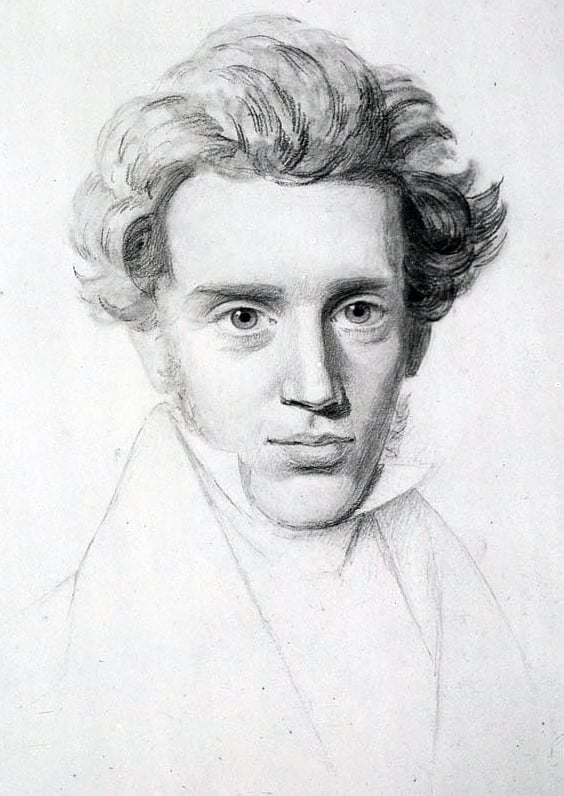
Illustration: Søren Kierkegaard (c. 1840), sketch by his cousin Niels Christian Kierkegaard, Royal Library, Copenhagen via https://www.flickr.com/photos/45270502@N06/9645352916/, Public Domain, https://commons.wikimedia.org/w/index.php?curid=78022219
Previous Post

July 28, 2025
Monday Miscellany, 7/28/25
Next Post

July 30, 2025 The Ethical Problems with AI Sermons
Recent Comments
"I know wired earbuds are making a comeback (I never stopped using them as I ..."
"VCRs, tape decks, and cassette players are all having a revival among a segment of ..."
"As a (retired) lawyer I see potential liability from sharing things like power or sharp ..."
"I am not sure the items you mentioned, though disused, discontinued, discarded, could be considered ..."
Browse Our Archives
Select a Category America Apologetics Art baseball Bible Blog Christ Church crime Culture Economics Education Ethics Family Food Football Government History Holidays Holy Week Humor International Islam Language Law Life Issues Literature Media Medicine Movies Music Nature News Personal Philosophy Politics psychology Reformation Religions Sacraments Science sex Social Science Sports technology television terrorism Theology Uncategorized Vocation war
Select a Month October 2026 September 2026 August 2026 July 2026 June 2026 May 2026 April 2026 March 2026 February 2026 January 2026 December 2025 November 2025 October 2025 September 2025 August 2025 July 2025 June 2025 May 2025 April 2025 March 2025 February 2025 January 2025 December 2024 November 2024 October 2024 September 2024 August 2024 July 2024 June 2024 May 2024 April 2024 March 2024 February 2024 January 2024 December 2023 November 2023 October 2023 September 2023 August 2023 July 2023 June 2023 May 2023 April 2023 March 2023 February 2023 January 2023 December 2022 November 2022 October 2022 September 2022 August 2022 July 2022 June 2022 May 2022 April 2022 March 2022 February 2022 January 2022 December 2021 November 2021 October 2021 September 2021 August 2021 July 2021 June 2021 May 2021 April 2021 March 2021 February 2021 January 2021 December 2020 November 2020 October 2020 September 2020 August 2020 July 2020 June 2020 May 2020 April 2020 March 2020 February 2020 January 2020 December 2019 November 2019 October 2019 September 2019 August 2019 July 2019 June 2019 May 2019 April 2019 March 2019 February 2019 January 2019 December 2018 November 2018 October 2018 September 2018 August 2018 July 2018 June 2018 May 2018 April 2018 March 2018 February 2018 January 2018 December 2017 November 2017 October 2017 September 2017 August 2017 July 2017 June 2017 May 2017 April 2017 March 2017 February 2017 January 2017 December 2016 November 2016 October 2016 September 2016 August 2016 July 2016 June 2016 May 2016 April 2016 March 2016 February 2016 January 2016 December 2015 November 2015 October 2015 September 2015 August 2015 July 2015 June 2015 May 2015 April 2015 March 2015 February 2015 January 2015 December 2014 November 2014 October 2014 September 2014 August 2014 July 2014 June 2014 May 2014 April 2014 March 2014 February 2014 January 2014 December 2013 November 2013 October 2013 September 2013 August 2013 July 2013 June 2013 May 2013 April 2013 March 2013 February 2013 January 2013 December 2012 November 2012 October 2012 September 2012 August 2012 July 2012 June 2012 May 2012 April 2012 March 2012 February 2012 January 2012 December 2011 November 2011 October 2011 September 2011 August 2011 July 2011 June 2011 May 2011 April 2011 March 2011 February 2011 January 2011 December 2010 November 2010 October 2010 September 2010 August 2010 July 2010 June 2010 May 2010 April 2010 March 2010 February 2010 January 2010 December 2009 November 2009 October 2009 September 2009 August 2009 July 2009 June 2009 May 2009 April 2009 March 2009 February 2009 January 2009 December 2008 November 2008 October 2008 September 2008 August 2008 July 2008 June 2008 May 2008 April 2008 March 2008 February 2008 January 2008 December 2007 November 2007 October 2007
Follow Us!
TAKE THE
Religious Wisdom Quiz
According to Philippians, whose name is above every name?
Select your answer to see how you score.
The Lord Christ God Jesus
Books by This Author Books by Gene Veith
Related posts from Cranach


Gen Z Wants Evildoers to Be Punished, Not...

The Family Estrangement Epidemic

As Fulton Sheen Is Beatified, Don't Forget Walter...
TRENDING AT PATHEOS Evangelical

The First Eucharistic Controversy: Christ’s Real Presence
For Catholics, the Eucharist is the source and summit of the Christian...

What a Stop Sign Can Teach Us About...
How to Make a Decision When You Can't Hear God Main point:...

Archdiocese Hosts Military Marriage Retreat in Germany
RASTATT, Germany — The transient military lifestyle, with its frequent deployments and...

Nearly every morning, I make the drive to Detroit with my high-school-age...

The Real AI Story Is Adoption Without Trust
Artificial intelligence has crossed a political threshold. It is no longer a...

A new article, written by Jeff Lindsay and Gale L. Pooley,...
view all Evangelical blogs
What Are Your Thoughts?leave a comment
Ad-Free & Subscriber Log-In Subscription Support
- About Us
- 2026 Calendar
- Videos
- Podcasts
- Library of World Religions
- Faith In Media Tracker
- Advertise With Us
- Write for Us
- Privacy Policy
- Terms of Service
- Do Not Sell My Data
- Contact Us
- Radiant Digital
- Manage Newsletter Subscriptions
- Unsubscribe From Notifications
- Sitemap
Copyright 2008-2026, Patheos. All rights reserved.
Subscription Support Ad-Free & Subscriber Log-In
Follow Patheos