
BuddhistCatholicContemplativeEvangelicalGeneral ChristianHinduJewishLatter-day SaintMuslimNew VisionsProgressive Christian
Beliefs
- Buddhist
- Catholic
- Contemplative
- Evangelical
- General Christian
- Hindu
- Jewish
- Latter-day Saint
- More Voices
- Muslim
- New Visions
- Pagan
- Progressive Christian
Topics
- Religion News
- Food and Religion
- Sports and Religion
- Religious Art
- Religious Music and Entertainment
- Religious Events
- History and Religion
- Style and Religion
- Politics and Religion
- Women in Religion
- Recreation Outdoors and Religion
- Business Finance and Religion
- Careers Workplace and Religion
- Education and Religion
- Family Parenting and Religion
- Health Fitness and Religion
- Home and Religion
- Relationships and Religion
- Technology and Religion
- Travel and Religion
Columnists
- Buddhist Columnists
- Business Finance and Religion Columnists
- Careers Workplace and Religion Columnists
- Catholic Columnists
- Contemplative Columnists
- Education and Religion Columnists
- Evangelists Columnists
- Family Parenting and Religion Columnists
- General Christian Columnists
- Health Fitness and Religion Columnists
- Hindu Columnists
- History and Religion Columnists
- Home and Religion Columnists
- Jewish Columnists
- More Voices Columnists
- Latter Day Columnists
- Muslim Columnists
- New Visions Columnists
- Nonreligious Columnists
- Pagan Columnists
- Politics and Religion Columnists
- Progressive Columnists
- Recreation Outdoors and Religion Columnists
- Relationships and Religion Columnists
- Religion News Columnists
- Religious Art Columnists
- Religious Events Columnists
- Religious Music and Entertainment Columnists
- Sports and Religion Columnists
- Style and Religion Columnists
- Technology and Religion Columnists
- Travel and Religion Columnists
- Women in Religion Columnists
Resource Library
- 2026 Calendar
- Library of World Religions
- The 100 Most Holy Places on Earth
- Patheos Answers
- Podcasts
- Videos
- Faith Leaders Database
- Anglican Episcopalian
- Bahai
- Baptist
- Buddhism
- Christianity
- Confucianism
- Eastern Orthodoxy
- Hinduism
- Holiness and Pentecostal
- ISKCON
- Islam
- Judaism
- Lutheran
- Methodist
- The Church of Jesus Christ of Latter-day Saints
- New Age
- Paganism
- Presbytarian and Reformed
- Protestantism
- Religion Behind the Scenes
- Roman Catholic
- Scientology
- Shia Islam
- Sikhism
- Sufism
- Sunni Islam
- Taoism
- Zen
- See all religions
Research Tools
 Ad-Free & Subscriber Log-In Subscription Support
Ad-Free & Subscriber Log-In Subscription Support
Follow Patheos 

- Trending:
- Forgiveness
- |
- Marriage
- |
- Consciousness
- |
- Death Penalty
- |
- Election
- |
- Halloween

- Home
- Evangelical
- Politics and Religion
- On Protestant Denominations
On Protestant Denominations
Last updated on: July 16, 2025 at 6:00 am by Gene Veith
On Protestant Denominations 2025-07-10T21:05:44-04:00 Gene Veith
Patheos Explore the world's faith through different perspectives on religion and spirituality! Patheos has the views of the prevalent religions and spiritualities of the world.
Denominations are being attacked from both a Catholic and a Protestant direction.
Many Catholics say there are thousands of Protestant denominations, with individual Christians all claiming the right to hold whatever beliefs they want and to just start their own churches, as opposed to the one true Church of Rome. Though thoughtful Catholics keep saying this is not exactly true.
But Protestants are also attacking denominations, insisting that each denomination is too much like the Church of Rome. They claim that individual Christians should have the right to hold whatever beliefs they want and should be able to just start their own churches.
OK, this isn’t exactly true either. Nondenominational churches do tend to hold to general evangelical beliefs. While individuals can hold a wide range of opinions on certain issues, others are defined by the congregation’s own statement of faith. Nondenominationalism is not so much grounded in different theologies but in a freedom from organizational structures. Each congregation is independent and unconnected formally to any larger ecclesiastical structure or association of churches. In this, nondenominational churches simply have a congregational church polity, which has a long pedigree in Protestant history.
It is, however, true that a common pattern for nondenominational churches is for a young man to graduate from a nondenominational seminary or Bible college and then just go out and start a church. He is under no ecclesiastical supervision. Freed from “denominational bureaucracy,” as he will call it, he is on his own. If he is successful in the religious marketplace, he might move from a rented auditorium to build a “campus” of his own. He is a religious entrepreneur.
Nondenominational churches are now, paradoxically, the largest Protestant denomination. That is, according to the probably outdated 2020 Religious Census, there are more members of non-denominational congregations, some 21 million, than any other Protestant church body. (Baptists come in next at 17.6 million; then Methodists at 8 million; then ELCA Lutherans at 3.1 million; then Assemblies of God at 3.09 million; then the National Missionary Baptists at 2.4 million; then, coming in seventh, the Lutheran Church Missouri Synod at 1.8 million.)
In this post, I’d like to address both the Catholic contention that there are too many denominations and the Protestant contention that we don’t need denominations at all.
I came across this brief video (only 3 minutes) with useful subtitles from Jordan Cooper:, a pastor and theologian with the American Association of Lutheran Churches, which which the LCMS is in fellowship. He points out that there are not all that many different kinds of Protestants:
First, he defines Protestants those who believe in sola scriptura. Those who don’t believe in the authority of Scripture, such as Mainline Liberal Protestants, are not really Protestants, according to him. He says that there are three major theological traditions within Protestantism: (1) Lutheran (2) Reformed (3) Anglican.
These can have different offshoots–John Wesley’s Methodism grew out of Anglicanism; the Reformed gave us various kinds of Presbyterians and, by his reckoning, Baptists–but these are the main types of Protestantism. He said that one could identify a few more but didn’t have time to get into those.
I think we have to classify Pentecostalism as a major strain, since it is one of the largest global movements. Then there are the Anabaptists, from which came the “peace churches,” such as the Mennonites and Amish.
While the Reformed are alike in not being sacramental, there is a big difference between Calvinists and Arminians, with Baptists and other evangelicals being one or the other.
I think Jordan’s breakdown is helpful, but it isn’t complete. And the classifications depend on what you emphasize: sola scriptura? beliefs about salvation? monergism or synergism? the relationship of faith and works? church government? worship? sacraments?
I appreciate his point that there are only a few kinds of Protestantism, but there are more than he giving credit for. I think some of the offshoots constitute distinctly different belief systems.
My breakdown would probably be (1) Lutheran (2) Reformed (3) Anglican (4) Evangelicals (5) Pentecostals (6) Anabaptist/communitarians
As for non-denominational Protestants, subscriber Steve Bauer alerted me to a defense of denominations by Reformed pastor Eric Tonjes who wrote a post for Mere Orthodoxy entitled Why Denominations are Good, Actually.
First, he observes that non-denominational congregations do not get rid of the differences between Christians:
The broad traditions within Christianity exist because there are questions that are key to our life together as Christians which we disagree about. How should the church be structured and governed? How do we think about the special role of baptism and the Lord’s Supper (and maybe other things too)? Who is a member of our church? How, broadly, do we understand Scripture’s shape? Christians read the Bible and reach different conclusions about those issues, and it is very hard to agree to disagree about those things while still doing life together.
Nondenominational churches inevitably have conclusions on these topics that place them in certain theological traditions. Indeed, it is a running joke in some circles that when a church says they are nondenominational, they’re really saying they’re either Baptist or charismatic and just trying to hide it. Such churches aren’t more theologically inclusive; they’re just less clear about their convictions.
There are also positive reasons why Tonjes appreciates being a part of a denomination. He values the accountability he has as a pastor:
I appreciate the fact that I’m part of a denominational world where the term “pastor” means something deeper, something connected to the broader church. I was examined by the broader church. I was set apart in ordination by them. We, as churches, are in mutual submission to each other. And, most importantly, I am accountable to that broader church for what I do and say. If I err, I fully expect to be corrected, and if I go totally off the rails, they will make it so I’m not a pastor anymore.
A major argument for non-denominationalism is church unity. But, says Tonjes, “There is a real sense in which every nondenominational church is just a single-congregation denomination. We aren’t decreasing divisions when they form; we are multiplying them.” And he experiences a special sense of unity
Tonjes cites other reasons to appreciate denominations: “They are wonderful spaces for cooperation in ministry and missions. They are deeply humbling structures, fighting back against the plague of celebrity pastors besetting churches. They are spaces of public witness.”
AN IMPORTANT NOTE: I realize that some of you readers belong to and are even pastors in nondenominational churches. This post defends denominations, but I mean no offense. I’d be curious to learn how, in your nondenominational context, you deal with some of the issues raised here (e.g., accountability, theology, unity, etc.). Also, how do you see yourself fitting in with the rest of Protestantism and, indeed, Christendom? Are you really anti-institutional religion, as some pundits have said, or are you just Congregational?
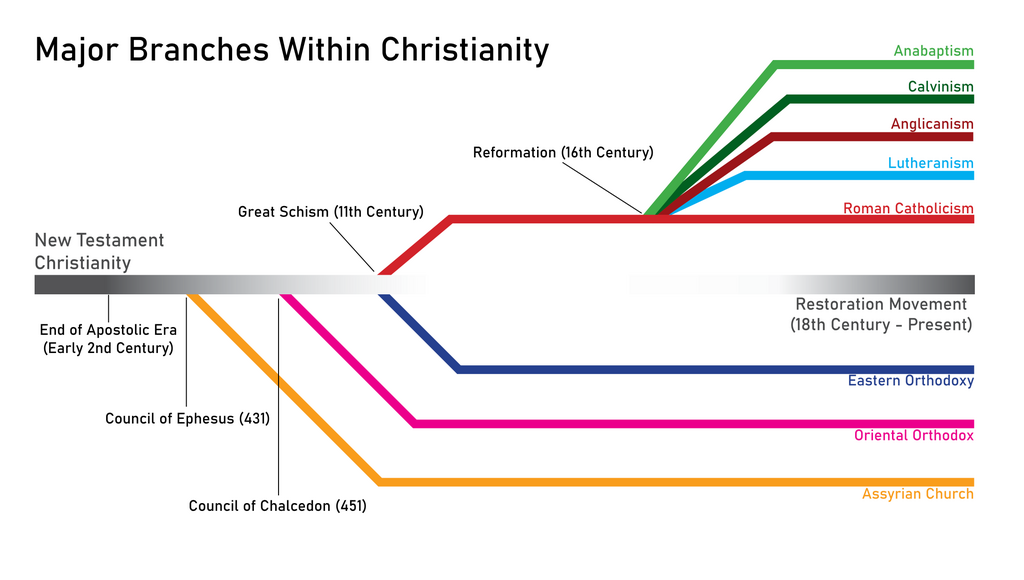
Illustration: Major Branches within Christianity by Noah Howard, CC BY-SA 4.0 <https://creativecommons.org/licenses/by-sa/4.0>, via Wikimedia Commons

[Here is another breakdown, including Catholicism and Orthodoxy, but giving only four major branches of Protestantism.]
Previous Post

July 15, 2025
The Texas Floods & Christ
Next Post
July 17, 2025 Liberal Theology & Eugenics
Recent Comments
"As a (retired) lawyer I see potential liability from sharing things like power or sharp ..."
"I am not sure the items you mentioned, though disused, discontinued, discarded, could be considered ..."
"“Friend, use me in your relations with your neighbor just as you would want your ..."
"Archaeology: It's the case that we don't have to go back very far to discover ..."
Browse Our Archives
Select a Category America Apologetics Art baseball Bible Blog Christ Church crime Culture Economics Education Ethics Family Food Football Government History Holidays Holy Week Humor International Islam Language Law Life Issues Literature Media Medicine Movies Music Nature News Personal Philosophy Politics psychology Reformation Religions Sacraments Science sex Social Science Sports technology television terrorism Theology Uncategorized Vocation war
Select a Month October 2026 September 2026 August 2026 July 2026 June 2026 May 2026 April 2026 March 2026 February 2026 January 2026 December 2025 November 2025 October 2025 September 2025 August 2025 July 2025 June 2025 May 2025 April 2025 March 2025 February 2025 January 2025 December 2024 November 2024 October 2024 September 2024 August 2024 July 2024 June 2024 May 2024 April 2024 March 2024 February 2024 January 2024 December 2023 November 2023 October 2023 September 2023 August 2023 July 2023 June 2023 May 2023 April 2023 March 2023 February 2023 January 2023 December 2022 November 2022 October 2022 September 2022 August 2022 July 2022 June 2022 May 2022 April 2022 March 2022 February 2022 January 2022 December 2021 November 2021 October 2021 September 2021 August 2021 July 2021 June 2021 May 2021 April 2021 March 2021 February 2021 January 2021 December 2020 November 2020 October 2020 September 2020 August 2020 July 2020 June 2020 May 2020 April 2020 March 2020 February 2020 January 2020 December 2019 November 2019 October 2019 September 2019 August 2019 July 2019 June 2019 May 2019 April 2019 March 2019 February 2019 January 2019 December 2018 November 2018 October 2018 September 2018 August 2018 July 2018 June 2018 May 2018 April 2018 March 2018 February 2018 January 2018 December 2017 November 2017 October 2017 September 2017 August 2017 July 2017 June 2017 May 2017 April 2017 March 2017 February 2017 January 2017 December 2016 November 2016 October 2016 September 2016 August 2016 July 2016 June 2016 May 2016 April 2016 March 2016 February 2016 January 2016 December 2015 November 2015 October 2015 September 2015 August 2015 July 2015 June 2015 May 2015 April 2015 March 2015 February 2015 January 2015 December 2014 November 2014 October 2014 September 2014 August 2014 July 2014 June 2014 May 2014 April 2014 March 2014 February 2014 January 2014 December 2013 November 2013 October 2013 September 2013 August 2013 July 2013 June 2013 May 2013 April 2013 March 2013 February 2013 January 2013 December 2012 November 2012 October 2012 September 2012 August 2012 July 2012 June 2012 May 2012 April 2012 March 2012 February 2012 January 2012 December 2011 November 2011 October 2011 September 2011 August 2011 July 2011 June 2011 May 2011 April 2011 March 2011 February 2011 January 2011 December 2010 November 2010 October 2010 September 2010 August 2010 July 2010 June 2010 May 2010 April 2010 March 2010 February 2010 January 2010 December 2009 November 2009 October 2009 September 2009 August 2009 July 2009 June 2009 May 2009 April 2009 March 2009 February 2009 January 2009 December 2008 November 2008 October 2008 September 2008 August 2008 July 2008 June 2008 May 2008 April 2008 March 2008 February 2008 January 2008 December 2007 November 2007 October 2007
Follow Us!
TAKE THE
Religious Wisdom Quiz
What miracle did Elijah perform for a widow at Zarephath?
Select your answer to see how you score.
Multiplied flour and oil Fed 5,000 Cured leprosy Turned water to wine
Books by This Author Books by Gene Veith
Related posts from Cranach


Gen Z Wants Evildoers to Be Punished, Not...

On Trump's Political Ads That You Paid For

TRENDING AT PATHEOS Evangelical

Archdiocese Hosts Military Marriage Retreat in Germany
RASTATT, Germany — The transient military lifestyle, with its frequent deployments and...

Nearly every morning, I make the drive to Detroit with my high-school-age...

The Real AI Story Is Adoption Without Trust
Artificial intelligence has crossed a political threshold. It is no longer a...

A new article, written by Jeff Lindsay and Gale L. Pooley,...

Swimfan: Forgotten Aughts Pleasures
This is a recovery effort. In 2002, My Big Fat Greek Wedding...

Top Three Anti-Catholic Lies About Catholicism
This is my initial transcript for the video, "THE 3 WORST...
view all Evangelical blogs
What Are Your Thoughts?leave a comment
Ad-Free & Subscriber Log-In Subscription Support
- About Us
- 2026 Calendar
- Videos
- Podcasts
- Library of World Religions
- Faith In Media Tracker
- Advertise With Us
- Write for Us
- Privacy Policy
- Terms of Service
- Do Not Sell My Data
- Contact Us
- Radiant Digital
- Manage Newsletter Subscriptions
- Unsubscribe From Notifications
- Sitemap
Copyright 2008-2026, Patheos. All rights reserved.
Subscription Support Ad-Free & Subscriber Log-In
Follow Patheos