
BuddhistCatholicContemplativeEvangelicalGeneral ChristianHinduJewishLatter-day SaintMuslimNew VisionsProgressive Christian
Beliefs
- Buddhist
- Catholic
- Contemplative
- Evangelical
- General Christian
- Hindu
- Jewish
- Latter-day Saint
- More Voices
- Muslim
- New Visions
- Pagan
- Progressive Christian
Topics
- Religion News
- Food and Religion
- Sports and Religion
- Religious Art
- Religious Music and Entertainment
- Religious Events
- History and Religion
- Style and Religion
- Politics and Religion
- Women in Religion
- Recreation Outdoors and Religion
- Business Finance and Religion
- Careers Workplace and Religion
- Education and Religion
- Family Parenting and Religion
- Health Fitness and Religion
- Home and Religion
- Relationships and Religion
- Technology and Religion
- Travel and Religion
Columnists
- Buddhist Columnists
- Business Finance and Religion Columnists
- Careers Workplace and Religion Columnists
- Catholic Columnists
- Contemplative Columnists
- Education and Religion Columnists
- Evangelists Columnists
- Family Parenting and Religion Columnists
- General Christian Columnists
- Health Fitness and Religion Columnists
- Hindu Columnists
- History and Religion Columnists
- Home and Religion Columnists
- Jewish Columnists
- More Voices Columnists
- Latter Day Columnists
- Muslim Columnists
- New Visions Columnists
- Nonreligious Columnists
- Pagan Columnists
- Politics and Religion Columnists
- Progressive Columnists
- Recreation Outdoors and Religion Columnists
- Relationships and Religion Columnists
- Religion News Columnists
- Religious Art Columnists
- Religious Events Columnists
- Religious Music and Entertainment Columnists
- Sports and Religion Columnists
- Style and Religion Columnists
- Technology and Religion Columnists
- Travel and Religion Columnists
- Women in Religion Columnists
Resource Library
- 2026 Calendar
- Library of World Religions
- The 100 Most Holy Places on Earth
- Patheos Answers
- Podcasts
- Videos
- Faith Leaders Database
- Anglican Episcopalian
- Bahai
- Baptist
- Buddhism
- Christianity
- Confucianism
- Eastern Orthodoxy
- Hinduism
- Holiness and Pentecostal
- ISKCON
- Islam
- Judaism
- Lutheran
- Methodist
- The Church of Jesus Christ of Latter-day Saints
- New Age
- Paganism
- Presbytarian and Reformed
- Protestantism
- Religion Behind the Scenes
- Roman Catholic
- Scientology
- Shia Islam
- Sikhism
- Sufism
- Sunni Islam
- Taoism
- Zen
- See all religions
Research Tools
 Ad-Free & Subscriber Log-In Subscription Support
Ad-Free & Subscriber Log-In Subscription Support
Follow Patheos 

- Trending:
- Forgiveness
- |
- Marriage
- |
- Consciousness
- |
- Death Penalty
- |
- Election
- |
- Halloween

- Home
- Evangelical
- Politics and Religion
- The Nicene Creed & Worship
The Nicene Creed & Worship
Last updated on: May 28, 2025 at 9:21 am by Gene Veith
The Nicene Creed & Worship 2025-05-28T09:21:53-04:00 Gene Veith
Patheos Explore the world's faith through different perspectives on religion and spirituality! Patheos has the views of the prevalent religions and spiritualities of the world.
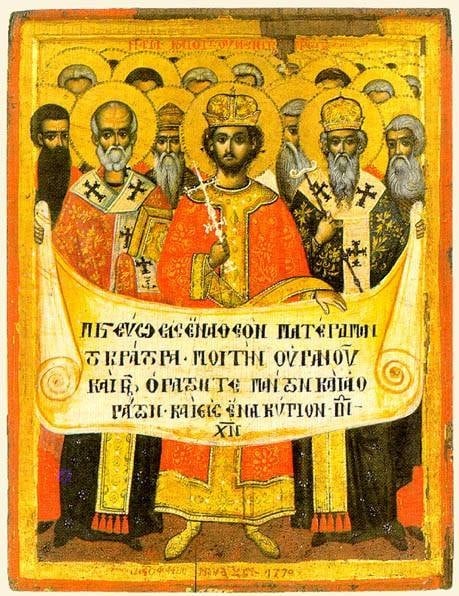
This year marks the 1700th anniversary of the Nicene Creed. This statement, which has been confessed in Christian churches ever since, was formulated by a council of bishops who met in the city of Nicaea in present-day Turkey from May 20 (the date I wrote this) through August, 325 A.D., to work out what Scripture teaches about the Trinity and to deal with the teachings of Arius, who maintained that Jesus was not fully divine.
Patristics scholar Adam Renberg has written a post for the Anxious Bench, a Patheos blog from Christian historians, entitled Nicene Worship: Then and Now. He reminds us that the Nicene Creed was not just a matter of theological abstractions. Rather, it had to do with worship. He writes,
Worship of God is not only about heart posture, but also about proper belief. To misunderstand the object of our worship is to worship something other than the true God. In other words, orthodoxy must (at least in one dimension) be tied to proper understanding of God, and heresy is therefore derivation from suitable belief. Heresy is idolatry, insofar as it worships something other than the Christian God.
That is to say, worship raises the question, Who are you worshiping? What God do you worship? This was especially an issue in the early church, when people in the Greco-Roman world might worship any number of gods. But it surely applies today as well. This is why “interfaith” services, which invoke the incompatible deities of multiple religions, are so problematic. And in today’s climate, when individuals are encouraged to formulate their own personal “spiritualities”—featuring privately-defined deities, the self as god, or no god at all—communal worship becomes impossible.
Renberg describes the Nicaean approach:
When the bishops gathered at Nicaea, one of the goals was to articulate an orthodox understanding of God and they accomplished this in a twofold manner through the creed. First, they developed the creed to summarize the basic beliefs of the Christian Church: the relationship of the Father to the Son, the salvific work of Christ, etc. Second, they expressed these core tenants in such a way that other views were excluded—namely, Arius’. That is to say, the bishops drew the boundary lines of orthodoxy in this document.
That’s a great phrase: “the boundary lines of orthodoxy.” The church needed to know, who is worshiping the God of the Bible—that is, the Father, the Son, and the Holy Spirit—and who is not? A related question is, with whom do we share a common faith? And another: with whom may I worship?
Do you think the Nicene Creed provides sufficient “boundary lines of orthodoxy” today? Some conservative Christians say that agreement on the Nicene Creed should be sufficient for church fellowship, as it was in the early church.
But clearly, many more heresies have arisen since the time of Arius. And many more doctrinal controversies have arisen, even among those who worship the Triune God and confess the deity of Christ. Is the Pope the head of the church? In 1054, the Eastern orthodox said, “no,” as would the Protestants five centuries later. Is salvation a matter of accumulating merits (Catholicism), theosis (Eastern Orthodoxy), or faith in Christ? Does baptism regenerate and is Christ actually present in Holy Communion (yes, say Catholics, Orthodox, and Lutherans; no, say most Protestants). Protestants also have significant differences among themselves over such things as the Holy Spirit, the nature of faith, the authority of Scripture, the office of the ministry, and the definition of the Gospel, to name a few.
It’s hard to imagine a common, unified, collective worship in light of disagreements such as these. The different theological traditions can be said to have their own “boundary lines of orthodoxy” that define those traditions. Perhaps we can say that those who confess the Nicene Creed, for all of their important differences, do worship the same Triune God, acknowledge the same Jesus Christ as true God and true Man, and hold to the basic facts about creation, redemption, and sanctification. This is a significant agreement. And it is especially important today when, as Renberg says, so many self-identifying Christians—including ostensibly conservative and evangelical Christians—do not believe what the Nicene Creed confesses! Renberg writes,
What are the proper boundary markers for worship in the Church? For around 1650 years, Nicaea has been the standard articulation of trinitarian orthodoxy for the church, with the creed being used in worship regularly from at least the sixth century onwards. In other words, the majority of Christians have affirmed that Nicaea describes who the Christian God is. But recent trends demonstrate that a Nicene understanding of God is quickly being forgotten. A survey in 2022 seemed to indicate that up to 53% of Christians and 27% of evangelicals in the US agree or somewhat agree with the statement that “Jesus was a great teacher, but he was not God.”
Not to mention the church bodies that consciously hold to positions that violate the Creed, from liberal theologies that reject the Creation, the Incarnation, and the Resurrection of Christ to evangelicals who would have a hard time with “I acknowledge one baptism for the remission of sins.”
So today, after 1,700 years, it would be good for Christians and their churches to rally around the Nicene Creed—confessing it, teaching it, and reflecting on the significance of each of its articles.
Illustration: First Nicea Council Icon from Protatos Church, 1770 via Picryl, Public Domain
1700th anniversary of Nicene Creed
Previous Post
May 27, 2025
Piercing God
Next Post
May 29, 2025 Finishing the Nicene Creed
Recent Comments
"As a (retired) lawyer I see potential liability from sharing things like power or sharp ..."
"I am not sure the items you mentioned, though disused, discontinued, discarded, could be considered ..."
"“Friend, use me in your relations with your neighbor just as you would want your ..."
"Archaeology: It's the case that we don't have to go back very far to discover ..."
Browse Our Archives
Select a Category America Apologetics Art baseball Bible Blog Christ Church crime Culture Economics Education Ethics Family Food Football Government History Holidays Holy Week Humor International Islam Language Law Life Issues Literature Media Medicine Movies Music Nature News Personal Philosophy Politics psychology Reformation Religions Sacraments Science sex Social Science Sports technology television terrorism Theology Uncategorized Vocation war
Select a Month October 2026 September 2026 August 2026 July 2026 June 2026 May 2026 April 2026 March 2026 February 2026 January 2026 December 2025 November 2025 October 2025 September 2025 August 2025 July 2025 June 2025 May 2025 April 2025 March 2025 February 2025 January 2025 December 2024 November 2024 October 2024 September 2024 August 2024 July 2024 June 2024 May 2024 April 2024 March 2024 February 2024 January 2024 December 2023 November 2023 October 2023 September 2023 August 2023 July 2023 June 2023 May 2023 April 2023 March 2023 February 2023 January 2023 December 2022 November 2022 October 2022 September 2022 August 2022 July 2022 June 2022 May 2022 April 2022 March 2022 February 2022 January 2022 December 2021 November 2021 October 2021 September 2021 August 2021 July 2021 June 2021 May 2021 April 2021 March 2021 February 2021 January 2021 December 2020 November 2020 October 2020 September 2020 August 2020 July 2020 June 2020 May 2020 April 2020 March 2020 February 2020 January 2020 December 2019 November 2019 October 2019 September 2019 August 2019 July 2019 June 2019 May 2019 April 2019 March 2019 February 2019 January 2019 December 2018 November 2018 October 2018 September 2018 August 2018 July 2018 June 2018 May 2018 April 2018 March 2018 February 2018 January 2018 December 2017 November 2017 October 2017 September 2017 August 2017 July 2017 June 2017 May 2017 April 2017 March 2017 February 2017 January 2017 December 2016 November 2016 October 2016 September 2016 August 2016 July 2016 June 2016 May 2016 April 2016 March 2016 February 2016 January 2016 December 2015 November 2015 October 2015 September 2015 August 2015 July 2015 June 2015 May 2015 April 2015 March 2015 February 2015 January 2015 December 2014 November 2014 October 2014 September 2014 August 2014 July 2014 June 2014 May 2014 April 2014 March 2014 February 2014 January 2014 December 2013 November 2013 October 2013 September 2013 August 2013 July 2013 June 2013 May 2013 April 2013 March 2013 February 2013 January 2013 December 2012 November 2012 October 2012 September 2012 August 2012 July 2012 June 2012 May 2012 April 2012 March 2012 February 2012 January 2012 December 2011 November 2011 October 2011 September 2011 August 2011 July 2011 June 2011 May 2011 April 2011 March 2011 February 2011 January 2011 December 2010 November 2010 October 2010 September 2010 August 2010 July 2010 June 2010 May 2010 April 2010 March 2010 February 2010 January 2010 December 2009 November 2009 October 2009 September 2009 August 2009 July 2009 June 2009 May 2009 April 2009 March 2009 February 2009 January 2009 December 2008 November 2008 October 2008 September 2008 August 2008 July 2008 June 2008 May 2008 April 2008 March 2008 February 2008 January 2008 December 2007 November 2007 October 2007
Follow Us!
TAKE THE
Religious Wisdom Quiz
What symbol is most commonly associated with Christianity worldwide?
Select your answer to see how you score.
The dove The lamb The fish The cross
Books by This Author Books by Gene Veith
Related posts from Cranach


Gen Z Wants Evildoers to Be Punished, Not...

On Trump's Political Ads That You Paid For

TRENDING AT PATHEOS Evangelical

How to Make a Decision When You Can't...
Main point: It’s much more valuable to stay close to God so...

Archdiocese Hosts Military Marriage Retreat in Germany
RASTATT, Germany — The transient military lifestyle, with its frequent deployments and...

Nearly every morning, I make the drive to Detroit with my high-school-age...

The Real AI Story Is Adoption Without Trust
Artificial intelligence has crossed a political threshold. It is no longer a...

A new article, written by Jeff Lindsay and Gale L. Pooley,...

Swimfan: Forgotten Aughts Pleasures
This is a recovery effort. In 2002, My Big Fat Greek Wedding...
view all Evangelical blogs
What Are Your Thoughts?leave a comment
Ad-Free & Subscriber Log-In Subscription Support
- About Us
- 2026 Calendar
- Videos
- Podcasts
- Library of World Religions
- Faith In Media Tracker
- Advertise With Us
- Write for Us
- Privacy Policy
- Terms of Service
- Do Not Sell My Data
- Contact Us
- Radiant Digital
- Manage Newsletter Subscriptions
- Unsubscribe From Notifications
- Sitemap
Copyright 2008-2026, Patheos. All rights reserved.
Subscription Support Ad-Free & Subscriber Log-In
Follow Patheos