
BuddhistCatholicContemplativeEvangelicalGeneral ChristianHinduJewishLatter-day SaintMuslimNew VisionsProgressive Christian
Beliefs
- Buddhist
- Catholic
- Contemplative
- Evangelical
- General Christian
- Hindu
- Jewish
- Latter-day Saint
- More Voices
- Muslim
- New Visions
- Pagan
- Progressive Christian
Topics
- Religion News
- Food and Religion
- Sports and Religion
- Religious Art
- Religious Music and Entertainment
- Religious Events
- History and Religion
- Style and Religion
- Politics and Religion
- Women in Religion
- Recreation Outdoors and Religion
- Business Finance and Religion
- Careers Workplace and Religion
- Education and Religion
- Family Parenting and Religion
- Health Fitness and Religion
- Home and Religion
- Relationships and Religion
- Technology and Religion
- Travel and Religion
Columnists
- Buddhist Columnists
- Business Finance and Religion Columnists
- Careers Workplace and Religion Columnists
- Catholic Columnists
- Contemplative Columnists
- Education and Religion Columnists
- Evangelists Columnists
- Family Parenting and Religion Columnists
- General Christian Columnists
- Health Fitness and Religion Columnists
- Hindu Columnists
- History and Religion Columnists
- Home and Religion Columnists
- Jewish Columnists
- More Voices Columnists
- Latter Day Columnists
- Muslim Columnists
- New Visions Columnists
- Nonreligious Columnists
- Pagan Columnists
- Politics and Religion Columnists
- Progressive Columnists
- Recreation Outdoors and Religion Columnists
- Relationships and Religion Columnists
- Religion News Columnists
- Religious Art Columnists
- Religious Events Columnists
- Religious Music and Entertainment Columnists
- Sports and Religion Columnists
- Style and Religion Columnists
- Technology and Religion Columnists
- Travel and Religion Columnists
- Women in Religion Columnists
Resource Library
- 2026 Calendar
- Library of World Religions
- The 100 Most Holy Places on Earth
- Patheos Answers
- Podcasts
- Videos
- Faith Leaders Database
- Anglican Episcopalian
- Bahai
- Baptist
- Buddhism
- Christianity
- Confucianism
- Eastern Orthodoxy
- Hinduism
- Holiness and Pentecostal
- ISKCON
- Islam
- Judaism
- Lutheran
- Methodist
- The Church of Jesus Christ of Latter-day Saints
- New Age
- Paganism
- Presbytarian and Reformed
- Protestantism
- Religion Behind the Scenes
- Roman Catholic
- Scientology
- Shia Islam
- Sikhism
- Sufism
- Sunni Islam
- Taoism
- Zen
- See all religions
Research Tools
 Ad-Free & Subscriber Log-In Subscription Support
Ad-Free & Subscriber Log-In Subscription Support
Follow Patheos 

- Trending:
- Forgiveness
- |
- Marriage
- |
- Consciousness
- |
- Death Penalty
- |
- Election
- |
- Halloween

- Home
- Evangelical
- Politics and Religion
- Changing the Culture from Above or Below?
Changing the Culture from Above or Below?
Last updated on: May 7, 2025 at 8:26 am by Gene Veith
Changing the Culture from Above or Below? 2025-05-07T08:26:47-04:00 Gene Veith
Patheos Explore the world's faith through different perspectives on religion and spirituality! Patheos has the views of the prevalent religions and spiritualities of the world.
Is culture changed primarily from below, by masses of people transforming their thinking and behavior, or from above, as a small number of elites exert their influence over everyone else? Both secularists and Christians have been debating which tactic is the best strategy.
Last week we blogged about Antonio Gramsci, who urged his fellow Communists to switch from trying to mobilize the working class to taking over institutions so as to create a revolution from the top down.
The Left took that advice. Today they dominate our elite institutions–universities, the arts, journalism, the media, to name a few–and their biggest revolutions have been in overthrowing the traditional family (as in the sexual revolution, feminism, homosexuality, same-sex marriage, transgenderism, the raising of children by the state, etc.)
Although Gramsci’s ideas were heretical from the perspective of orthodox Marxism, he did describe how Communism actually worked in practice. In the countries that went Communist, there was no withering away of the state, as Marx predicted. Rather, the countries were ruled by party strongmen who installed an elite corps of nomenklaturato impose state control of all of life.
That the base of today’s Democratic party is no longer the working class, but affluent, university-educated professionals, leaving the working class to the Republicans thus makes perfect sense.
It turns out, a similar debate over tactics has been churning among Christians who would like to change the culture in a more Christian-friendly direction.
I came across an article in First Things by one of my former students who is now a formidable Christian (and Lutheran) thinker, John Ehrett. In his article Colson’s Last Word, Ehrett tells about how a book by James Davison Hunter fell into his hands that belonged to former Nixon-operative turned Christian activist Charles Colson. The book, in which Hunter urged the top-down approach, was filled with marginal notes from Colson, who favored the bottom-up approach, resulting in a kind of debate between them.
Ehrett’s account of that debate and his own contributions to it are worth reading, but I want to make some points of my own. I’ll let Ehrett explain Hunter’s position:
In 2010, James Davison Hunter’s To Change the World landed like a bombshell among Christian intellectuals. It is difficult to do justice to the scale and sophistication of Hunter’s argument, but at bottom To Change the World argued for a new “Christian strategy.”
In Hunter’s telling, the possibility of Christian social transformation had far less to do with “worldview” than with “culture,” a social matrix of values and assumptions that “often seems eerily independent of majority opinion.” That matrix was shaped by influential people “operating in common purpose within institutions at the high-prestige centers of cultural production.” These elites, Hunter argued, tended to form tight networks that exercised creative power in ways unavailable to those outside the inner rings. The decline of Western Christian influence was due to Christians’ “absen[ce] from the arenas in which the greatest influence in the culture is exerted.” (The decline was also, Hunter made clear, linked to the fact that mainstream Christian tastes “run to the lower-middle and middle brow rather than the high brow.”)
Hunter concluded that generations of Christian efforts to shape society through conversion and revival had been fundamentally misguided, because “cultures change from the top down, rarely if ever from the bottom up.”
How did I miss that bombshell? I was vaguely aware of Hunter’s book, but I didn’t read it or follow the controversy. I guess I was too busy as an administrator and teacher at Patrick Henry College. I see now that PHC was working both sides, encouraging the grass-roots popular movement of homeschooling, while giving bright homeschooled kids a powerful classical education that equipped them to blow the top off of law school and other graduate school entrance exams and so break into the nation’s elite institutions. Ehrett, for example, went to law school at Yale. Many other PHC grads now have Ivy League pedigrees. PHC grads can be found scattered throughout the nation’s think tanks, legal systems, and political staffs. One of my students, Gabe Evans, is now a congressman from Colorado.
Let me add another distinction. We can speak of “folk culture,” the culture of the people as a whole. And we can speak of the “high culture,” the realm of unique individual achievement. Folk culture is about traditions, customs, and assumptions. It is innately conservative, which is why Gramsci gave up on it. High culture comes from a civilization’s artists, thinkers, scientists, inventors, and other elite creators. These denizens of the high culture are often at odds with the unwashed masses of the folk culture, criticizing them and bringing new ideas that the people don’t approve of.
The conflict between the two makes for a dynamic civilization. Sometimes the high culture of the elite class does indeed influence the masses, as in the sexual revolution, often to their harm. Sometimes the folk culture influences the elite, as in the Romantic movement of the 19th century. Sometimes, though, they work together, as in the American revolution.
Where does Christianity come into this? As Colson points out, Christianity took root in the Roman Empire as a popular movement, but then when the Emperor Constantine was converted, it took hold among the elite. As Colson also points out, the Reformation was a popular movement, though it needed the Protestant princes to protect it. Throughout Western civilization, up until the last few centuries, Christianity played an important role in the high culture, with its artists, musicians, theologians, writers, and thinkers. Today, Christianity is still plays an important role in our folk culture–what with the churches, the holidays, and many of the values held even by non-believers. While the high culture, with some significant exceptions, has largely turned against Christianity.
That last point, as Ehrett also says, poses a problem for Christians wanting to pursue Hunter’s strategy. It’s hard for a Christian to break into an elite circle, such as the dominant art scene, if it actively excludes not just Christians but any religious expression. It’s possible, but it often requires Christians to keep quiet about their beliefs, which defeats the purpose of Christian cultural change.
When I was at Concordia University Wisconsin, the Cranach Institute sponsored a symposium on H. Richard Niebuhr’s Christ and Culture, which examined the various historical possibilities of that relationship: Culture over Christ; Christ over culture; Christ transforming culture; Christ against culture; and Christ and culture in paradox.
My friend Wayne Martindale, a professor from Wheaton who had spent time in China, said that Niebuhr left out the possibility that was most pertinent for Christians in China and is increasingly pertinent for Christians in the West: Culture against Christ.
We naively assume that we can just pick a position, but when the culture, whether high or low, actively opposes Christianity we do not have the luxury of a choice. Being faithful and living the Christian life in a culture that hates you, even persecutes you, is a different kind of challenge.
To be sure, some elite professions are easier to infiltrate than others and Christians pop up in surprising places.
When Christians find themselves excluded from some professions because of their faith, one alternative is the parallel Christian institutions that have come into existence. For example, there are many Christian colleges and universities that can keep the Christian intellectual tradition alive. Though these might sometimes be tempted to conform to their secularist counterparts, on the whole they can be a haven for Christian academics and students. (That’s the route I chose.)
Christians’ main goal, though, should not be changing the culture, as such, but saving souls. There are still Christian churches, Christian families, Christian art, Christian music, Christian authors, Christian scholars, both from today and from our past. Learning our Christian heritage can give us a cultural and civilizational grounding that can get us through many of the conflicts we find today. So can the doctrine of vocation, which shows Christians how they can pursue even secular-seeming callings in love and service to their neighbors, and so be salt and light wherever God places them.
And vocation answers the question of how to change a culture. If you are displeased with the current society and want to make it better, start where you are: in your own life, your own family, your own workplace, your own church, your own community. Maybe you do have a vocation of major influence, but, if not, you can influence the people around you in the estates to which God has called you. And that’s usually the most significant.
Culture is people, and the goal of the culture-shaping elites is to shape and usually control “the people.” But we don’t have to let them. Our task first is be the people God wants us to be. As St. Peter reminds us, “Once you were not a people, but now you are God’s people” (1 Peter 2:10).
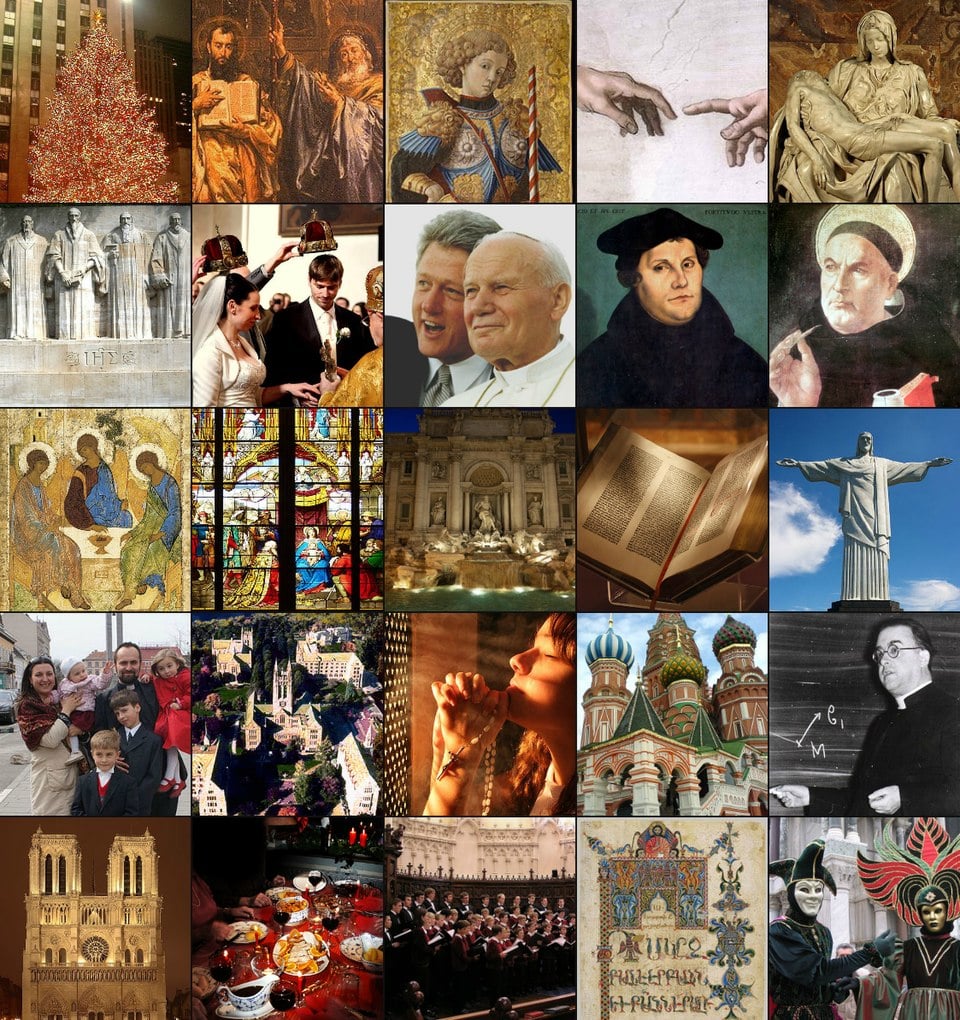
Illustration: Collage Christian Culture by User:jobas – self-made fromOther photosThe lecturing priest is scientific Georges Lemaître, CC BY-SA 3.0, https://commons.wikimedia.org/w/index.php?curid=31465391

Previous Post

May 6, 2025
The Conclave to Elect a New Pope
Next Post

May 8, 2025 Surprises from a Huge Study on Human Flourishing
Recent Comments
"While she worked for Trump she was a tool's tool!"
"I know wired earbuds are making a comeback (I never stopped using them as I ..."
"VCRs, tape decks, and cassette players are all having a revival among a segment of ..."
"As a (retired) lawyer I see potential liability from sharing things like power or sharp ..."
Browse Our Archives
Select a Category America Apologetics Art baseball Bible Blog Christ Church crime Culture Economics Education Ethics Family Food Football Government History Holidays Holy Week Humor International Islam Language Law Life Issues Literature Media Medicine Movies Music Nature News Personal Philosophy Politics psychology Reformation Religions Sacraments Science sex Social Science Sports technology television terrorism Theology Uncategorized Vocation war
Select a Month October 2026 September 2026 August 2026 July 2026 June 2026 May 2026 April 2026 March 2026 February 2026 January 2026 December 2025 November 2025 October 2025 September 2025 August 2025 July 2025 June 2025 May 2025 April 2025 March 2025 February 2025 January 2025 December 2024 November 2024 October 2024 September 2024 August 2024 July 2024 June 2024 May 2024 April 2024 March 2024 February 2024 January 2024 December 2023 November 2023 October 2023 September 2023 August 2023 July 2023 June 2023 May 2023 April 2023 March 2023 February 2023 January 2023 December 2022 November 2022 October 2022 September 2022 August 2022 July 2022 June 2022 May 2022 April 2022 March 2022 February 2022 January 2022 December 2021 November 2021 October 2021 September 2021 August 2021 July 2021 June 2021 May 2021 April 2021 March 2021 February 2021 January 2021 December 2020 November 2020 October 2020 September 2020 August 2020 July 2020 June 2020 May 2020 April 2020 March 2020 February 2020 January 2020 December 2019 November 2019 October 2019 September 2019 August 2019 July 2019 June 2019 May 2019 April 2019 March 2019 February 2019 January 2019 December 2018 November 2018 October 2018 September 2018 August 2018 July 2018 June 2018 May 2018 April 2018 March 2018 February 2018 January 2018 December 2017 November 2017 October 2017 September 2017 August 2017 July 2017 June 2017 May 2017 April 2017 March 2017 February 2017 January 2017 December 2016 November 2016 October 2016 September 2016 August 2016 July 2016 June 2016 May 2016 April 2016 March 2016 February 2016 January 2016 December 2015 November 2015 October 2015 September 2015 August 2015 July 2015 June 2015 May 2015 April 2015 March 2015 February 2015 January 2015 December 2014 November 2014 October 2014 September 2014 August 2014 July 2014 June 2014 May 2014 April 2014 March 2014 February 2014 January 2014 December 2013 November 2013 October 2013 September 2013 August 2013 July 2013 June 2013 May 2013 April 2013 March 2013 February 2013 January 2013 December 2012 November 2012 October 2012 September 2012 August 2012 July 2012 June 2012 May 2012 April 2012 March 2012 February 2012 January 2012 December 2011 November 2011 October 2011 September 2011 August 2011 July 2011 June 2011 May 2011 April 2011 March 2011 February 2011 January 2011 December 2010 November 2010 October 2010 September 2010 August 2010 July 2010 June 2010 May 2010 April 2010 March 2010 February 2010 January 2010 December 2009 November 2009 October 2009 September 2009 August 2009 July 2009 June 2009 May 2009 April 2009 March 2009 February 2009 January 2009 December 2008 November 2008 October 2008 September 2008 August 2008 July 2008 June 2008 May 2008 April 2008 March 2008 February 2008 January 2008 December 2007 November 2007 October 2007
Follow Us!
TAKE THE
Religious Wisdom Quiz
Who did Joseph eventually forgive and provide for in Egypt?
Select your answer to see how you score.
His captors Potiphar Pharaoh His brothers
Books by This Author Books by Gene Veith
Related posts from Cranach



Our New Book on Technology & Vocation

Gen Z Wants Evildoers to Be Punished, Not...
TRENDING AT PATHEOS Evangelical

Letters on Living the Faith by C.S. Lewis
Most of us met C.S. Lewis as a public intellectual. Mere Christianity....

When Halloween Unmasks Married Hearts
Written by Dr. David K. Ewen from Eternal Truth Bible College Behind...

Aristotle. He’s been called the father of logic, the father of the...

Methodist Central Hall and Westminster Abbey
Situated on the same square is Methodist Central Hall and Westminster Abbey. ...

57th Dove Awards Honor Dolly Parton, Crown New...
On gospel music’s biggest night, the 57th annual GMA Dove Awards honored...

The First Eucharistic Controversy: Christ’s Real Presence
For Catholics, the Eucharist is the source and summit of the Christian...
view all Evangelical blogs
What Are Your Thoughts?leave a comment
Ad-Free & Subscriber Log-In Subscription Support
- About Us
- 2026 Calendar
- Videos
- Podcasts
- Library of World Religions
- Faith In Media Tracker
- Advertise With Us
- Write for Us
- Privacy Policy
- Terms of Service
- Do Not Sell My Data
- Contact Us
- Radiant Digital
- Manage Newsletter Subscriptions
- Unsubscribe From Notifications
- Sitemap
Copyright 2008-2026, Patheos. All rights reserved.
Subscription Support Ad-Free & Subscriber Log-In
Follow Patheos