
BuddhistCatholicContemplativeEvangelicalGeneral ChristianHinduJewishLatter-day SaintMuslimNew VisionsProgressive Christian
Beliefs
- Buddhist
- Catholic
- Contemplative
- Evangelical
- General Christian
- Hindu
- Jewish
- Latter-day Saint
- More Voices
- Muslim
- New Visions
- Pagan
- Progressive Christian
Topics
- Religion News
- Food and Religion
- Sports and Religion
- Religious Art
- Religious Music and Entertainment
- Religious Events
- History and Religion
- Style and Religion
- Politics and Religion
- Women in Religion
- Recreation Outdoors and Religion
- Business Finance and Religion
- Careers Workplace and Religion
- Education and Religion
- Family Parenting and Religion
- Health Fitness and Religion
- Home and Religion
- Relationships and Religion
- Technology and Religion
- Travel and Religion
Columnists
- Buddhist Columnists
- Business Finance and Religion Columnists
- Careers Workplace and Religion Columnists
- Catholic Columnists
- Contemplative Columnists
- Education and Religion Columnists
- Evangelists Columnists
- Family Parenting and Religion Columnists
- General Christian Columnists
- Health Fitness and Religion Columnists
- Hindu Columnists
- History and Religion Columnists
- Home and Religion Columnists
- Jewish Columnists
- More Voices Columnists
- Latter Day Columnists
- Muslim Columnists
- New Visions Columnists
- Nonreligious Columnists
- Pagan Columnists
- Politics and Religion Columnists
- Progressive Columnists
- Recreation Outdoors and Religion Columnists
- Relationships and Religion Columnists
- Religion News Columnists
- Religious Art Columnists
- Religious Events Columnists
- Religious Music and Entertainment Columnists
- Sports and Religion Columnists
- Style and Religion Columnists
- Technology and Religion Columnists
- Travel and Religion Columnists
- Women in Religion Columnists
Resource Library
- 2026 Calendar
- Library of World Religions
- The 100 Most Holy Places on Earth
- Patheos Answers
- Podcasts
- Videos
- Faith Leaders Database
- Anglican Episcopalian
- Bahai
- Baptist
- Buddhism
- Christianity
- Confucianism
- Eastern Orthodoxy
- Hinduism
- Holiness and Pentecostal
- ISKCON
- Islam
- Judaism
- Lutheran
- Methodist
- The Church of Jesus Christ of Latter-day Saints
- New Age
- Paganism
- Presbytarian and Reformed
- Protestantism
- Religion Behind the Scenes
- Roman Catholic
- Scientology
- Shia Islam
- Sikhism
- Sufism
- Sunni Islam
- Taoism
- Zen
- See all religions
Research Tools
 Ad-Free & Subscriber Log-In Subscription Support
Ad-Free & Subscriber Log-In Subscription Support
Follow Patheos 

- Trending:
- Forgiveness
- |
- Marriage
- |
- Consciousness
- |
- Death Penalty
- |
- Election
- |
- Halloween

- Home
- Evangelical
- Politics and Religion
- The “Vast and Spacious Things” at Gethsemane
The “Vast and Spacious Things” at Gethsemane
Last updated on: April 17, 2025 at 6:00 am by Gene Veith
The “Vast and Spacious Things” at Gethsemane 2025-04-13T16:21:32-04:00 Gene Veith
Patheos Explore the world's faith through different perspectives on religion and spirituality! Patheos has the views of the prevalent religions and spiritualities of the world.
I owe a lot to George Herbert (1593-1633). He was an Anglican priest, back when the Church of England was still under the influence of the Reformation, who is recognized as one of the greatest poets in the English language. He is also one of the greatest Christian religious poets in any language who deserves to be far better known among today’s Christians than he is.
I wrote my dissertation on Herbert. At the time, most scholarship about his poetry tried to relate him to medieval Catholic models, but I saw him, for all of his liturgical and sacramental imagery, as a poet of the Reformation. Researching that topic led me to read Luther for the first time, exposing me to the great theme in both Luther and Herbert of justification by grace through faith in the atoning work of Christ. I was greatly intrigued by both writers’ evangelical sacramentalism.
So I’m indebted to Herbert for my Ph.D. That dissertation was published and became my first book, Reformation Spirituality: The Religion of George Herbert. That boosted my career as a literary scholar, with my views on Herbert’s Protestantism now being generally accepted in the field. So thanks, George, for that. Publishing that book led me to more writing about Christianity and literature, which led me to writing about Christianity and the arts, which led me to writing about Christianity and culture. . . .So George Herbert is also responsible for my becoming a Christian author myself.
Above all, I’m indebted to George Herbert for getting me, as well as my wife (who typed my dissertation, this being before word processing computers were invented) started on the road to Lutheranism. When I got my first academic job after grad school, we visited a small town LCMS congregation, where what was taught was pretty much what we had been studying in Herbert! We took the adult instruction class and became Lutherans.
Every Maundy Thursday, I return to my favorite Herbert poem, “The Agony.” Before you read it, let me set it up for you. It begins by reflecting on how scientists (called “natural philosophers” in his day) measure things: the heights of mountains, the depths of the oceans, and–anticipating quantitative social science by 400 years–the dynamics of societies and politics.
But there are two “vast, spacious things” that would be even more worth measuring, yet few people even try to comprehend their heights and depths: sin and love.
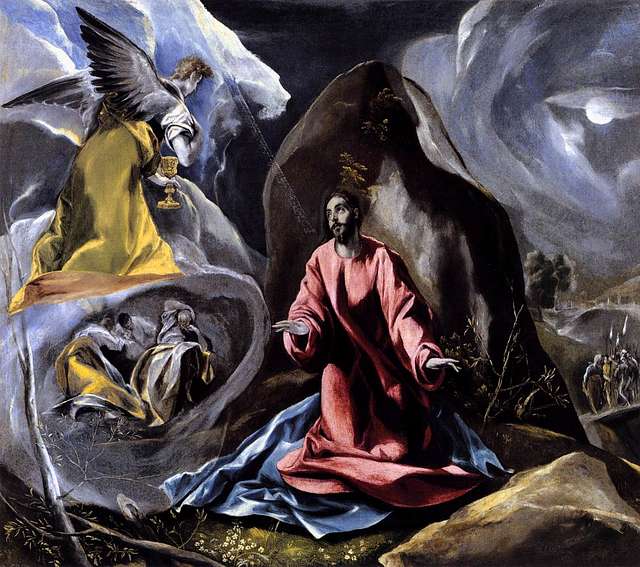
If you want to know the magnitude of sin, says the poet, go to the Mount of Olives, to the Garden of Gethsemane, where you will see a Man sweating blood. Herbert uses the imagery of a man under pressure. Again, Herbert is anticipating by 400 years what has become a common way of describing intense psychological stress.
The word “Gethsemane” means “olive press,” and Herbert uses that imagery to describe the sin of the world that is pressing down on Jesus, like an olive being pressed for its oil, or, picking up on the next stanza and the imagery of blood, like a grape in a winepress. “Sin is that press and vice” [get it? another implement of pressure and also a synonym for sin, Herbert loving puns the way he does], “which forceth pain/ To hunt his cruel food through every vein.”
If you want to know the magnitude of love, also go to the Mount of Olives, and beyond that to the Mount of Calvary where it leads. Herbert describes how the soldier pierced Christ on the cross with a spear (a “pike”) in terms of someone tapping a cask of wine (see the definition of “abroach“). Whereupon the poem ends with a startling and unforgettable sacramental image.
OK, I think you’re ready to read the poem now. . . . (I have modernized some of the spellings.)
‘The Agony’
Philosophers have measured mountains,
Fathomed the depths of seas, of states, and kings,
Walked with a staff to heaven, and traced fountains:But there are two vast, spacious things,
The which to measure it doth more behove:
Yet few there are that sound them: Sin and Love.
Who would know Sin, let him repair
Unto Mount Olivet; there shall he see
A man so wrung with pains, that all his hair,
His skin, his garments bloody be.
Sin is that press and vice, which forceth pain
To hunt his cruel food through every vein.
Who knows not Love, let him assay
And taste that juice, which on the cross a pike
Did set again abroach; then let him say
If ever he did taste the like.
Love is that liquor sweet and most divine,
Which my God feels as blood; but I, as wine.
Love is the blood that Christ pours out for us on the cross! Christ bleeds in agony, and yet when we receive His blood, His love, to us it is “sweet and most divine.” Indeed, this collision of sin and love–our sin and Christ’s love–manifests itself tangibly every time we receive Holy Communion. What “my God feels as blood”–the spiritual agony of Gethsemane, the physical agony of the cross–we experience, we “taste,” as sweet, sweet wine.
Our sin: Christ’s love. Christ’s suffering: our salvation. This is the atonement. This is the Gospel.
When you take Communion–on Easter as the climax of Lent and every other time–receiving Christ’s body that was broken for you on the cross and His blood poured out for the remission of all of your sins, think of these lines:
Love is that liquor sweet and most divine,
Which my God feels as blood; but I, as wine.
Illustration: The Agony in the Garden by El Greco via Picryl, Public Domain
Previous Post
April 16, 2025
A Stunning Text on Vocation from the Apocrypha
Next Post

April 18, 2025 DISCUSS: The Death of God
Recent Comments
"So Katie Zacharia lasted only a deciScaramucci as press secretary......"
"Apropos to the post on Gen Z a couple days ago: "If you want the ..."
"“Don't eat with your hands, son, use your entrenching tool.”"
"You serious, Clark?"
Browse Our Archives
Select a Category America Apologetics Art baseball Bible Blog Christ Church crime Culture Economics Education Ethics Family Food Football Government History Holidays Holy Week Humor International Islam Language Law Life Issues Literature Media Medicine Movies Music Nature News Personal Philosophy Politics psychology Reformation Religions Sacraments Science sex Social Science Sports technology television terrorism Theology Uncategorized Vocation war
Select a Month October 2026 September 2026 August 2026 July 2026 June 2026 May 2026 April 2026 March 2026 February 2026 January 2026 December 2025 November 2025 October 2025 September 2025 August 2025 July 2025 June 2025 May 2025 April 2025 March 2025 February 2025 January 2025 December 2024 November 2024 October 2024 September 2024 August 2024 July 2024 June 2024 May 2024 April 2024 March 2024 February 2024 January 2024 December 2023 November 2023 October 2023 September 2023 August 2023 July 2023 June 2023 May 2023 April 2023 March 2023 February 2023 January 2023 December 2022 November 2022 October 2022 September 2022 August 2022 July 2022 June 2022 May 2022 April 2022 March 2022 February 2022 January 2022 December 2021 November 2021 October 2021 September 2021 August 2021 July 2021 June 2021 May 2021 April 2021 March 2021 February 2021 January 2021 December 2020 November 2020 October 2020 September 2020 August 2020 July 2020 June 2020 May 2020 April 2020 March 2020 February 2020 January 2020 December 2019 November 2019 October 2019 September 2019 August 2019 July 2019 June 2019 May 2019 April 2019 March 2019 February 2019 January 2019 December 2018 November 2018 October 2018 September 2018 August 2018 July 2018 June 2018 May 2018 April 2018 March 2018 February 2018 January 2018 December 2017 November 2017 October 2017 September 2017 August 2017 July 2017 June 2017 May 2017 April 2017 March 2017 February 2017 January 2017 December 2016 November 2016 October 2016 September 2016 August 2016 July 2016 June 2016 May 2016 April 2016 March 2016 February 2016 January 2016 December 2015 November 2015 October 2015 September 2015 August 2015 July 2015 June 2015 May 2015 April 2015 March 2015 February 2015 January 2015 December 2014 November 2014 October 2014 September 2014 August 2014 July 2014 June 2014 May 2014 April 2014 March 2014 February 2014 January 2014 December 2013 November 2013 October 2013 September 2013 August 2013 July 2013 June 2013 May 2013 April 2013 March 2013 February 2013 January 2013 December 2012 November 2012 October 2012 September 2012 August 2012 July 2012 June 2012 May 2012 April 2012 March 2012 February 2012 January 2012 December 2011 November 2011 October 2011 September 2011 August 2011 July 2011 June 2011 May 2011 April 2011 March 2011 February 2011 January 2011 December 2010 November 2010 October 2010 September 2010 August 2010 July 2010 June 2010 May 2010 April 2010 March 2010 February 2010 January 2010 December 2009 November 2009 October 2009 September 2009 August 2009 July 2009 June 2009 May 2009 April 2009 March 2009 February 2009 January 2009 December 2008 November 2008 October 2008 September 2008 August 2008 July 2008 June 2008 May 2008 April 2008 March 2008 February 2008 January 2008 December 2007 November 2007 October 2007
Follow Us!
TAKE THE
Religious Wisdom Quiz
What does James say is the implanted word able to do?
Select your answer to see how you score.
Heal your body Defeat your enemies Judge the nations Save your souls
Books by This Author Books by Gene Veith
Related posts from Cranach


Our New Book on Technology & Vocation

Gen Z Wants Evildoers to Be Punished, Not...

Why AI Bots Don't Really Have Emotions
TRENDING AT PATHEOS Evangelical

Swimfan: Forgotten Aughts Pleasures
This is a recovery effort. In 2002, My Big Fat Greek Wedding...

Top Three Anti-Catholic Lies About Catholicism
This is my initial transcript for the video, "THE 3 WORST...

Pope Leo Celebrates Mass for Nurses & Docs...
I don't have any idea how he did it, but Pope Leo...

The Sermon on the Mount, Part I: Matthew...
The Sermon on the Mount, Part I (Matthew 4:12-5:12) St. Matthew moves...

What's up from Crossway: Reviewing some of their latest A few weeks...

Janie Learns the Way of the Cross: A...
Teaching children about Jesus' Passion can be challenging. Many parents and educators...
view all Evangelical blogs
What Are Your Thoughts?leave a comment
Ad-Free & Subscriber Log-In Subscription Support
- About Us
- 2026 Calendar
- Videos
- Podcasts
- Library of World Religions
- Faith In Media Tracker
- Advertise With Us
- Write for Us
- Privacy Policy
- Terms of Service
- Do Not Sell My Data
- Contact Us
- Radiant Digital
- Manage Newsletter Subscriptions
- Unsubscribe From Notifications
- Sitemap
Copyright 2008-2026, Patheos. All rights reserved.
Subscription Support Ad-Free & Subscriber Log-In
Follow Patheos