
BuddhistCatholicContemplativeEvangelicalGeneral ChristianHinduJewishLatter-day SaintMuslimNew VisionsProgressive Christian
Beliefs
- Buddhist
- Catholic
- Contemplative
- Evangelical
- General Christian
- Hindu
- Jewish
- Latter-day Saint
- More Voices
- Muslim
- New Visions
- Pagan
- Progressive Christian
Topics
- Religion News
- Food and Religion
- Sports and Religion
- Religious Art
- Religious Music and Entertainment
- Religious Events
- History and Religion
- Style and Religion
- Politics and Religion
- Women in Religion
- Recreation Outdoors and Religion
- Business Finance and Religion
- Careers Workplace and Religion
- Education and Religion
- Family Parenting and Religion
- Health Fitness and Religion
- Home and Religion
- Relationships and Religion
- Technology and Religion
- Travel and Religion
Columnists
- Buddhist Columnists
- Business Finance and Religion Columnists
- Careers Workplace and Religion Columnists
- Catholic Columnists
- Contemplative Columnists
- Education and Religion Columnists
- Evangelists Columnists
- Family Parenting and Religion Columnists
- General Christian Columnists
- Health Fitness and Religion Columnists
- Hindu Columnists
- History and Religion Columnists
- Home and Religion Columnists
- Jewish Columnists
- More Voices Columnists
- Latter Day Columnists
- Muslim Columnists
- New Visions Columnists
- Nonreligious Columnists
- Pagan Columnists
- Politics and Religion Columnists
- Progressive Columnists
- Recreation Outdoors and Religion Columnists
- Relationships and Religion Columnists
- Religion News Columnists
- Religious Art Columnists
- Religious Events Columnists
- Religious Music and Entertainment Columnists
- Sports and Religion Columnists
- Style and Religion Columnists
- Technology and Religion Columnists
- Travel and Religion Columnists
- Women in Religion Columnists
Resource Library
- 2026 Calendar
- Library of World Religions
- The 100 Most Holy Places on Earth
- Patheos Answers
- Podcasts
- Videos
- Faith Leaders Database
- Anglican Episcopalian
- Bahai
- Baptist
- Buddhism
- Christianity
- Confucianism
- Eastern Orthodoxy
- Hinduism
- Holiness and Pentecostal
- ISKCON
- Islam
- Judaism
- Lutheran
- Methodist
- The Church of Jesus Christ of Latter-day Saints
- New Age
- Paganism
- Presbytarian and Reformed
- Protestantism
- Religion Behind the Scenes
- Roman Catholic
- Scientology
- Shia Islam
- Sikhism
- Sufism
- Sunni Islam
- Taoism
- Zen
- See all religions
Research Tools
 Ad-Free & Subscriber Log-In Subscription Support
Follow Patheos 

- Trending:
- Advent
- |
- Forgiveness
- |
- Thanksgiving
- |
- Election
- |
- Seasonal Holidays
- |
- Marriage

- Home
- Evangelical
- Politics and Religion
- How an LCMS Tech Titan Lost His Faith & Is Getting It Back
How an LCMS Tech Titan Lost His Faith & Is Getting It Back
Last updated on: March 5, 2025 at 7:58 am by Gene Veith
How an LCMS Tech Titan Lost His Faith & Is Getting It Back 2025-03-05T07:58:04-05:00 Gene Veith
Patheos Explore the world's faith through different perspectives on religion and spirituality! Patheos has the views of the prevalent religions and spiritualities of the world.

We’ve written about Christianity breaking out in the tech world. One of the new converts is Larry Sanger, the co-founder of Wikipedia (which he now criticizes). It turns out, like Apple founder Steve Jobs, he grew up in the Lutheran Church Missouri Synod.
He tells his story of “why I was not a Christian and why I am one now” in a post at his website entitled How a Skeptical Philosopher Becomes a Christian. Every pastor, especially every Lutheran pastor, should read it. (Towards that end, I am taking down the paywall and making this a free post.)
Sanger had an impeccable LCMS background:
My parents met and married in the Lutheran Church, Missouri Synod, the more conservative of the two largest Lutheran denominations in the United States. One of my great-grandparents was a professor of musicology and church organist; we still have his books. My father was an elder in our church when I was a small child. I remember a few Bible commentaries on the bookshelves, which I found forbiddingly difficult. . . .I was confirmed at age 12 in the Lutheran Church, but soon after, my family stopped going to church.
His family seems to have gone through its own period of falling away but later returning to faith. As for young Larry, he said that he had always been a kid who asked “too many questions.” After a high school philosophy class and his own musings, he felt his faith “slipping away.” So he went for a talk with his pastor:
At some point in my late teens, I remember calling up a pastor—I forget which—to ask skeptical questions. It felt bold for a teenager to do, but I was not merely being rebellious. I really needed help thinking these things through. But the pastor had no clear or strong answers. He seemed to be brushing me off and even to treat me with contempt. It seemed to me he did not care, and if anything, I had the impression that he felt threatened by me. This was a surprise. The damage was quickly done: being met with hostile unconcern by a person I expected to be, well, pastoral confirmed me in my disbelief.
This is similar to what happened with Steve Jobs! As a teenager, full of questions about the problem of evil, he went to his pastor, who blew him off with condescension and a refusal to take his questions seriously. The same thing happened with a friend of mine, a precocious teenager going to her pastor with questions, only to get belittled.
They all three left their Lutheran church and their faith. Jobs went on to become a Buddhist. My friend is not a tech titan, but she is a precious soul, whom God brought back to Himself, as he did Sanger. (More on how pastors should approach teenagers with questions on Thursday.)
Sanger tells about how, in search of answers, he turned to philosophy, to the point of earning a Ph.D. in the subject. He became what he calls a “methodological skeptic,” resolving not to believe anything unless he could be certain about it on rationalistic grounds.
He didn’t oppose religion as such. He saw its benefits. Some of his favorite people were Christians. He found the New Atheists to be obnoxious, refusing to take religion seriously, which he was willing to do. He was a nonbeliever, but he considered himself an agnostic, thinking that it was impossible to know with certainty whether God exists or not.
He found the arguments of Intelligent Design strangely plausible, particularly the notion of the fine tuning of the universe. He had always found the classic proofs of the existence of God unpersuasive. If they proved there had to be a “necessary being,” or a designer, or a first cause, or a source of morality, that does not necessarily prove there to be a God, much less the personal God of the Bible. But then Sanger realized that the individual proofs taken together suggest a multi-faceted God (necessary to existence, a creator, moral) that is, in fact, close to the Biblical God. (There is much more to his intellectual journey towards belief, including a fascinating and quite original thought experiment about Artificial Intelligence. Read his post for the whole story.)
Meanwhile, his life–specifically, his marriage and the birth of his children–made him recognize the reality of the moral order. He felt willing to sacrifice himself for his family, which made him reject the “virtue of selfishness” that he had picked up from Ayn Rand.
But what had the strongest impact was his reading of the Bible. He plunged into that project, with the help of annotations and commentaries:
When I really sought to understand it, I found the Bible far more interesting and—to my shock and consternation—coherent than I was expecting. I looked up answers to all my critical questions, thinking that perhaps others had not thought of issues I saw. I was wrong. Not only had they thought of all the issues, and more that I had not thought of, they had well-worked-out positions about them. I did not believe their answers, which sometimes struck me as contrived or unlikely. But often, they were shockingly plausible. The Bible could sustain interrogation; who knew? It slowly dawned on me that I was acquainting myself with the two-thousand-year-old tradition of theology. I found myself positively ashamed to realize that, despite having a Ph.D. in philosophy, I had never really understood what theology even is. Theology is, I found, an attempt to systematize, harmonize, explicate, and to a certain extent justify the many, many ideas contained in the Bible. It is what rational people do when they try to come to grips with the Bible in all its richness. The notion that the Bible might actually be able to interestingly and plausibly sustain such treatment is a proposition that had never entered my head.
Reading the Bible “obsessively,” Sanger began to understand the necessity of revelation and he began to recognize the overarching themes of the Bible: righteousness, sin, the fall, sacrifice, the promise of a savior, the Incarnation, Christ’s death and resurrection, salvation.
There was a moment, soon after I started reading the Gospels (toward the end of February, 2020), when I said I should admit to myself that I now believe in God, and pray to God properly. I did so, silently and eyes closed, lying in bed. I’m not saying this is what I should have done, but it is what I did. It was anti-climactic. I never had a mind-blowing conversion experience. I approached faith in God slowly and reluctantly—with great interest, yes, but filled with confusion and consternation.
In his post, Sanger concludes with a statement of his faith, his own credo. He believes in the Trinity, the deity of Christ, His death for sinners, His resurrection, and pretty much every tenet of orthodox Protestantism. He even affirms the inerrancy of Scripture. (Again, read it yourself.)
Where is he now, in his newly-found Christian faith? He needs a church. He is part of a lively Bible study that fills part of his need for fellowship with other Christians, but he is aware that he should be going to an actual church.
He hesitates because he doesn’t want to join a congregation only to leave it if he arrives at some belief that goes against his church. He doesn’t want conflict with the pastor. He is studying all the different denominations, but his own convictions right now are in flux.
As for the Lutheran Church Missouri Synod, that remains an option. He writes,
I might consider going back to my childhood church, the Lutheran Church—Missouri Synod, but I’m fairly sure I’d need to go on disagreeing with them about the meaning of the communion. That seems possible. (I doubt the meaning of the communion need keep me out of the LCMS.) But I wouldn’t want to start debating the pastor about that; I’d better make sure I’m on board.
Well, yes, rejecting the meaning of communion would keep you out of the LCMS. That Jesus gives us His body and blood in the Sacrament is the beating heart of Lutheran spirituality.
Sanger goes more into his difficulty with Lutheranism in a follow-up post to his long “testimony” entitled A Response to My New Brothers and Sisters. He describes what he likes about the various church traditions and what he has trouble with in each one.
He firmly rejects Roman Catholicism because they don’t accept “sola fide” and “sola scriptura.” He likes Orthodoxy more, but that would still violate his belief in the solas. (I wonder where he picked up the importance of those Latin phrases!)
Anglicanism, of the conservative ACNA variety, is a possibility, but he worries about Anglo-Catholicism. The Wesleyan tradition would give him doctrinal latitude, but he is leery about its tendency towards liberalism. Baptist? But he rejects dispensationalism. Pentecostalism? He is not an emotional kind of guy. It would seem like one of the many non-denominational churches would ideal for him, but he doesn’t care for contemporary worship music. He does like conservative Presbyterianism, except for the Calvinism. (I wonder where he picked up each and every one of these criticisms?)
Ditto, conservative Lutheranism: I like it quite a bit, except for the thing that is maybe the most distinctive thing about it among American Protestants, namely, sacramentalism. (This is the view that baptism and communion are “means of grace,” and required, for most believers, for salvation.) I would like to think that quibbles on this issue do not matter that much, as I said earlier; but I am apprised that Lutherans would disagree that they are quibbles. I know that they distinguish their view from Catholic sacramentalism, rejecting the idea of ex opere operato (grace imparted by the act alone). I do think the ordinances of baptism and communion can be nearly as strong as you like, even if I am breaking one of these, in that case, for now. But I am not convinced that they are required for salvation, according to Scripture. This is highly debatable; there are strong “proof texts” on both sides. (Have fun comparing John 3:5, Mark 16:16, and Acts 2:38 with Luke 23:43, Ephesians 2:8-9, and 1 Corinthians 1:17.) I’m also chary about the “real presence” of the body and blood of Christ in the Lord’s Supper; I am inclined to think of these as deeply important symbols we use to remember his sacrifice for us.
Well, I’d like to ask him, is the Bible necessary for salvation? The answer is surely no and yes. Strictly speaking, all that is necessary for salvation is faith in “Jesus Christ and him crucified” (1 Corinthians 2:2). The Word of God is what communicates this good news, this gospel, to us, and is the means by which the Holy Spirit kindles faith in our hearts. So, yes, the Word is necessary to convey this salvation. Baptism and the Lord’s Supper convey this same gospel. They do so only because the water and bread and wine are connected to the Word. (Dust off your catechism, Larry!) They are only necessary in the sense that we need them to build up our faith, just as we need to continually read and hear God’s Word (as you are commendably doing), for the same reason.
As for the Real Presence of Christ in the bread and wine, don’t let your rationalism keep you from mystery. We are tangible, embodied human beings–not just abstract intellects–so we should not be surprised that Christ comes to us in a tangible, embodied way. Why wouldn’t He?
You express some concern that you lack religious experience. And that you lack enough contrition for your sin. When you receive the Lord’s Supper, believing sheerly through faith alone rather than your intellectual understanding (sola fide), that Jesus Christ is actually there, giving His broken body “for you,” giving His atoning blood “for the remission of all your sins,” the experience is as real as eating and drinking.
My impulse is to recommend my book Spirituality of the Cross: The Way of the First Evangelicals for a sense of Lutheran Christianity as a whole. And, since you have been catechized and confirmed, my book Embracing Your Lutheran Identity. And for the Real Presence, Hermann Sasse’s This Is My Body.
But, as I’ve discovered in my own pilgrimage, books are not enough. What you really need to do is try, once again, to talk with a Lutheran pastor.
OK. . . About that. . . .
Tomorrow is Ash Wednesday, so I’ll be posting about Lent. On Thursday I want to have a heart-to-heart discussion with pastors based on the unfortunate experiences of Larry Sanger, Steve Jobs, and my friend.
Photo: Larry Sanger., CC BY-SA 2.0 <https://creativecommons.org/licenses/by-sa/2.0>, via Wikimedia Commons

Christianity in Silicon Valley
Lutheran Church Missouri Synod
Previous Post

March 3, 2025
Monday Miscellany, 3/3/25
Next Post

March 5, 2025 Lenten Sermons That Stopped the Chaos
Recent Comments
"Wright certainly agrees with 1another that Jesus reigns now, and that His kingdom is already ..."
Belief and Disbelief in Christ’s Presence ..."
"I'm parking this note here for later reference. Apropos to 1another's frequent discussion of the ..."
Belief and Disbelief in Christ’s Presence ..."
"I'll add my voice to others here regarding gratitude. Grace is a faithful categorization of ..."
Gratitude as the Parent of All ..."
"What this study requires is letting Ryan Burge loose on the data. I checked and ..."
Belief and Disbelief in Christ’s Presence ..."
Browse Our Archives
Select a Category America Apologetics Art baseball Bible Blog Christ Church crime Culture Economics Education Ethics Family Food Football Government History Holidays Holy Week Humor International Islam Language Law Life Issues Literature Media Medicine Movies Music Nature News Personal Philosophy Politics psychology Reformation Religions Sacraments Science sex Social Science Sports technology television terrorism Theology Uncategorized Vocation war
Select a Month November 2026 October 2026 September 2026 August 2026 July 2026 June 2026 May 2026 April 2026 March 2026 February 2026 January 2026 December 2025 November 2025 October 2025 September 2025 August 2025 July 2025 June 2025 May 2025 April 2025 March 2025 February 2025 January 2025 December 2024 November 2024 October 2024 September 2024 August 2024 July 2024 June 2024 May 2024 April 2024 March 2024 February 2024 January 2024 December 2023 November 2023 October 2023 September 2023 August 2023 July 2023 June 2023 May 2023 April 2023 March 2023 February 2023 January 2023 December 2022 November 2022 October 2022 September 2022 August 2022 July 2022 June 2022 May 2022 April 2022 March 2022 February 2022 January 2022 December 2021 November 2021 October 2021 September 2021 August 2021 July 2021 June 2021 May 2021 April 2021 March 2021 February 2021 January 2021 December 2020 November 2020 October 2020 September 2020 August 2020 July 2020 June 2020 May 2020 April 2020 March 2020 February 2020 January 2020 December 2019 November 2019 October 2019 September 2019 August 2019 July 2019 June 2019 May 2019 April 2019 March 2019 February 2019 January 2019 December 2018 November 2018 October 2018 September 2018 August 2018 July 2018 June 2018 May 2018 April 2018 March 2018 February 2018 January 2018 December 2017 November 2017 October 2017 September 2017 August 2017 July 2017 June 2017 May 2017 April 2017 March 2017 February 2017 January 2017 December 2016 November 2016 October 2016 September 2016 August 2016 July 2016 June 2016 May 2016 April 2016 March 2016 February 2016 January 2016 December 2015 November 2015 October 2015 September 2015 August 2015 July 2015 June 2015 May 2015 April 2015 March 2015 February 2015 January 2015 December 2014 November 2014 October 2014 September 2014 August 2014 July 2014 June 2014 May 2014 April 2014 March 2014 February 2014 January 2014 December 2013 November 2013 October 2013 September 2013 August 2013 July 2013 June 2013 May 2013 April 2013 March 2013 February 2013 January 2013 December 2012 November 2012 October 2012 September 2012 August 2012 July 2012 June 2012 May 2012 April 2012 March 2012 February 2012 January 2012 December 2011 November 2011 October 2011 September 2011 August 2011 July 2011 June 2011 May 2011 April 2011 March 2011 February 2011 January 2011 December 2010 November 2010 October 2010 September 2010 August 2010 July 2010 June 2010 May 2010 April 2010 March 2010 February 2010 January 2010 December 2009 November 2009 October 2009 September 2009 August 2009 July 2009 June 2009 May 2009 April 2009 March 2009 February 2009 January 2009 December 2008 November 2008 October 2008 September 2008 August 2008 July 2008 June 2008 May 2008 April 2008 March 2008 February 2008 January 2008 December 2007 November 2007 October 2007
Give A Subscription
Follow Us!
TAKE THE
Religious Wisdom Quiz
In Revelation, how many elders sit on thrones around God's throne?
Select your answer to see how you score.
Seven Seventy Twelve Twenty-four
Books by This Author Books by Gene Veith
Related posts from Cranach

God and the Contingency of This World
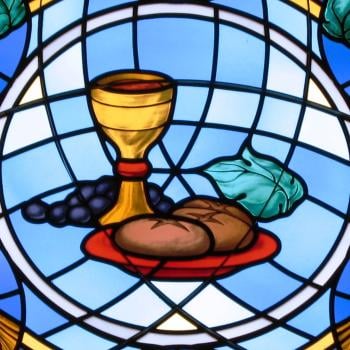
Belief and Disbelief in Christ's Presence in Holy...


The Contingency of Our Technology
TRENDING AT PATHEOS Evangelical

As was predicted many years ago, the Interpreter Foundation's website is...

"Why Do Churches Talk So Much About Money?"
If you were inclined to do so, you could probably find any...

Watch and Pray: On Mark 13:33-37
Jesus said to his disciples: “Be watchful! Be alert! You do not...

Debate on Purgatory & Biblical Evidences for It
This is from a combox on my video channel, Catholic Bible Highlights....

Set the table for the coming King
On Thursday we visited my sister-in-law for Thanksgiving, and throughout the entire...

If I Stop Becoming, Will I Disappear?
(At our most recent half day Zen retreat, Dr Chris Hoff, a...
view all Evangelical blogs
What Are Your Thoughts?leave a comment
Ad-Free & Subscriber Log-In Subscription Support
- About Us
- 2026 Calendar
- Videos
- Podcasts
- Library of World Religions
- Faith In Media Tracker
- Advertise With Us
- Write for Us
- Privacy Policy
- Terms of Service
- Do Not Sell My Data
- Contact Us
- Radiant Digital
- Manage Newsletter Subscriptions
- Unsubscribe From Notifications
- Sitemap
Copyright 2008-2026, Patheos, part of the Radiant Digital network of media brands. All rights reserved.
Subscription Support Ad-Free & Subscriber Log-In
Follow Patheos