
BuddhistCatholicContemplativeEvangelicalGeneral ChristianHinduJewishLatter-day SaintMuslimNew VisionsProgressive Christian
Beliefs
- Buddhist
- Catholic
- Contemplative
- Evangelical
- General Christian
- Hindu
- Jewish
- Latter-day Saint
- More Voices
- Muslim
- New Visions
- Pagan
- Progressive Christian
Topics
- Religion News
- Food and Religion
- Sports and Religion
- Religious Art
- Religious Music and Entertainment
- Religious Events
- History and Religion
- Style and Religion
- Politics and Religion
- Women in Religion
- Recreation Outdoors and Religion
- Business Finance and Religion
- Careers Workplace and Religion
- Education and Religion
- Family Parenting and Religion
- Health Fitness and Religion
- Home and Religion
- Relationships and Religion
- Technology and Religion
- Travel and Religion
Columnists
- Buddhist Columnists
- Business Finance and Religion Columnists
- Careers Workplace and Religion Columnists
- Catholic Columnists
- Contemplative Columnists
- Education and Religion Columnists
- Evangelists Columnists
- Family Parenting and Religion Columnists
- General Christian Columnists
- Health Fitness and Religion Columnists
- Hindu Columnists
- History and Religion Columnists
- Home and Religion Columnists
- Jewish Columnists
- More Voices Columnists
- Latter Day Columnists
- Muslim Columnists
- New Visions Columnists
- Nonreligious Columnists
- Pagan Columnists
- Politics and Religion Columnists
- Progressive Columnists
- Recreation Outdoors and Religion Columnists
- Relationships and Religion Columnists
- Religion News Columnists
- Religious Art Columnists
- Religious Events Columnists
- Religious Music and Entertainment Columnists
- Sports and Religion Columnists
- Style and Religion Columnists
- Technology and Religion Columnists
- Travel and Religion Columnists
- Women in Religion Columnists
Resource Library
- 2026 Calendar
- Library of World Religions
- The 100 Most Holy Places on Earth
- Patheos Answers
- Podcasts
- Videos
- Faith Leaders Database
- Anglican Episcopalian
- Bahai
- Baptist
- Buddhism
- Christianity
- Confucianism
- Eastern Orthodoxy
- Hinduism
- Holiness and Pentecostal
- ISKCON
- Islam
- Judaism
- Lutheran
- Methodist
- The Church of Jesus Christ of Latter-day Saints
- New Age
- Paganism
- Presbytarian and Reformed
- Protestantism
- Religion Behind the Scenes
- Roman Catholic
- Scientology
- Shia Islam
- Sikhism
- Sufism
- Sunni Islam
- Taoism
- Zen
- See all religions
Research Tools
 Ad-Free & Subscriber Log-In Subscription Support
Ad-Free & Subscriber Log-In Subscription Support
Follow Patheos 

- Trending:
- Forgiveness
- |
- Marriage
- |
- Consciousness
- |
- Death Penalty
- |
- Election
- |
- Halloween

- Home
- Evangelical
- Politics and Religion
- The Four Strands of America’s Christian Revival
The Four Strands of America’s Christian Revival
Last updated on: February 21, 2025 at 6:00 am by Gene Veith
The Four Strands of America’s Christian Revival 2025-02-17T17:17:26-05:00 Gene Veith
Patheos Explore the world's faith through different perspectives on religion and spirituality! Patheos has the views of the prevalent religions and spiritualities of the world.
Spencer Klavan is the author of Light of the Mind, Light of the World: Illuminating Science Through Faith, which shows how quantum physics has shaken the materialist worldview and how contemporary science is making theism credible again. It’s one of the three recent books that we discussed that are being hailed as “game changers” in contemporary apologetics.
He has written an essay on his New Jerusalem Substack entitled American Revival: A nation with the soul of many churches. He believes that a revival of Christianity is brewing in the United States, seeing signs such as the new openness to religion among Generation Z men and Silicon Valley technologists, plus the surge in Bible sales and some prominent converts.
He observes that religion is deeply embedded in American culture. He describes four strains of American Christianity that date from colonial times and that have been historically formative. And he expects a Christian revival to emerge along those same four lines.
(1) The Puritans of New England sought a personal piety, moral lifestyles, and social reform. Klavan sees the heirs of the Puritans today to be the Evangelicals, who continue to win converts and exert a political influence.
(2) The Anglicans of the South valued the rites, the ceremonies, and the traditions of the English church. The equivalent today, Klavan says, are the Catholics, who are attracting people today with their “high liturgy and deep traditions.”
(3) The Quakers of Pennsylvania and the Delaware Valley offered a less doctrinal, highly personal, more mystical Christianity. Klavan sees this spiritual mindset manifesting itself in what he calls the “Nearly-Nones,” the spiritual-but-not-religious folks who are still not going to churches but who have started to read the Bible, pray, and talk about Jesus.
(4) The Frontiersmen of the West, whom Klavan describes as “the hardbitten warriors who tamed the backcountry, defiantly independent in their theology as they were in their rough ways of life.” These pioneers typically held intense but highly individualistic religious beliefs, starting new theologies (e.g., the Pentecostals), new church bodies (e.g., the Restoration movement), and even new religions (e.g., the Mormons).
Their modern equivalent? Here is what Klavan says:
Certainly one group of people is growing more comfortable with the Christian label than anyone might have expected a decade ago. There’s an intellectual vanguard—philosophers, critics, artists, tech entrepreneurs—making the high-minded case for belief. The most recent was Larry Sanger, co-founder of Wikipedia, who can’t yet sign up for any particular denomination but who recently described at length his decision that “I should admit to myself that I now believe in God, and pray to God properly.” Before Sanger came Ayaan Hirsi Ali, Matthew Crawford, Peter Thiel. There are enough of them now to be called a movement.
These are surely our frontiersmen. Like the old frontiersmen, they favor adventurous and dramatic theology for their adventurous and dramatic circumstances. They are prone to grand theories about the end times and the clash of civilizations, all of which figures. Those in tech, especially, work at the edge of humanity’s limits in a perilous new age of exploration. They are among those pressing forward into outer space, into the workings of the body and brain, into machine capabilities. Out in that dark wilderness there are rival and even savage faiths, preached by babel-builders who want to kneel before AI superintelligence or hail a rising one-world government. It’s dangerous to ride the high country without a map, and Christianity is a time-tested one, well-known for keeping its followers from dropping into snake pits.
These four are not completely different, Klavan says. They all hold to some common articles “articles of faith—the triune God, the resurrection, the forgiveness of sins—without which Christianity is not Christian.” (It’s interesting that mainline liberal Protestantism, which tries to have Christianity without such articles, doesn’t even show up on Klavan’s religious radar.)
He concludes with C. S. Lewis’s metaphor of Christianity as a building, with “mere Christianity,” what all Christians have in common, being the hallway, off of which are different rooms, the various Christian traditions. Lewis stresses that Christians, who might start in the hallway, must enter one of the rooms: “It is in the rooms, not in the hall, that there are fires and chairs and meals. The hall is a place to wait in, not a place to live in.”
Klavan adds to the metaphor: “The building might need all the rooms—all the passion of the evangelicals, all the ancient solemnity of the Catholics, all the longing of the nearly-nones and wild-eyed mysticism of the pioneers—to stand.”
Sounds like Lutheranism to me! Well, up to a point.
Klavan’s four colonial strands derive from England, of course, as does American culture. Many other peoples with many other religions also became part of America. Such as us Lutherans from northern and eastern Europe. We don’t fit neatly into any of those four categories.
If you bring some of them together, though, we might come closer. Confessional Lutheranism has both the evangelicals’ emphasis on the Gospel and the Bible, plus the “ancient solemnity” associated with the Catholic liturgy and Catholic sacramentalism. Today’s “new theists” attracted to both evangelicalism and Catholicism and trying to decide between them would do well to consider Lutheranism.
Many Christians so torn go the Anglican route, but that’s a via media between the two traditions. Lutherans are very evangelical and very sacramental.
Lutheranism arguably has a higher view of the Gospel (not just as a one-time “decision” but as the continual source of the Christian life) and the Bible (not just as a fact book but as a means of grace). And a higher view of the Sacraments than Catholics (with the “sacramental union” being far more incarnational than transubstantiation, which dismisses the physical elements as mere illusions).
I find Lutheran Christianity very “spiritual,” but not in the open-ended non-doctrinal inwardness of the Quakers and the “nearly-nones.” Lutheran spirituality rests on the objective truths revealed in the Word of God.
I find Lutheran Christianity very emotionally satisfying to me as an individual, but not in the individualistic, go-it-alone, look-for-something-new spirit of the “frontiersmen.” Lutheran Christianity needs a congregation and a pastor, sees itself as continuous with historic Christianity, and has a high view of church.
For me, Lutheranism was what tied the other strands of Christianity–not just these four, but many others–together.
(For more about Lutheranism, see my book Spirituality of the Cross: The Way of the First Evangelicals and, especially for Lutherans in need of recovering their heritage, my newest book Embracing Your Lutheran Identity.)
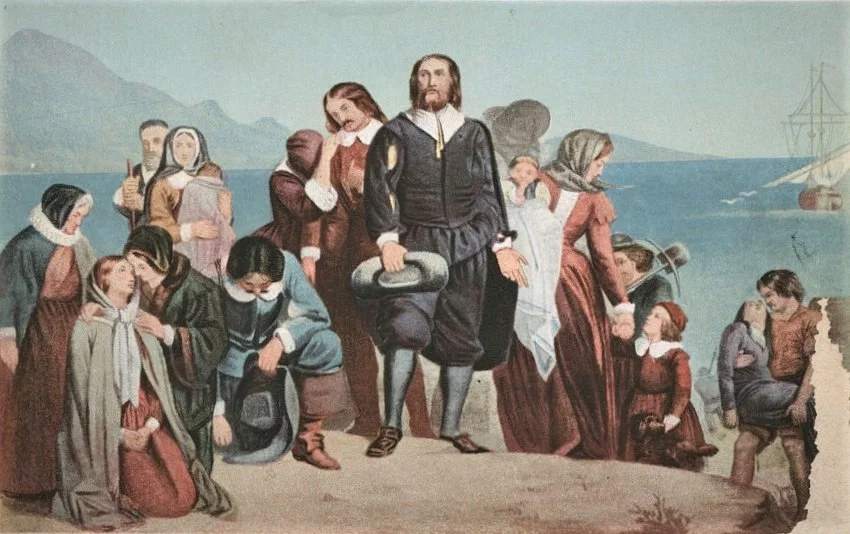
Illustration: “The Landing of the Pilgrim Fathers in America, A. D. 1620“, (1848 CE) by Charles Lucy (1814–1873 CE). White House copy of the painting. (From The White House Historical Association), via World History Encyclopedia, CC BY 4.0.
Christianity and American culture
Previous Post

February 21, 2025
DISCUSS: Should the U.S. Government Buy TikTok?
Next Post

February 24, 2025 Monday Miscellany, 2/24/25
Recent Comments
"Apropos to the post on Gen Z a couple days ago: "If you want the ..."
"“Don't eat with your hands, son, use your entrenching tool.”"
"You serious, Clark?"
"And all tools are made of media, thus making language and literature a tool (see, ..."
Browse Our Archives
Select a Category America Apologetics Art baseball Bible Blog Christ Church crime Culture Economics Education Ethics Family Food Football Government History Holidays Holy Week Humor International Islam Language Law Life Issues Literature Media Medicine Movies Music Nature News Personal Philosophy Politics psychology Reformation Religions Sacraments Science sex Social Science Sports technology television terrorism Theology Uncategorized Vocation war
Select a Month October 2026 September 2026 August 2026 July 2026 June 2026 May 2026 April 2026 March 2026 February 2026 January 2026 December 2025 November 2025 October 2025 September 2025 August 2025 July 2025 June 2025 May 2025 April 2025 March 2025 February 2025 January 2025 December 2024 November 2024 October 2024 September 2024 August 2024 July 2024 June 2024 May 2024 April 2024 March 2024 February 2024 January 2024 December 2023 November 2023 October 2023 September 2023 August 2023 July 2023 June 2023 May 2023 April 2023 March 2023 February 2023 January 2023 December 2022 November 2022 October 2022 September 2022 August 2022 July 2022 June 2022 May 2022 April 2022 March 2022 February 2022 January 2022 December 2021 November 2021 October 2021 September 2021 August 2021 July 2021 June 2021 May 2021 April 2021 March 2021 February 2021 January 2021 December 2020 November 2020 October 2020 September 2020 August 2020 July 2020 June 2020 May 2020 April 2020 March 2020 February 2020 January 2020 December 2019 November 2019 October 2019 September 2019 August 2019 July 2019 June 2019 May 2019 April 2019 March 2019 February 2019 January 2019 December 2018 November 2018 October 2018 September 2018 August 2018 July 2018 June 2018 May 2018 April 2018 March 2018 February 2018 January 2018 December 2017 November 2017 October 2017 September 2017 August 2017 July 2017 June 2017 May 2017 April 2017 March 2017 February 2017 January 2017 December 2016 November 2016 October 2016 September 2016 August 2016 July 2016 June 2016 May 2016 April 2016 March 2016 February 2016 January 2016 December 2015 November 2015 October 2015 September 2015 August 2015 July 2015 June 2015 May 2015 April 2015 March 2015 February 2015 January 2015 December 2014 November 2014 October 2014 September 2014 August 2014 July 2014 June 2014 May 2014 April 2014 March 2014 February 2014 January 2014 December 2013 November 2013 October 2013 September 2013 August 2013 July 2013 June 2013 May 2013 April 2013 March 2013 February 2013 January 2013 December 2012 November 2012 October 2012 September 2012 August 2012 July 2012 June 2012 May 2012 April 2012 March 2012 February 2012 January 2012 December 2011 November 2011 October 2011 September 2011 August 2011 July 2011 June 2011 May 2011 April 2011 March 2011 February 2011 January 2011 December 2010 November 2010 October 2010 September 2010 August 2010 July 2010 June 2010 May 2010 April 2010 March 2010 February 2010 January 2010 December 2009 November 2009 October 2009 September 2009 August 2009 July 2009 June 2009 May 2009 April 2009 March 2009 February 2009 January 2009 December 2008 November 2008 October 2008 September 2008 August 2008 July 2008 June 2008 May 2008 April 2008 March 2008 February 2008 January 2008 December 2007 November 2007 October 2007
Follow Us!
TAKE THE
Religious Wisdom Quiz
We are the tribe assigned to carry the sacred objects and serve in worship. Who are we?
Select your answer to see how you score.
The Levites The Danites The Tribe of Naphtali The Tribe of Judah
Books by This Author Books by Gene Veith
Related posts from Cranach


Gen Z Wants Evildoers to Be Punished, Not...

On Trump's Political Ads That You Paid For

TRENDING AT PATHEOS Evangelical

The Sermon on the Mount, Part I: Matthew...
The Sermon on the Mount, Part I (Matthew 4:12-5:12) St. Matthew moves...

What's up from Crossway: Reviewing some of their latest A few weeks...

Janie Learns the Way of the Cross: A...
Teaching children about Jesus' Passion can be challenging. Many parents and educators...

Looking For Good Catholic Writing - October 2026
He alone extends the heavens, and he walks upon the waves of...

In "Irreplaceable," our book on vocation and technology, Trevor Sutton and I...

I was strolling through the top floor of the brand new Parthenon...
view all Evangelical blogs
What Are Your Thoughts?leave a comment
Ad-Free & Subscriber Log-In Subscription Support
- About Us
- 2026 Calendar
- Videos
- Podcasts
- Library of World Religions
- Faith In Media Tracker
- Advertise With Us
- Write for Us
- Privacy Policy
- Terms of Service
- Do Not Sell My Data
- Contact Us
- Radiant Digital
- Manage Newsletter Subscriptions
- Unsubscribe From Notifications
- Sitemap
Copyright 2008-2026, Patheos. All rights reserved.
Subscription Support Ad-Free & Subscriber Log-In
Follow Patheos