
BuddhistCatholicContemplativeEvangelicalGeneral ChristianHinduJewishLatter-day SaintMuslimNew VisionsProgressive Christian
Beliefs
- Buddhist
- Catholic
- Contemplative
- Evangelical
- General Christian
- Hindu
- Jewish
- Latter-day Saint
- More Voices
- Muslim
- New Visions
- Pagan
- Progressive Christian
Topics
- Religion News
- Food and Religion
- Sports and Religion
- Religious Art
- Religious Music and Entertainment
- Religious Events
- History and Religion
- Style and Religion
- Politics and Religion
- Women in Religion
- Recreation Outdoors and Religion
- Business Finance and Religion
- Careers Workplace and Religion
- Education and Religion
- Family Parenting and Religion
- Health Fitness and Religion
- Home and Religion
- Relationships and Religion
- Technology and Religion
- Travel and Religion
Columnists
- Buddhist Columnists
- Business Finance and Religion Columnists
- Careers Workplace and Religion Columnists
- Catholic Columnists
- Contemplative Columnists
- Education and Religion Columnists
- Evangelists Columnists
- Family Parenting and Religion Columnists
- General Christian Columnists
- Health Fitness and Religion Columnists
- Hindu Columnists
- History and Religion Columnists
- Home and Religion Columnists
- Jewish Columnists
- More Voices Columnists
- Latter Day Columnists
- Muslim Columnists
- New Visions Columnists
- Nonreligious Columnists
- Pagan Columnists
- Politics and Religion Columnists
- Progressive Columnists
- Recreation Outdoors and Religion Columnists
- Relationships and Religion Columnists
- Religion News Columnists
- Religious Art Columnists
- Religious Events Columnists
- Religious Music and Entertainment Columnists
- Sports and Religion Columnists
- Style and Religion Columnists
- Technology and Religion Columnists
- Travel and Religion Columnists
- Women in Religion Columnists
Resource Library
- 2026 Calendar
- Library of World Religions
- The 100 Most Holy Places on Earth
- Patheos Answers
- Podcasts
- Videos
- Faith Leaders Database
- Anglican Episcopalian
- Bahai
- Baptist
- Buddhism
- Christianity
- Confucianism
- Eastern Orthodoxy
- Hinduism
- Holiness and Pentecostal
- ISKCON
- Islam
- Judaism
- Lutheran
- Methodist
- The Church of Jesus Christ of Latter-day Saints
- New Age
- Paganism
- Presbytarian and Reformed
- Protestantism
- Religion Behind the Scenes
- Roman Catholic
- Scientology
- Shia Islam
- Sikhism
- Sufism
- Sunni Islam
- Taoism
- Zen
- See all religions
Research Tools
 Ad-Free & Subscriber Log-In Subscription Support
Ad-Free & Subscriber Log-In Subscription Support
Follow Patheos 

- Trending:
- Forgiveness
- |
- Marriage
- |
- Consciousness
- |
- Death Penalty
- |
- Election
- |
- Halloween

- Home
- Evangelical
- Politics and Religion
- The Christmas Music That Is Advent Music
The Christmas Music That Is Advent Music
Last updated on: December 23, 2024 at 6:00 am by Gene Veith
The Christmas Music That Is Advent Music 2024-12-19T16:10:21-05:00 Gene Veith
Patheos Explore the world's faith through different perspectives on religion and spirituality! Patheos has the views of the prevalent religions and spiritualities of the world.
Much of our Christmas music, both sacred and secular, is actually Advent music, expressing a longing for a Christmas to come. True Christmas music is about the longing fulfilled, expressing the emotion of joy. There are also songs that look back to Christmas in the past, whether in nostalgia or faith. And Luther’s Christmas songs do something completely different.
Villanova professor Terrence Sweeney is a liturgical purist, believing that Advent is for Advent songs, while Christmas with its twelve days is the season for Christmas songs. But then he noticed that many of our Christmas songs are really Advent songs. He discusses the point in a fascinating post for Plough entitled Not Enough Christmas Music, with the deck, “We barely have any Christmas music at all. We have too much Advent music.”
“Few popular Christmas songs are about celebrating Christmas in the present,” he says. “They are about the longing for Christmas in the future.”
The problem with having so much Advent music masquerading as Christmas music is that it leaves us, well, without Christmas music. We are left in a culture of longing without arrival, yearning without joy, a culture that only arrives home in its dreams. This is particularly dire for those who do not attend Christmas services and do not hear the music of joy. Advent music, secular or religious, is music of a heart that is restless. But it’s not to be a permanent state of restlessness; as Augustine says, “O Lord, our hearts are restless until they rest in you.”
“The season of Advent is the season when we long for our loves to be present so that we can delight in them as here-with-us. Most of what you hear on the radio is music just like this, even if the presence we yearn for is family, friends, a lover, Santa Claus, or just presents.” He observes that often this Advent/Christmas music “is suffused with a rich sense of the minor key, the tonal quality of sorrow but also of aching desire.” In contrast, “Christmas music is saturated with joy, with rest in the one longed for, with the presence of our Love and our loves.”
This has made me attend more closely to Christmas songs. I’ve noticed another category: reflections on Christmas in the past. And that Martin Luther’s Christmas songs break out of the categories. Let’s see how Sweeney’s thesis plays out. The titles in bold are those he himself mentions. I’ve added some more. The bracketed comments are my own, except when I cite Sweeney.
Christmas in the Future
“I’m dreaming of a white Christmas.”
“It’s beginning to look a lot like Christmas.”
Santa Claus Is Coming to Town. [A secular judgement day, when Santa comes to separate the naughty from the nice. (“You better watch out! You better not shout! You better not pout, I’m telling you why. . . “)]
“All I want for Christmas [is you].” [Mariah Carey, Sweeney points out, is here longing for the presence of a loved one.]
“I’ll be home for Christmas.” [This achingly poignant song from World War II depicts a GI yearning for home, ending, though, with the realization that this will happen “only in my dreams.”]
“Deck the Halls.” [About decorating for Christmas. Unusually joyful for the category.]
“Silver Bells.” [About shopping].
“We Three Kings.” [They “traverse afar” and “westward leading, still proceeding,” but they never quite get there.]
Christmas in the Present
“Joy to the World.” [“The Lord is come.”]
“Hark the Herald Angels Sing.” [Hark. That is, you can hear them now. “Veiled in flesh the Godhead see.”]
“O, Come, All Ye Faithful.” [As Sweeney says, this time it isn’t Christ who is coming, we are coming to Him. “Come let us adore Him.”]
“Silent Night.” [“Glories stream from Heaven afar. . .Christ the Savior is born!”]
“O Little Town of Bethlehem.” [“The hopes and fears of all the years, are met in thee tonight.”]
“Angels We Have Heard on High.” [We have heard them! And this is what they sang!]
“What Child Is This?” [The one who is sleeping on Mary’s lap.]
Christmas in the Past
“Away in a Manger.” [“The stars in the sky looked down where He lay.” But the response of faith in the present: the prayer of the last stanza, concluding with “take us to Heaven to live with Thee there.”
“It Came upon the Midnight Clear.” [“That glorious song of old.”]
“Once in Royal David’s City.” [Once the lowly cattle shed stood.]
“God Rest Ye Merry Gentlemen.” [Sweeney classifies this one as Christmas in the present, but it refers to the past: “Remember, Christ, our Savior/Was born on Christmas Day.” But it does, as he says express a joyful faith in that fact.]
“The Christmas Song (Chestnuts Roasting On An Open Fire).” [Nostalgia.]
I invite you to add songs in the various categories, though they don’t all fit neatly. Notice that the secular songs are mostly about “Christmas in the future,” while the religious songs are mostly about “Christmas in the present.” There may be a commercial and a liturgical reason for that, with the secular Christmas songs having been written for the shopping season leading up to the big day, while the Christmas hymns were written for the feast day itself. Also, songs about the birth of Christ that situate that event in the future, such as “Come, O Come, Emmanuel,” are actual Advent hymns and are sung during that season.
But Sweeney’s point seems to hold true. These secular Christmas/Advent songs are indeed largely about yearning, not for Jesus, who is not mentioned, but for a loved ones, whether an individual or a family, or for Santa, or presents, or something the singer is not even aware of. And the music is often wistful and melancholy (e.g., “White Christmas,” “I’ll be Home for Christmas,” “Silver Bells.”)
Whereas the Christmas songs about Christ tend to be overwhelmingly joyful. Sweeney says that even those with a darker tune, such as “Silent Night,” are joyful. “To hold the baby one has longed for is different than to await the baby one longs for. Christmas music is saturated with joy, with rest in the one longed for, with the presence of our Love and our loves.”
The ones that situate Christmas in the past are of two types. The secular ones are nostalgic, looking back on fond memories. Some of the ones Sweeney classifies as “Advent” refer back to “Christmases long, long ago.” As in the yearning for a “White Christmas,” “just like the ones I used to know.” And yet the object of the desire never happens. As in “I’ll Be Home for Christmas,” the singer is only “dreaming.” The religious ones look back to what happened in that manger, as described in the Bible, and often include a statement of faith, supremely in “Away in a Manger,” but also in “Once in David’s Royal City” (“And our eyes at last shall see him/Through His own redeeming love”) and “God Rest You, Merry Gentlemen,” who are urged to “remember Christ our Savior” who was born “to save us all from Satan’s pow’r/when we were gone astray.”
In trying to classify Luther’s Christmas songs, I found that he jumped around freely in time, but then leaped to the present contemporary moment, not just in the moment Christ was born, but in the moment that He dwells in our hearts. “Savior of the Nations, Come” is an Advent hymn, of course, asking Jesus to come, and yet some of its verbs are in the past tense (“God the Father was His source”; “Here a maid was found with child”), some are in the present tense (“For You are the Father’s Son”; “From the manger newborn light/Shines in glory through the night”). And the lyrics also describe His real presence with us now: “Make here your home”; “In this light faith now abides.”
Something of the same can be seen in Luther’s supreme Christmas song, “From Heaven Above to Earth I Come.” In the first stanza, the speaker, presumably an angel, says, I am coming from Heaven to earth to tell you about the Christchild, who “shall be [future tense] the joy of all the earth.” After hearing all about Him, the sings are invited to join the shepherds: “How glad we’ll be to find it so!/Then with the shepherds let us go/To see what God has done/In sending us His own dear Son.” The other stanzas go back and forth between past and present (“Ah, Lord, though You created all,/How weak you are, so poor and small”). The joy Sweeney talks about is certainly here (“My heart for very joy must leap”). And then it gets personal:
Ah, dearest Jesus, holy Child,
Prepare a bed, soft, undefiled,
A quiet chamber set apart
For You to dwell within my heart.
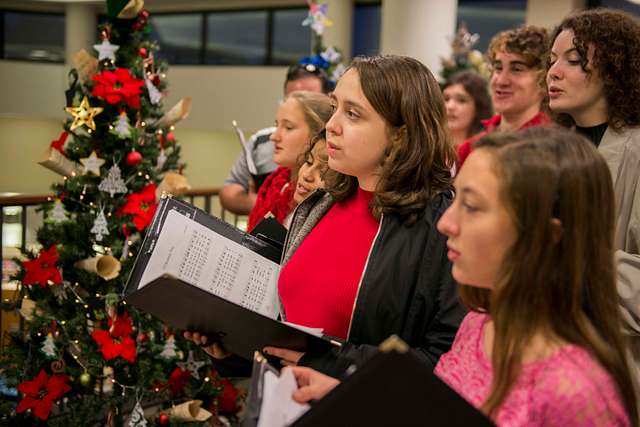
Photo: The Naples Middle High School Choir performs in the Support Site library onboard Naval Support Activity (NSA) Naples during Navy Community Recreation’s annual Holiday Village Tree Lighting event, Dec. 6, 2019, Defense Visual Information Distribution Service via GetArchive, Public Domain.
Previous Post

December 20, 2024
The Vibe Shift
Next Post

December 24, 2024 Why Christmas Is at the Beginning of Winter
Recent Comments
"Apropos to the post on Gen Z a couple days ago: "If you want the ..."
"“Don't eat with your hands, son, use your entrenching tool.”"
"You serious, Clark?"
"And all tools are made of media, thus making language and literature a tool (see, ..."
Browse Our Archives
Select a Category America Apologetics Art baseball Bible Blog Christ Church crime Culture Economics Education Ethics Family Food Football Government History Holidays Holy Week Humor International Islam Language Law Life Issues Literature Media Medicine Movies Music Nature News Personal Philosophy Politics psychology Reformation Religions Sacraments Science sex Social Science Sports technology television terrorism Theology Uncategorized Vocation war
Select a Month October 2026 September 2026 August 2026 July 2026 June 2026 May 2026 April 2026 March 2026 February 2026 January 2026 December 2025 November 2025 October 2025 September 2025 August 2025 July 2025 June 2025 May 2025 April 2025 March 2025 February 2025 January 2025 December 2024 November 2024 October 2024 September 2024 August 2024 July 2024 June 2024 May 2024 April 2024 March 2024 February 2024 January 2024 December 2023 November 2023 October 2023 September 2023 August 2023 July 2023 June 2023 May 2023 April 2023 March 2023 February 2023 January 2023 December 2022 November 2022 October 2022 September 2022 August 2022 July 2022 June 2022 May 2022 April 2022 March 2022 February 2022 January 2022 December 2021 November 2021 October 2021 September 2021 August 2021 July 2021 June 2021 May 2021 April 2021 March 2021 February 2021 January 2021 December 2020 November 2020 October 2020 September 2020 August 2020 July 2020 June 2020 May 2020 April 2020 March 2020 February 2020 January 2020 December 2019 November 2019 October 2019 September 2019 August 2019 July 2019 June 2019 May 2019 April 2019 March 2019 February 2019 January 2019 December 2018 November 2018 October 2018 September 2018 August 2018 July 2018 June 2018 May 2018 April 2018 March 2018 February 2018 January 2018 December 2017 November 2017 October 2017 September 2017 August 2017 July 2017 June 2017 May 2017 April 2017 March 2017 February 2017 January 2017 December 2016 November 2016 October 2016 September 2016 August 2016 July 2016 June 2016 May 2016 April 2016 March 2016 February 2016 January 2016 December 2015 November 2015 October 2015 September 2015 August 2015 July 2015 June 2015 May 2015 April 2015 March 2015 February 2015 January 2015 December 2014 November 2014 October 2014 September 2014 August 2014 July 2014 June 2014 May 2014 April 2014 March 2014 February 2014 January 2014 December 2013 November 2013 October 2013 September 2013 August 2013 July 2013 June 2013 May 2013 April 2013 March 2013 February 2013 January 2013 December 2012 November 2012 October 2012 September 2012 August 2012 July 2012 June 2012 May 2012 April 2012 March 2012 February 2012 January 2012 December 2011 November 2011 October 2011 September 2011 August 2011 July 2011 June 2011 May 2011 April 2011 March 2011 February 2011 January 2011 December 2010 November 2010 October 2010 September 2010 August 2010 July 2010 June 2010 May 2010 April 2010 March 2010 February 2010 January 2010 December 2009 November 2009 October 2009 September 2009 August 2009 July 2009 June 2009 May 2009 April 2009 March 2009 February 2009 January 2009 December 2008 November 2008 October 2008 September 2008 August 2008 July 2008 June 2008 May 2008 April 2008 March 2008 February 2008 January 2008 December 2007 November 2007 October 2007
Follow Us!
TAKE THE
Religious Wisdom Quiz
How many books is the Book of Psalms divided into?
Select your answer to see how you score.
Three Ten Five Seven
Books by This Author Books by Gene Veith
Related posts from Cranach


Gen Z Wants Evildoers to Be Punished, Not...

As Fulton Sheen Is Beatified, Don't Forget Walter...

How the Integralists Are Like the Socialists
TRENDING AT PATHEOS Evangelical

Pope Leo Celebrates Mass for Nurses & Docs...
I don't have any idea how he did it, but Pope Leo...

The Sermon on the Mount, Part I: Matthew...
The Sermon on the Mount, Part I (Matthew 4:12-5:12) St. Matthew moves...

What's up from Crossway: Reviewing some of their latest A few weeks...

Janie Learns the Way of the Cross: A...
Teaching children about Jesus' Passion can be challenging. Many parents and educators...

Looking For Good Catholic Writing - October 2026
He alone extends the heavens, and he walks upon the waves of...

In "Irreplaceable," our book on vocation and technology, Trevor Sutton and I...
view all Evangelical blogs
What Are Your Thoughts?leave a comment
Ad-Free & Subscriber Log-In Subscription Support
- About Us
- 2026 Calendar
- Videos
- Podcasts
- Library of World Religions
- Faith In Media Tracker
- Advertise With Us
- Write for Us
- Privacy Policy
- Terms of Service
- Do Not Sell My Data
- Contact Us
- Radiant Digital
- Manage Newsletter Subscriptions
- Unsubscribe From Notifications
- Sitemap
Copyright 2008-2026, Patheos. All rights reserved.
Subscription Support Ad-Free & Subscriber Log-In
Follow Patheos