
BuddhistCatholicContemplativeEvangelicalGeneral ChristianHinduJewishLatter-day SaintMuslimNew VisionsProgressive Christian
Beliefs
- Buddhist
- Catholic
- Contemplative
- Evangelical
- General Christian
- Hindu
- Jewish
- Latter-day Saint
- More Voices
- Muslim
- New Visions
- Pagan
- Progressive Christian
Topics
- Religion News
- Food and Religion
- Sports and Religion
- Religious Art
- Religious Music and Entertainment
- Religious Events
- History and Religion
- Style and Religion
- Politics and Religion
- Women in Religion
- Recreation Outdoors and Religion
- Business Finance and Religion
- Careers Workplace and Religion
- Education and Religion
- Family Parenting and Religion
- Health Fitness and Religion
- Home and Religion
- Relationships and Religion
- Technology and Religion
- Travel and Religion
Columnists
- Buddhist Columnists
- Business Finance and Religion Columnists
- Careers Workplace and Religion Columnists
- Catholic Columnists
- Contemplative Columnists
- Education and Religion Columnists
- Evangelists Columnists
- Family Parenting and Religion Columnists
- General Christian Columnists
- Health Fitness and Religion Columnists
- Hindu Columnists
- History and Religion Columnists
- Home and Religion Columnists
- Jewish Columnists
- More Voices Columnists
- Latter Day Columnists
- Muslim Columnists
- New Visions Columnists
- Nonreligious Columnists
- Pagan Columnists
- Politics and Religion Columnists
- Progressive Columnists
- Recreation Outdoors and Religion Columnists
- Relationships and Religion Columnists
- Religion News Columnists
- Religious Art Columnists
- Religious Events Columnists
- Religious Music and Entertainment Columnists
- Sports and Religion Columnists
- Style and Religion Columnists
- Technology and Religion Columnists
- Travel and Religion Columnists
- Women in Religion Columnists
Resource Library
- 2026 Calendar
- Library of World Religions
- The 100 Most Holy Places on Earth
- Patheos Answers
- Podcasts
- Videos
- Faith Leaders Database
- Anglican Episcopalian
- Bahai
- Baptist
- Buddhism
- Christianity
- Confucianism
- Eastern Orthodoxy
- Hinduism
- Holiness and Pentecostal
- ISKCON
- Islam
- Judaism
- Lutheran
- Methodist
- The Church of Jesus Christ of Latter-day Saints
- New Age
- Paganism
- Presbytarian and Reformed
- Protestantism
- Religion Behind the Scenes
- Roman Catholic
- Scientology
- Shia Islam
- Sikhism
- Sufism
- Sunni Islam
- Taoism
- Zen
- See all religions
Research Tools
 Ad-Free & Subscriber Log-In Subscription Support
Ad-Free & Subscriber Log-In Subscription Support
Follow Patheos 

- Trending:
- Forgiveness
- |
- Marriage
- |
- Consciousness
- |
- Death Penalty
- |
- Election
- |
- Halloween

- Home
- Evangelical
- Politics and Religion
- More Thoughts on the Original Nicene Creed
More Thoughts on the Original Nicene Creed
Last updated on: September 27, 2024 at 6:00 am by Gene Veith
More Thoughts on the Original Nicene Creed 2024-09-22T20:56:56-04:00 Gene Veith
Patheos Explore the world's faith through different perspectives on religion and spirituality! Patheos has the views of the prevalent religions and spiritualities of the world.
We blogged about the controversy over the “Filoque” phrase in the Nicene Creed, the confession that the Holy Spirit proceeds “from the Father and the Son.” The original text said that the Holy Spirit proceeds from the Father, with the “and the Son” being added by the Pope in 1014. This apparent usurpation of an authoritative church council was a major factor in the Eastern church breaking away from the Western church in the “Great Schism,” which divided Christendom into Western “Catholics” and Eastern “Orthodox.”
Now the Lutheran World Federation, in its talks with the Orthodox, is recommending that member churches (which do not include confessional Lutherans such as the LCMS, WELS, and ELS) drop the “and the Son” from the Nicene Creed.
In the post, we maintained that the “and the Son” is Biblical, so there is nothing wrong with including the Filioque in the Creed, though there is nothing wrong with dropping it either.
But there are other differences from the original creed as formulated by the Councils of Nicaea and Constantinople that also deserve our consideration.
Our version of the creed begins: “I believe in one God, the Father Almighty, maker of heaven and earth and of all things visible and invisible.” It goes on to say, “And in one Lord, Jesus Christ,” then going into detail about Him. Concluding, “And I believe in the Holy Spirit, the Lord and giver of life.”
The original Nicene Creed didn’t say “I believe.” Rather, it said, “We believe.” “We believe in one God, the Father Almighty, maker of heaven and earth. . . .And we believe in the Holy Spirit, the Lord and giver of life.” Do you see the difference?
The Apostle’s Creed, on the other hand, does say “I believe.” As it was explained to me, the Apostle’s Creed is a baptism confession. Thus, the individual is making a profession of faith. This is why the Apostle’s Creed is used in catechesis to instruct adults in preparation for their baptism and for confirmation for those who were baptized as children and are now taking on the baptismal vows as their own.
The Nicene Creed, though, is a church confession. It is what the church as a whole, including all of the individuals within it, believes and teaches. It represents a collective doctrinal agreement on the Trinity and the Incarnation of Christ.
The reason the creed got shifted to the first person singular is that the Latin translation of the original Greek used “Credo” (I believe). So this became the version used by Catholics and other Western Christians after the Reformation.
But the Eastern Orthodox churches, for whom Greek was their liturgical language as Latin was the Catholics, made a new Greek translation from the original Greek that also used the first person singular (from Πιστεύομεν to Πιστεύω). This is surprising, since the Orthodox are usually sticklers for the original Greek and especially for texts approved by the Ecumenical Church Councils (remember “filioque”). But they also say “I believe” rather than the conciliar “We believe.”
If we use the first person plural pronoun (“we”), we are including the first person singular pronoun (“I”). And if everyone in a church body is saying “I believe,” that amounts to a “we believe.” Still, I think it would be better to return to the original terminology of the Council of Nicaea, “we believe” and keep the distinction between an individual profession of faith and a collective doctrinal confession. Some church bodies, Eastern and Protestant, do use the plural. On the other hand, perhaps it would be better to keep this rare case of Roman, Orthodox, and Protestant Catholicity, even though it is based on a mistake.
Speaking of Catholicity, we Missouri Synod Lutherans are just about the only ones who say “I believe [vs. ‘we believe’] in one holy Christian and apostolic Church” instead of the original “one holy catholic and apostolic church.”
The original Greek word is Καθολικὴν, which the Latin simply transliterates instead of translates, giving us “catholic.” I am aware that the old German translation used “Christian” even before the Reformation, so that’s the reason given for the German Lutherans rendering it the same way, even when translating their liturgy and confessions into English.
But “Christian” is not a good translation of “catholic” into English, which is the language we are using here. I am, however, sympathetic to the complaint from the pews that we don’t want to sound like we are confessing Roman Catholicism. So why don’t we translate the Greek and Latin word “catholic”? If Καθολικὴν and “catholic” mean “universal,” why not say, “We believe in one holy universal and apostolic church”?
UPDATE: I see that the Wisconsin Synod uses “we,” but “Christian” rather than “Catholic.” ELCA uses both “we” and “catholic.” The ELS uses the same text with “I” and “Christian church” as the LCMS.
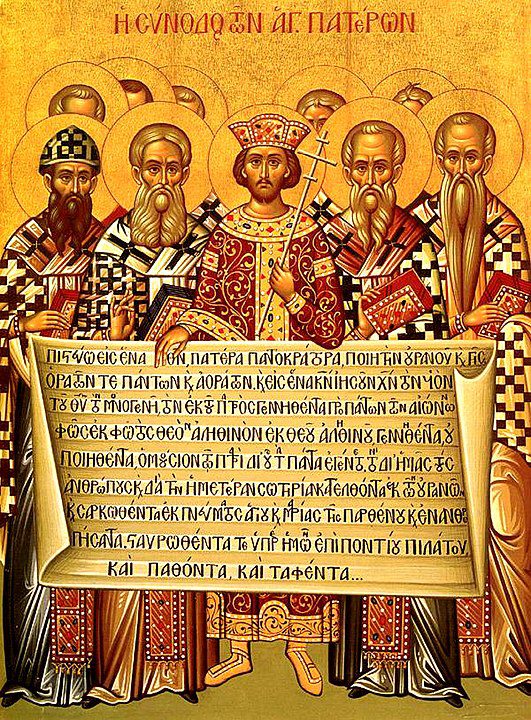
Illustration: Icon depicting Constantine the Great, accompanied by the bishops of the First Council of Nicaea (325), holding the Niceno-Constantinopolitan Creed of 381. First line of main text in Greek: Πιστεύω εἰς ἕνα Θ[εό]ν, πατέρα παντοκράτορα, ποιητὴν οὐρανοῦ κ[αὶ] γῆς,. Translation: “I believe in one God, the Father the Almighty, Maker of heaven and earth.” By Unknown author – http://home.scarlet.be, http://home.scarlet.be, Public Domain, https://commons.wikimedia.org/w/index.php?curid=117976

[Notice that the version held up in this Orthodox icon is “I believe.”]
Previous Post

September 27, 2024
DISCUSS: The Exploding Electronic Devices
Next Post

September 30, 2024 Monday Miscellany, 9/30/24
Recent Comments
"I know wired earbuds are making a comeback (I never stopped using them as I ..."
"VCRs, tape decks, and cassette players are all having a revival among a segment of ..."
"As a (retired) lawyer I see potential liability from sharing things like power or sharp ..."
"I am not sure the items you mentioned, though disused, discontinued, discarded, could be considered ..."
Browse Our Archives
Select a Category America Apologetics Art baseball Bible Blog Christ Church crime Culture Economics Education Ethics Family Food Football Government History Holidays Holy Week Humor International Islam Language Law Life Issues Literature Media Medicine Movies Music Nature News Personal Philosophy Politics psychology Reformation Religions Sacraments Science sex Social Science Sports technology television terrorism Theology Uncategorized Vocation war
Select a Month October 2026 September 2026 August 2026 July 2026 June 2026 May 2026 April 2026 March 2026 February 2026 January 2026 December 2025 November 2025 October 2025 September 2025 August 2025 July 2025 June 2025 May 2025 April 2025 March 2025 February 2025 January 2025 December 2024 November 2024 October 2024 September 2024 August 2024 July 2024 June 2024 May 2024 April 2024 March 2024 February 2024 January 2024 December 2023 November 2023 October 2023 September 2023 August 2023 July 2023 June 2023 May 2023 April 2023 March 2023 February 2023 January 2023 December 2022 November 2022 October 2022 September 2022 August 2022 July 2022 June 2022 May 2022 April 2022 March 2022 February 2022 January 2022 December 2021 November 2021 October 2021 September 2021 August 2021 July 2021 June 2021 May 2021 April 2021 March 2021 February 2021 January 2021 December 2020 November 2020 October 2020 September 2020 August 2020 July 2020 June 2020 May 2020 April 2020 March 2020 February 2020 January 2020 December 2019 November 2019 October 2019 September 2019 August 2019 July 2019 June 2019 May 2019 April 2019 March 2019 February 2019 January 2019 December 2018 November 2018 October 2018 September 2018 August 2018 July 2018 June 2018 May 2018 April 2018 March 2018 February 2018 January 2018 December 2017 November 2017 October 2017 September 2017 August 2017 July 2017 June 2017 May 2017 April 2017 March 2017 February 2017 January 2017 December 2016 November 2016 October 2016 September 2016 August 2016 July 2016 June 2016 May 2016 April 2016 March 2016 February 2016 January 2016 December 2015 November 2015 October 2015 September 2015 August 2015 July 2015 June 2015 May 2015 April 2015 March 2015 February 2015 January 2015 December 2014 November 2014 October 2014 September 2014 August 2014 July 2014 June 2014 May 2014 April 2014 March 2014 February 2014 January 2014 December 2013 November 2013 October 2013 September 2013 August 2013 July 2013 June 2013 May 2013 April 2013 March 2013 February 2013 January 2013 December 2012 November 2012 October 2012 September 2012 August 2012 July 2012 June 2012 May 2012 April 2012 March 2012 February 2012 January 2012 December 2011 November 2011 October 2011 September 2011 August 2011 July 2011 June 2011 May 2011 April 2011 March 2011 February 2011 January 2011 December 2010 November 2010 October 2010 September 2010 August 2010 July 2010 June 2010 May 2010 April 2010 March 2010 February 2010 January 2010 December 2009 November 2009 October 2009 September 2009 August 2009 July 2009 June 2009 May 2009 April 2009 March 2009 February 2009 January 2009 December 2008 November 2008 October 2008 September 2008 August 2008 July 2008 June 2008 May 2008 April 2008 March 2008 February 2008 January 2008 December 2007 November 2007 October 2007
Follow Us!
TAKE THE
Religious Wisdom Quiz
What city was Paul heading to when he encountered Jesus?
Select your answer to see how you score.
Antioch Jerusalem Rome Damascus
Books by This Author Books by Gene Veith
Related posts from Cranach


Gen Z Wants Evildoers to Be Punished, Not...


Why AI Bots Don't Really Have Emotions
TRENDING AT PATHEOS Evangelical

The First Eucharistic Controversy: Christ’s Real Presence
For Catholics, the Eucharist is the source and summit of the Christian...

What a Stop Sign Can Teach Us About...
How to Make a Decision When You Can't Hear God Main point:...

Archdiocese Hosts Military Marriage Retreat in Germany
RASTATT, Germany — The transient military lifestyle, with its frequent deployments and...

Nearly every morning, I make the drive to Detroit with my high-school-age...

The Real AI Story Is Adoption Without Trust
Artificial intelligence has crossed a political threshold. It is no longer a...

A new article, written by Jeff Lindsay and Gale L. Pooley,...
view all Evangelical blogs
What Are Your Thoughts?leave a comment
Ad-Free & Subscriber Log-In Subscription Support
- About Us
- 2026 Calendar
- Videos
- Podcasts
- Library of World Religions
- Faith In Media Tracker
- Advertise With Us
- Write for Us
- Privacy Policy
- Terms of Service
- Do Not Sell My Data
- Contact Us
- Radiant Digital
- Manage Newsletter Subscriptions
- Unsubscribe From Notifications
- Sitemap
Copyright 2008-2026, Patheos. All rights reserved.
Subscription Support Ad-Free & Subscriber Log-In
Follow Patheos