
BuddhistCatholicContemplativeEvangelicalGeneral ChristianHinduJewishLatter-day SaintMuslimNew VisionsProgressive Christian
Beliefs
- Buddhist
- Catholic
- Contemplative
- Evangelical
- General Christian
- Hindu
- Jewish
- Latter-day Saint
- More Voices
- Muslim
- New Visions
- Pagan
- Progressive Christian
Topics
- Religion News
- Food and Religion
- Sports and Religion
- Religious Art
- Religious Music and Entertainment
- Religious Events
- History and Religion
- Style and Religion
- Politics and Religion
- Women in Religion
- Recreation Outdoors and Religion
- Business Finance and Religion
- Careers Workplace and Religion
- Education and Religion
- Family Parenting and Religion
- Health Fitness and Religion
- Home and Religion
- Relationships and Religion
- Technology and Religion
- Travel and Religion
Columnists
- Buddhist Columnists
- Business Finance and Religion Columnists
- Careers Workplace and Religion Columnists
- Catholic Columnists
- Contemplative Columnists
- Education and Religion Columnists
- Evangelists Columnists
- Family Parenting and Religion Columnists
- General Christian Columnists
- Health Fitness and Religion Columnists
- Hindu Columnists
- History and Religion Columnists
- Home and Religion Columnists
- Jewish Columnists
- More Voices Columnists
- Latter Day Columnists
- Muslim Columnists
- New Visions Columnists
- Nonreligious Columnists
- Pagan Columnists
- Politics and Religion Columnists
- Progressive Columnists
- Recreation Outdoors and Religion Columnists
- Relationships and Religion Columnists
- Religion News Columnists
- Religious Art Columnists
- Religious Events Columnists
- Religious Music and Entertainment Columnists
- Sports and Religion Columnists
- Style and Religion Columnists
- Technology and Religion Columnists
- Travel and Religion Columnists
- Women in Religion Columnists
Resource Library
- 2026 Calendar
- Library of World Religions
- The 100 Most Holy Places on Earth
- Patheos Answers
- Podcasts
- Videos
- Faith Leaders Database
- Anglican Episcopalian
- Bahai
- Baptist
- Buddhism
- Christianity
- Confucianism
- Eastern Orthodoxy
- Hinduism
- Holiness and Pentecostal
- ISKCON
- Islam
- Judaism
- Lutheran
- Methodist
- The Church of Jesus Christ of Latter-day Saints
- New Age
- Paganism
- Presbytarian and Reformed
- Protestantism
- Religion Behind the Scenes
- Roman Catholic
- Scientology
- Shia Islam
- Sikhism
- Sufism
- Sunni Islam
- Taoism
- Zen
- See all religions
Research Tools
 Ad-Free & Subscriber Log-In Subscription Support
Ad-Free & Subscriber Log-In Subscription Support
Follow Patheos 

- Trending:
- Forgiveness
- |
- Marriage
- |
- Consciousness
- |
- Death Penalty
- |
- Election
- |
- Halloween

- Home
- Evangelical
- Politics and Religion
- An Empty Hell?
An Empty Hell?
Last updated on: January 25, 2024 at 6:00 am by Gene Veith
An Empty Hell? 2024-01-20T19:10:47-05:00 Gene Veith
Patheos Explore the world's faith through different perspectives on religion and spirituality! Patheos has the views of the prevalent religions and spiritualities of the world.
“This isn’t dogma, just my thought,” said Pope Francis recently on an Italian talk show. “I like to think of Hell as being empty. I hope it is.”
Once again the pontiff, in an office that Catholics used to claim assured the clarity of doctrine, stirred up controversy and confusion.
The pope was responding to a question about how he “imagines Hell.” As Eric Sammons, the editor of the conservative Catholic Crisis Magazine, said, the pope was not necessarily being unorthodox. We can imagine all kinds of things. He went further in expressing his desire. He “hopes” that Hell is empty. The Catholic catechism, citing 1 Timothy 2:4, says that “In hope, the Church prays for ‘all men to be saved’” (CCC 1821).
But Sammons says that the catechism and the words of Jesus also indicate that people have gone and continue to go there. He argues that “Pope Francis’s hope that Hell is empty is not harmless wishful thinking. It leads people away from a serious practice of the faith, and it leads them away from bringing others to a serious practice of the faith.” He concludes, “Ironically, a hope that Hell is empty will do much to help fill it up.”
But the pope is not the only one to minimize the doctrine of Hell. A number of evangelicals have rejected the doctrine of Hell in favor of either annihilationism, in which God’s judgment simply annihilates the lost, or universalism, in which everyone is saved. The prominent Christian thinker David Bentley Hart, a convert to eastern Orthodoxy, insists that universalism is the only valid Christian teaching, as he expresses in his book That All Shall Be Saved. And, to be honest, we hardly ever hear about Hell anymore even in very conservative churches, even when those churches formally confess that Hell is real.
Certainly, the prospect of eternal punishment is horrible to contemplate. Dante helped me to understand the concept. The punishments he dramatizes in the Inferno are the sins themselves. The wrathful attack and tear each other in a river of blood, just as they did on earth. Those who reject love completely by betraying those who did good to them exist forever in the isolation they have chosen, their cold hearts frozen in a lake of ice. The recently-died sinners in the Inferno are eager to find their place of punishment, rushing to it as they rushed to their sin. In rejecting God, they reject everything that is good, including their very humanness, and, in a sense, become their sin. (Dorothy L. Sayers has written an excellent guide to this reading of the Inferno and the entire Divine Comedy in the notes to her translation and in her book Introductory Papers to Dante.)
The controversy, though, about whether a just and loving God would ever punish anyone eternally reminds me of something J. G. Hamann said in his notes on the Book of Job in the London Writings:*
The speeches of the three friends teach us how insufficient faith, or the knowledge of God’s name, is that is based on His general attributes. Yes, they teach us how we can misuse them so badly through their improper application in particular cases, and how, instead of justifying God’s wisdom and holiness, we can deny them. (Job 9 April 1758, “Biblical Meditations,” London Writings, p. 152).
For Hamann, trying to approach or understand God from His “general attributes” risks turning God into an abstraction, rather than an actual person. Yes, God is righteous, just, loving, omnipotent, omniscient, etc., but we know those attributes from His revelation of Himself in His Word. Job’s “comforters” were playing off God’s attributes against each other, reasoning that since God is just, Job must deserve his suffering.
We do the same when we play off God’s attributes against each other in trying to unravel the “problem of suffering.” If God is both righteous and omnipotent, He would eliminate suffering. Therefore, He is either not righteous, not omnipotent, or He does not exist! But, rejoins Hamann, we cannot know God sheerly by reasoning from His attributes. He is a real Person, not a puzzle, nor an idea, nor a collection of qualities for us to harmonize. Righteousness does describe Him, but we may not be able to fathom the fullness of what that means as it pertains to the Holy One of Israel as revealed in His Word. It is evidently a righteousness that allows for human suffering, as the Book of Job shows and as human experience confirms.
In the rest of this passage, Hamann says that God’s rebuke of Job’s friends demonstrates that “human compassion for the weakness and suffering of our neighbor is more acceptable to God than the justification of His ways.” The friends try to rationalize and justify God’s actions, whereas God doesn’t care about any of that. He just wants the friends to show compassion for Job’s weakness and suffering!)
As it relates to the question of Hell, many of the arguments against it take the form of what God “would” or “would not” do. God has the attributes of justice and mercy; therefore, He “would not” consign anyone to Hell.
But it is futile for us mere mortals to speculate what God “would” or “would not” do. We cannot know that, apart from what God reveals to us in His Word, where we find lots of things that baffle our understanding.
The question is whether or not Hell exists (and is populated), and, more importantly for us, how to avoid going there. God’s Word tells us–to our horror–that it does (e.g., Matthew 5:22-30; 10:28; 25:41, etc.). But it goes on to tell us how God Himself bore our sins and took our punishment to prevent us from going to Hell.
So if Christ died for all, why would anyone have to go there? Why would God make it so that we have to be “in Christ” by faith to receive this benefit? If God extends His grace to all of those sinners who have faith in Him, He would surely extend that grace to everybody, whether they have faith in Him or not. Well, there we go again, trying to figure out God and, in fact, constrain Him so that He does what we would like Him to do, by playing around with His attributes. As opposed to believing His Word.
What we need to know about Hell is that “There is therefore now no condemnation for those who are in Christ Jesus” (Romans 8:1).
*Ballast Press has sold Hamann’s London Writings, translated by John W. Kleinig and edited by yours truly, to Lexham Press, which will be coming out with its edition in the days ahead. So though the Ballast Press version is still listed at Amazon, it is no longer available from that publisher. The Kindle version, which I linked to above, may still be available.
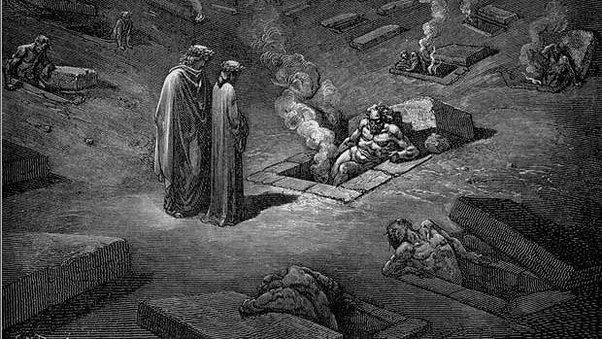
Illustration: The Sixth Circle: The Heretics (Cantos IX-X) by Gustav Doré, Illustrations of Dante (1861) via Wikipedia, Public Domain, https://commons.wikimedia.org/w/index.php?curid=73412462

Previous Post

January 24, 2024
The Coming Plague of Locusts
Next Post

January 26, 2024 DISCUSSION: Marco Rubio's Pro-Life Strategy
Recent Comments
"While she worked for Trump she was a tool's tool!"
"I know wired earbuds are making a comeback (I never stopped using them as I ..."
"VCRs, tape decks, and cassette players are all having a revival among a segment of ..."
"As a (retired) lawyer I see potential liability from sharing things like power or sharp ..."
Browse Our Archives
Select a Category America Apologetics Art baseball Bible Blog Christ Church crime Culture Economics Education Ethics Family Food Football Government History Holidays Holy Week Humor International Islam Language Law Life Issues Literature Media Medicine Movies Music Nature News Personal Philosophy Politics psychology Reformation Religions Sacraments Science sex Social Science Sports technology television terrorism Theology Uncategorized Vocation war
Select a Month October 2026 September 2026 August 2026 July 2026 June 2026 May 2026 April 2026 March 2026 February 2026 January 2026 December 2025 November 2025 October 2025 September 2025 August 2025 July 2025 June 2025 May 2025 April 2025 March 2025 February 2025 January 2025 December 2024 November 2024 October 2024 September 2024 August 2024 July 2024 June 2024 May 2024 April 2024 March 2024 February 2024 January 2024 December 2023 November 2023 October 2023 September 2023 August 2023 July 2023 June 2023 May 2023 April 2023 March 2023 February 2023 January 2023 December 2022 November 2022 October 2022 September 2022 August 2022 July 2022 June 2022 May 2022 April 2022 March 2022 February 2022 January 2022 December 2021 November 2021 October 2021 September 2021 August 2021 July 2021 June 2021 May 2021 April 2021 March 2021 February 2021 January 2021 December 2020 November 2020 October 2020 September 2020 August 2020 July 2020 June 2020 May 2020 April 2020 March 2020 February 2020 January 2020 December 2019 November 2019 October 2019 September 2019 August 2019 July 2019 June 2019 May 2019 April 2019 March 2019 February 2019 January 2019 December 2018 November 2018 October 2018 September 2018 August 2018 July 2018 June 2018 May 2018 April 2018 March 2018 February 2018 January 2018 December 2017 November 2017 October 2017 September 2017 August 2017 July 2017 June 2017 May 2017 April 2017 March 2017 February 2017 January 2017 December 2016 November 2016 October 2016 September 2016 August 2016 July 2016 June 2016 May 2016 April 2016 March 2016 February 2016 January 2016 December 2015 November 2015 October 2015 September 2015 August 2015 July 2015 June 2015 May 2015 April 2015 March 2015 February 2015 January 2015 December 2014 November 2014 October 2014 September 2014 August 2014 July 2014 June 2014 May 2014 April 2014 March 2014 February 2014 January 2014 December 2013 November 2013 October 2013 September 2013 August 2013 July 2013 June 2013 May 2013 April 2013 March 2013 February 2013 January 2013 December 2012 November 2012 October 2012 September 2012 August 2012 July 2012 June 2012 May 2012 April 2012 March 2012 February 2012 January 2012 December 2011 November 2011 October 2011 September 2011 August 2011 July 2011 June 2011 May 2011 April 2011 March 2011 February 2011 January 2011 December 2010 November 2010 October 2010 September 2010 August 2010 July 2010 June 2010 May 2010 April 2010 March 2010 February 2010 January 2010 December 2009 November 2009 October 2009 September 2009 August 2009 July 2009 June 2009 May 2009 April 2009 March 2009 February 2009 January 2009 December 2008 November 2008 October 2008 September 2008 August 2008 July 2008 June 2008 May 2008 April 2008 March 2008 February 2008 January 2008 December 2007 November 2007 October 2007
Follow Us!
TAKE THE
Religious Wisdom Quiz
Who became queen in Persia and saved the Jewish people from destruction?
Select your answer to see how you score.
Bathsheba Esther Deborah Ruth
Books by This Author Books by Gene Veith
Related posts from Cranach


Gen Z Wants Evildoers to Be Punished, Not...

As Fulton Sheen Is Beatified, Don't Forget Walter...

How the Integralists Are Like the Socialists
TRENDING AT PATHEOS Evangelical

The Pillar of the Boatmen: the Ancient Monument...
The Pillar of the Boatmen is a Romano-Gaulish sculpture that dates from...

In one sense walking into Westminster Abbey is like walking down the...

'Super Scam Me' Exposes AI Jon Bon Jovi...
Leslie Pickett believed she was in a relationship with Jon Bon Jovi....

The Brazilian Remake of Kendricks' 'Flywheel' Opens in...
“Flywheel,” the story that launched the Kendrick Brothers’ filmmaking career is getting...

The Dangers of Gradual Accommodation (Winking at Sin)
Recently, the “law of gradualness” resurfaced during the opening of a weeklong,...

The Iron Gates and the Lion of the...
Yesterday, I didn't finish my report about, well, yesterday. So I'll...
view all Evangelical blogs
What Are Your Thoughts?leave a comment
Ad-Free & Subscriber Log-In Subscription Support
- About Us
- 2026 Calendar
- Videos
- Podcasts
- Library of World Religions
- Faith In Media Tracker
- Advertise With Us
- Write for Us
- Privacy Policy
- Terms of Service
- Do Not Sell My Data
- Contact Us
- Radiant Digital
- Manage Newsletter Subscriptions
- Unsubscribe From Notifications
- Sitemap
Copyright 2008-2026, Patheos. All rights reserved.
Subscription Support Ad-Free & Subscriber Log-In
Follow Patheos