
BuddhistCatholicContemplativeEvangelicalGeneral ChristianHinduJewishLatter-day SaintMuslimNew VisionsProgressive Christian
Beliefs
- Buddhist
- Catholic
- Contemplative
- Evangelical
- General Christian
- Hindu
- Jewish
- Latter-day Saint
- More Voices
- Muslim
- New Visions
- Pagan
- Progressive Christian
Topics
- Religion News
- Food and Religion
- Sports and Religion
- Religious Art
- Religious Music and Entertainment
- Religious Events
- History and Religion
- Style and Religion
- Politics and Religion
- Women in Religion
- Recreation Outdoors and Religion
- Business Finance and Religion
- Careers Workplace and Religion
- Education and Religion
- Family Parenting and Religion
- Health Fitness and Religion
- Home and Religion
- Relationships and Religion
- Technology and Religion
- Travel and Religion
Columnists
- Buddhist Columnists
- Business Finance and Religion Columnists
- Careers Workplace and Religion Columnists
- Catholic Columnists
- Contemplative Columnists
- Education and Religion Columnists
- Evangelists Columnists
- Family Parenting and Religion Columnists
- General Christian Columnists
- Health Fitness and Religion Columnists
- Hindu Columnists
- History and Religion Columnists
- Home and Religion Columnists
- Jewish Columnists
- More Voices Columnists
- Latter Day Columnists
- Muslim Columnists
- New Visions Columnists
- Nonreligious Columnists
- Pagan Columnists
- Politics and Religion Columnists
- Progressive Columnists
- Recreation Outdoors and Religion Columnists
- Relationships and Religion Columnists
- Religion News Columnists
- Religious Art Columnists
- Religious Events Columnists
- Religious Music and Entertainment Columnists
- Sports and Religion Columnists
- Style and Religion Columnists
- Technology and Religion Columnists
- Travel and Religion Columnists
- Women in Religion Columnists
Resource Library
- 2026 Calendar
- Library of World Religions
- The 100 Most Holy Places on Earth
- Patheos Answers
- Podcasts
- Videos
- Faith Leaders Database
- Anglican Episcopalian
- Bahai
- Baptist
- Buddhism
- Christianity
- Confucianism
- Eastern Orthodoxy
- Hinduism
- Holiness and Pentecostal
- ISKCON
- Islam
- Judaism
- Lutheran
- Methodist
- The Church of Jesus Christ of Latter-day Saints
- New Age
- Paganism
- Presbytarian and Reformed
- Protestantism
- Religion Behind the Scenes
- Roman Catholic
- Scientology
- Shia Islam
- Sikhism
- Sufism
- Sunni Islam
- Taoism
- Zen
- See all religions
Research Tools
 Ad-Free & Subscriber Log-In Subscription Support
Ad-Free & Subscriber Log-In Subscription Support
Follow Patheos 

- Trending:
- Forgiveness
- |
- Marriage
- |
- Consciousness
- |
- Death Penalty
- |
- Election
- |
- Halloween

- Home
- Evangelical
- Politics and Religion
- A Christmas Miscellany, 2023 A.D.
A Christmas Miscellany, 2023 A.D.
Last updated on: December 25, 2023 at 7:45 am by Gene Veith
A Christmas Miscellany, 2023 A.D. 2023-12-25T07:45:37-05:00 Gene Veith
Patheos Explore the world's faith through different perspectives on religion and spirituality! Patheos has the views of the prevalent religions and spiritualities of the world.
Merry Christmas to all my readers, every one of whom I appreciate more than I can say! Christmas falls on a Monday this year, which turns our customary Monday Miscellany into a Christmas Miscellany, covering the following topics:
God the Baby; the world Jesus was born into; and Christianity, paganism, and the gospel.
Also, on Friday and next Monday on New Year’s Day, this blog will come out from behind the paywall so all can participate in our annual custom of first reviewing the predictions that readers made for 2023, and then making new predictions for 2024.
God the Baby
Gregory Seltz of the Lutheran Center for Religious Liberty gives a remarkable quotation from the late newscaster Harry Reasoner. Dr. Selz gives as his source a 2020 column from Cal Thomas, who notes that this was an on air commentary for ABC News given on Christmas Eve, 1973, the year of Watergate, economic recession, and war in the Middle East.
Christmas is such a unique idea that most non-Christians accept it, and I think sometimes envy it. If Christmas is the anniversary of the appearance of the Lord of the Universe in the form of a helpless baby, it’s quite a day. It’s a startling idea, and the theologians, who sometimes love logic more than they love God, find it uncomfortable. But if God did do it, He had a tremendous insight.
People are afraid of God and standing in His very bright light. But everyone has seen babies and almost everyone likes them. So, if God wanted to be loved as well as feared, He moved correctly here. And if He wanted to know people, as well as rule them, He moved correctly, because a baby growing up learns all there is to know about people.
If God wanted to be intimately a part of Man, He moved correctly. For the experience of birth and familyhood is our most intimate and precious experience.
So, it comes beyond logic. It’s what a bishop I used to know called a kind of divine insanity. It is either all falsehood or it is the truest thing in the world. It is the story of the great innocence of God the baby. God in the power of Man. And it is such a dramatic shot toward the heart, that if it is not true, for Christians, nothing is true.
So even if you did not get your shopping all done, and you were swamped with the commercialism and frenzy, be at peace. And even if you are the deacon having to arrange the extra seating for all the Christmas Christians that you won’t see until Easter, be at peace. The story stands.
It’s all right that so many Christians are touched only once a year by this incomparable story. Because some final quiet Christmas morning, the touch will take.
Remember Harry Reasoner? Remember when journalists occasionally would say something like this? This is the 50th anniversary of that broadcast, a time when the nation and the world were also in a very dark place. That one phrase will haunt me for Christmases to come: “God the Baby.”
The World Jesus Was Born Into
You think times are bad now? That our government is corrupt? That our country is dysfunctional? That violence in the world is out of control? Wait until you learn what was going on when and where Jesus was born.
Historian Philip Jenkins will enlighten you about this in his post The Year Jesus Was Born. I’ll get you started, then click the link for the rest:
Scholars differ on the exact birth-date of Jesus of Nazareth, though a fair consensus holds that it was not in the year 1. Many favor a date in or around 4 BC, and for the sake of argument, let us take that as accurate. If so, the birth occurred during or near a truly dreadful time in the history of what was already a troubled and turbulent land: arguably, the story has a special new relevance in the horribly violent conditions in that region today. Although these events are familiar to scholars, they are not at all well known by non-specialists. This is unfortunate, because memories of this crisis certainly shaped memories and perceptions for decades afterwards, and conditioned attitudes during Jesus’s lifetime. If we don’t understand those conflicts, we are missing the prehistory of the earliest Jesus Movement. And they do provide a necessary, if unsettling, context for the Christmas story we recount at this time of year. Was this really what that first Christmas was like?
Christmas, Paganism, and the Gospel
Anthony Costello has written a fascinating post on the conflict between Christianity and Paganism–how this begins with the ancient Hebrews, how this conflict is a major theme of the Old Testament, and how the coming of Christ at Christmas killed paganism and for all.
Read the whole piece. I’ll quote a few paragraphs–without the connections between them, with some being from the scholars he quotes–to give you a sample. But, having praised it, I then want to say a few words of criticism.
From Anthony Costello, The True Meaning of Christmas: The Death of Paganism, at Theological Apologetics:
Historian Paul Veyne characterized the pagan gods this way:
The pagan gods, by contrast [to the biblical God], live their lives and are not confined to a metaphysical [transcendent] role. They are part of this world, one of three races that populate the earth: animals, which are neither immortal nor gifted with reason; humans, who are mortal but reasonable; and gods, who are immortal and reasonable. So true is it that the divine race is an animal genus that every god is either male or female.
Veyne, A History of Private Life: From Pagan Rome to Byzantium (208)
Moreover, for the most part, all cultures around the world had this basic understanding of the world: that the world was enchanted with god-like beings or divine, mysterious powers. This was roughly the same for the ancient Greeks, as well as the Algonquins. The philosopher, Charles Taylor, described this ancient, pagan world as “enchanted,” meaning that ancient cultures experienced the natural world as imbued with “spirit agents”– innate, mysterious powers that had their own wills and intentions, moods and attitudes. . . .
In contrast to this pagan view of nature, there were a handful of ancient communities that believed roughly the opposite of this: that there was only one God. Further, this God was separate from and transcendent to the realm of nature, i.e., from the cosmos. Following logically from this, this God, and only this God, was eternal and uncreated and that the world human beings inhabited was not eternal or uncreated, and, likewise, neither were its gods. The most obvious and relevant example of a community like this were the Israelites. . . .
The history of Israel is the history of a persistent spiritual and physical battle between the following: between Yahweh the Creator and others of His creatures who rebelled against Him; between the belief in one, big God and belief in many, little gods; between the one, revealed religion of the Israelites and the many speculative religions of the pagans; between God’s people and not-God’s people; between the transcendent and the immanent; between miracles and magic; between light, love and liberty and darkness, bondage and the power of death.
When Jesus comes, He will cast out devils and defeat all the powers of darkness. And by His death and resurrection, he founds His church, which will convert the world from paganism. I like his explanation of St. Peter’s confession that Jesus is “the Christ, the Son of the Living God,” and how Jesus promises that “on this rock I will build my church, and the gates of hell shall not prevail against it” (Matthew 16:13-19).
The word translated “hell” is actually “Hades,” which is the name both of a place (the realm of the dead) and a god (the god of the dead). “Jesus’ point here is crystal clear: He is going to initiate something new, a new dispensation of God’s grace, the next phase of the battle plan that will destroy the “gates” of Paganism’s main headquarters: hell, the realm of the dead.” And he reminds us that “gates” are for defense, not offense. The figure of speech isn’t that hell is attacking the church. The church is attacking hell! And the walled fortress of Hades will not be able to prevent the church from casting down its gates and sacking the city.
My problem with this reading is that the destruction of paganism is seen as “the true meaning of Christmas.” That would be what St. Paul said: “Christ Jesus came into the world to save sinners, of whom I am the foremost” (1 Timothy 1:15).
Not only did Christ Jesus come, to save sinners, but he came for St. Paul, who thought of himself as the worst of sinners. And by extension, He came “into the world” at Christmas for me and for you.
Luther said that the chief words in the Sacrament are “for you.” Similarly, Christ coming into the world for you makes Christmas the purest Gospel.
I think Christ saves us by delivering us from the power of sin, death, and the devil, so this would include paganism. I am sure that Costello believes this. I just wish he would have foregrounded the Gospel more.
Those in the Reformed tradition seem especially preoccupied with the threat of paganism, including the alleged “idolatry” of accepting anything physical (water, bread, wine) as a means that God uses to manifest Himself. And their doctrine of the Limited Atonement keeps them from an unreserved proclamation to everyone that Christ came into the world “for you.”
But, another definitive Biblical text about the true meaning of Christmas is the first chapter of John’s Gospel: “In the beginning was the Word, and the Word was with God, and the Word was God. . . .And the Word became flesh and dwelt among us” (John 1:1, 14). And the “for you” comes a few verses later, when John the Baptist proclaimed “Behold, the Lamb of God, who takes away the sin of the world!” (John 1:29).
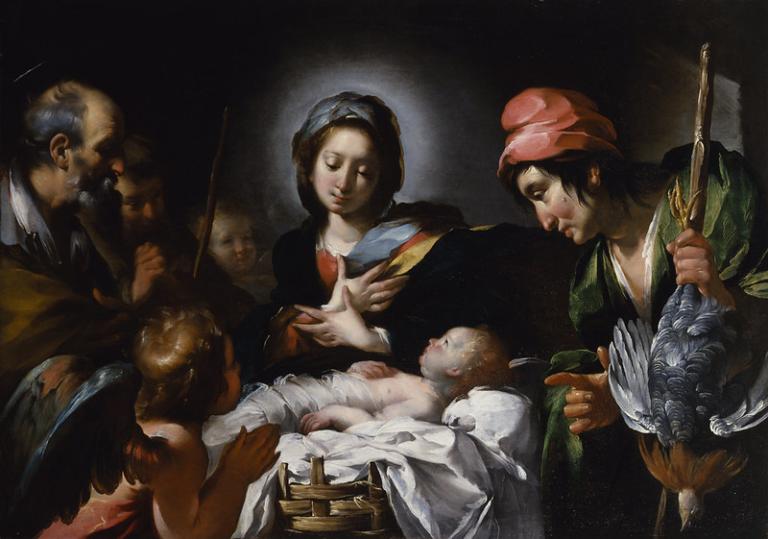
Illustration: “Adoration Of The Shepherds” [c.1615] by Bernardo Strozzi, via Flickr, CC BY-NC-SA 4.0 Deed | Attribution-NonCommercial-ShareAlike 4.0 International
Previous Post

December 22, 2023
Hamas, Bible Prophecy, and Dispensationalism
Next Post

December 26, 2023 The Anniversary of Nativity Scenes
Recent Comments
"I am told one only gets the $90 if one is on a Supplemental Medicare ..."
On Trump’s Political Ads That You ..."
"I too don't think the $5,000 giveaway will happen, but only because the Trumpublicans won't ..."
On Trump’s Political Ads That You ..."
"Well, large cash give-aways are generally bad policy, but really bad in any of the ..."
On Trump’s Political Ads That You ..."
"Well, we think it pretty much fits my thesis, except I'm not sure whether all ..."
On Trump’s Political Ads That You ..."
Browse Our Archives
Select a Category America Apologetics Art baseball Bible Blog Christ Church crime Culture Economics Education Ethics Family Food Football Government History Holidays Holy Week Humor International Islam Language Law Life Issues Literature Media Medicine Movies Music Nature News Personal Philosophy Politics psychology Reformation Religions Sacraments Science sex Social Science Sports technology television terrorism Theology Uncategorized Vocation war
Select a Month October 2026 September 2026 August 2026 July 2026 June 2026 May 2026 April 2026 March 2026 February 2026 January 2026 December 2025 November 2025 October 2025 September 2025 August 2025 July 2025 June 2025 May 2025 April 2025 March 2025 February 2025 January 2025 December 2024 November 2024 October 2024 September 2024 August 2024 July 2024 June 2024 May 2024 April 2024 March 2024 February 2024 January 2024 December 2023 November 2023 October 2023 September 2023 August 2023 July 2023 June 2023 May 2023 April 2023 March 2023 February 2023 January 2023 December 2022 November 2022 October 2022 September 2022 August 2022 July 2022 June 2022 May 2022 April 2022 March 2022 February 2022 January 2022 December 2021 November 2021 October 2021 September 2021 August 2021 July 2021 June 2021 May 2021 April 2021 March 2021 February 2021 January 2021 December 2020 November 2020 October 2020 September 2020 August 2020 July 2020 June 2020 May 2020 April 2020 March 2020 February 2020 January 2020 December 2019 November 2019 October 2019 September 2019 August 2019 July 2019 June 2019 May 2019 April 2019 March 2019 February 2019 January 2019 December 2018 November 2018 October 2018 September 2018 August 2018 July 2018 June 2018 May 2018 April 2018 March 2018 February 2018 January 2018 December 2017 November 2017 October 2017 September 2017 August 2017 July 2017 June 2017 May 2017 April 2017 March 2017 February 2017 January 2017 December 2016 November 2016 October 2016 September 2016 August 2016 July 2016 June 2016 May 2016 April 2016 March 2016 February 2016 January 2016 December 2015 November 2015 October 2015 September 2015 August 2015 July 2015 June 2015 May 2015 April 2015 March 2015 February 2015 January 2015 December 2014 November 2014 October 2014 September 2014 August 2014 July 2014 June 2014 May 2014 April 2014 March 2014 February 2014 January 2014 December 2013 November 2013 October 2013 September 2013 August 2013 July 2013 June 2013 May 2013 April 2013 March 2013 February 2013 January 2013 December 2012 November 2012 October 2012 September 2012 August 2012 July 2012 June 2012 May 2012 April 2012 March 2012 February 2012 January 2012 December 2011 November 2011 October 2011 September 2011 August 2011 July 2011 June 2011 May 2011 April 2011 March 2011 February 2011 January 2011 December 2010 November 2010 October 2010 September 2010 August 2010 July 2010 June 2010 May 2010 April 2010 March 2010 February 2010 January 2010 December 2009 November 2009 October 2009 September 2009 August 2009 July 2009 June 2009 May 2009 April 2009 March 2009 February 2009 January 2009 December 2008 November 2008 October 2008 September 2008 August 2008 July 2008 June 2008 May 2008 April 2008 March 2008 February 2008 January 2008 December 2007 November 2007 October 2007
Follow Us!
TAKE THE
Religious Wisdom Quiz
Who was healed by touching the hem of Jesus’ garment?
Select your answer to see how you score.
A blind man A leper A woman with an issue of blood A centurion
Books by This Author Books by Gene Veith
Related posts from Cranach


Gen Z Wants Evildoers to Be Punished, Not...

On Trump's Political Ads That You Paid For

As Fulton Sheen Is Beatified, Don't Forget Walter...
TRENDING AT PATHEOS Evangelical

Janie Learns the Way of the Cross: A...
Teaching children about Jesus' Passion can be challenging. Many parents and educators...

Looking For Good Catholic Writing - October 2026
He alone extends the heavens, and he walks upon the waves of...

In "Irreplaceable," our book on vocation and technology, Trevor Sutton and I...

I was strolling through the top floor of the brand new Parthenon...

What Does Gêvâh Mean For Kimberley Guifoyle &...
This week, a lot of the news is focused on Kimberly Guilfoyle....

INNER CIRCLE: Profound Mystery (Of Christ In All...
Ephesians 5:31-32 “For this reason, a man will leave his father and...
view all Evangelical blogs
What Are Your Thoughts?leave a comment
Ad-Free & Subscriber Log-In Subscription Support
- About Us
- 2026 Calendar
- Videos
- Podcasts
- Library of World Religions
- Faith In Media Tracker
- Advertise With Us
- Write for Us
- Privacy Policy
- Terms of Service
- Do Not Sell My Data
- Contact Us
- Radiant Digital
- Manage Newsletter Subscriptions
- Unsubscribe From Notifications
- Sitemap
Copyright 2008-2026, Patheos. All rights reserved.
Subscription Support Ad-Free & Subscriber Log-In
Follow Patheos