
BuddhistCatholicContemplativeEvangelicalGeneral ChristianHinduJewishLatter-day SaintMuslimNew VisionsProgressive Christian
Beliefs
- Buddhist
- Catholic
- Contemplative
- Evangelical
- General Christian
- Hindu
- Jewish
- Latter-day Saint
- More Voices
- Muslim
- New Visions
- Pagan
- Progressive Christian
Topics
- Religion News
- Food and Religion
- Sports and Religion
- Religious Art
- Religious Music and Entertainment
- Religious Events
- History and Religion
- Style and Religion
- Politics and Religion
- Women in Religion
- Recreation Outdoors and Religion
- Business Finance and Religion
- Careers Workplace and Religion
- Education and Religion
- Family Parenting and Religion
- Health Fitness and Religion
- Home and Religion
- Relationships and Religion
- Technology and Religion
- Travel and Religion
Columnists
- Buddhist Columnists
- Business Finance and Religion Columnists
- Careers Workplace and Religion Columnists
- Catholic Columnists
- Contemplative Columnists
- Education and Religion Columnists
- Evangelists Columnists
- Family Parenting and Religion Columnists
- General Christian Columnists
- Health Fitness and Religion Columnists
- Hindu Columnists
- History and Religion Columnists
- Home and Religion Columnists
- Jewish Columnists
- More Voices Columnists
- Latter Day Columnists
- Muslim Columnists
- New Visions Columnists
- Nonreligious Columnists
- Pagan Columnists
- Politics and Religion Columnists
- Progressive Columnists
- Recreation Outdoors and Religion Columnists
- Relationships and Religion Columnists
- Religion News Columnists
- Religious Art Columnists
- Religious Events Columnists
- Religious Music and Entertainment Columnists
- Sports and Religion Columnists
- Style and Religion Columnists
- Technology and Religion Columnists
- Travel and Religion Columnists
- Women in Religion Columnists
Resource Library
- 2026 Calendar
- Library of World Religions
- The 100 Most Holy Places on Earth
- Patheos Answers
- Podcasts
- Videos
- Faith Leaders Database
- Anglican Episcopalian
- Bahai
- Baptist
- Buddhism
- Christianity
- Confucianism
- Eastern Orthodoxy
- Hinduism
- Holiness and Pentecostal
- ISKCON
- Islam
- Judaism
- Lutheran
- Methodist
- The Church of Jesus Christ of Latter-day Saints
- New Age
- Paganism
- Presbytarian and Reformed
- Protestantism
- Religion Behind the Scenes
- Roman Catholic
- Scientology
- Shia Islam
- Sikhism
- Sufism
- Sunni Islam
- Taoism
- Zen
- See all religions
Research Tools
 Ad-Free & Subscriber Log-In Subscription Support
Ad-Free & Subscriber Log-In Subscription Support
Follow Patheos 

- Trending:
- Forgiveness
- |
- Marriage
- |
- Consciousness
- |
- Death Penalty
- |
- Election
- |
- Halloween

- Home
- Evangelical
- Politics and Religion
- The Dream of Frederick the Wise
The Dream of Frederick the Wise
Last updated on: November 23, 2022 at 6:00 am by Gene Veith
The Dream of Frederick the Wise 2022-11-19T14:53:04-05:00 Gene Veith
Patheos Explore the world's faith through different perspectives on religion and spirituality! Patheos has the views of the prevalent religions and spiritualities of the world.
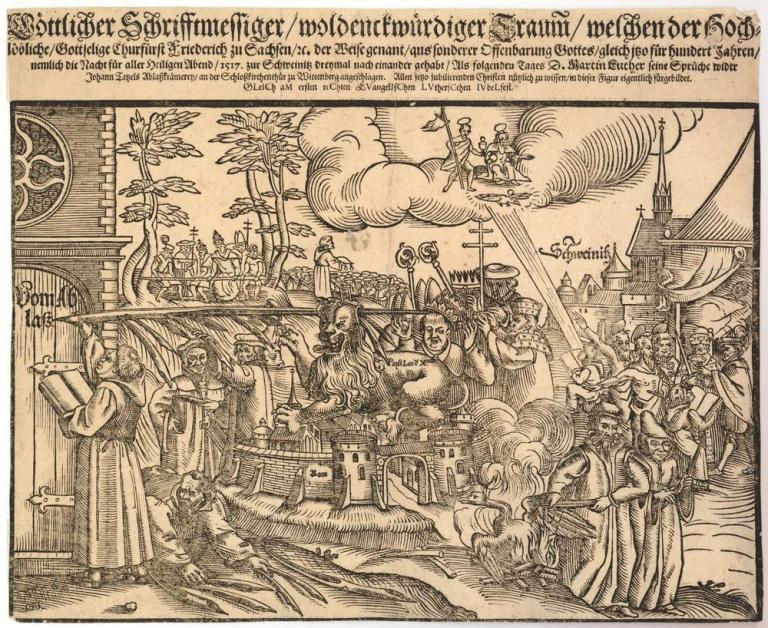
I illustrated my recent post The Political Influence of the Reformation with a 17th century painting entitled “The Dream of Frederic the Wise of Saxony” by Jan Barentsz. It depicted a dream that the Elector supposedly had the night before Luther posted his theses, in which a monk writes something on the door of the Castle Church with a quill that reaches all the way to Rome, where it threatened to knock off the pope’s tiara.
I had never heard of that before, so I dug deeper. The story sounds like a legend, if not Reformation propaganda, but I was curious where it came from.
I found the account of the dream discussed and translated at The Red Brick Parsonage, a wonderful site in which Rev. Nathaniel J. Biebert offers “translations for confessional Lutherans.”
He says that the dream, which became a popular subject for woodcuts in the 17th century, indeed sounds apocryphal. But it can be traced, though indirectly and at third hand, to the Elector’s court.
And, if the account of the dream is in any way accurate, it would help solve one of the biggest mysteries of the Reformation: Duke Frederick was known as an exceptionally devout adherent of the Church of Rome, who owned one of the biggest collections of relics in Christendom, the veneration of which could earn pilgrims (who also paid a fee) thousands of years of indulgences. So why did this loyal son of the Church support and protect Luther?
Rev. Biebert traces the provenance of the earliest account of the dream, a manuscript in Dresden, which is a 1591 copy of a manuscript by Anton Musa (c. 1485–1547), who testifies that he heard the story from George Spalatin (1484–1545), the Elector’s advisor who became a close friend of Luther, who, in turn, heard it directly from Frederick.
I urge you to read Rev. Biebert’s translation of the manuscript in its entirety. Frederick is telling about his dream to his brother (who would succeed him, the fervently Lutheran John the Steadfast), asking him what it could possibly mean, if anything. He describes going to sleep, waking up with thoughts of All Saints’ Day and praying for the “dear souls” in purgatory, then falling to sleep again.
“Then I dreamed that the almighty God was sending a monk to me with a nice, honest face, who was the natural son of St. Paul, the dear apostle. He was accompanied, at God’s command, by all the dear saints, who were supposed to vouch for the monk before me that there was no deceit in him, but that he was truly an ambassador of God. God told them to instruct me to allow the monk to write something for me on my Castle Church in Wittenberg; I would not regret it. So I sent him word through the chancellor, saying that since God was telling me to do this, and since he was so powerfully vouched for, he could write what had been entrusted to him. Then the monk started to write, and his writing was so large that I could make it out here in Schweinitz. He was also using such a long quill pen that the back part of it reached all the way to Rome, and its shaft stabbed a lion who was lying in Rome in one of his ears, so that the shaft came back out through his other ear. The quill extended further all the way to the Papal Holiness’s tiara, and it knocked against it so hard that it began to wobble and was about to fall from His Holiness’s head. So as it was falling—I think I and Your Dearness were not standing too far away—I reached out my hand and tried to help steady it. Right when I was quickly grabbing hold of it, I woke up, and I was still holding my arm in the air.
Says Frederick, “I was completely terrified and at the same time angry at the monk for not exercising more restraint with his pen when writing.” He goes to sleep again, and the dream recurs, with additions. This time the quill “caused the lion to roar so dreadfully that the entire city of Rome and all the estates of the Holy Roman Empire came running to see what was going on. And then the Papal Holiness demanded of the estates that the monk be restrained, and especially that I be informed of this outrage.”
Frederick woke up and “prayed that God would guard the Papal Holiness from all evil.” Then the dream recurred for a third time. He described trying to break the quill. “But the more we tried to get at the quill, the more rigid it became.” Then the dreaming Duke tries to find out what is going on. “Nevertheless I had someone ask the monk (for at one moment I was in Rome, in Wittenberg the next) how he had come into the possession of such a feather, and how it happened to be so tough and firm? He relayed to me that it was from an old, hundred-year-old Bohemian goose.” That is a clear reference to the proto-Reformer John Hus, whose last name means “goose” in Czech!
Then more quills started appearing. “Many countless other quills had grown out of the monk’s long quill here in Wittenberg, and it was entertaining to watch as many scholars were scrambling to get them, with some of them thinking that these fresh, new quills would in time become just as large and long as this monk’s quill, and that something special would certainly happen as a result of this monk and his long quill.”
OK, the reference to Hus and the other quills might seem a little fishy. But the account is certainly dreamlike, as in the odd shifts and Frederick saying he was in Rome one moment and Wittenberg the next. That sort of thing happens in dreams, but not so much in literary allegories presented as dreams.
And it falls short as propaganda. Frederick is not presented as a hero of the Reformation, but as someone who prays for the souls in Purgatory and who seeks to defend the Pope against this monk and his quill. John the Steadfast says that the dream probably doesn’t mean anything. And there is no mention of the dream coming true the next day, when an actual monk writes an actual text on the door of Castle Church, which sets off a chain of events that does reach to Rome and unsettles the Pope’s authority.
So did Frederick the Wise really dream this and recognize that it was coming true with Luther? And did he consider the dream a sign from God, causing him to side with this monk with the formidable pen? Luther would surely have pointed the Elector to the Word of God, not to dreams, as the means of discerning God’s will. But attending to a dream would not have been that unusual for a medieval Catholic, a loyal son of Rome. Maybe God made an exception in reaching the Elector in this way.
As Rev. Biebert says, “Some act of special, divine intervention is almost required in order to understand why this otherwise loyal Catholic prince went out of his way to protect a subject who caused him so many headaches.”
Illustrations: Anonymous, Elector Frederick the Wise of Saxony’s Dream in Schweinitz on October 31, 1517, 1717, woodcut, via Red Brick Parsonage, Public Domain.
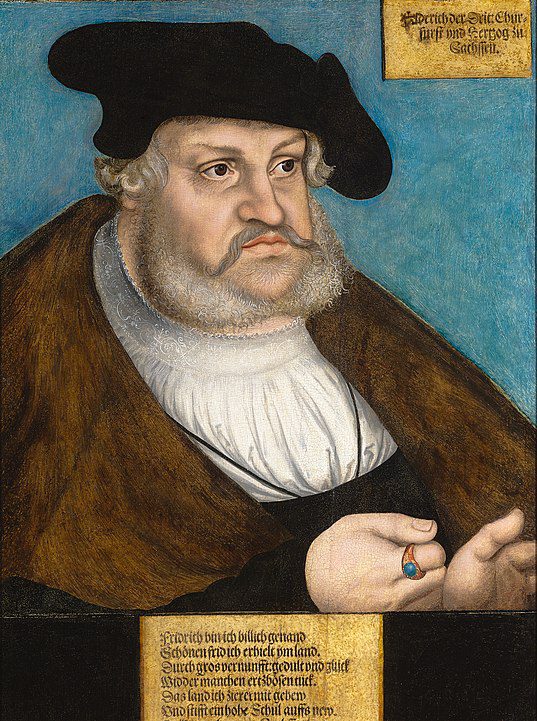
Portrait of Frederick the Wise by Lucas Cranach the Elder – https://www.artsy.net/artwork/lucas-cranach-the-elder-portrait-of-frederick-the-wise, Public Domain, https://commons.wikimedia.org/w/index.php?curid=74870924
the dream of Frederick the Wise
Previous Post

November 22, 2022
Will Human Beings Become Unable to Reproduce?
Next Post

November 24, 2022 The Sacrifice of Thanksgiving
Recent Comments
"While she worked for Trump she was a tool's tool!"
"I know wired earbuds are making a comeback (I never stopped using them as I ..."
"VCRs, tape decks, and cassette players are all having a revival among a segment of ..."
"As a (retired) lawyer I see potential liability from sharing things like power or sharp ..."
Browse Our Archives
Select a Category America Apologetics Art baseball Bible Blog Christ Church crime Culture Economics Education Ethics Family Food Football Government History Holidays Holy Week Humor International Islam Language Law Life Issues Literature Media Medicine Movies Music Nature News Personal Philosophy Politics psychology Reformation Religions Sacraments Science sex Social Science Sports technology television terrorism Theology Uncategorized Vocation war
Select a Month October 2026 September 2026 August 2026 July 2026 June 2026 May 2026 April 2026 March 2026 February 2026 January 2026 December 2025 November 2025 October 2025 September 2025 August 2025 July 2025 June 2025 May 2025 April 2025 March 2025 February 2025 January 2025 December 2024 November 2024 October 2024 September 2024 August 2024 July 2024 June 2024 May 2024 April 2024 March 2024 February 2024 January 2024 December 2023 November 2023 October 2023 September 2023 August 2023 July 2023 June 2023 May 2023 April 2023 March 2023 February 2023 January 2023 December 2022 November 2022 October 2022 September 2022 August 2022 July 2022 June 2022 May 2022 April 2022 March 2022 February 2022 January 2022 December 2021 November 2021 October 2021 September 2021 August 2021 July 2021 June 2021 May 2021 April 2021 March 2021 February 2021 January 2021 December 2020 November 2020 October 2020 September 2020 August 2020 July 2020 June 2020 May 2020 April 2020 March 2020 February 2020 January 2020 December 2019 November 2019 October 2019 September 2019 August 2019 July 2019 June 2019 May 2019 April 2019 March 2019 February 2019 January 2019 December 2018 November 2018 October 2018 September 2018 August 2018 July 2018 June 2018 May 2018 April 2018 March 2018 February 2018 January 2018 December 2017 November 2017 October 2017 September 2017 August 2017 July 2017 June 2017 May 2017 April 2017 March 2017 February 2017 January 2017 December 2016 November 2016 October 2016 September 2016 August 2016 July 2016 June 2016 May 2016 April 2016 March 2016 February 2016 January 2016 December 2015 November 2015 October 2015 September 2015 August 2015 July 2015 June 2015 May 2015 April 2015 March 2015 February 2015 January 2015 December 2014 November 2014 October 2014 September 2014 August 2014 July 2014 June 2014 May 2014 April 2014 March 2014 February 2014 January 2014 December 2013 November 2013 October 2013 September 2013 August 2013 July 2013 June 2013 May 2013 April 2013 March 2013 February 2013 January 2013 December 2012 November 2012 October 2012 September 2012 August 2012 July 2012 June 2012 May 2012 April 2012 March 2012 February 2012 January 2012 December 2011 November 2011 October 2011 September 2011 August 2011 July 2011 June 2011 May 2011 April 2011 March 2011 February 2011 January 2011 December 2010 November 2010 October 2010 September 2010 August 2010 July 2010 June 2010 May 2010 April 2010 March 2010 February 2010 January 2010 December 2009 November 2009 October 2009 September 2009 August 2009 July 2009 June 2009 May 2009 April 2009 March 2009 February 2009 January 2009 December 2008 November 2008 October 2008 September 2008 August 2008 July 2008 June 2008 May 2008 April 2008 March 2008 February 2008 January 2008 December 2007 November 2007 October 2007
Follow Us!
TAKE THE
Religious Wisdom Quiz
Who doubted Jesus' resurrection until he saw His wounds?
Select your answer to see how you score.
Thomas Philip Peter James
Books by This Author Books by Gene Veith
Related posts from Cranach

As Fulton Sheen Is Beatified, Don't Forget Walter...

Denying Laity the Chalice--Again
TRENDING AT PATHEOS Evangelical

Letters on Living the Faith by C.S. Lewis
Most of us met C.S. Lewis as a public intellectual. Mere Christianity....

When Halloween Unmasks Married Hearts
Written by Dr. David K. Ewen from Eternal Truth Bible College Behind...

Aristotle. He’s been called the father of logic, the father of the...

Methodist Central Hall and Westminster Abbey
Situated on the same square is Methodist Central Hall and Westminster Abbey. ...

57th Dove Awards Honor Dolly Parton, Crown New...
On gospel music’s biggest night, the 57th annual GMA Dove Awards honored...

The First Eucharistic Controversy: Christ’s Real Presence
For Catholics, the Eucharist is the source and summit of the Christian...
view all Evangelical blogs
What Are Your Thoughts?leave a comment
Ad-Free & Subscriber Log-In Subscription Support
- About Us
- 2026 Calendar
- Videos
- Podcasts
- Library of World Religions
- Faith In Media Tracker
- Advertise With Us
- Write for Us
- Privacy Policy
- Terms of Service
- Do Not Sell My Data
- Contact Us
- Radiant Digital
- Manage Newsletter Subscriptions
- Unsubscribe From Notifications
- Sitemap
Copyright 2008-2026, Patheos. All rights reserved.
Subscription Support Ad-Free & Subscriber Log-In
Follow Patheos