
BuddhistCatholicContemplativeEvangelicalGeneral ChristianHinduJewishLatter-day SaintMuslimNew VisionsProgressive Christian
Beliefs
- Buddhist
- Catholic
- Contemplative
- Evangelical
- General Christian
- Hindu
- Jewish
- Latter-day Saint
- More Voices
- Muslim
- New Visions
- Pagan
- Progressive Christian
Topics
- Religion News
- Food and Religion
- Sports and Religion
- Religious Art
- Religious Music and Entertainment
- Religious Events
- History and Religion
- Style and Religion
- Politics and Religion
- Women in Religion
- Recreation Outdoors and Religion
- Business Finance and Religion
- Careers Workplace and Religion
- Education and Religion
- Family Parenting and Religion
- Health Fitness and Religion
- Home and Religion
- Relationships and Religion
- Technology and Religion
- Travel and Religion
Columnists
- Buddhist Columnists
- Business Finance and Religion Columnists
- Careers Workplace and Religion Columnists
- Catholic Columnists
- Contemplative Columnists
- Education and Religion Columnists
- Evangelists Columnists
- Family Parenting and Religion Columnists
- General Christian Columnists
- Health Fitness and Religion Columnists
- Hindu Columnists
- History and Religion Columnists
- Home and Religion Columnists
- Jewish Columnists
- More Voices Columnists
- Latter Day Columnists
- Muslim Columnists
- New Visions Columnists
- Nonreligious Columnists
- Pagan Columnists
- Politics and Religion Columnists
- Progressive Columnists
- Recreation Outdoors and Religion Columnists
- Relationships and Religion Columnists
- Religion News Columnists
- Religious Art Columnists
- Religious Events Columnists
- Religious Music and Entertainment Columnists
- Sports and Religion Columnists
- Style and Religion Columnists
- Technology and Religion Columnists
- Travel and Religion Columnists
- Women in Religion Columnists
Resource Library
- 2026 Calendar
- Library of World Religions
- The 100 Most Holy Places on Earth
- Patheos Answers
- Podcasts
- Videos
- Faith Leaders Database
- Anglican Episcopalian
- Bahai
- Baptist
- Buddhism
- Christianity
- Confucianism
- Eastern Orthodoxy
- Hinduism
- Holiness and Pentecostal
- ISKCON
- Islam
- Judaism
- Lutheran
- Methodist
- The Church of Jesus Christ of Latter-day Saints
- New Age
- Paganism
- Presbytarian and Reformed
- Protestantism
- Religion Behind the Scenes
- Roman Catholic
- Scientology
- Shia Islam
- Sikhism
- Sufism
- Sunni Islam
- Taoism
- Zen
- See all religions
Research Tools
 Ad-Free & Subscriber Log-In Subscription Support
Ad-Free & Subscriber Log-In Subscription Support
Follow Patheos 

- Trending:
- Forgiveness
- |
- Marriage
- |
- Consciousness
- |
- Death Penalty
- |
- Election
- |
- Halloween

- Home
- Evangelical
- Politics and Religion
- Agents to be Persuaded or Victims to be Nudged?
Agents to be Persuaded or Victims to be Nudged?
Last updated on: June 8, 2022 at 6:09 am by Gene Veith
Agents to be Persuaded or Victims to be Nudged? 2022-06-04T12:24:16-04:00 Gene Veith
Patheos Explore the world's faith through different perspectives on religion and spirituality! Patheos has the views of the prevalent religions and spiritualities of the world.
What is a citizen? A rational, self-governing individual, so that the political task consists largely of debate and persuasion? Or a potential victim whom the government must protect from harm by imposing controls?
According to Matthew Crawford, we have drifted to that latter conception of the role of citizens and the role of government. In his essay Covid Was Liberalism’s Endgame, he argues that the pandemic exposed the weakened state of liberal democracy and, indeed, may have brought it to an end.
Please, read it all. Here are some samples:
Our regime is founded on two rival pictures of the human subject. The Lockean one regards us as rational, self-governing creatures. It locates reason in a common human endowment — common sense, more or less — and underwrites a basically democratic or majoritarian form of politics. There are no secrets to governing. The second, rival picture insists we are irrationally proud, and in need of being governed. This Hobbesian picture is more hortatory than the first; it needs us to think of ourselves as vulnerable, so the state can play the role of saving us. It underwrites a technocratic, progressive form of politics.
The Lockean assumption has been quietly put to bed over the last 30 years, and we have fully embraced the Hobbesian alternative.
The Nineties saw the rise of new currents in the social sciences that emphasise the cognitive incompetence of human beings, deposing the “rational actor” model of human behaviour. This gave us nudge theory, a way to alter people’s behaviour without having to persuade them of anything. . . .
This is one front in a larger development: an intensifying distrust of human judgment when it operates in the wild, unsupervised. Sometimes this takes the purely bureaucratic form of insisting on metrics of performance and imposing uniform procedures on professionals. “Evidence-based medicine” circumscribes the discretion of doctors; standardised tests and curricula do the same for teachers. At other times, this same impulse takes a technological form, with algorithms substituting for individual judgment on the grounds that human rationality is the weak link in the system. For example, it is stipulated that human beings are terrible drivers and must be replaced in a new regime of autonomous vehicles. The effect, consistently, is to remove agency from skilled practitioners on the grounds of incompetence, and devolve power upward toward a separate layer of information managers that grows ever thicker. . . .
In 2020, a fearful public acquiesced to an extraordinary extension of expert jurisdiction over every domain of life, and a corresponding transfer of sovereignty from representative bodies to unelected agencies located in the executive branch of government. Notoriously, polling indicated that perception of the risks of Covid outstripped the reality by one to two orders of magnitude, but with a sharp demarcation: the hundredfold distortion was among self-identified liberal Democrats, that is, those whose yard signs exhorted us to “believe in science.”
In a technocratic regime, whoever controls what Science Says controls the state. What Science Says is then subject to political contest, and subject to capture by whoever funds it. Which turns out to be the state itself. Here is an epistemic self-licking ice cream cone that bristles at outside interference. Many factual ambiguities and rival hypotheses about the pandemic, typical of the scientific process, were resolved not by rational debate but by intimidation, with heavy use of the term “disinformation” and attendant enforcement by social media companies acting as franchisees of the state. In this there seems to have been a consistent bias toward scientific interpretations that induced fear, even at the cost of omitting relevant context.
He says much more, covering also “moral emergencies,” “victim dramas,” and how the COVID lockdowns worked to create “social distance” from intermediary institutions and relationships, leaving only dependence on the state. Again, you’ve got to read it all.
Although Crawford describes liberal Democrats as the most in thrall to this way of thinking, he suggests that conservatives too have fallen into this “Hobbesian” view of citizenship and government. Conservatives also appeal to our sense of vulnerability and victimhood and promises to relieve our fears by state action. And much Republican rhetoric also seeks to “nudge” voters rather than persuade them.
Some fears are surely legitimate, though. What conservatives are mostly afraid of is precisely the intrusive and paternalistic state: that it will persecute our religion, corrupt our children, take our guns, and destroy our economy.
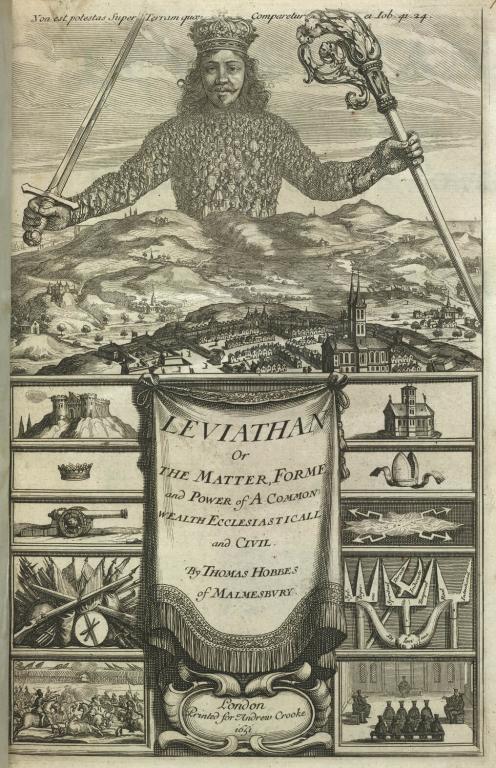
One could argue that a Biblical view of government suggests that we are not as rational as Locke assumed and that Hobbes had a point (Romans 13:1-7; 1 Peter 2:13-17). But punishing evildoers so as to allow those who do well to flourish ascribes a fairly minimalistic role to government compared to the all-encompassing Leviathan advocated by Hobbes and put into practice by politicians today.
What do you think of Crawford’s concerns?
Illustration: Title Page of Thomas Hobbes’ “Leviathan” (1651), British Library, CC0, via Wikimedia Commons
Previous Post

June 7, 2022
The Conversion of a "Spiritual but Not Religious" Secularist
Next Post

June 9, 2022 The Greater Diversity of Small Towns
Recent Comments
"While she worked for Trump she was a tool's tool!"
"I know wired earbuds are making a comeback (I never stopped using them as I ..."
"VCRs, tape decks, and cassette players are all having a revival among a segment of ..."
"As a (retired) lawyer I see potential liability from sharing things like power or sharp ..."
Browse Our Archives
Select a Category America Apologetics Art baseball Bible Blog Christ Church crime Culture Economics Education Ethics Family Food Football Government History Holidays Holy Week Humor International Islam Language Law Life Issues Literature Media Medicine Movies Music Nature News Personal Philosophy Politics psychology Reformation Religions Sacraments Science sex Social Science Sports technology television terrorism Theology Uncategorized Vocation war
Select a Month October 2026 September 2026 August 2026 July 2026 June 2026 May 2026 April 2026 March 2026 February 2026 January 2026 December 2025 November 2025 October 2025 September 2025 August 2025 July 2025 June 2025 May 2025 April 2025 March 2025 February 2025 January 2025 December 2024 November 2024 October 2024 September 2024 August 2024 July 2024 June 2024 May 2024 April 2024 March 2024 February 2024 January 2024 December 2023 November 2023 October 2023 September 2023 August 2023 July 2023 June 2023 May 2023 April 2023 March 2023 February 2023 January 2023 December 2022 November 2022 October 2022 September 2022 August 2022 July 2022 June 2022 May 2022 April 2022 March 2022 February 2022 January 2022 December 2021 November 2021 October 2021 September 2021 August 2021 July 2021 June 2021 May 2021 April 2021 March 2021 February 2021 January 2021 December 2020 November 2020 October 2020 September 2020 August 2020 July 2020 June 2020 May 2020 April 2020 March 2020 February 2020 January 2020 December 2019 November 2019 October 2019 September 2019 August 2019 July 2019 June 2019 May 2019 April 2019 March 2019 February 2019 January 2019 December 2018 November 2018 October 2018 September 2018 August 2018 July 2018 June 2018 May 2018 April 2018 March 2018 February 2018 January 2018 December 2017 November 2017 October 2017 September 2017 August 2017 July 2017 June 2017 May 2017 April 2017 March 2017 February 2017 January 2017 December 2016 November 2016 October 2016 September 2016 August 2016 July 2016 June 2016 May 2016 April 2016 March 2016 February 2016 January 2016 December 2015 November 2015 October 2015 September 2015 August 2015 July 2015 June 2015 May 2015 April 2015 March 2015 February 2015 January 2015 December 2014 November 2014 October 2014 September 2014 August 2014 July 2014 June 2014 May 2014 April 2014 March 2014 February 2014 January 2014 December 2013 November 2013 October 2013 September 2013 August 2013 July 2013 June 2013 May 2013 April 2013 March 2013 February 2013 January 2013 December 2012 November 2012 October 2012 September 2012 August 2012 July 2012 June 2012 May 2012 April 2012 March 2012 February 2012 January 2012 December 2011 November 2011 October 2011 September 2011 August 2011 July 2011 June 2011 May 2011 April 2011 March 2011 February 2011 January 2011 December 2010 November 2010 October 2010 September 2010 August 2010 July 2010 June 2010 May 2010 April 2010 March 2010 February 2010 January 2010 December 2009 November 2009 October 2009 September 2009 August 2009 July 2009 June 2009 May 2009 April 2009 March 2009 February 2009 January 2009 December 2008 November 2008 October 2008 September 2008 August 2008 July 2008 June 2008 May 2008 April 2008 March 2008 February 2008 January 2008 December 2007 November 2007 October 2007
Follow Us!
TAKE THE
Religious Wisdom Quiz
Who was the first woman?
Select your answer to see how you score.
Eve Deborah Sarah Mary
Books by This Author Books by Gene Veith
Related posts from Cranach



Our New Book on Technology & Vocation

On Trump's Political Ads That You Paid For
TRENDING AT PATHEOS Evangelical

The Problem with False Prophets
Miller’s Station UMC| 10/18/26| Anchor Verse: Jeremiah 23: 1, 9-23 I...

Emotion in Early Christianity by Andrew Crislip
Andrew Crislip’s Emotion in Early Christianity examines an often overlooked dimension of...

16 Spiritual Touchstones for a More Grounded Life
After decades of spiritual study, here are 16 principles I try...

Catholic Evangelization: Sharing Your Faith Every Day
Welcome back to the Graceful Awakening mini-series called, “From Faith to Mission.” ...

The Pillar of the Boatmen: the Ancient Monument...
The Pillar of the Boatmen is a Romano-Gaulish sculpture that dates from...

In one sense walking into Westminster Abbey is like walking down the...
view all Evangelical blogs
What Are Your Thoughts?leave a comment
Ad-Free & Subscriber Log-In Subscription Support
- About Us
- 2026 Calendar
- Videos
- Podcasts
- Library of World Religions
- Faith In Media Tracker
- Advertise With Us
- Write for Us
- Privacy Policy
- Terms of Service
- Do Not Sell My Data
- Contact Us
- Radiant Digital
- Manage Newsletter Subscriptions
- Unsubscribe From Notifications
- Sitemap
Copyright 2008-2026, Patheos. All rights reserved.
Subscription Support Ad-Free & Subscriber Log-In
Follow Patheos