
BuddhistCatholicContemplativeEvangelicalGeneral ChristianHinduJewishLatter-day SaintMuslimNew VisionsProgressive Christian
Beliefs
- Buddhist
- Catholic
- Contemplative
- Evangelical
- General Christian
- Hindu
- Jewish
- Latter-day Saint
- More Voices
- Muslim
- New Visions
- Pagan
- Progressive Christian
Topics
- Religion News
- Food and Religion
- Sports and Religion
- Religious Art
- Religious Music and Entertainment
- Religious Events
- History and Religion
- Style and Religion
- Politics and Religion
- Women in Religion
- Recreation Outdoors and Religion
- Business Finance and Religion
- Careers Workplace and Religion
- Education and Religion
- Family Parenting and Religion
- Health Fitness and Religion
- Home and Religion
- Relationships and Religion
- Technology and Religion
- Travel and Religion
Columnists
- Buddhist Columnists
- Business Finance and Religion Columnists
- Careers Workplace and Religion Columnists
- Catholic Columnists
- Contemplative Columnists
- Education and Religion Columnists
- Evangelists Columnists
- Family Parenting and Religion Columnists
- General Christian Columnists
- Health Fitness and Religion Columnists
- Hindu Columnists
- History and Religion Columnists
- Home and Religion Columnists
- Jewish Columnists
- More Voices Columnists
- Latter Day Columnists
- Muslim Columnists
- New Visions Columnists
- Nonreligious Columnists
- Pagan Columnists
- Politics and Religion Columnists
- Progressive Columnists
- Recreation Outdoors and Religion Columnists
- Relationships and Religion Columnists
- Religion News Columnists
- Religious Art Columnists
- Religious Events Columnists
- Religious Music and Entertainment Columnists
- Sports and Religion Columnists
- Style and Religion Columnists
- Technology and Religion Columnists
- Travel and Religion Columnists
- Women in Religion Columnists
Resource Library
- 2026 Calendar
- Library of World Religions
- The 100 Most Holy Places on Earth
- Patheos Answers
- Podcasts
- Videos
- Faith Leaders Database
- Anglican Episcopalian
- Bahai
- Baptist
- Buddhism
- Christianity
- Confucianism
- Eastern Orthodoxy
- Hinduism
- Holiness and Pentecostal
- ISKCON
- Islam
- Judaism
- Lutheran
- Methodist
- The Church of Jesus Christ of Latter-day Saints
- New Age
- Paganism
- Presbytarian and Reformed
- Protestantism
- Religion Behind the Scenes
- Roman Catholic
- Scientology
- Shia Islam
- Sikhism
- Sufism
- Sunni Islam
- Taoism
- Zen
- See all religions
Research Tools
 Ad-Free & Subscriber Log-In Subscription Support
Ad-Free & Subscriber Log-In Subscription Support
Follow Patheos 

- Trending:
- Forgiveness
- |
- Marriage
- |
- Consciousness
- |
- Death Penalty
- |
- Election
- |
- Halloween

- Home
- Evangelical
- Politics and Religion
- Attaining Reconciliation
Attaining Reconciliation
Last updated on: September 22, 2021 at 6:00 am by Gene Veith
Attaining Reconciliation 2021-09-21T08:42:49-04:00 Gene Veith
Patheos Explore the world's faith through different perspectives on religion and spirituality! Patheos has the views of the prevalent religions and spiritualities of the world.
In yesterday’s post, we discussed the difference between forgiveness and reconciliation. Forgiveness deals with individuals who are wronged by other individuals. Reconciliation deals with restoring relationships. The Bible says that we need both and that in Christ we have both forgiveness for our sins and reconciliation with God, who calls us to both forgive and be reconciled to each other.
We hear a lot about forgiveness here in our individualistic culture, but reconciliation, which is emphasized in collectivist cultures including that of ancient Israel, is harder to wrap our minds around.
Today I want to delve more deeply into the concept of reconciliation and try to think through how we can carry out “our ministry of reconciliation” with other people. And then I want to apply it to conflicts within the family and to conflicts within our nation. (If you haven’t already, read yesterday’s post. We’ll wait.)
As Prof. Joshua Berman explains it, in his article No Apologies, Just a Kiss, it is possible to be reconciled without forgiving. To use one of his examples, King David initiated a reconciliation with his son Absalom, despite his murder of his other son Amnon, but Absalom did not forgive his father for not punishing Amnon for raping his sister and eventually tried to seize the throne from his father.
And it is possible to forgive without being reconciled, as we see in marriages in which one spouse might ask for and receive forgiveness from the wronged spouse, but the relationship between them is never restored.
So how is reconciliation attained?
Prof. Berman points out that in the Old Testament, as in other “cultures of reconciliation,” “the party with the higher status” or “the aggrieved party” initiates the reconciliation, doing so with a kiss, a one-sided expression of love, which is given and received with overwhelming emotion and God, of course, has the highest status of all, and He has initiated our reconciliation with a one-sided expression of love; namely, becoming incarnate and dying for us.
Notice how well this corresponds to the theology of grace, that God initiates our reconciliation with Him, with no obligation to do so, as a one-sided act of love.
How do we carry out Christ’s command to “be reconciled to your brother” (Matthew 5:23-24)? It would seem that on the human level, the person who is in the higher position or who is the aggrieved party would need to take the initiative, which must be of pure grace.
In a toxic workplace where everybody is at everybody’s throat, it’s likely up to the boss to make things right. In a family that is torn apart, the “head of the family”–traditionally, the father–should try to work reconciliation. In a marriage that is marred by fighting and resentment, the husband, in his traditional role, should initiate reconciliation with his wife.
But if there is a specific “aggrieved party,” a person who has been hurt–perhaps even by the “head” authority–that person must initiate any reconciliation that is to take place. And he or she is under no obligation to do so. It must be an act of “grace.”
I have heard of a church that had a member family in which the husband was unfaithful and abusive to his wife. But he said that he was sorry, but his wife still left him. The church exercised church discipline not on the sinful husband but on the wife, excommunicating her for the sin of “not forgiving” her “repentant” husband! Among many confusions here, this church was not distinguishing forgiveness and reconciliation. The wife might extend words of forgiveness to the husband’s words of repentance, but that would not be likely to heal the marriage. She might not want to reconcile with this person who mistreated her so terribly. And that, it seems to me, is her right.
As Prof. Berman says of the reconciliations recorded in Scripture, one side–whether the one with the “higher” position or “the aggrieved party”–“seeks to bring harmony to the relationship – never by demanding contrition, but simply by offering a kiss – the kiss of reconciliation, a potent, non-verbal sign: we are too important to each other to allow this continue.”
Not that a kiss and tears on the part of the authority or the aggrieved will necessarily do anything, but some act of love and generosity can be a catalyst for reconciliation.
What about the national reconciliation that our polarized nation seems to need? I’m not sure how that can be carried out, to be honest. Who is aggrieved and who has authority are not always clear–even in marriages, much less in huge groups such as nations–and that may not even apply in disputes between factions. And is common citizenship an actual relationship of the kind that lends itself to reconciliation?
Even if it isn’t, we can speak of national unity, which I suspect is related but has a different dynamic. Historically, a catastrophe–an invasion, an earthquake, an economic collapse, a national tragedy–can bring citizens together. That happened briefly with the 9/11 attacks. But it didn’t happen with COVID, which seems to have only heightened our divisions. But we, no doubt, have plenty of disasters ahead of us, which will likely have an impact on our mutual animosities.
Leadership too, following more the contour of Prof. Berman’s analysis, can pull people together. Winston Churchill and Franklin Roosevelt rallied their factious citizens together in the face of the Depression and World War II. Ronald Reagan, despite pockets of hostility, was overall a uniting figure after the trauma of the Vietnam war.
What about racial reconciliation? Black Americans have a legitimate grievance in their enslavement and subsequent discrimination. Many white Americans became newly sensitive to racial injustice due to last year’s cases of police brutality, as well as new awareness of the historic mistreatment of black people, as disclosed, for example, in the centennial of the Tulsa race riots. This sensitivity was apparent both among white liberals and white conservatives, and it looked like a movement for racial reconciliation could happen. But those moments got hijacked by political extremists, and the subsequent riots, the burning of cities, and the “defund the police” movement have only created more polarization. Critical race theory only heightens the divisions by teaching that they are innate and inevitable.
But what would bring about racial reconciliation? Would reparations? That would have higher-placed whites paying money to the descendants of slaves, but that would seem to be more in the transactional realm of seeking forgiveness, in which the person who does the wrong owes and pays a debt to the person who was mistreated. But since neither those who would pay the reparations or those who would receive them are individually and personally involved in the institution of slavery, that would not seem to accomplish much.
Black Americans are certainly the aggrieved party, though. They could pursue reconciliation without having to forgive the crimes of slavery or the historic and sometimes continual denial of their civil rights. They could initiate some act of grace–I think of the ethos of Martin Luther King, or the grace-filled way that many Black churches have treated their attackers–but those have had limited reach and effect. Again, they are under no obligation to reconcile with anyone.
Then again, time does heal a lot of wounds, at least, and as mistreated minorities take their place in the mainstream and the old hierarchies that once victimized them break down, a certain reconciliation can happen. The Irish, Italians, Poles, and Chinese used to be discriminated against in the United States, but now, though they will still complain about those days and what was done to their ancestors, they have a full share in the American identity. Black Americans have already come a long way towards attaining this, though problems remain, and it may be that racial reconciliation is already happening and will come to fruition.
There are other problems as well as success stories. Native Americans have much to be aggrieved about. Hispanics have faced discrimination but many are well-integrated into the rest of American society and are increasingly asserting their religious and family values to the point of becoming political conservatives. But mass uncontrolled immigration is working against national unity.
I’m not sure that reconciliation, as such, is always possible or even desirable in all circumstances. Again, reconciliation has to do with the restoration of relationships, not reconciling different ideas or beliefs. In ideological conflicts, such as those between pro-lifers and pro-abortionists, there can be no reconciliation of positions. But ideas or political positions are not relationships. There should be a reconciliation between family members who are divided over politics, but that would be a restoration of the family, though the political differences would still remain.
I don’t have all the answers and I’m not even sure of all of the answers I am putting forward. How would you apply these principles of reconciliation?
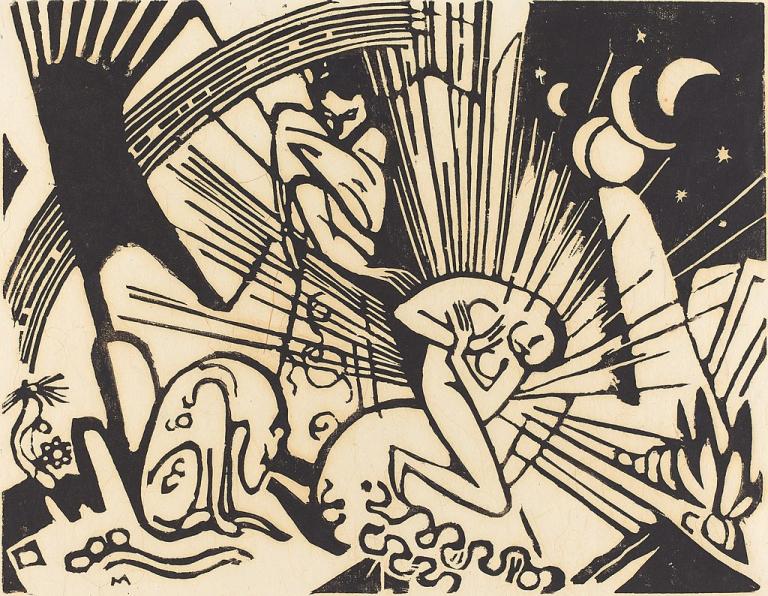
Illustration: “Reconciliation” (1912) by Franz Marc, CC0, via Wikimedia Commons
Previous Post

September 21, 2021
Forgiveness vs. Reconciliation
Next Post

September 23, 2021 Our Elective Monarchy
Recent Comments
"Turns out, she wasn’t the right tool for the job."
"You may have just given me my next sermon opening line."
"So Katie Zacharia lasted only a demiScaramucci as press secretary......"
"Apropos to the post on Gen Z a couple days ago: "If you want the ..."
Browse Our Archives
Select a Category America Apologetics Art baseball Bible Blog Christ Church crime Culture Economics Education Ethics Family Food Football Government History Holidays Holy Week Humor International Islam Language Law Life Issues Literature Media Medicine Movies Music Nature News Personal Philosophy Politics psychology Reformation Religions Sacraments Science sex Social Science Sports technology television terrorism Theology Uncategorized Vocation war
Select a Month October 2026 September 2026 August 2026 July 2026 June 2026 May 2026 April 2026 March 2026 February 2026 January 2026 December 2025 November 2025 October 2025 September 2025 August 2025 July 2025 June 2025 May 2025 April 2025 March 2025 February 2025 January 2025 December 2024 November 2024 October 2024 September 2024 August 2024 July 2024 June 2024 May 2024 April 2024 March 2024 February 2024 January 2024 December 2023 November 2023 October 2023 September 2023 August 2023 July 2023 June 2023 May 2023 April 2023 March 2023 February 2023 January 2023 December 2022 November 2022 October 2022 September 2022 August 2022 July 2022 June 2022 May 2022 April 2022 March 2022 February 2022 January 2022 December 2021 November 2021 October 2021 September 2021 August 2021 July 2021 June 2021 May 2021 April 2021 March 2021 February 2021 January 2021 December 2020 November 2020 October 2020 September 2020 August 2020 July 2020 June 2020 May 2020 April 2020 March 2020 February 2020 January 2020 December 2019 November 2019 October 2019 September 2019 August 2019 July 2019 June 2019 May 2019 April 2019 March 2019 February 2019 January 2019 December 2018 November 2018 October 2018 September 2018 August 2018 July 2018 June 2018 May 2018 April 2018 March 2018 February 2018 January 2018 December 2017 November 2017 October 2017 September 2017 August 2017 July 2017 June 2017 May 2017 April 2017 March 2017 February 2017 January 2017 December 2016 November 2016 October 2016 September 2016 August 2016 July 2016 June 2016 May 2016 April 2016 March 2016 February 2016 January 2016 December 2015 November 2015 October 2015 September 2015 August 2015 July 2015 June 2015 May 2015 April 2015 March 2015 February 2015 January 2015 December 2014 November 2014 October 2014 September 2014 August 2014 July 2014 June 2014 May 2014 April 2014 March 2014 February 2014 January 2014 December 2013 November 2013 October 2013 September 2013 August 2013 July 2013 June 2013 May 2013 April 2013 March 2013 February 2013 January 2013 December 2012 November 2012 October 2012 September 2012 August 2012 July 2012 June 2012 May 2012 April 2012 March 2012 February 2012 January 2012 December 2011 November 2011 October 2011 September 2011 August 2011 July 2011 June 2011 May 2011 April 2011 March 2011 February 2011 January 2011 December 2010 November 2010 October 2010 September 2010 August 2010 July 2010 June 2010 May 2010 April 2010 March 2010 February 2010 January 2010 December 2009 November 2009 October 2009 September 2009 August 2009 July 2009 June 2009 May 2009 April 2009 March 2009 February 2009 January 2009 December 2008 November 2008 October 2008 September 2008 August 2008 July 2008 June 2008 May 2008 April 2008 March 2008 February 2008 January 2008 December 2007 November 2007 October 2007
Follow Us!
TAKE THE
Religious Wisdom Quiz
Which book includes "A time to weep and a time to laugh"?
Select your answer to see how you score.
Judges Genesis Ecclesiastes Malachi
Books by This Author Books by Gene Veith
Related posts from Cranach


Gen Z Wants Evildoers to Be Punished, Not...

On Trump's Political Ads That You Paid For
TRENDING AT PATHEOS Evangelical

Swimfan: Forgotten Aughts Pleasures
This is a recovery effort. In 2002, My Big Fat Greek Wedding...

Top Three Anti-Catholic Lies About Catholicism
This is my initial transcript for the video, "THE 3 WORST...

Pope Leo Celebrates Mass for Nurses & Docs...
I don't have any idea how he did it, but Pope Leo...

The Sermon on the Mount, Part I: Matthew...
The Sermon on the Mount, Part I (Matthew 4:12-5:12) St. Matthew moves...

What's up from Crossway: Reviewing some of their latest A few weeks...

Janie Learns the Way of the Cross: A...
Teaching children about Jesus' Passion can be challenging. Many parents and educators...
view all Evangelical blogs
What Are Your Thoughts?leave a comment
Ad-Free & Subscriber Log-In Subscription Support
- About Us
- 2026 Calendar
- Videos
- Podcasts
- Library of World Religions
- Faith In Media Tracker
- Advertise With Us
- Write for Us
- Privacy Policy
- Terms of Service
- Do Not Sell My Data
- Contact Us
- Radiant Digital
- Manage Newsletter Subscriptions
- Unsubscribe From Notifications
- Sitemap
Copyright 2008-2026, Patheos. All rights reserved.
Subscription Support Ad-Free & Subscriber Log-In
Follow Patheos