
BuddhistCatholicContemplativeEvangelicalGeneral ChristianHinduJewishLatter-day SaintMuslimNew VisionsProgressive Christian
Beliefs
- Buddhist
- Catholic
- Contemplative
- Evangelical
- General Christian
- Hindu
- Jewish
- Latter-day Saint
- More Voices
- Muslim
- New Visions
- Pagan
- Progressive Christian
Topics
- Religion News
- Food and Religion
- Sports and Religion
- Religious Art
- Religious Music and Entertainment
- Religious Events
- History and Religion
- Style and Religion
- Politics and Religion
- Women in Religion
- Recreation Outdoors and Religion
- Business Finance and Religion
- Careers Workplace and Religion
- Education and Religion
- Family Parenting and Religion
- Health Fitness and Religion
- Home and Religion
- Relationships and Religion
- Technology and Religion
- Travel and Religion
Columnists
- Buddhist Columnists
- Business Finance and Religion Columnists
- Careers Workplace and Religion Columnists
- Catholic Columnists
- Contemplative Columnists
- Education and Religion Columnists
- Evangelists Columnists
- Family Parenting and Religion Columnists
- General Christian Columnists
- Health Fitness and Religion Columnists
- Hindu Columnists
- History and Religion Columnists
- Home and Religion Columnists
- Jewish Columnists
- More Voices Columnists
- Latter Day Columnists
- Muslim Columnists
- New Visions Columnists
- Nonreligious Columnists
- Pagan Columnists
- Politics and Religion Columnists
- Progressive Columnists
- Recreation Outdoors and Religion Columnists
- Relationships and Religion Columnists
- Religion News Columnists
- Religious Art Columnists
- Religious Events Columnists
- Religious Music and Entertainment Columnists
- Sports and Religion Columnists
- Style and Religion Columnists
- Technology and Religion Columnists
- Travel and Religion Columnists
- Women in Religion Columnists
Resource Library
- 2026 Calendar
- Library of World Religions
- The 100 Most Holy Places on Earth
- Patheos Answers
- Podcasts
- Videos
- Faith Leaders Database
- Anglican Episcopalian
- Bahai
- Baptist
- Buddhism
- Christianity
- Confucianism
- Eastern Orthodoxy
- Hinduism
- Holiness and Pentecostal
- ISKCON
- Islam
- Judaism
- Lutheran
- Methodist
- The Church of Jesus Christ of Latter-day Saints
- New Age
- Paganism
- Presbytarian and Reformed
- Protestantism
- Religion Behind the Scenes
- Roman Catholic
- Scientology
- Shia Islam
- Sikhism
- Sufism
- Sunni Islam
- Taoism
- Zen
- See all religions
Research Tools
 Ad-Free & Subscriber Log-In Subscription Support
Ad-Free & Subscriber Log-In Subscription Support
Follow Patheos 

- Trending:
- Forgiveness
- |
- Marriage
- |
- Consciousness
- |
- Death Penalty
- |
- Election
- |
- Halloween

- Home
- Evangelical
- Politics and Religion
- A Post-Christian Version of a Christian Classic
A Post-Christian Version of a Christian Classic
Last updated on: August 12, 2021 at 6:00 am by Gene Veith
A Post-Christian Version of a Christian Classic 2021-08-09T16:03:09-04:00 Gene Veith
Patheos Explore the world's faith through different perspectives on religion and spirituality! Patheos has the views of the prevalent religions and spiritualities of the world.
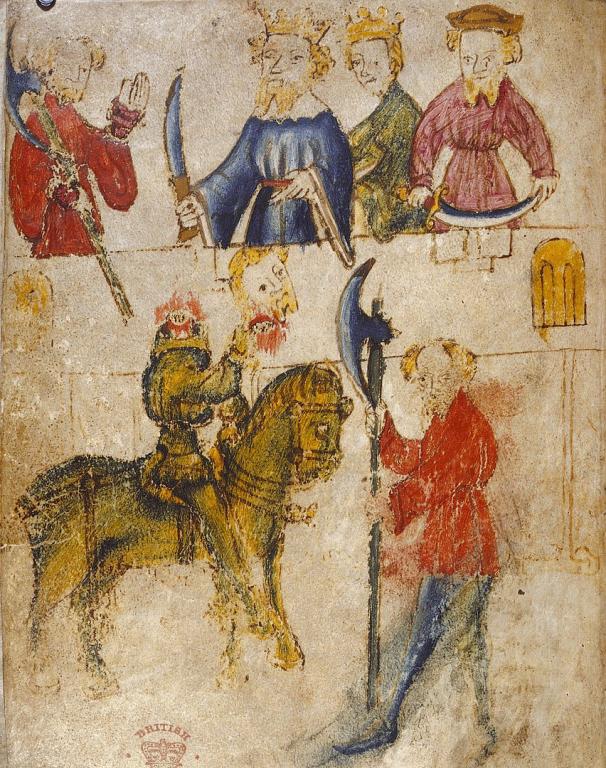
In my opinion, informed by decades of literary study, one of the greatest stories in literature is Sir Gawain and the Green Knight. It has inspired a contemporary film, The Green Knight, which–though well-done in many respects–completely reverses the medieval tale’s original meaning, perhaps suggesting where our post-Christian mentality is heading.
The anonymous narrative poem of the 14th century, written in an obscure English dialect, is full of twists and surprises, with a brilliant structure, both comedy and thrills, and profound themes of both culture and faith.
I urge you to read it in J. R. R. Tolkien’s translation, collected in his book Sir Gawain and the Green Knight, The Pearl, and Sir Orfeo. This is one of Tolkien’s greatest works, bringing together his vocations as a medieval scholar, a linguist, a literary artist, and a master of imaginative fantasy. Tolkien was, like C. S. Lewis, an academic in his day job; and both Tolkien and Lewis are still highly respected in their fields of literary history to this very day, and by fellow-scholars who would never read The Lord of the Rings or Christian apologetics. Tolkien not only understands this chivalric romance and emulates its power as a fantasy, he also brings into modern English the poem’s rhythm, alliteration, and rhyme scheme–something almost never even attempted, let alone brought off successfully, in translations.
Let me briefly tell you the main elements of the tale. And then I’ll tell you what the movie does with it.
Spoiler alert!
The Original
The story begins on New Year’s Eve in the early days of Camelot. Still celebrating the 12 days of Christmas with a feast, the young, energetic King Arthur, the beautiful Guinevere by his side, proclaims that he will not eat until he has witnessed some adventure.
Whereupon a giant green knight rides into the hall on his green horse, carrying an axe. Despite this breach of etiquette (horses are to be left outside), King Arthur welcomes him. The Green Knight proposes a game of trading blows. A knight may give him his best shot with the axe. And then, in a year and a day, it will be the Green Knight’s turn to strike the knight.
Young King Arthur wants to do it, but his court restrains him, so the young but already accomplished Sir Gawain takes up the challenge. (In the Arthurian tales of Celtic Britain, Sir Gawain becomes the greatest of the knights. Later, in the French versions, bringing in the theme of courtly love, the greatest knight is a Frenchman, Sir Lancelot. In Sir Thomas Malory’s synthesis of the traditions, this will later lead to the civil war that destroys the civilization King Arthur has built.)
Sir Gawain, agreeing with the terms, goes up to the intruder, who bares his neck, and with one blow of the axe cuts off his head. That would seem to be that. But then the decapitated body of the Green Knight stands up and picks up his bloody head, which speaks: I will see you in a year and a day at the Green Chapel.
The Green Knight is a vegetation deity, representing the old nature-based paganism that Christianity was supplanting in Britain. Of course, if you cut off the head of a plant, it just grows back, something we are well aware of every time we mow the lawn. Not so with human beings. The story depicts a test for the new religion and for the new cultural values that Camelot represents: Will this new order of knights, supposedly so superior to the old pagan warriors, keep their promises?
The year passes, with vivid and suspense-building descriptions, as Gawain gets closer and closer to the date of his certain doom. When the time comes, he does as he promises, setting off on a quest to find the Green Knight and this mysterious Green Chapel, not having a clue where they might be. But he sets forth anyway. Unlike conventional quests to find a glorious treasure, this one, as far as Gawain is concerned, is a quest for his death.
After many hard adventures, Gawain, starving and in ice-encased armor, comes to a castle. Here he is warmly received. A friendly, hearty knight named Bertilak is delighted to entertain a knight from Camelot who has come all this way into the hinterlands. And he says that he knows where the Green Chapel is, which is quite nearby. He invites Gawain to rest up and to sleep in, while he himself goes hunting. He proposes a friendly exchange: He will give Gawain whatever he gets on his hunt, and Gawain will give him whatever he receives while back at the castle. (Again: Will a knight keep his promises?)
The next morning, while Gawain is luxuriating in bed, Bertilak’s beautiful wife comes into his bedchamber. Gawain is aghast at this impropriety, but because of his courtesy and his chivalrous concern for women, both hallmarks of Camelot, he does not want to berate her or embarrass her. As she asks about the fashions at court, though, she becomes more and more flirtatious. Gawain pretends not to notice, and at the end of the morning, she leaves, but gives him a chaste kiss on the cheek. When her husband gets back, he gives Gawain the deer he has slain, and Gawain honors their agreement by kissing him on the cheek. (Note the moral test: Will this Christian follow the sexual morality he says he believes in, and resist committing adultery?)
The next day goes much the same, with Bertilak’s hunt being much more difficult, going after a wild bore that attacks him, and his wife’s “hunt” also intensifying, as she becomes more and more aggressive. Again, Sir Gawain fends off her and his own passions, and settles for another chaste kiss, which he returns to her husband.
On the third day, though, the wife just comes out with her desire to have sex with Gawaine, and he forthrightly–but with chivalrous consideration for her–refuses. She says that she understands and, to show that there are no hard feelings, she gives him the gift of a magic green belt. Wear it, she says, and no harm can come to you.
Suddenly, we readers, along with Gawain, are reminded of the main plot: The rendezvous with the Green Knight! This can protect him! Gawain gladly takes the belt. But when Bertilak comes back, giving him the only fruit of a bad hunt, a mangy fox, Gawain gives him a kiss, but keeps the belt for himself, thus violating their agreement.
He goes to the Green Chapel and meets the Green Knight. “Now bare your neck like I did!” Gawain does, but as the axe is raised to strike and starts to come down, he flinches. “I didn’t flinch when you did that to me!” “Well, I won’t be able to pick up my head and ride off like you did!” Again, he prepares himself for the blow, but he flinches again. The third time, the axe misses, merely scratching his neck! Gawain jumps up, draws his sword, says you’ve had your blow, and is ready to fight. Whereupon the Green Knight starts to laugh.
“You have passed the test, or at least done well enough.” The Green Knight turns out to be Bertilak. The real test was not in the Green Chapel but in the bedroom. Chivalry and Christian morality were proven. “You only failed once, in desiring to protect your own life, but that is understandable.”
Gawain is abashed, though, at how he depended on a pagan talisman to protect him, instead of Jesus and His Mother, who were painted on the inside of his shield. He goes back to Camelot, which rejoices to see him, and confesses to all his failure and dishonor. Whereupon the King and the court laugh. They all resolve to wear a green belt in his honor, to remind them all of that crucial chivalrous and Christian virtue of humility.
The Movie
The movie is well-made, with strong acting and gorgeous cinematography. It even picked up on some of the original story’s themes, giving me high hopes. Even material it added seemed to be in line with the original (such as the bit it added with Gawain’s mother Morgause, the sister of both Arthur and Morgan le Fay, whom the book credits for orchestrating the test.) But then the movie switched the themes around.
Whereas the original tale was set at the beginning of King Arthur’s reign, the movie presents it at the end. Arthur is old, weak, and decrepit, still noble, but approaching his end. The book, as it were, dramatized the beginning of Christendom to a recently and probably not completely converted Celtic audience. The movie depicts Christianity and the Western Civilization it created as being essentially over.
Instead of the way the book shows paganism giving way to Christianity, the movie shows Christianity giving way to paganism. For example, Bertilak’s castle is full of books, which Gawain marvels at to the wife, who says she has read or written them all. Christianity is presented as backwards, while paganism is presented as a well-spring of learning and education. Which violates history completely! In reality, Christianity in the middle and the previous dark ages was responsible for books and learning, while paganism, as depicted in the book, is about instincts, passion, and irrationalism.
The movie includes the original’s riff on the number 5 as symbolizing the five fingers, the five senses, the five knightly virtues, the five wounds of Christ, the five joys of Mary, etc., but presents it as a magical incantation rather than a confession of how his faith must impact his life. It shows the inside of Gawain’s shield, with its icon of Mary and Jesus, only to have robbers throw it on the ground and cut it in two.
In the movie, Gawain is not even a knight, even though the title of the source book specifies “Sir Gawain. . . ” Rather, he is presented as a clueless youth–though portrayed by a mature man–who wants to be a knight, something he associates with “honor,” with little reference to what that entailed back then.
And the movie doesn’t even consider the virtue of chastity. Gawain is shown at the beginning frequenting brothels. He has a sexual relationship with a lower-class Essel, but he is oblivious to her love for him and treats her despicably, unlike the way actual chivalry would demand.
And Gawain immediately gives in sexually to Bertilak’s wife so that she will give him the magic belt. Here the movie comes off the tracks completely, in leaving out the best and most important part of the original story. The three days of temptation and resistance, paralleling Bertilak’s three hunts, is eliminated completely, crunched into one day with a sex scene, ending with a shot of semen on the green belt.
The old paganism was at least a fertility religion. This newly emergent paganism wants sex, but not fertility, which entails having children and generating new life. Reflecting our new pornographic view of sex, this one is more of a masturbatory religion.
As for the ending, Gawain does flinch from the Green Knight blow and seems to run away, whereas, in a long and confusing sequence, we see his unhappy life unfold. But that turns out be only a vision, from which he wakes up and says he is ready for the blow. The Green Knight speaks kindly to him, but then says, “Now, off with your head!” Fade to credits.
That abrupt, non-conclusive ending prevents any kind of happy ending, which is a necessity in every fairy tale. Nature brings death, the film seems to say, but that is better than the pointless life you would have lived.
The problems of the film are not just the thematic inversions from the original. They are also artistic, as elements are thrown in without being accounted for (such as the naked female giants that parade through) and loose ends are never tied together (such as Bertilak not being revealed as the Green Knight).
There was another more subtle problem that grated on me. The movie is full of “thee’s” and “thou’s,” which I appreciate as being an attempt to evoke medieval language (though it is actually Early Modern). But if you are going to use those pronouns, use them correctly! In the movie, King Arthur gives a wimpy speech to his knights, in which he gives credit for all of his accomplishments “to thee.”
“Thee” is a singular! “Thou” is the subject form, “thee” is the object form, and “thy/thine” are the possessives. “Ye” is the plural subject form (as in “go ye into all the world and preach the gospel), and “you” is the plural object form, with “your/yours” being the possessive.
These distinctions acquired a social distinction, with the singular forms (“thou, thee, thy”) becoming an intimate address reserved for family and close friends. (It was also used to address God, our most intimate friend of all.) The plural forms (ye, you, your) were used to address social superiors. But it was also still used as a plural, when addressing more than one person.
Eventually, we lost all distinctions and use “you” for everyone. But no one in the Middle Ages or the early modern period would address a group as “thee”!
Read this for the grammar and this for the difference it makes in reading Shakespeare.
What this tells me is that the filmmakers of The Green Knight do not understand medieval history, language, or religion. Unlike J. R. R. Tolkien.
Illustration: From the original manuscript of “Sir Gawain and the Green Knight” (14th century) by Unknown author – http://gawain.ucalgary.ca, Public Domain, https://commons.wikimedia.org/w/index.php?curid=621711
Sir Gawain and the Green Knight
Previous Post

August 11, 2021
The Advantage of Using Hymnals
Next Post

August 13, 2021 A Religion That Tried Too Hard to Blend into the Culture
Recent Comments
"Turns out, she wasn’t the right tool for the job."
"You may have just given me my next sermon opening line."
"So Katie Zacharia lasted only a demiScaramucci as press secretary......"
"Apropos to the post on Gen Z a couple days ago: "If you want the ..."
Browse Our Archives
Select a Category America Apologetics Art baseball Bible Blog Christ Church crime Culture Economics Education Ethics Family Food Football Government History Holidays Holy Week Humor International Islam Language Law Life Issues Literature Media Medicine Movies Music Nature News Personal Philosophy Politics psychology Reformation Religions Sacraments Science sex Social Science Sports technology television terrorism Theology Uncategorized Vocation war
Select a Month October 2026 September 2026 August 2026 July 2026 June 2026 May 2026 April 2026 March 2026 February 2026 January 2026 December 2025 November 2025 October 2025 September 2025 August 2025 July 2025 June 2025 May 2025 April 2025 March 2025 February 2025 January 2025 December 2024 November 2024 October 2024 September 2024 August 2024 July 2024 June 2024 May 2024 April 2024 March 2024 February 2024 January 2024 December 2023 November 2023 October 2023 September 2023 August 2023 July 2023 June 2023 May 2023 April 2023 March 2023 February 2023 January 2023 December 2022 November 2022 October 2022 September 2022 August 2022 July 2022 June 2022 May 2022 April 2022 March 2022 February 2022 January 2022 December 2021 November 2021 October 2021 September 2021 August 2021 July 2021 June 2021 May 2021 April 2021 March 2021 February 2021 January 2021 December 2020 November 2020 October 2020 September 2020 August 2020 July 2020 June 2020 May 2020 April 2020 March 2020 February 2020 January 2020 December 2019 November 2019 October 2019 September 2019 August 2019 July 2019 June 2019 May 2019 April 2019 March 2019 February 2019 January 2019 December 2018 November 2018 October 2018 September 2018 August 2018 July 2018 June 2018 May 2018 April 2018 March 2018 February 2018 January 2018 December 2017 November 2017 October 2017 September 2017 August 2017 July 2017 June 2017 May 2017 April 2017 March 2017 February 2017 January 2017 December 2016 November 2016 October 2016 September 2016 August 2016 July 2016 June 2016 May 2016 April 2016 March 2016 February 2016 January 2016 December 2015 November 2015 October 2015 September 2015 August 2015 July 2015 June 2015 May 2015 April 2015 March 2015 February 2015 January 2015 December 2014 November 2014 October 2014 September 2014 August 2014 July 2014 June 2014 May 2014 April 2014 March 2014 February 2014 January 2014 December 2013 November 2013 October 2013 September 2013 August 2013 July 2013 June 2013 May 2013 April 2013 March 2013 February 2013 January 2013 December 2012 November 2012 October 2012 September 2012 August 2012 July 2012 June 2012 May 2012 April 2012 March 2012 February 2012 January 2012 December 2011 November 2011 October 2011 September 2011 August 2011 July 2011 June 2011 May 2011 April 2011 March 2011 February 2011 January 2011 December 2010 November 2010 October 2010 September 2010 August 2010 July 2010 June 2010 May 2010 April 2010 March 2010 February 2010 January 2010 December 2009 November 2009 October 2009 September 2009 August 2009 July 2009 June 2009 May 2009 April 2009 March 2009 February 2009 January 2009 December 2008 November 2008 October 2008 September 2008 August 2008 July 2008 June 2008 May 2008 April 2008 March 2008 February 2008 January 2008 December 2007 November 2007 October 2007
Follow Us!
TAKE THE
Religious Wisdom Quiz
According to Galatians 5:22-23, what are these called: love, joy, peace, patience, kindness, goodness, faithfulness, gentleness, self-control?
Select your answer to see how you score.
The Ten Commandments The Gifts of the Spirit The Beatitudes The Fruit of the Spirit
Books by This Author Books by Gene Veith
Related posts from Cranach


Gen Z Wants Evildoers to Be Punished, Not...

Why AI Bots Don't Really Have Emotions
TRENDING AT PATHEOS Evangelical

A new article, written by Jeff Lindsay and Gale L. Pooley,...

Swimfan: Forgotten Aughts Pleasures
This is a recovery effort. In 2002, My Big Fat Greek Wedding...

Top Three Anti-Catholic Lies About Catholicism
This is my initial transcript for the video, "THE 3 WORST...

Pope Leo Celebrates Mass for Nurses & Docs...
I don't have any idea how he did it, but Pope Leo...

The Sermon on the Mount, Part I: Matthew...
The Sermon on the Mount, Part I (Matthew 4:12-5:12) St. Matthew moves...

What's up from Crossway: Reviewing some of their latest A few weeks...
view all Evangelical blogs
What Are Your Thoughts?leave a comment
Ad-Free & Subscriber Log-In Subscription Support
- About Us
- 2026 Calendar
- Videos
- Podcasts
- Library of World Religions
- Faith In Media Tracker
- Advertise With Us
- Write for Us
- Privacy Policy
- Terms of Service
- Do Not Sell My Data
- Contact Us
- Radiant Digital
- Manage Newsletter Subscriptions
- Unsubscribe From Notifications
- Sitemap
Copyright 2008-2026, Patheos. All rights reserved.
Subscription Support Ad-Free & Subscriber Log-In
Follow Patheos