
BuddhistCatholicContemplativeEvangelicalGeneral ChristianHinduJewishLatter-day SaintMuslimNew VisionsProgressive Christian
Beliefs
- Buddhist
- Catholic
- Contemplative
- Evangelical
- General Christian
- Hindu
- Jewish
- Latter-day Saint
- More Voices
- Muslim
- New Visions
- Pagan
- Progressive Christian
Topics
- Religion News
- Food and Religion
- Sports and Religion
- Religious Art
- Religious Music and Entertainment
- Religious Events
- History and Religion
- Style and Religion
- Politics and Religion
- Women in Religion
- Recreation Outdoors and Religion
- Business Finance and Religion
- Careers Workplace and Religion
- Education and Religion
- Family Parenting and Religion
- Health Fitness and Religion
- Home and Religion
- Relationships and Religion
- Technology and Religion
- Travel and Religion
Columnists
- Buddhist Columnists
- Business Finance and Religion Columnists
- Careers Workplace and Religion Columnists
- Catholic Columnists
- Contemplative Columnists
- Education and Religion Columnists
- Evangelists Columnists
- Family Parenting and Religion Columnists
- General Christian Columnists
- Health Fitness and Religion Columnists
- Hindu Columnists
- History and Religion Columnists
- Home and Religion Columnists
- Jewish Columnists
- More Voices Columnists
- Latter Day Columnists
- Muslim Columnists
- New Visions Columnists
- Nonreligious Columnists
- Pagan Columnists
- Politics and Religion Columnists
- Progressive Columnists
- Recreation Outdoors and Religion Columnists
- Relationships and Religion Columnists
- Religion News Columnists
- Religious Art Columnists
- Religious Events Columnists
- Religious Music and Entertainment Columnists
- Sports and Religion Columnists
- Style and Religion Columnists
- Technology and Religion Columnists
- Travel and Religion Columnists
- Women in Religion Columnists
Resource Library
- 2026 Calendar
- Library of World Religions
- The 100 Most Holy Places on Earth
- Patheos Answers
- Podcasts
- Videos
- Faith Leaders Database
- Anglican Episcopalian
- Bahai
- Baptist
- Buddhism
- Christianity
- Confucianism
- Eastern Orthodoxy
- Hinduism
- Holiness and Pentecostal
- ISKCON
- Islam
- Judaism
- Lutheran
- Methodist
- The Church of Jesus Christ of Latter-day Saints
- New Age
- Paganism
- Presbytarian and Reformed
- Protestantism
- Religion Behind the Scenes
- Roman Catholic
- Scientology
- Shia Islam
- Sikhism
- Sufism
- Sunni Islam
- Taoism
- Zen
- See all religions
Research Tools
 Ad-Free & Subscriber Log-In Subscription Support
Ad-Free & Subscriber Log-In Subscription Support
Follow Patheos 

- Trending:
- Forgiveness
- |
- Marriage
- |
- Consciousness
- |
- Death Penalty
- |
- Election
- |
- Halloween

- Home
- Evangelical
- Politics and Religion
- Simone Weil on Vocation
Simone Weil on Vocation
Last updated on: September 16, 2020 at 7:42 am by Gene Veith
Simone Weil on Vocation 2020-09-16T07:42:58-04:00 Gene Veith
Patheos Explore the world's faith through different perspectives on religion and spirituality! Patheos has the views of the prevalent religions and spiritualities of the world.
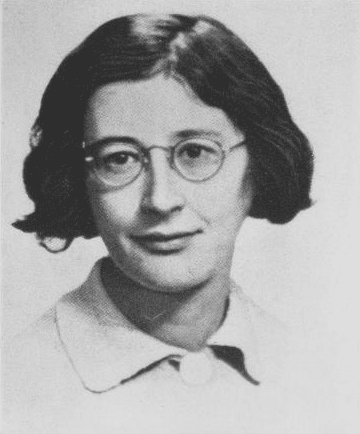
Simone Weil (pronounced “Vay”) was a French thinker who converted from Judaism to an idiosyncratic, mystical Christianity. In her short life (1909-1943), she was a radical leftist, worked with the French resistance to the Nazi occupiers, and had a dramatic conversion experience when she contemplated George Herbert’s poem on human sin and the grace of Christ, Love III. (See my book Reformation Spirituality: The Religion of George Herbert.)
Through it all, Weil always worked, not just with her mind but with her hands, including a long stint in an automobile factory. She wrote a great deal about the importance and value of working. And her insights tie in interestingly to Luther’s doctrine of vocation.
Richard Gunderman sums up her thoughts on the matter:
Weil looked at work as more than an exchange of money for labor. She argued that people need to work not only for income but also for the experience of labor itself. From her perspective, money does not solve the core problems of joblessness. Instead, work provides vital opportunities to live more fully by helping others. . . .
Though Weil understood that people need work to live, she argued that labor fulfills other equally essential functions. One is the opportunity it offers to become more fully focused and present in living. To multitask is to live superficially, but those who are completely present with another can give fully of themselves. She called attention “the rarest and purest form of generosity.”
Weil believed that humans are not cut out for lives of idle pleasure. It is through work, whether in agriculture, manufacturing, the service industry or maintaining a home and raising children that people contribute to the lives of others. Work reminds us, she wrote, that individuals are part of something greater and provides a larger purpose to live for. She wrote of the calling to serve others:
“Anyone whose attention and love are really directed towards the reality outside the world recognizes at the same time that he is bound, both in public and private life, by the single and permanent obligation to remedy, according to his responsibilities and to the extent of his power, all the privations of soul and body which are liable to destroy or damage the earthly life of any human being whatsoever.”
Work must be seen in its larger context, for if it isn’t, laborers may soon feel like cogs in a machine, winding a nut onto a bolt or moving papers from an inbox to an outbox. To do work well, people need to understand the context of work and how it makes a difference in the lives of others.
Here is Luther’s emphasis that, while vocation is important to our own well-being, the purpose of all of our vocations is to love and serve our neighbors. She also has Luther’s understanding that God is in vocation, that He loves and blesses those whom He has created through us.
Here is how the Wikipedia article about her describes her insights about loving God and loving our neighbor:
In Waiting for God, Simone Weil explains that the three forms of implicit love of God are (1) love of neighbor (2) love of the beauty of the world and (3) love of religious ceremonies.[70] As Weil writes, by loving these three objects (neighbor, world’s beauty, and religious ceremonies), one indirectly loves God before “God comes in person to take the hand of his future bride,” since prior to God’s arrival, one’s soul cannot yet directly love God as the object.[71] Love of neighbor occurs (i) when the strong treat the weak as equals,[72] (ii) when people give personal attention to those that otherwise seem invisible, anonymous, or non-existent,[73] and (iii) when we look at and listen to the afflicted as they are, without explicitly thinking about God—i.e., Weil writes, when “God in us” loves the afflicted, rather than we loving them in God.[74] Second, Weil explains, love of the world’s beauty occurs when humans imitate God’s love for the cosmos: just as God creatively renounced his command over the world—letting it be ruled by human autonomy and matter’s “blind necessity”—humans give up their imaginary command over the world, seeing the world no longer as if they were the world’s center.[75] Finally, Weil explains, love of religious ceremonies occurs as an implicit love of God, when religious practices are pure.[76] Weil writes that purity in religion is seen when “faith and love do not fail,” and most absolutely, in the Eucharist.[77]
She is also interesting on the subjects of beauty and of suffering. Again, from Wikipedia:
For Weil, “The beautiful is the experiential proof that the incarnation is possible”. The beauty which is inherent in the form of the world (this inherency is proven, for her, in geometry, and expressed in all good art) is the proof that the world points to something beyond itself; it establishes the essentially telic character of all that exists. Her concept of beauty extends throughout the universe: “we must have faith that the universe is beautiful on all levels…and that it has a fullness of beauty in relation to the bodily and psychic structure of each of the thinking beings that actually do exist and of all those that are possible. It is this very agreement of an infinity of perfect beauties that gives a transcendent character to the beauty of the world…He (Christ) is really present in the universal beauty. The love of this beauty proceeds from God dwelling in our souls and goes out to God present in the universe”. She also wrote that “The beauty of this world is Christ’s tender smile coming to us through matter”.[66]
Beauty also served a soteriological function for Weil: “Beauty captivates the flesh in order to obtain permission to pass right to the soul.” It constitutes, then, another way in which the divine reality behind the world invades our lives. Where affliction conquers us with brute force, beauty sneaks in and topples the empire of the self from within.
Though she is quite Christ-centered, she is not completely orthodox. She is extreme and aesthetic in her pursuit of virtue. She said that Hinduism and Buddhism also “deliver me into Christ’s hands as his captive,” and yet she opposed syncretism.
She was most interested in Catholicism, but she never became a Catholic. I was under the impression that she refused to be baptized out of a sense of solidarity with those who were not inside the church, but while that was true for awhile, the Wikipedia article said that she finally was baptized shortly before she died of tuberculosis at the age of 34.
Her take on Christianity is so unusual, yet substantive, that she might get through to that “None” friend of yours who is “spiritual but not religious.”

Photo: Simone Weil by Unknown photographer / Public domain via Wikimedia Commons
Previous Post

September 15, 2020
Luther on Why Belief May Not Be Coerced
Next Post

September 17, 2020 Evangelicals Who Don't Believe in Christ?
Recent Comments
"VCRs, tape decks, and cassette players are all having a revival among a segment of ..."
"As a (retired) lawyer I see potential liability from sharing things like power or sharp ..."
"I am not sure the items you mentioned, though disused, discontinued, discarded, could be considered ..."
"“Friend, use me in your relations with your neighbor just as you would want your ..."
Browse Our Archives
Select a Category America Apologetics Art baseball Bible Blog Christ Church crime Culture Economics Education Ethics Family Food Football Government History Holidays Holy Week Humor International Islam Language Law Life Issues Literature Media Medicine Movies Music Nature News Personal Philosophy Politics psychology Reformation Religions Sacraments Science sex Social Science Sports technology television terrorism Theology Uncategorized Vocation war
Select a Month October 2026 September 2026 August 2026 July 2026 June 2026 May 2026 April 2026 March 2026 February 2026 January 2026 December 2025 November 2025 October 2025 September 2025 August 2025 July 2025 June 2025 May 2025 April 2025 March 2025 February 2025 January 2025 December 2024 November 2024 October 2024 September 2024 August 2024 July 2024 June 2024 May 2024 April 2024 March 2024 February 2024 January 2024 December 2023 November 2023 October 2023 September 2023 August 2023 July 2023 June 2023 May 2023 April 2023 March 2023 February 2023 January 2023 December 2022 November 2022 October 2022 September 2022 August 2022 July 2022 June 2022 May 2022 April 2022 March 2022 February 2022 January 2022 December 2021 November 2021 October 2021 September 2021 August 2021 July 2021 June 2021 May 2021 April 2021 March 2021 February 2021 January 2021 December 2020 November 2020 October 2020 September 2020 August 2020 July 2020 June 2020 May 2020 April 2020 March 2020 February 2020 January 2020 December 2019 November 2019 October 2019 September 2019 August 2019 July 2019 June 2019 May 2019 April 2019 March 2019 February 2019 January 2019 December 2018 November 2018 October 2018 September 2018 August 2018 July 2018 June 2018 May 2018 April 2018 March 2018 February 2018 January 2018 December 2017 November 2017 October 2017 September 2017 August 2017 July 2017 June 2017 May 2017 April 2017 March 2017 February 2017 January 2017 December 2016 November 2016 October 2016 September 2016 August 2016 July 2016 June 2016 May 2016 April 2016 March 2016 February 2016 January 2016 December 2015 November 2015 October 2015 September 2015 August 2015 July 2015 June 2015 May 2015 April 2015 March 2015 February 2015 January 2015 December 2014 November 2014 October 2014 September 2014 August 2014 July 2014 June 2014 May 2014 April 2014 March 2014 February 2014 January 2014 December 2013 November 2013 October 2013 September 2013 August 2013 July 2013 June 2013 May 2013 April 2013 March 2013 February 2013 January 2013 December 2012 November 2012 October 2012 September 2012 August 2012 July 2012 June 2012 May 2012 April 2012 March 2012 February 2012 January 2012 December 2011 November 2011 October 2011 September 2011 August 2011 July 2011 June 2011 May 2011 April 2011 March 2011 February 2011 January 2011 December 2010 November 2010 October 2010 September 2010 August 2010 July 2010 June 2010 May 2010 April 2010 March 2010 February 2010 January 2010 December 2009 November 2009 October 2009 September 2009 August 2009 July 2009 June 2009 May 2009 April 2009 March 2009 February 2009 January 2009 December 2008 November 2008 October 2008 September 2008 August 2008 July 2008 June 2008 May 2008 April 2008 March 2008 February 2008 January 2008 December 2007 November 2007 October 2007
Follow Us!
TAKE THE
Religious Wisdom Quiz
What is the Jewish day of rest called?
Select your answer to see how you score.
Hanukkah Sabbath Passover Purim
Books by This Author Books by Gene Veith
Related posts from Cranach


Our New Book on Technology & Vocation

Gen Z Wants Evildoers to Be Punished, Not...

The Family Estrangement Epidemic
TRENDING AT PATHEOS Evangelical

The First Eucharistic Controversy: Christ’s Real Presence
For Catholics, the Eucharist is the source and summit of the Christian...

What a Stop Sign Can Teach Us About...
How to Make a Decision When You Can't Hear God Main point:...

Archdiocese Hosts Military Marriage Retreat in Germany
RASTATT, Germany — The transient military lifestyle, with its frequent deployments and...

Nearly every morning, I make the drive to Detroit with my high-school-age...

The Real AI Story Is Adoption Without Trust
Artificial intelligence has crossed a political threshold. It is no longer a...

A new article, written by Jeff Lindsay and Gale L. Pooley,...
view all Evangelical blogs
What Are Your Thoughts?leave a comment
Ad-Free & Subscriber Log-In Subscription Support
- About Us
- 2026 Calendar
- Videos
- Podcasts
- Library of World Religions
- Faith In Media Tracker
- Advertise With Us
- Write for Us
- Privacy Policy
- Terms of Service
- Do Not Sell My Data
- Contact Us
- Radiant Digital
- Manage Newsletter Subscriptions
- Unsubscribe From Notifications
- Sitemap
Copyright 2008-2026, Patheos. All rights reserved.
Subscription Support Ad-Free & Subscriber Log-In
Follow Patheos